
There is something wonderfully old-fashioned about a marrow.
Perhaps it is the memory of village produce shows, where enormous vegetables sit proudly on display, their growers looking quietly pleased with themselves. Or perhaps it is the sight of a substantial green marrow resting among the leaves of a late-summer vegetable patch, having grown to an almost ridiculous size while nobody was paying attention.
Marrows have a certain character that smaller vegetables simply cannot compete with.
They are generous, occasionally enormous and wonderfully versatile in the kitchen. They belong to the same species as courgettes, although varieties traditionally grown as marrows have been selected for their larger fruits and different growing habits.
And despite their impressive appearance, they are surprisingly straightforward to grow.
Give a marrow plant a sunny position, fertile soil and enough water, and it will generally reward you with a generous harvest. One or two plants can provide more than enough for an ordinary household, particularly during a warm British summer.
From stuffed marrows and comforting soups to homemade chutney, this rather overlooked vegetable deserves another moment in the spotlight.
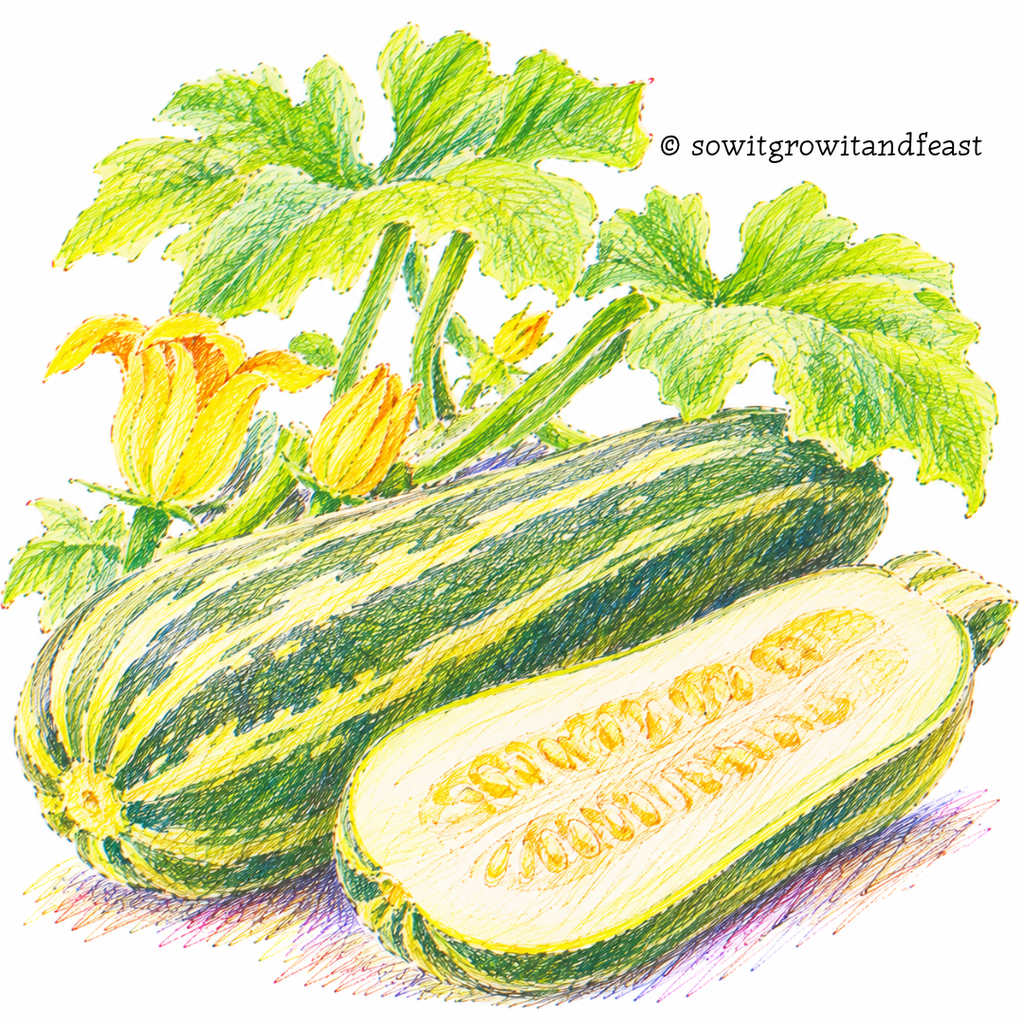
What Exactly Is a Marrow?
Marrows belong to the squash family, Cucurbitaceae, and are classified botanically as Cucurbita pepo.
They are closely related to courgettes, pumpkins and several other summer squashes.
In fact, marrows and courgettes belong to the same species, and the distinction between them is partly a matter of variety and harvesting stage.
A courgette is generally picked while young, when its skin is tender and its seeds are still immature.
A marrow is usually allowed to grow considerably larger, developing a firmer skin, more substantial flesh and mature seeds.
However, not every marrow is simply an overgrown courgette.
Traditional marrow varieties have been bred specifically for their shape, size, colouring and suitability for harvesting as larger fruits.
Some produce long, striped vegetables, while others develop pale green, cream or almost white skins.
The flesh is generally mild in flavour, making marrows particularly good at absorbing the ingredients with which they are cooked.
Garlic, tomatoes, herbs, spices and cheese all work beautifully.
And although a large marrow can look rather intimidating on the kitchen worktop, there is very little mystery to preparing one.
The History of Marrows in Britain
The story of the marrow begins far beyond the British vegetable garden.
Squashes belonging to the species Cucurbita pepo were domesticated in the Americas thousands of years ago, with evidence of ancient cultivation particularly associated with parts of present-day Mexico.
Following European contact with the Americas, squashes gradually became established in European agriculture and cooking.
Over the centuries, gardeners and growers selected plants for different characteristics, including fruit shape, colour, texture and size.
By the nineteenth century, vegetable marrows were familiar crops in British kitchen gardens.
They suited a tradition of productive gardening in which substantial vegetables were valued for feeding households and making good use of growing space.
Marrows also became associated with horticultural competitions and village produce shows.
Growing an exceptionally large specimen offered an opportunity to demonstrate both gardening skill and a certain amount of determination.
The tradition continues in some local shows today.
There is, after all, something irresistible about a vegetable that requires two hands to carry.
Yet the marrow’s appeal has never depended entirely upon size.
For generations, it has provided a useful ingredient for economical family cooking, particularly during late summer and autumn when the harvest is at its most generous.
The Best Marrow Varieties to Grow in the UK
Choosing the right variety can make a considerable difference to the success of your crop.
Some marrows grow as relatively compact bushes, while others produce long, trailing stems that need plenty of room.
For smaller gardens, a bush variety is often the most practical choice.
‘Long Green Trailing’
A traditional marrow variety producing elongated green fruits, often with paler markings.
As its name suggests, it has a trailing habit and requires considerable growing space.
It is particularly suited to larger vegetable gardens and allotments where its stems can spread across the ground.
The fruits can be harvested while relatively young or allowed to develop into substantial marrows.
‘Long White Bush’
A familiar bush marrow variety producing pale green to creamy-white fruits.
Its relatively compact growing habit makes it useful where space is more limited, although it still requires a generous planting area.
The young fruits are tender and suitable for a range of dishes.
‘Table Dainty’
A traditional striped marrow variety, valued for its attractive appearance and culinary qualities.
It can be harvested while young or allowed to mature further.
Check the growth habit described by your seed supplier, as this is a trailing variety and may need more room than its name suggests.
Choosing Between Bush and Trailing Varieties
Bush marrows are generally easier to accommodate in smaller gardens.
They form relatively compact plants, although their large leaves still occupy a surprising amount of space.
Trailing varieties produce longer stems and can spread over several square metres.
These are well suited to allotments or larger vegetable beds.
If space is limited, it is worth choosing a variety specifically described as bush-growing rather than relying upon the size of the fruit as a guide.
When to Sow Marrow Seeds in the UK
Marrows are tender plants that dislike frost and cold soil.
In Britain, they are usually sown indoors during spring and planted outside once the weather has warmed.
The exact timing depends on your location and seasonal conditions.
In southern and eastern England, outdoor planting may be possible towards the end of May.
In colder districts, exposed gardens and northern parts of Britain, early June may be more suitable.
Sowing Indoors
April and May are generally good months for starting marrow seeds under cover.
Fill individual pots with good-quality peat-free seed compost.
Sow one seed per pot, approximately 2–3cm deep.
Marrow seeds are large and easy to handle, making them particularly suitable for children and beginner gardeners.
Place the pots somewhere warm, ideally at approximately 18–21°C.
A propagator can be useful, although a warm, bright indoor position is often sufficient.
Keep the compost moist but not waterlogged.
Germination usually takes around 5–10 days in suitable conditions, although cooler temperatures can slow the process.
Once seedlings emerge, provide plenty of light to encourage sturdy growth.
Avoid Sowing Too Early
It is tempting to start marrow seeds as soon as spring arrives.
However, these plants grow quickly and can become rather large before outdoor conditions are suitable.
Seedlings kept in small pots for too long may become congested and difficult to manage.
Sowing in late April or early May is often preferable to beginning several weeks earlier without sufficient protected growing space.
Sowing Directly Outdoors
Marrows can also be sown directly into garden soil.
Wait until the risk of frost has passed and the soil has warmed, usually from late May into June in many parts of Britain.
Sow seeds approximately 2–3cm deep in prepared soil.
Protect emerging seedlings from slugs and snails, which can cause considerable damage.
Direct sowing avoids transplanting, but seedlings may establish more slowly during unsettled weather.
Preparing the Soil for Marrows
Marrows are hungry, vigorous plants.
Their large leaves and substantial fruits require fertile soil, adequate moisture and plenty of room for their roots to develop.
Choose a sunny, sheltered position with well-drained but moisture-retentive soil.
Before planting, incorporate well-rotted garden compost or manure into the planting area.
This improves soil structure and helps the ground retain moisture during dry weather.
Avoid using fresh manure immediately around young plants.
Marrows benefit from fertile soil, but excessive nitrogen feeding can encourage lush foliage at the expense of fruit production.
The aim is to support balanced growth.
Making a Marrow Planting Station
A traditional approach is to prepare a generous planting area enriched with organic matter.
Dig a broad hole and mix well-rotted compost into the surrounding soil before replacing it.
Rather than creating a deep pocket of rich material surrounded by unimproved ground, aim to improve a wider area so roots can spread naturally.
Water the planting area before transplanting if the soil is dry.
Once established, a mulch of compost or other suitable organic material can help conserve moisture.
Planting Marrows Outdoors
Before planting indoor-raised seedlings outside, they need time to adjust to outdoor conditions.
This process is known as hardening off.
Over approximately 7–10 days, gradually expose the plants to outdoor temperatures, sunlight and breezes.
Begin by placing them outside during mild daytime conditions, bringing them back under cover at night.
Increase their exposure gradually.
Once the danger of frost has passed, plant them into their prepared growing positions.
Handle the rootballs carefully and water thoroughly after planting.
How Much Space Do Marrows Need?
Marrow plants can become surprisingly large.
Bush varieties may need approximately 90–120cm between plants.
Trailing varieties often require considerably more space, sometimes 1.5–2m or more, depending on the variety.
Always check the seed packet for specific spacing guidance.
Crowded plants can compete for moisture and nutrients, and restricted airflow may encourage disease.
If you have a small garden, growing one healthy marrow plant is often more productive than squeezing several into an unsuitable space.
Can You Grow Marrows in Containers?
Yes, although marrows are not the easiest vegetable to grow in a small pot.
Their vigorous growth and considerable water requirements mean they need a substantial container.
Choose a compact bush variety and use a large pot or growing container, ideally holding at least 40–60 litres of compost, with more space beneficial for vigorous plants.
Ensure there are adequate drainage holes.
Fill with a good-quality peat-free growing medium suitable for productive vegetables.
Place the container somewhere sunny and sheltered.
Container-grown marrows will require more frequent watering and feeding than plants established in open ground.
During hot weather, the compost may dry out quickly.
A small pot on a sunny patio may look perfectly adequate in May, but by July the plant may have other ideas.
Watering Marrow Plants
Marrows need consistent moisture, particularly while flowering and developing fruits.
Their broad leaves lose considerable amounts of water during warm weather.
During dry spells, water thoroughly so moisture reaches the root zone.
Avoid frequent, superficial watering that wets only the surface.
Direct water towards the soil around the plant rather than soaking the foliage unnecessarily.
A layer of organic mulch can help reduce evaporation and maintain more even soil moisture.
Why Consistent Watering Matters
Irregular watering can place plants under stress and contribute to poor fruit development.
Severe drought may cause flowers or developing fruits to fail.
Container-grown plants are especially vulnerable because their roots have access to a limited volume of compost.
Check the growing medium regularly and adjust watering according to the weather.
Feeding Marrows for a Generous Harvest
Marrows benefit from fertile soil and may need additional feeding during their most productive period.
Plants grown in well-prepared garden soil may require less supplementary feeding than those in containers.
Once flowering and fruiting begin, a suitable liquid feed formulated for fruiting vegetables can be used according to the manufacturer’s instructions.
Avoid excessive feeding.
Too much nitrogen can encourage impressive leaves without necessarily producing an equally impressive harvest.
Healthy plants, sufficient moisture and successful pollination are generally more important than applying large quantities of fertiliser.
Marrow Flowers and Pollination
One of the loveliest features of a marrow plant is its flowers.
Large, golden-yellow blossoms appear among the leaves during summer.
Marrow plants produce separate male and female flowers on the same plant.
Male flowers grow on slender stalks.
Female flowers have a small swelling immediately behind the blossom, which develops into the fruit if pollination is successful.
Bees and other insects usually transfer pollen between the flowers.
Why Are My Marrows Not Developing?
It is quite common for gardeners to notice flowers appearing without any fruits developing.
Early in the growing season, plants may produce more male flowers than female ones.
This is normal.
Poor weather can also reduce pollinator activity.
If a female flower is not adequately pollinated, the small developing fruit may yellow, shrivel and drop away.
Insect activity generally improves fruit set, so encouraging pollinators into the garden is valuable.
Hand Pollinating Marrows
If pollination is poor, you can transfer pollen by hand.
Choose a freshly opened male flower and use a small, soft brush to collect pollen from its centre.
Gently transfer the pollen to the stigma inside a freshly opened female flower.
This is best done while flowers are open, usually during the morning.
Hand pollination can be particularly useful during prolonged wet weather or where pollinator activity is limited.
Common Marrow Pests and Problems
Marrows are generally productive plants, but they can encounter a few difficulties during the growing season.
Slugs and Snails
Young seedlings are particularly vulnerable to slug and snail damage.
Protect newly planted marrows until they are well established.
Inspect plants regularly and use suitable wildlife-conscious control methods where necessary.
Powdery Mildew
Powdery mildew is common on courgettes, marrows and other squashes, particularly later in summer.
It appears as a white, powdery coating on the leaves.
Although it can reduce the plant’s vigour, older plants may continue producing useful fruits.
Maintain adequate spacing, avoid unnecessary water stress and remove badly affected foliage where appropriate.
Do not remove so many leaves that the plant can no longer support its developing fruits.
Fruits Rotting at the Blossom End
Small fruits sometimes begin developing but then turn yellow and rot.
Poor pollination is one possible cause.
Irregular moisture, unsuitable temperatures and other growing stresses can also contribute.
Check that the plant is receiving adequate water and that pollination is taking place.
Yellowing Leaves
Older leaves naturally decline as the growing season progresses.
However, widespread yellowing may indicate water stress, nutrient problems or disease.
Check soil moisture and inspect the plant before applying fertiliser or removing foliage.
Bitter Marrows
An unusually bitter marrow should never be eaten.
Members of the squash family can occasionally produce elevated levels of cucurbitacins, naturally occurring bitter compounds that can cause serious gastrointestinal illness.
This is uncommon in commercially bred edible varieties, but it is important to recognise.
If the flesh tastes distinctly bitter, discard the entire fruit.
Do not attempt to make it safe through cooking.
When Are Marrows Ready to Harvest?
One of the advantages of growing marrows is that you can choose when to harvest them.
Young fruits are tender, with softer skins and less developed seeds.
Larger fruits have a firmer texture and are particularly suitable for stuffing, baking and preserving.
Harvesting Young Marrows
For tender fruits, harvest when they have reached a useful size but before the skin becomes very hard.
The exact size depends on the variety.
Young marrows are often particularly good for roasting, grilling and cooking in sauces.
They generally require less preparation than fully mature fruits.
Harvesting Mature Marrows
For larger marrows, allow the fruits to develop fully.
The skin should become firmer and the fruit should reach the characteristic size and colouring of its variety.
Unlike winter squashes, however, vegetable marrows are not generally reliable long-storage crops.
A hard skin does not automatically mean a marrow will keep for months.
If you intend to store a fruit for a short period, choose a healthy, undamaged specimen and harvest it before frost.
Use clean secateurs or a sharp knife, leaving a short length of stalk attached.
Avoid lifting the fruit by its stem.
How to Store Marrows
Marrows are best used reasonably soon after harvesting.
Young fruits have tender skins and are particularly perishable.
Keep them in a cool place or refrigerate them for short-term storage, taking care to avoid chilling damage from prolonged exposure to excessively low temperatures.
Larger, mature marrows with sound skins may keep longer in a cool, dry, frost-free place with good ventilation.
However, storage life varies considerably according to the variety, maturity and conditions.
Unlike properly cured winter squashes, ordinary vegetable marrows should not be assumed to remain sound for several months.
Inspect stored fruits regularly and use them promptly if they begin to soften or deteriorate.
For longer-term preservation, freezing or preparing a tested chutney or pickle recipe is usually more dependable.
Can You Freeze Marrows?
Yes, marrows can be frozen for use in cooked dishes.
However, their high water content means the texture will soften considerably after thawing.
This makes frozen marrow particularly useful for soups, stews, sauces and curries.
Peel mature marrows if the skin is tough.
Remove large seeds and the surrounding fibrous centre.
Cut the flesh into suitable pieces.
Blanching before freezing can help preserve quality, although preparation times depend on the size of the pieces.
Cool rapidly, drain thoroughly and freeze in suitable containers.
Grated marrow can also be frozen for recipes where a soft texture is acceptable.
Are Marrows Good for You?
Marrows are naturally low in energy and contain a high proportion of water.
They provide small amounts of dietary fibre and various vitamins and minerals, including vitamin C and potassium.
Their precise nutritional composition varies according to variety, maturity and preparation.
Because mature marrows contain considerable water, they are not particularly concentrated sources of nutrients compared with some other vegetables.
However, they can be a useful part of a varied diet.
Their mild flavour makes them easy to combine with beans, lentils, tomatoes, herbs and other vegetables.
They also add volume and texture to meals without requiring large quantities of rich ingredients.
Perhaps their greatest nutritional advantage is their versatility.
A marrow can be part of a light vegetable soup, a substantial stuffed dish or a warming autumn curry.
How to Prepare a Marrow for Cooking
Preparing a marrow is straightforward, although larger fruits need a little more attention than young courgettes.
Wash the outside thoroughly.
For young marrows, the skin and small seeds may be tender enough to eat.
For larger, mature fruits, the skin can become tough and the seeds hard.
In this case, peel the marrow if required, cut it lengthways and scoop out the central seeds and fibrous material.
The remaining flesh can be sliced, diced, grated or hollowed out for stuffing.
Marrow has a mild flavour and a high water content.
For some dishes, salting grated marrow briefly and squeezing out excess moisture can improve the finished texture.
This is particularly useful for fritters.
Five Delicious Ways to Cook Marrows
Marrows may not have the immediate glamour of ripe tomatoes or freshly picked asparagus, but they are wonderfully adaptable.
Their gentle flavour makes them particularly good with garlic, onions, herbs, spices and cheese.
Here are five ways to make the most of the harvest.
1. Traditional Stuffed Marrow
Stuffed marrow is one of the great classics of British home cooking.
It is substantial, comforting and an excellent way to use a large fruit.
Ingredients
- 1 medium marrow
- 1 tablespoon olive oil
- 1 onion, finely chopped
- 2 garlic cloves, crushed
- 400g minced beef or a suitable plant-based alternative
- 400g chopped tomatoes
- 100g cooked rice
- 1 teaspoon dried oregano
- 75g grated mature Cheddar
- Salt and black pepper
Method
Preheat the oven to 190°C, or 170°C fan.
Cut the marrow lengthways and remove the seeds and fibrous centre.
If the skin is particularly tough, peel it or plan to scoop out the cooked flesh when serving.
Place the marrow halves in a baking dish.
Heat the olive oil in a frying pan and gently cook the onion until softened.
Add the garlic and minced beef, cooking until browned.
Stir in the tomatoes, cooked rice and oregano.
Simmer until the mixture thickens.
Season to taste.
Spoon the filling into the marrow halves and cover loosely with foil.
Bake until the marrow is tender and the filling is thoroughly cooked.
Remove the foil, scatter over the cheese and return to the oven until golden.
If using minced meat, ensure the filling is cooked thoroughly, reaching at least 75°C in the centre.
Serve with a green salad or seasonal vegetables.
2. Marrow, Tomato and Basil Soup
A lovely way to use summer vegetables together.
Ingredients
- 600g prepared marrow, diced
- 400g ripe tomatoes, chopped
- 1 onion
- 2 garlic cloves
- 1 tablespoon olive oil
- 600ml vegetable stock
- A handful of fresh basil
- Black pepper
Method
Heat the olive oil in a large saucepan.
Add the chopped onion and cook gently until softened.
Stir in the garlic and cook briefly.
Add the marrow, tomatoes and vegetable stock.
Simmer for approximately 20–25 minutes, or until the marrow is tender.
Blend until smooth.
Stir through the freshly chopped basil just before serving.
The result is a light, comforting soup that captures something of the late-summer garden.
3. Crispy Marrow Fritters
Marrow fritters are an excellent way to use smaller fruits or the flesh from a larger marrow.
Ingredients
- 400g grated marrow
- 2 eggs
- 75g plain flour
- 2 spring onions, finely chopped
- 2 tablespoons chopped parsley
- Salt and black pepper
- A little oil for frying
Method
Grate the marrow and place it in a colander.
Sprinkle lightly with salt and leave for approximately 15 minutes.
Squeeze out as much excess moisture as possible.
Combine the marrow with the eggs, flour, spring onions and parsley.
Season lightly.
Heat a little oil in a frying pan.
Spoon small portions of the mixture into the pan and flatten gently.
Cook over a medium heat until golden on both sides and cooked through.
Serve with natural yoghurt, lemon or a fresh tomato salad.
4. Warming Marrow and Chickpea Curry
Marrow works beautifully in a gently spiced curry because it absorbs the flavours of the sauce.
Ingredients
- 600g marrow, peeled and diced if mature
- 1 onion
- 2 garlic cloves
- 1 tablespoon grated fresh ginger
- 1 tablespoon curry powder
- 400g chopped tomatoes
- 400g tin chickpeas, drained
- 200ml coconut milk
- 1 tablespoon vegetable oil
- Fresh coriander to serve
Method
Heat the oil in a saucepan.
Add the onion and cook until softened.
Stir in the garlic, ginger and curry powder.
Cook gently for another minute.
Add the tomatoes, chickpeas and marrow.
Pour in the coconut milk and stir well.
Simmer until the marrow is tender and the sauce has thickened.
Finish with freshly chopped coriander.
Serve with rice or warm flatbreads.
5. Homemade Marrow Chutney
Marrow chutney is a traditional way of making use of a generous harvest.
Its mild flesh works particularly well with onions, apples, vinegar and warming spices.
A typical marrow chutney might contain diced marrow, cooking apples, onions, sugar, vinegar, ginger and mustard seeds.
The ingredients are simmered slowly until thick and richly flavoured.
However, if you intend to store chutney at room temperature, it is important to follow a properly tested preservation recipe with the correct acidity, ingredient proportions and processing method.
The acidity of the finished product is essential for safe preservation.
Do not assume that an improvised mixture of vegetables, vinegar and sugar will be shelf-stable.
For small experimental batches, refrigerate promptly and use within a suitably short period rather than storing them in the cupboard.
Saving Marrow Seeds for Next Year
If you grow an open-pollinated marrow variety, you may be able to save seeds for future sowing.
Choose a healthy plant and allow a fruit to mature fully.
Once harvested, remove the seeds, wash away the surrounding flesh and dry them thoroughly.
Store the completely dry seeds in a labelled envelope or suitable airtight container somewhere cool and dry.
However, there is an important complication.
Marrows and courgettes belong to the same species as many pumpkins and ornamental gourds.
They can cross-pollinate with other compatible Cucurbita pepo varieties grown nearby.
Seeds saved from cross-pollinated plants may produce unpredictable fruits the following year.
More importantly, some crosses involving ornamental gourds or plants carrying genes for elevated cucurbitacin production can result in bitter, potentially toxic fruit.
For this reason, seed saving from marrows and courgettes requires care.
If you cannot ensure suitable isolation and varietal purity, purchasing fresh seed from a reputable supplier is the safer option.
Never eat squash or marrow that tastes unusually bitter.
Growing Marrows for a Village Produce Show
There is a long-standing British tradition of growing impressive vegetables for local horticultural shows.
Marrows are particularly well suited to this enthusiasm.
Some competitions reward size, while others assess uniformity, condition and how closely the exhibit matches the requirements of the class.
If you intend to enter a marrow, read the show schedule carefully.
A class for the heaviest marrow is rather different from one asking for a pair of well-matched fruits.
Growing a Large Marrow
Choose a suitable vigorous variety.
Prepare fertile soil with plenty of well-rotted organic matter.
Provide consistent watering during dry weather.
Allow sufficient space for the plant to develop.
For exceptionally large fruits, growers sometimes restrict the number of marrows developing on a plant so more resources are directed towards the remaining fruit.
However, growing for maximum size is not always the best approach for eating quality.
A very large marrow may have tougher skin, larger seeds and coarser flesh.
The largest vegetable on the show bench is not necessarily the one you would most enjoy for supper.
What Else Can You Do with Marrows?
Not every marrow needs to become a stuffed dinner.
There are a few other useful and enjoyable ways to make use of the harvest.
Autumn Decorations
Large marrows can make attractive additions to seasonal displays.
Their green, cream and striped skins sit beautifully alongside pumpkins, squashes and dried seedheads.
They can also be painted or decorated for harvest celebrations.
Children’s Gardening Projects
Marrows are particularly rewarding for children because the seeds are large, the plants grow quickly and the fruits can become enormous.
Measuring a developing marrow each week provides a simple way to explore plant growth.
And there is something rather exciting about watching a vegetable become almost too heavy to lift.
Composting Marrow Waste
Peelings, seeds and unused flesh can be added to a suitable home compost heap.
Chopping large pieces into smaller sections helps them break down more quickly.
Mix wet marrow waste with dry, carbon-rich materials such as shredded cardboard or dry leaves to maintain a balanced heap.
Avoid adding diseased plant material to a typical cool composting system.
Seasonal Garden Crafts
A mature marrow can be carved or decorated for a short-lived autumn display.
However, unlike hard-shelled ornamental gourds, ordinary vegetable marrows contain considerable moisture and are not generally suitable for making durable bowls, long-lasting lanterns or permanent garden containers.
They soften and decay relatively quickly.
Use them for temporary displays, then compost the remains where appropriate.
Making Room for Marrows in the Vegetable Garden
Marrows may have fallen a little out of fashion in recent years, particularly as courgettes have become such familiar ingredients in everyday cooking.
But there is still a great deal to admire about them.
They are productive, versatile and wonderfully suited to the British tradition of growing food for the household.
A single healthy plant can provide a succession of fruits through summer and into early autumn, depending on the weather.
The young marrows can be cooked much like courgettes, while larger fruits are excellent for stuffing, baking and preserving.
They also offer a gentle reminder that gardening does not always need to be about unusual varieties or complicated techniques.
Sometimes the most satisfying crops are the familiar ones.
Those that have been grown in allotments and kitchen gardens for generations.
Those that ask for a little sunshine, a generous helping of compost and a gardener willing to give them enough room.
The Quiet Satisfaction of a Marrow Harvest
There is a particular pleasure in harvesting a marrow.
Perhaps because it is impossible to ignore.
Where a handful of peas can disappear into a pocket and a few radishes barely fill a bowl, a marrow makes its presence known.
It arrives in the kitchen with a certain confidence, demanding space on the worktop and a little thought about what should happen next.
And yet, beneath its substantial appearance, it is a wonderfully modest vegetable.
It asks for no elaborate preparation and makes no great claims about its flavour.
Instead, it takes on the character of whatever surrounds it.
Tomatoes, garlic and basil. Warming spices and chickpeas. A savoury filling beneath a golden layer of cheese.
Marrows are generous in the garden and accommodating in the kitchen.
They remind us of the pleasures of growing food in abundance, of sharing the harvest and of making good use of what the seasons provide.
And perhaps that is why this slightly old-fashioned vegetable deserves a place in our gardens once again.
Not because it is fashionable or particularly glamorous.
But because it grows well, feeds generously and carries with it something of the enduring charm of the British kitchen garden.
And if one happens to grow large enough to win a prize at the village show, well, that is simply a rather splendid bonus.
Further Reading: Why Growing Food Makes You Feel Better, Take the Guesswork Out of Growing Veg, How to Create a Garden That Feeds Your Family, How to Start a Vegetable Garden Now Ready for Spring
Follow us on Instagram, Threads, BlueSky, Twitter, Pinterest & Facebook
Not sure where to start? Take a look at our Grow Your Own Packs with detailed step by step instructions, seeds and 1 years online support.