
There was a time when growing vegetables was considered a national duty. Gardens became productive plots, lawns gave way to potatoes and ordinary households discovered that even the smallest patch of earth could make a difference. More than eighty years later, perhaps there is something worth remembering in that simple idea.
There is a particular pleasure in stepping into the garden with an empty bowl and returning to the kitchen with something for supper.
A handful of runner beans, a few freshly lifted carrots, perhaps some parsley for the potatoes. Nothing particularly extravagant, yet somehow these small harvests feel more valuable than anything wrapped in plastic on a supermarket shelf.
Growing our own food connects us to something fundamental. The changing seasons, the soil beneath our feet and the remarkable process by which a tiny seed becomes something nourishing.
But in a world of rising food costs, unpredictable weather and increasingly complicated supply chains, perhaps growing our own food is becoming more than a pleasant pastime.
Perhaps it is time to rediscover a little of the spirit of Dig for Victory.
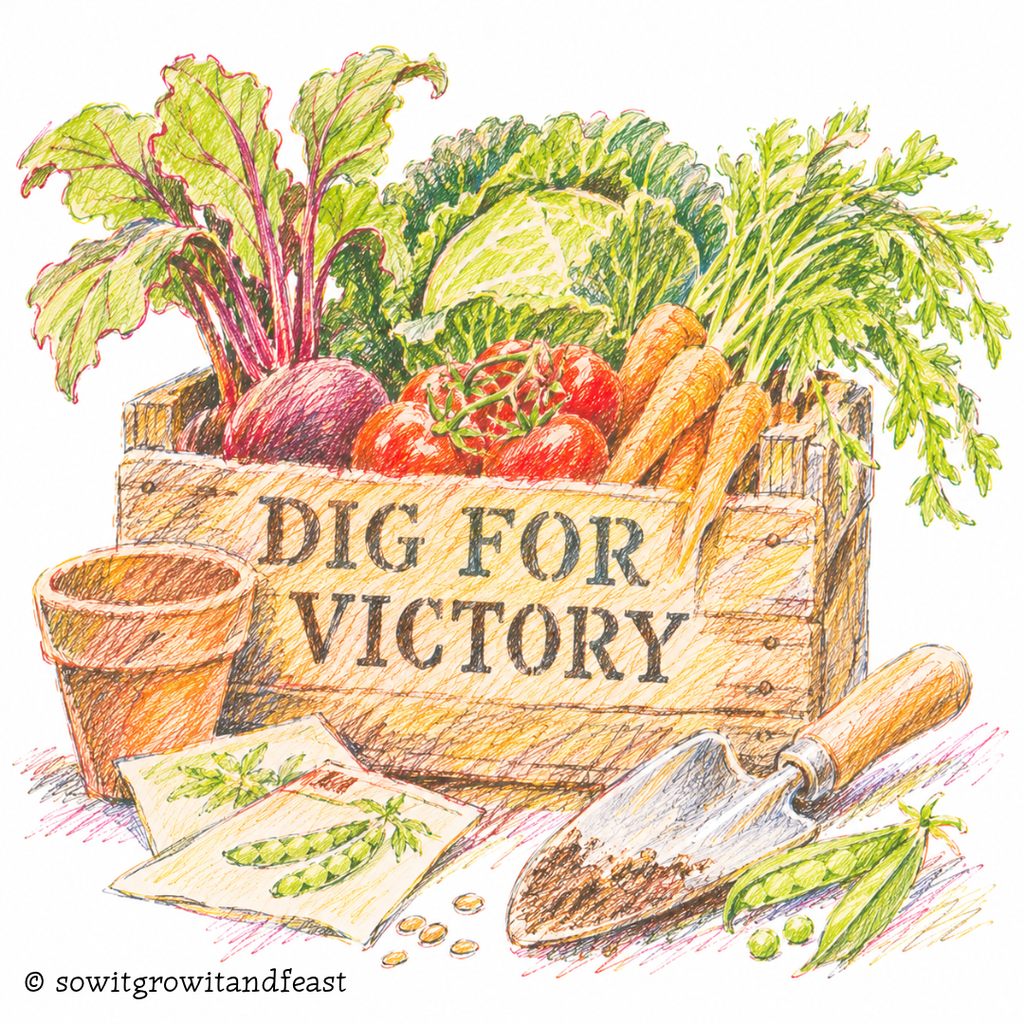
Dig for Victory: A Lesson from the Past
In September 1939, as Britain entered the Second World War, the government faced an enormous challenge.
The country relied heavily on imported food, and wartime disruption threatened the ships bringing essential supplies to British ports.
With food security becoming a national priority, the Ministry of Agriculture launched its famous Dig for Victory campaign.
The message was straightforward: grow what you can, wherever you can.
Private gardens, public parks, school grounds and previously neglected pieces of land were transformed into productive growing spaces.
Flower beds made room for cabbages. Lawns were dug over for potatoes. Families who had never grown so much as a radish found themselves learning about compost, crop rotation and the importance of a good harvest.
Even the most modest garden had a part to play.
The campaign was about more than vegetables. It encouraged people to become resourceful, share knowledge and contribute to something larger than themselves.
Growing food became an act of collective resilience.
Of course, gardening during wartime was not quite the romantic picture we might imagine today. There were shortages of equipment, demanding physical work and the occasional disappointment of a crop that refused to cooperate.
Some things, it seems, never change.
Yet the campaign demonstrated something important: when circumstances demand it, ordinary people can achieve remarkable things with a little land, some seeds and a willingness to learn.
And while today’s challenges are very different, the lessons remain surprisingly relevant.
Why Growing Our Own Food Matters Today
We are fortunate to live in a country where supermarket shelves generally offer an extraordinary variety of food throughout the year.
Strawberries in January, asparagus in December and tomatoes long after the British growing season has ended.
It is a convenience previous generations could scarcely have imagined.
Yet that abundance can disguise the complicated journey our food makes before reaching our kitchens.
Behind every purchase lies a network of growers, agricultural workers, transport systems, energy supplies and international markets.
Most of the time, these systems work remarkably well.
But recent years have shown how vulnerable they can be to disruption.
Extreme weather, international conflict, rising production costs and changing trading arrangements can all influence the availability and price of food.
Growing a few vegetables at home will not replace the national food supply, nor should we pretend that it can.
What it can do is provide a small measure of independence, encourage greater understanding of where our food comes from and remind us that producing food is a skill worth preserving.
And sometimes, a small measure of independence is quite enough to make a difference.
The Rising Cost of Putting Food on the Table
Few households have escaped noticing the changing cost of the weekly food shop.
Food prices are influenced by a complicated combination of factors, including agricultural production, energy, labour, transport and international trade.
Poor harvests caused by drought or flooding can reduce supplies. Higher energy costs affect everything from greenhouse production to food processing and refrigeration.
Conflicts and disruptions to global trade can influence the price of grain, fertiliser and other essential agricultural materials.
The consequences eventually find their way into our shopping baskets.
For families trying to manage household budgets, growing some of their own produce can be a practical way of reducing expenditure.
But it is worth approaching the idea sensibly.
Not every homegrown vegetable will save money.
A heated greenhouse full of exotic crops may provide enormous satisfaction, but it is unlikely to be the cheapest way to fill a dinner plate.
The greatest savings often come from growing crops that are productive, relatively inexpensive to establish and regularly used in the kitchen.
What Should You Grow to Save Money?
Consider cut-and-come-again lettuce, which can provide repeated harvests from a relatively small area.
Runner beans and climbing French beans can be wonderfully productive throughout summer, particularly when picked regularly.
Courgettes are another generous crop. Anyone who has grown them successfully will understand the sudden need to develop seventeen different courgette recipes.
Herbs are particularly worthwhile.
A packet of parsley seeds can provide months of fresh leaves, while established thyme, rosemary and chives can be harvested over several seasons.
Soft fruit, including strawberries, raspberries and currants, can also offer good value once plants are established.
The secret is to grow what you enjoy eating.
There is little financial benefit in producing an impressive quantity of vegetables that nobody in the household particularly likes.
Understanding Where Our Food Comes From
One of the less obvious benefits of growing food is the knowledge it brings.
When we buy vegetables, we see the finished product.
We rarely see the months of cultivation, the changing weather, the pests, the watering or the decisions involved in producing it.
Growing even a small amount ourselves changes that perspective.
We discover that carrots are not always perfectly straight, that tomatoes ripen at their own pace and that a cabbage can attract an astonishing number of hungry caterpillars.
We begin to understand why farmers are so dependent upon favourable weather and why producing reliable harvests requires considerable skill.
There is also the opportunity to make our own decisions about how crops are grown.
We can choose whether to use pesticides, how to manage soil fertility and which varieties to cultivate.
That does not automatically make homegrown food more nutritious or environmentally friendly than commercially grown produce.
Much depends upon our methods.
But it does allow us to take a more informed and thoughtful approach to the food we eat.
Growing Food in a Changing Climate
British gardeners are already becoming familiar with increasingly unpredictable growing conditions.
Long dry periods can be followed by intense rainfall. Mild winters encourage early growth, only for a late frost to cause damage.
These changes present challenges for commercial agriculture and home gardeners alike.
Water availability, soil health and the ability of plants to withstand weather extremes are becoming increasingly important considerations.
Growing food at home offers an opportunity to develop more resilient gardening habits.
Collecting rainwater, improving soil with homemade compost and mulching vegetable beds can help us use resources more efficiently.
Choosing crops suited to our local conditions can reduce the need for additional watering, heating and other inputs.
A productive garden can also provide valuable habitat for wildlife.
Flowering herbs attract pollinating insects, while hedges, ponds and undisturbed corners support the wider network of creatures that contribute to a healthy garden.
However, it is important to remember that homegrown food is not automatically the lowest-carbon option.
Heating a greenhouse throughout winter, using large quantities of purchased compost or relying on energy-intensive equipment can outweigh some of the environmental benefits.
The most sustainable approach is often the simplest: grow seasonally, use resources carefully and work with the conditions nature provides.
Rediscovering the Value of Seasonal Eating
Perhaps one of the loveliest consequences of growing food is the way it changes our relationship with the seasons.
When everything is available throughout the year, it becomes easy to forget that different foods have their own natural moment.
The first tender broad beans of early summer.
Tomatoes warmed by August sunshine.
Apples gathered as autumn settles across the garden.
Leeks and kale standing patiently through the colder months.
Each harvest arrives with its own character and culinary possibilities.
And because we have waited for it, we appreciate it all the more.
There is something wonderfully satisfying about planning a meal around what is ready to pick rather than deciding what to buy and expecting the seasons to accommodate us.
Sometimes supper begins with a recipe.
Sometimes it begins with the discovery that the runner beans have produced another enormous handful overnight.
Both approaches have their merits.
You Don’t Need an Allotment to Make a Difference
One of the most enduring lessons from Dig for Victory is that productive growing need not be confined to large gardens.
During the war, people made use of whatever space was available.
That same resourcefulness remains valuable today.
A sunny balcony can accommodate pots of herbs, salad leaves and compact tomatoes.
A small courtyard might have room for a container of strawberries or a climbing bean growing against a support.
Even a windowsill can provide a modest harvest of herbs, pea shoots or other suitable edible plants.
The important thing is to begin with what you have.
Start with Something Simple
For those new to growing food, there is no need to transform the entire garden immediately.
A small bed or a few containers are quite enough to begin learning.
Radishes are quick to mature and provide an encouraging first harvest.
Lettuce can be grown in relatively small spaces, with repeated sowings providing leaves over several months.
Spring onions are straightforward and useful in the kitchen.
Potatoes can be grown in large containers, provided they have sufficient compost, drainage and water.
And herbs such as parsley, chives and mint are wonderfully useful, although mint is generally best kept in a pot unless you fancy giving it ownership of the entire garden.
As confidence grows, so can the vegetable patch.
The best gardens are rarely created in a single season.
They develop gradually, shaped by experience, curiosity and the occasional spectacular failure.
Compost: Turning Waste into Something Wonderful
If the wartime gardeners understood one thing, it was the value of making use of available resources.
Nothing useful was wasted unnecessarily.
Today, composting remains one of the most practical ways to bring that resourcefulness into the garden.
Vegetable peelings, suitable garden clippings, fallen leaves and other compostable materials can be transformed into a valuable soil improver.
Good homemade compost helps improve soil structure, supports soil organisms and can increase the soil’s ability to retain moisture.
It also reduces the amount of organic waste that needs to be collected and processed elsewhere.
Composting requires a little understanding of the balance between green, nitrogen-rich materials and brown, carbon-rich ingredients.
But once established, a compost heap becomes one of the most useful features of a productive garden.
There is something rather pleasing about knowing that yesterday’s vegetable peelings may eventually help grow tomorrow’s supper.
The Importance of Sharing What We Grow
The Dig for Victory campaign was built upon a sense of shared responsibility.
People exchanged advice, learned new skills and helped one another make the most of available resources.
That community spirit is perhaps one of the most valuable things we can carry forward.
Growing food has a remarkable ability to bring people together.
An experienced gardener might share spare seedlings with a neighbour.
Someone with a productive apple tree may offer fruit to friends.
A local seed swap can introduce gardeners to interesting varieties without the expense of buying numerous packets.
Community gardens and allotment associations provide opportunities to learn, share equipment and exchange practical knowledge.
And then there is the simple pleasure of giving someone a bag of freshly picked vegetables.
Not because they are expensive or particularly unusual, but because they have been grown with care.
Food has always been a way of bringing people together.
Growing it gives us another reason to share.
Teaching the Next Generation Where Food Begins
For children, a vegetable garden can be a wonderful place of discovery.
A seed disappears beneath the soil.
For several days, apparently nothing happens.
Then a tiny green shoot emerges, and the mystery begins to unfold.
Children learn that food takes time to grow, that plants need suitable conditions and that the natural world does not always operate according to our preferred timetable.
They discover worms, ladybirds, pollinating insects and the extraordinary life beneath the soil.
They also learn that vegetables do not arrive in the world washed, trimmed and neatly arranged in plastic packaging.
Perhaps most importantly, growing food can encourage curiosity about what we eat.
A child who has watched a pea plant climb, flower and produce pods may be rather more interested in tasting those peas.
And even when enthusiasm for eating vegetables remains limited, there is still plenty to be gained from the experience.
Patience, responsibility, observation and an understanding of the seasons are lessons that extend far beyond the vegetable patch.
Could We Really Dig for Victory Again?
It would be easy to look back at the wartime campaign with nostalgia.
The posters were memorable, the message was clear and the image of a nation united in growing vegetables remains appealing.
But the circumstances were very different.
Britain was facing an immediate threat to its food supplies, and the campaign formed part of a much wider national effort involving agriculture, rationing and government planning.
Today’s food system is more complex, and home gardening alone cannot resolve the challenges of food security, climate change or household poverty.
Nor should the responsibility for addressing those problems fall upon individuals with a few square metres of garden.
Yet the central principle of Dig for Victory remains remarkably powerful.
We can become more resourceful.
We can waste less.
We can learn practical skills that previous generations considered essential.
We can make better use of the spaces around us and develop a deeper appreciation of the people who produce our food.
And we can recognise that small, individual efforts become more meaningful when they are shared.
Growing Something More Than Vegetables
There is a quiet confidence that comes from knowing how to grow food.
Not the confidence of complete self-sufficiency, because few of us could realistically achieve that, but the reassurance of possessing a useful skill.
Knowing when to sow broad beans.
Understanding how to improve tired soil.
Recognising when a tomato is ready to pick.
Learning how to preserve a surplus harvest for the colder months.
These are ordinary skills, yet they connect us to generations of gardeners who understood the value of working with the land.
Perhaps that is what makes growing food feel particularly relevant today.
In a world that often encourages us to seek convenience, speed and immediate results, gardening offers something quite different.
It asks us to pay attention.
To work with the seasons rather than against them.
To accept that not everything can be controlled, and that a disappointing harvest is sometimes simply part of the experience.
It reminds us that worthwhile things often begin slowly.
With a handful of seeds.
A patch of prepared earth.
And the willingness to see what might grow.
A Little of the Dig for Victory Spirit
We may no longer be growing vegetables as part of a wartime campaign, but the spirit behind Dig for Victory still has something to teach us.
Resourcefulness does not have to mean hardship.
Self-reliance need not mean doing everything alone.
And sustainability does not require us to transform our lives overnight.
Sometimes it begins with a pot of parsley outside the kitchen door.
A few potatoes planted in a spare corner.
A compost heap quietly working away at the bottom of the garden.
Or a handful of runner beans shared over the garden fence.
None of these things will change the world on its own.
But together, they encourage a different way of thinking about food, resources and the natural world.
Perhaps the greatest lesson of Dig for Victory is not that everyone should grow enough food to feed themselves, but that everyone who has the opportunity can grow something.
And in doing so, we might discover that the real harvest is not simply what we bring into the kitchen.
It is the knowledge we gain, the connections we make and the renewed appreciation for the earth that sustains us.
After all, every productive garden begins in much the same way.
With a little hope, a little effort and the decision to plant something.
Further Reading: Why Growing Food Makes You Feel Better, Take the Guesswork Out of Growing Veg, How to Create a Garden That Feeds Your Family, How to Start a Vegetable Garden Now Ready for Spring
Follow us on Instagram, Threads, BlueSky, Twitter, Pinterest & Facebook
Not sure where to start? Take a look at our Grow Your Own Packs with detailed step by step instructions, seeds and 1 years online support.