
There is something rather lovely about a simple piece of fish, cooked gently with a little butter, a squeeze of lemon and a handful of freshly picked herbs.
Nothing particularly elaborate. No complicated sauces or lengthy lists of ingredients. Just good food, thoughtfully prepared, with flavours that complement rather than compete.
A few feathery sprigs of dill can transform a salmon fillet. Parsley brings freshness to buttery white fish, while coriander adds a bright, fragrant character to prawns and seafood curries. Basil belongs with ripe tomatoes and Mediterranean fish dishes, and thyme lends a gentle, earthy warmth to fish roasted with garlic and olive oil.
The wonderful thing about herbs is that they offer so much from relatively little space.
A few pots beside the kitchen door, a small herb bed or a sunny corner of the garden can provide a generous supply of fresh ingredients throughout the growing season.
And there is a particular pleasure in stepping outside to gather a handful of dill while the salmon is cooking.
It is one of those small moments that makes growing your own food so rewarding.
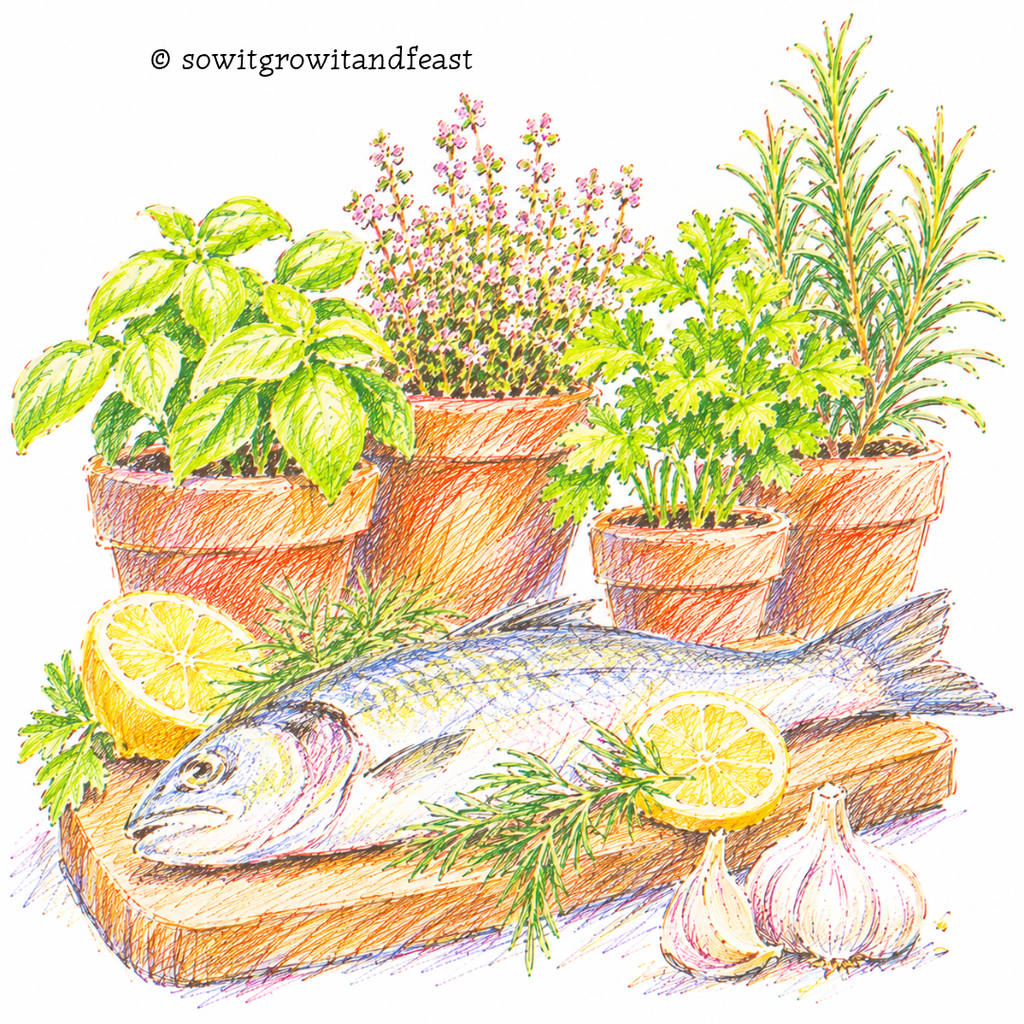
Why Herbs and Fish Work So Beautifully Together
Fish has a wonderfully varied range of flavours and textures.
Delicate white fish, such as cod, haddock and plaice, often benefits from light, fresh herbs that enhance without overwhelming.
Richer, oilier fish, including salmon, trout and mackerel, can stand up to more distinctive flavours.
Shellfish, meanwhile, works beautifully with herbs that bring brightness and freshness, particularly when combined with citrus, garlic or a little chilli.
The secret is understanding the character of each herb.
Dill has a distinctive, gently aniseed flavour that complements salmon and trout. Parsley brings freshness to buttery sauces, while coriander works particularly well with lime, ginger and spices.
Basil adds sweetness to tomato-based dishes, and thyme releases its fragrance gradually during cooking.
Some herbs are best added towards the end, while others can be tucked into a roasting dish and allowed to flavour the fish as it cooks.
And once you begin growing them yourself, experimenting becomes part of the pleasure.
Dill: The Classic Companion to Salmon and Trout
Anethum graveolens
Few herbs are as closely associated with fish as dill.
Its fine, feathery leaves have a distinctive fragrance that is fresh, slightly sweet and gently reminiscent of aniseed.
Dill is particularly popular in Scandinavian and northern European cooking, where it is traditionally paired with salmon, herring and other fish.
It also works beautifully with potatoes, cucumber, yoghurt and lemon.
A handful of freshly chopped dill can bring a wonderful freshness to a simple salmon dish.
Growing Dill in the UK
Dill is an annual herb that grows well in British gardens.
It prefers a sunny position and reasonably fertile, well-drained soil.
Sow seeds directly into their final growing position from April onwards, once the soil has begun to warm.
Dill develops a taproot and can resent being transplanted, so direct sowing is generally preferable.
Sow seeds thinly, approximately 1cm deep, and keep the soil moist during germination.
Depending on the variety and growing conditions, dill can reach around 60–90cm tall, sometimes more.
Its delicate stems can be vulnerable to strong winds, so a sheltered position is helpful.
Keeping Dill Productive
Dill is not a particularly long-lived herb.
As plants mature, they naturally begin flowering and producing seeds.
Rather than relying on one large sowing, sow small quantities every three or four weeks during spring and early summer.
This helps provide a regular supply of tender leaves.
Harvest the foliage while it is fresh and green, taking care not to remove too much growth at once.
If you allow some plants to flower, their delicate yellow umbels are attractive to hoverflies and other beneficial insects.
The seeds can also be harvested and dried for culinary use.
Using Dill with Fish
Dill is particularly good with salmon, trout, cod and prawns.
Try mixing chopped dill with natural yoghurt, lemon juice and a little garlic to make a simple sauce.
It is lovely served with baked salmon and new potatoes.
Fresh dill is generally best added towards the end of cooking, as its delicate flavour can diminish with prolonged heat.
Parsley: The Freshness That Brings Fish to Life
Petroselinum crispum
Parsley is one of the most useful herbs in the kitchen garden.
Its fresh, slightly peppery flavour complements fish beautifully, particularly when combined with butter, garlic and lemon.
It is a familiar ingredient in traditional British fish dishes, from parsley sauce served with poached fish to herb butters spooned over freshly cooked fillets.
Flat-leaf parsley is often preferred for cooking, although curly parsley is equally edible and useful.
Growing Parsley in Britain
Parsley is a biennial plant, generally grown for its leaves during the first year.
It prefers fertile, moisture-retentive soil and grows well in sunshine or partial shade.
Unlike Mediterranean herbs, parsley does not appreciate being allowed to dry out completely.
Sow seeds from spring onwards, either directly into garden soil or in pots and modules.
Parsley can be slow to germinate, sometimes taking several weeks.
Keep the compost consistently moist and be patient.
Once established, harvest the outer stems from the base of the plant, leaving the central growth to continue developing.
In its second year, parsley usually flowers and sets seed, after which the leaves become less desirable for cooking.
Sowing fresh plants each year helps maintain a reliable supply.
Using Parsley with Fish
Parsley is particularly good with cod, haddock, plaice, sea bass and shellfish.
Finely chop a handful and mix it with softened butter, lemon zest and a little garlic.
Allow the butter to melt over freshly cooked fish.
Parsley is also delicious in fishcakes, seafood soups and light dressings.
Sometimes a scattering of fresh parsley is all a dish needs.
Coriander: Bright Flavours for Fish and Shellfish
Coriandrum sativum
Coriander brings a very different character to fish dishes.
Its leaves have a distinctive, fresh flavour often described as citrusy and slightly peppery.
It is particularly useful in dishes inspired by Indian, Thai and other Asian cuisines, where it complements lime, ginger, garlic, chilli and coconut milk.
Coriander is also lovely with prawns and grilled fish.
Interestingly, not everyone experiences its flavour in the same way.
Some people find coriander pleasantly fresh, while others perceive an unpleasant soapy taste. This difference is partly linked to genetic variation in how certain aromatic compounds are detected.
For those who enjoy it, however, coriander is a wonderfully versatile herb.
Growing Coriander in the UK
Coriander is an annual herb that grows successfully in British gardens.
It generally prefers cooler growing conditions and can bolt quickly during prolonged hot weather or long summer days.
Sow seeds directly into pots or garden soil from spring onwards.
Choose a sunny position during cooler weather, with some light shade during hotter periods.
Keep the soil reasonably moist and avoid allowing plants to suffer prolonged drought.
Coriander develops a taproot and does not particularly appreciate root disturbance, so direct sowing is often preferable.
Succession Sowing Coriander
The best way to maintain a steady supply is to sow small quantities regularly.
Try sowing every two or three weeks during suitable growing conditions.
This provides fresh leaves as older plants begin flowering.
Once coriander produces flower stems, the leaves often become less useful for cooking.
However, the flowers can attract beneficial insects, and the seeds can be harvested once mature.
Coriander seeds have a warm, citrus-like flavour quite different from the fresh leaves.
Using Coriander with Fish
Coriander is particularly good with prawns, salmon, white fish and seafood curries.
Combine chopped coriander with lime juice, garlic and a little olive oil for a fresh dressing.
Or scatter the leaves over a coconut-based fish curry just before serving.
Its bright flavour provides a lovely contrast to richer sauces and spices.
Basil: Mediterranean Sunshine on a Plate
Ocimum basilicum
Basil is one of the most fragrant herbs you can grow.
Its soft, glossy leaves carry a sweet, gently peppery aroma that seems made for ripe tomatoes, olive oil and garlic.
Although basil is more commonly associated with pasta and salads, it also works beautifully with fish.
It is particularly good in Mediterranean-inspired dishes featuring tomatoes, courgettes, peppers and white fish.
Growing Basil in the UK
Basil is a tender annual in Britain and requires warmth to thrive.
Sow seeds indoors from March or April, keeping them somewhere warm and bright.
Once seedlings have developed several true leaves, pot them on individually.
Move plants outdoors only after the danger of frost has passed, usually from late May or early June in many parts of the UK.
Choose a warm, sheltered position with plenty of light.
Basil dislikes cold winds and chilly nights, so it may perform better in a greenhouse or sheltered patio during cooler summers.
Keep the compost evenly moist without allowing it to become waterlogged.
Keeping Basil Bushy
Regular harvesting encourages basil to produce more leaves.
Pinch out the growing tips just above a pair of leaves, allowing new side shoots to develop.
Remove developing flower spikes if you want to prolong the production of tender foliage.
Basil is generally best used fresh.
Its delicate fragrance can be lost through prolonged cooking, so add it towards the end of a dish.
Using Basil with Fish
Basil is particularly good with sea bass, cod, haddock and red mullet.
Try cooking white fish in a simple sauce of tomatoes, garlic and olive oil, then stirring through torn basil leaves just before serving.
It is also delicious in a fresh herb dressing or a spoonful of homemade pesto served alongside grilled fish.
Thyme: Gentle Warmth for Roasted Fish
Thymus vulgaris
Thyme is a wonderfully versatile herb.
Its tiny leaves carry a warm, earthy fragrance with subtle floral and peppery notes.
Unlike basil and coriander, thyme holds its flavour well during cooking.
This makes it particularly useful for roasting, baking and preparing fish soups.
It works beautifully with garlic, lemon, tomatoes and olive oil.
Growing Thyme in Britain
Thyme is a hardy, low-growing perennial that prefers full sun and well-drained soil.
It is particularly well suited to raised beds, gravel gardens and containers.
Like rosemary, thyme dislikes prolonged winter wet.
If your garden has heavy clay soil, growing it in a pot or raised bed may be the simplest solution.
Once established, thyme generally needs little additional watering in the ground.
Avoid excessive fertiliser and trim lightly after flowering to help maintain a compact plant.
Do not cut deeply into old, woody stems, as regrowth can be unreliable.
Thyme also produces delicate flowers that are attractive to bees and other pollinating insects.
Using Thyme with Fish
Thyme is particularly good with cod, haddock, sea bass and richer fish such as mackerel.
Place a few sprigs beneath fish fillets before roasting, along with sliced lemon and garlic.
As the fish cooks, the thyme releases its fragrance gradually.
It is also lovely in fish soups, where its earthy flavour complements tomatoes, vegetables and stock.
Other Herbs Worth Growing for Fish
Once you have established a few favourites, there are several other herbs worth adding to your collection.
Chives — Allium schoenoprasum
Chives have a gentle onion flavour that works beautifully with fish.
They are particularly good in creamy sauces, herb butters and dressings.
Chives are hardy perennials that grow well in pots or garden beds.
Their purple flowers are attractive to pollinating insects and are also edible.
Try finely chopped chives in a yoghurt dressing for smoked trout or salmon.
Fennel — Foeniculum vulgare
Fennel has a distinctive aniseed flavour that complements fish particularly well.
Both the feathery leaves and seeds can be used in cooking.
Florence fennel, grown for its swollen leaf bases, is a related cultivated form with its own growing requirements.
Herb fennel is a tall perennial that prefers sunshine and well-drained soil.
It can reach considerable height, so give it plenty of space and be aware that it may self-seed.
The leaves are lovely with baked fish, while the seeds can be used sparingly in marinades and seasoning mixtures.
French Tarragon — Artemisia dracunculus var. sativa
French tarragon has a distinctive, gently sweet aniseed flavour.
It is particularly good with fish served in buttery or creamy sauces.
Grow it in a sunny, sheltered position with well-drained soil.
French tarragon is a herbaceous perennial and usually dies back during winter.
True French tarragon is normally propagated by division or cuttings rather than seed.
A little freshly chopped tarragon stirred into a warm cream sauce can make a simple fish supper feel rather special.
Creating a Herb Garden for Fish Recipes
One of the most important things to understand about growing culinary herbs is that they do not all want the same conditions.
Thyme prefers relatively dry, well-drained soil.
Parsley, dill and coriander need more consistent moisture.
Basil requires warmth and protection from cold weather.
Rather than planting everything together in one large container, it is usually better to group herbs according to their needs.
A Sunny Mediterranean Corner
Grow thyme in a sunny, sheltered position with free-draining soil.
It works particularly well in raised beds, gravel gardens and terracotta pots.
If you are also growing rosemary or sage, these make suitable companions because they enjoy similar conditions.
A Productive Leafy Herb Bed
Parsley, dill and coriander can be grown in a separate bed or collection of containers.
These herbs appreciate reasonably fertile soil and regular watering during dry weather.
Dill and coriander are particularly suited to succession sowing, allowing you to harvest fresh leaves over a longer period.
A Warm Pot for Basil
Grow basil separately in a warm, sheltered container.
This makes it easier to provide the moisture and warmth it needs without keeping Mediterranean herbs unnecessarily wet.
A Space for Chives and Tarragon
Chives are particularly useful in a mixed herb bed, while French tarragon often benefits from its own well-drained growing space.
Both can provide fresh leaves over several seasons.
Growing Herbs in Containers
You do not need a large garden to grow a useful collection of culinary herbs.
A sunny patio, balcony or even a few pots outside the kitchen door can provide plenty of fresh ingredients.
Choose containers with drainage holes and fill them with a suitable peat-free growing medium.
For Mediterranean herbs such as thyme, good drainage is especially important.
For leafy herbs such as parsley, dill and coriander, aim for a compost that retains moisture without becoming waterlogged.
Terracotta pots are attractive and can be particularly suitable for Mediterranean herbs, although they dry out more quickly than glazed or plastic containers.
There is no need to place a layer of stones at the bottom of the pot.
This does not reliably improve drainage and can reduce the space available for roots.
Instead, ensure drainage holes are clear and use a growing medium appropriate for the plant.
Harvesting Herbs for the Best Flavour
One of the pleasures of growing culinary herbs is being able to gather exactly what you need, when you need it.
For many herbs, harvesting in the morning after any dew has dried is a good choice.
Use clean scissors or secateurs and avoid removing too much growth at once.
For parsley, harvest the outer stems from the base of the plant.
For basil, pinch out growing tips to encourage branching.
For dill and coriander, gather young leaves regularly, while allowing some plants to flower if you want to harvest seeds.
For thyme, take small sprigs without cutting deeply into old woody stems.
And remember that fresh herbs are often at their most fragrant when used promptly.
A handful of dill gathered while the salmon is cooking can make a surprising difference to the finished dish.
Preserving Herbs for Winter Cooking
A productive herb garden can provide more than you need during summer.
Fortunately, several herbs preserve well.
Drying Thyme
Thyme retains much of its flavour when dried.
Gather healthy stems and dry them in a warm, airy place away from direct sunlight.
Alternatively, use a food dehydrator at an appropriate low temperature.
Once completely dry, strip the leaves from the stems and store them in a clean, airtight jar somewhere cool and dark.
Freezing Dill, Parsley, Coriander and Basil
Soft herbs generally retain more of their fresh character when frozen rather than dried.
Wash and dry the leaves thoroughly before chopping and freezing in small portions.
They can be added directly to cooked dishes.
Dill and parsley can also be frozen in small portions with water, ready for soups and sauces.
Take care with homemade herb and garlic oils, which should not be stored at room temperature without a validated preservation method because of the potential risk of botulism.
Five Delicious Fish Recipes Using Home-Grown Herbs
The real pleasure of growing culinary herbs comes when they find their way into the kitchen.
Fish provides a wonderfully versatile starting point, allowing delicate herbs to shine without the need for complicated cooking.
These five recipes make the most of fresh herbs, from comforting baked salmon to fragrant seafood dishes.
1. Baked Salmon with Dill and Lemon
A beautifully simple dish that celebrates the classic partnership of salmon and dill.
Ingredients
- 4 salmon fillets
- 2 tablespoons olive oil
- 1 lemon
- 2 tablespoons freshly chopped dill
- 1 garlic clove, finely chopped
- Salt and black pepper
Method
Preheat the oven to 200°C, or 180°C fan.
Place the salmon fillets in a lightly oiled baking dish.
Mix the olive oil, garlic and half the dill.
Brush over the fish and add a little lemon zest.
Arrange lemon slices around the fillets.
Bake for approximately 12–18 minutes, depending on thickness, until the salmon is cooked through.
For a reliable food-safety check, the centre should reach 63°C, measured with a food thermometer.
Scatter over the remaining fresh dill before serving.
This is lovely with new potatoes and steamed green vegetables.
2. Sea Bass with Parsley and Garlic Butter
A simple dish that makes wonderful use of freshly harvested parsley.
Ingredients
- 4 sea bass fillets
- 40g unsalted butter
- 2 garlic cloves, finely chopped
- 2 tablespoons chopped flat-leaf parsley
- Juice of half a lemon
- Salt and black pepper
Method
Pat the fish fillets dry and season lightly.
Heat a frying pan over a medium heat and cook the fish, skin-side down first if the skin is present, until golden.
Turn carefully and continue cooking until the fish is cooked through.
Remove the fish and keep warm.
Reduce the heat and add the butter and garlic to the pan.
Cook gently until fragrant, taking care not to burn the garlic.
Stir in the parsley and lemon juice.
Spoon the butter over the fish just before serving.
Serve with seasonal vegetables or a simple green salad.
3. Coriander and Lime Prawns
Fresh, fragrant and particularly good for summer cooking.
Ingredients
- 400g raw, peeled prawns
- 2 tablespoons olive oil
- Juice and zest of 1 lime
- 2 garlic cloves, finely chopped
- 1 small red chilli, finely chopped
- A generous handful of fresh coriander
- Salt and black pepper
Method
Combine the olive oil, lime zest, garlic and chilli in a bowl.
Add the prawns and mix thoroughly.
Cover and marinate in the fridge for approximately 15–20 minutes.
Heat a frying pan over a medium-high heat.
Cook the prawns for a few minutes, turning once, until they are opaque, firm and thoroughly cooked.
Remove from the heat and stir through the lime juice and freshly chopped coriander.
Serve immediately with rice, salad or warm flatbreads.
4. Mediterranean Fish with Tomatoes and Basil
A lovely way to make the most of summer tomatoes and fresh basil.
Ingredients
- 4 cod or haddock fillets
- 400g ripe tomatoes, chopped
- 2 tablespoons olive oil
- 1 small onion, finely chopped
- 2 garlic cloves, crushed
- A generous handful of fresh basil
- Salt and black pepper
Method
Heat the olive oil in a large frying pan.
Add the onion and cook gently until softened.
Stir in the garlic and cook for another minute.
Add the tomatoes and simmer for approximately 10–15 minutes, until they begin to break down into a sauce.
Nestle the fish fillets into the tomatoes.
Cover and cook gently until the fish is thoroughly cooked and flakes easily.
Check for a centre temperature of 63°C if using a food thermometer.
Tear the basil leaves and scatter them over the dish just before serving.
This is particularly good with crusty bread or new potatoes.
5. Roasted Cod with Thyme, Garlic and Lemon
A comforting dish that makes the most of thyme’s warm, earthy fragrance.
Ingredients
- 4 cod fillets
- 2 tablespoons olive oil
- 4 sprigs fresh thyme
- 2 garlic cloves, lightly crushed
- 1 lemon, sliced
- Salt and black pepper
Method
Preheat the oven to 200°C, or 180°C fan.
Arrange the cod fillets in a lightly oiled baking dish.
Drizzle with olive oil and season lightly.
Scatter the thyme and garlic around the fish, then add the lemon slices.
Roast for approximately 12–18 minutes, depending on the thickness of the fillets, until the fish is cooked through.
Check that the centre reaches 63°C.
Remove the woody thyme stems before serving.
Serve with roasted vegetables or a simple potato salad.
A Note on Choosing Fish Sustainably
Growing your own herbs is one way to make your cooking more connected to the seasons, but the fish itself deserves a little thought too.
Fish stocks and fishing methods vary considerably, and a species that is a responsible choice from one fishery may be under pressure elsewhere.
When shopping, look for reliable information about where and how the fish was caught or farmed.
The Marine Conservation Society’s Good Fish Guide is a useful UK resource for checking current seafood sustainability recommendations.
Choosing fish thoughtfully, reducing food waste and making good use of seasonal ingredients are all small steps towards more considered cooking.
Are Culinary Herbs Good for Your Health?
Fresh herbs contain a variety of naturally occurring plant compounds, including antioxidants, alongside varying amounts of vitamins and minerals.
Parsley, for example, provides vitamin K and vitamin C, while dill, basil, coriander and thyme contain aromatic compounds that have attracted scientific interest.
However, it is important to keep their nutritional benefits in perspective.
Herbs are generally eaten in relatively small quantities, and research involving concentrated extracts does not necessarily demonstrate that ordinary culinary portions will prevent or treat illness.
The strongest reason to use herbs regularly is much simpler.
They bring freshness and flavour to meals without relying heavily on salt or rich sauces.
And growing them yourself offers the additional pleasure of spending time outdoors, tending plants and gathering ingredients for the kitchen.
The Quiet Pleasure of Growing What You Cook
There is something particularly satisfying about growing herbs for fish dishes.
Perhaps it is the freshness.
The delicate fragrance of dill gathered moments before it is scattered over salmon. The bright green parsley chopped into warm butter. The scent of thyme released as its leaves are brushed between your fingers.
Or perhaps it is the way these small plants connect the garden with the meals we prepare.
A fish supper begins to feel a little more personal when some of the ingredients have been grown just outside the kitchen door.
You remember sowing the dill, watching the parsley establish and waiting for the basil to enjoy a little proper summer warmth.
And now, something you have nurtured is becoming part of a meal.
That is one of the loveliest things about growing your own food.
It need not involve enormous harvests or an immaculate kitchen garden.
Sometimes the reward is simply a handful of fresh herbs, gathered a few steps from the kitchen.
Dill for salmon. Parsley for sea bass. Coriander for prawns. Basil for summer tomatoes and thyme for a comforting baked fish dish.
Small harvests, perhaps, but full of flavour.
And a rather lovely reminder that some of the finest ingredients are the ones we grow ourselves.
From the garden to the table, with a little help from the sea.
Further Reading: Why Growing Food Makes You Feel Better, Take the Guesswork Out of Growing Veg, How to Create a Garden That Feeds Your Family, How to Start a Vegetable Garden Now Ready for Spring
Follow us on Instagram, Threads, BlueSky, Twitter, Pinterest & Facebook
Not sure where to start? Take a look at our Grow Your Own Packs with detailed step by step instructions, seeds and 1 years online support.