
There is something deeply comforting about the aroma of beef slowly roasting in the oven, particularly when it is accompanied by the fragrance of rosemary, thyme and garlic.
It is the sort of smell that seems to find its way into every corner of the house, quietly announcing that something rather good is happening in the kitchen.
A Sunday roast, perhaps. A casserole bubbling away on a cold afternoon. Or a steak sizzling in a pan with a little butter and a few freshly picked herbs.
Beef has a wonderfully rich, savoury flavour, and the right herbs can bring out its character without overwhelming it.
Rosemary adds warmth and depth. Thyme brings a gentle earthiness. Sage offers something more robust, while oregano lends a Mediterranean character to tomato-based dishes. And parsley, with its fresh, slightly peppery flavour, provides a welcome contrast to all that richness.
The lovely thing is that these herbs are relatively straightforward to grow in a British garden.
You do not need an elaborate kitchen garden or acres of space. A few pots on the patio, a sunny corner of the garden or a small raised bed can provide a generous supply of fresh herbs throughout the growing season.
And there is a particular satisfaction in stepping outside to gather a sprig of rosemary for the Sunday roast.
It is a small gesture, but one that connects the garden and the kitchen in the most delightful way.
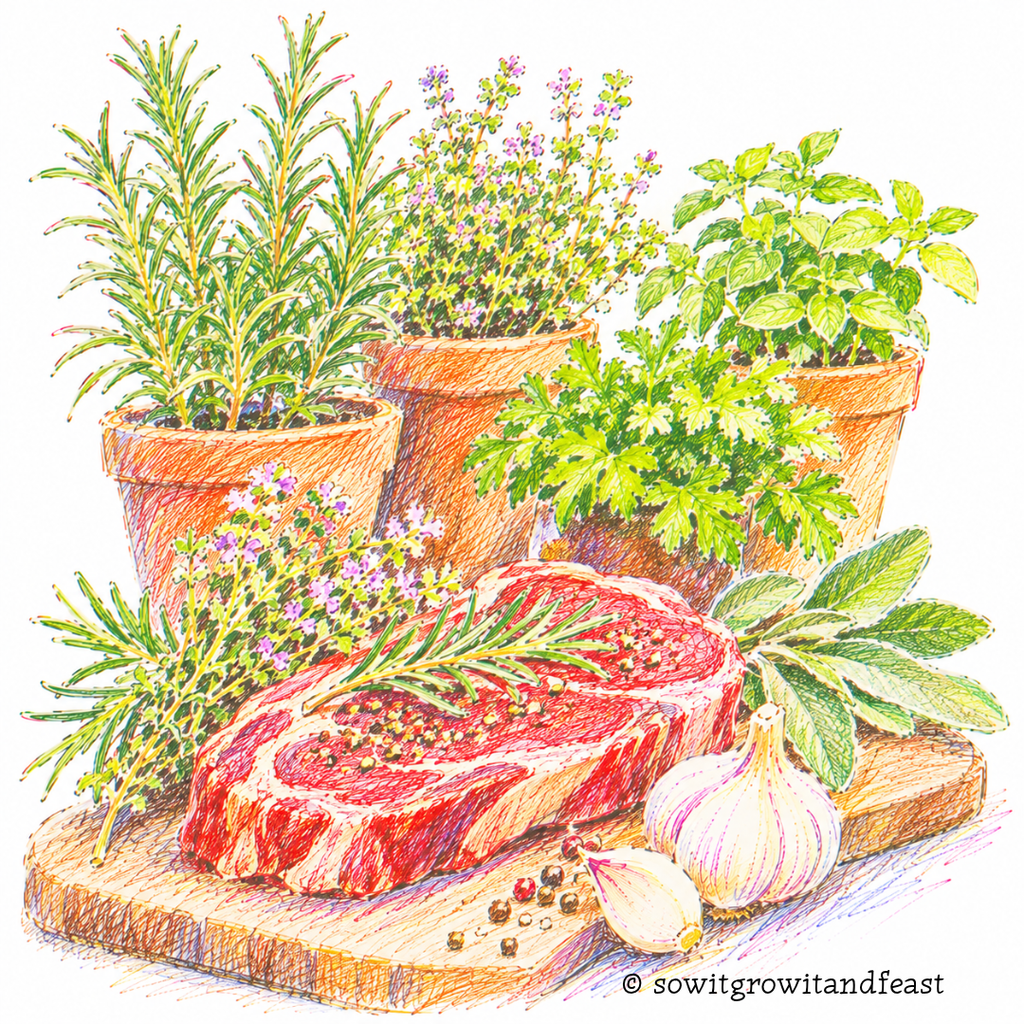
Why Herbs Work So Beautifully with Beef
Beef has a stronger, richer flavour than many other meats, which means it can stand up to herbs with plenty of character.
The secret is choosing herbs that complement the dish rather than compete with it.
Woody herbs such as rosemary and thyme release their flavours gradually during cooking. They are particularly well suited to roasting, braising and slow-cooked casseroles.
Sage has a more assertive flavour and is best used thoughtfully, while oregano brings warmth to dishes featuring tomatoes, garlic and olive oil.
Parsley is different again.
Its fresh, clean flavour is often most effective when added towards the end of cooking, bringing brightness to a rich sauce or a beautifully cooked steak.
Understanding these differences makes it easier to choose the right herbs for each recipe.
And once you begin growing them yourself, experimenting becomes part of the pleasure.
Rosemary: The Traditional Companion to Roast Beef
Salvia rosmarinus, formerly Rosmarinus officinalis
Few herbs are as immediately recognisable as rosemary.
Its narrow evergreen leaves carry a strong, resinous fragrance with notes of pine, warmth and a gentle peppery sharpness.
Rosemary is particularly well suited to beef because its robust flavour can stand alongside the meat’s natural richness.
It works beautifully with garlic, olive oil and black pepper, making it a favourite for roasting joints, grilling steaks and preparing slow-cooked dishes.
Growing Rosemary in the UK
Rosemary is a perennial evergreen shrub that prefers full sun and well-drained soil.
Choose a sheltered position, particularly if your garden is exposed to cold winds.
Although rosemary is reasonably hardy in many British gardens, prolonged winter wet can be more troublesome than cold alone.
In heavy clay soil, consider growing it in a raised bed or a generous container filled with a free-draining peat-free growing medium.
Water regularly while the plant establishes, but once mature, rosemary growing in the ground generally tolerates dry conditions reasonably well.
Avoid excessive feeding, which can encourage soft growth.
Light pruning after flowering helps maintain a compact shape, but avoid cutting heavily into old, leafless wood.
Rosemary can become a substantial shrub over time, so allow it sufficient space.
Its flowers are also attractive to bees and other visiting insects.
Using Rosemary with Beef
Rosemary is particularly good with roast beef, steak, slow-cooked brisket and beef kebabs.
For a simple roast, finely chop a little rosemary and combine it with garlic, olive oil and black pepper.
Rub the mixture over the beef before cooking.
Alternatively, add a whole sprig to a roasting tin and allow its fragrance to develop gently.
Rosemary is quite powerful, so a little often goes a long way.
The aim is to complement the beef, not disguise it.
Thyme: The Quiet Hero of Slow Cooking
Thymus vulgaris
Thyme is one of those herbs that rarely receives much attention, yet its contribution to a dish can be remarkable.
Its tiny leaves carry a warm, earthy fragrance with subtle floral and peppery notes.
It is particularly good in dishes that are allowed to cook slowly, where its flavour develops gradually alongside onions, garlic, mushrooms and wine.
A few sprigs of thyme can bring wonderful depth to a beef casserole.
It is also a traditional ingredient in bouquet garni, the bundle of herbs used to flavour stocks, soups and braised dishes.
Growing Thyme in Britain
Thyme is a hardy, low-growing perennial that thrives in sunny, well-drained conditions.
It is particularly well suited to raised beds, gravel gardens and containers.
Like rosemary, thyme dislikes prolonged winter wet.
If your garden has heavy soil, growing it in a pot or raised bed may be the simplest solution.
Once established, thyme generally requires little additional watering in the ground.
Avoid excessive fertiliser and trim lightly after flowering to help maintain a compact plant.
Do not cut deeply into old, woody stems, as regrowth can be unreliable.
Thyme also produces delicate flowers that attract bees and other pollinating insects.
Using Thyme with Beef
Thyme is particularly good in beef bourguignon, casseroles, stews and rich gravies.
Add whole sprigs during cooking, removing the woody stems before serving.
For steak, try adding a few sprigs of thyme to a pan with butter and garlic.
As the butter melts, it takes on the fragrance of the herb and can be spooned over the meat during cooking.
It is a simple technique that brings a lovely depth of flavour.
Sage: A Robust Herb for Rich, Comforting Dishes
Salvia officinalis
Sage has a distinctive flavour that is difficult to mistake.
Its soft, grey-green leaves carry a strong, earthy aroma with slightly peppery and resinous notes.
It is more assertive than thyme and can easily dominate a dish if used too generously.
But when used with care, sage brings warmth and complexity to beef.
It is particularly good in hearty winter dishes, sausages, slow-cooked beef and recipes featuring onions, mushrooms or butter.
Growing Sage in the UK
Sage is a hardy evergreen or semi-evergreen perennial shrub, depending on growing conditions.
It prefers full sun and well-drained soil.
Like many Mediterranean herbs, sage can struggle in heavy, waterlogged ground.
Choose a sheltered position or grow it in a container if your soil is particularly wet during winter.
Water young plants while they establish, but avoid keeping mature plants constantly wet.
Light pruning helps maintain a compact shape.
However, avoid cutting hard into old, bare wood.
Older sage plants can become woody and less productive, so replacing them periodically with young plants or cuttings can be worthwhile.
Its flowers are also attractive to pollinating insects.
Using Sage with Beef
Sage works particularly well in beef sausages, meatballs, braised beef and rich casseroles.
Try finely chopping two or three leaves and adding them to a beef and mushroom sauce.
Alternatively, gently cook a few sage leaves in butter and spoon the fragrant butter over a freshly cooked steak.
Because sage has such a strong character, begin with a small amount.
You can always add more, but once it has taken over the dish, there is little going back.
Oregano: Bringing Mediterranean Warmth to Beef
Origanum vulgare
Oregano brings a different character to beef dishes.
Its flavour is warm, earthy and slightly peppery, with a gentle bitterness that works particularly well alongside tomatoes, garlic and olive oil.
It is closely associated with Mediterranean cooking and is a familiar ingredient in meatballs, tomato sauces and grilled dishes.
Unlike some soft herbs, oregano often develops a more concentrated flavour when dried.
This makes it particularly useful for keeping in the kitchen throughout winter.
Growing Oregano in Britain
Oregano is a hardy perennial that grows well in sunny, free-draining positions.
Once established, it generally tolerates dry conditions and requires relatively little feeding.
It is well suited to containers, raised beds and gravel gardens.
Its flowers are also popular with bees, butterflies and other pollinating insects.
For a stronger culinary flavour, look for Greek oregano, commonly sold as Origanum vulgare subsp. hirtum.
The flavour of ordinary garden oregano can vary considerably between plants.
Harvesting and Drying Oregano
Harvest stems during active growth, ideally before or around the beginning of flowering when the leaves are strongly aromatic.
Dry them somewhere warm, airy and out of direct sunlight.
Once thoroughly dry, strip the leaves from the stems and store them in a clean, airtight jar.
Using Oregano with Beef
Oregano is particularly good in beef meatballs, burgers, tomato-based sauces and Mediterranean-style casseroles.
Combine it with garlic, black pepper and olive oil for a simple beef marinade.
It also works beautifully with roasted peppers, aubergines and tomatoes.
A little dried oregano added to a slow-cooked beef sauce can bring a surprising amount of flavour.
Parsley: Freshness for Rich Beef Dishes
Petroselinum crispum
Parsley may seem rather modest beside the stronger flavours of rosemary and sage, but it has an important role to play.
Its fresh, slightly peppery flavour provides a welcome contrast to the richness of beef.
It is particularly useful in sauces, dressings and finishing mixtures, where it brings freshness without overwhelming the other ingredients.
Flat-leaf parsley is often preferred for cooking, although curly parsley is equally edible and useful.
Growing Parsley in the UK
Parsley is a biennial plant, generally grown for its leaves during the first year.
It prefers fertile, moisture-retentive soil and grows well in sunshine or partial shade.
Unlike rosemary, thyme and oregano, parsley does not appreciate being allowed to dry out completely.
Sow seeds from spring onwards in pots, modules or directly into garden soil.
Germination can be slow and irregular, sometimes taking several weeks.
Keep the compost moist and be patient.
Once established, harvest the outer stems from the base of the plant, leaving the central growth to continue developing.
In its second year, parsley generally flowers and sets seed, after which the leaves become less desirable for cooking.
Sowing fresh plants each year helps maintain a reliable supply.
Using Parsley with Beef
Parsley is particularly good in fresh sauces served with grilled or roasted beef.
One of the finest examples is chimichurri, the vibrant Argentine sauce traditionally made with parsley, garlic, vinegar, olive oil and oregano.
Its sharp, fresh flavour cuts beautifully through the richness of grilled beef.
Parsley is also useful in meatballs, beef stews and herb butters.
Sometimes all a rich dish needs is a generous scattering of freshly chopped parsley just before serving.
Are Culinary Herbs Good for Your Health?
Fresh herbs contain a variety of naturally occurring plant compounds, including antioxidants, alongside varying amounts of vitamins and minerals.
Parsley, for example, provides vitamin K and vitamin C, while rosemary, thyme, sage and oregano contain aromatic compounds that have attracted scientific interest.
However, it is important to keep their nutritional benefits in perspective.
Herbs are generally eaten in relatively small quantities, and research involving concentrated extracts does not necessarily demonstrate that ordinary culinary portions will prevent or treat illness.
The strongest reason to use herbs regularly is much simpler.
They bring flavour to meals without relying heavily on salt or rich sauces.
They also encourage us to cook with fresh ingredients and experiment with vegetables, pulses and other plant foods.
And, of course, growing herbs provides its own pleasures.
A little time spent outdoors, tending plants and gathering ingredients for supper can be a welcome part of the daily routine.
Creating a Herb Garden for Beef Recipes
One of the most useful lessons in herb gardening is understanding that different plants prefer different growing conditions.
Rosemary, thyme, sage and oregano all enjoy sunshine and well-drained soil.
Parsley, on the other hand, prefers more consistent moisture and generally appreciates richer growing conditions.
Rather than placing everything together in one large planter, group herbs according to their needs.
A Mediterranean Herb Bed
Rosemary, thyme, sage and oregano work well together in a sunny, sheltered position.
They are particularly suited to raised beds, gravel gardens and containers with free-draining growing media.
Allow enough room for rosemary and sage to develop into mature shrubs.
Thyme can grow towards the front of the bed, while oregano provides softer, spreading foliage.
These herbs are not only useful in the kitchen but also attractive in the garden.
Their flowers provide nectar for visiting insects, and their foliage offers fragrance and structure throughout much of the year.
A Separate Pot for Parsley
Parsley is best grown in a container or garden bed where the soil can be kept reasonably moist.
Choose a fertile, peat-free growing medium and water regularly during dry weather.
It will tolerate some shade, making it useful for positions that are not quite sunny enough for Mediterranean herbs.
Growing Herbs in Small Spaces
You do not need a large garden to grow a useful collection of culinary herbs.
A few pots on a sunny patio or balcony can provide plenty of fresh ingredients.
Choose containers with drainage holes and use a suitable peat-free growing medium.
Terracotta pots are particularly attractive for Mediterranean herbs, although they dry out more quickly than glazed or plastic containers.
There is no need to place a layer of stones at the bottom of the pot.
This does not reliably improve drainage and can reduce the volume of compost available for roots.
Instead, ensure that drainage holes are clear and use a growing medium suited to the plant.
Watering Herbs Properly
One of the most common mistakes in herb gardening is treating every plant in exactly the same way.
Rosemary, thyme, sage and oregano generally prefer their growing medium to begin drying between waterings.
Parsley needs more consistent moisture.
However, even drought-tolerant herbs require regular watering while they establish.
Container-grown plants also dry out more quickly than those growing in open ground.
Rather than following a rigid watering schedule, check the compost and consider the weather, the size of the container and the needs of the individual plant.
Water thoroughly when required, allowing excess water to drain away.
Avoid leaving pots standing in water for prolonged periods.
The aim is to provide the right conditions for each herb, not simply to water everything because the watering can happens to be nearby.
Harvesting Herbs for the Best Flavour
One of the pleasures of growing culinary herbs is being able to gather exactly what you need, when you need it.
For many herbs, harvesting in the morning after any dew has dried is a good choice.
Use clean scissors or secateurs and avoid removing too much growth at once.
For rosemary, thyme, sage and oregano, harvest small sprigs during active growth.
Avoid cutting deeply into old, woody stems.
For parsley, remove the outer stems from the base of the plant, allowing the centre to continue producing fresh leaves.
Regular, thoughtful harvesting helps keep plants productive.
And freshly gathered herbs are often at their most fragrant when used promptly.
There is something rather lovely about stepping outside while supper is cooking and returning with exactly the ingredients you need.
Preserving Herbs for Winter Cooking
A productive herb garden can provide more than you need during summer.
Fortunately, several herbs preserve well.
Drying Rosemary, Thyme, Sage and Oregano
These herbs retain much of their flavour when dried.
Gather healthy stems and dry them in a warm, airy place away from direct sunlight.
Alternatively, use a food dehydrator at an appropriate low temperature.
Once completely dry, remove the leaves from the stems and store them in clean, airtight jars somewhere cool and dark.
Freezing Parsley
Parsley generally retains more of its fresh character when frozen rather than dried.
Wash and dry the leaves thoroughly before chopping and freezing in small portions.
It can then be added directly to cooked dishes.
You can also freeze chopped parsley with a little water in ice cube trays, ready to add to soups and casseroles.
Five Delicious Beef Recipes Using Home-Grown Herbs
The real pleasure of growing culinary herbs comes when they find their way into the kitchen.
And beef provides a wonderfully versatile starting point.
From a traditional Sunday roast to a bright, fresh herb sauce, these recipes make the most of the plants growing just outside your door.
1. Rosemary and Garlic Roast Beef
A beautifully simple roast that allows the natural flavour of the beef to shine.
Ingredients
- 1.5kg beef roasting joint, such as sirloin or topside
- 2 tablespoons olive oil
- 2 sprigs fresh rosemary, leaves finely chopped
- 3 garlic cloves, crushed
- 1 teaspoon Dijon mustard
- Sea salt and freshly ground black pepper
Method
Remove the beef from the fridge approximately 30 minutes before cooking, keeping it covered and away from sources of heat.
Preheat the oven to 220°C, or 200°C fan.
Mix the olive oil, rosemary, garlic and mustard into a paste.
Season the beef and rub the herb mixture over the surface.
Place the joint in a roasting tin.
Roast at the higher temperature for approximately 15 minutes, then reduce the oven to 180°C, or 160°C fan.
Continue roasting until the centre reaches your preferred temperature, checking with a meat thermometer.
Cooking time will depend on the cut, shape and weight of the joint.
For an intact whole-muscle joint, commonly used temperature guides are approximately 55°C for medium-rare and 60–65°C for medium, although food-safety requirements differ for vulnerable individuals and mechanically tenderised meat.
Allow the beef to rest before carving.
Serve with roasted potatoes, seasonal vegetables and gravy made from the roasting juices.
2. Slow-Cooked Beef with Thyme and Red Wine
A comforting dish for colder evenings.
Ingredients
- 750g diced braising beef
- 2 tablespoons olive oil
- 1 onion, chopped
- 2 carrots, sliced
- 2 garlic cloves, crushed
- 200g mushrooms, halved
- 250ml red wine
- 350ml beef stock
- 2 tablespoons tomato purée
- 4 sprigs fresh thyme
- 1 bay leaf
- Salt and black pepper
Method
Preheat the oven to 160°C, or 140°C fan.
Heat the oil in a large ovenproof casserole dish.
Brown the beef in batches, then remove and set aside.
Add the onion, carrots and mushrooms, cooking gently until they begin to soften.
Stir in the garlic and tomato purée.
Pour in the wine, scraping the base of the pan to release the browned cooking juices.
Return the beef to the dish and add the stock, thyme and bay leaf.
Bring to a gentle simmer, cover and transfer to the oven.
Cook for approximately 2½–3 hours, or until the beef is tender.
Remove the thyme stems and bay leaf before serving.
This is particularly good with mashed potatoes or crusty bread.
3. Steak with Thyme and Garlic Butter
A simple way to make the most of freshly harvested thyme.
Ingredients
- 2 steaks, approximately 2–3cm thick
- 1 tablespoon olive oil
- 30g butter
- 2 garlic cloves, lightly crushed
- 3 sprigs fresh thyme
- Salt and black pepper
Method
Pat the steaks dry and season lightly.
Heat a heavy-based frying pan until hot.
Add the oil and cook the steaks, turning as required to develop an even crust.
Reduce the heat slightly and add the butter, garlic and thyme.
As the butter melts, tilt the pan carefully and spoon it over the steaks.
Continue cooking until the steaks reach your preferred doneness.
For intact whole-muscle steaks, medium-rare is commonly around 55°C and medium around 60–65°C at the centre. Mechanically tenderised steaks and steaks intended for vulnerable people require more cautious cooking.
Rest briefly before serving.
Spoon over a little of the fragrant butter.
Serve with new potatoes and a green salad.
4. Beef Meatballs with Oregano and Tomato Sauce
A lovely family supper that makes excellent use of fresh or dried oregano.
Ingredients
For the meatballs:
- 500g minced beef
- 1 small onion, finely grated
- 1 garlic clove, crushed
- 1 egg
- 40g fresh breadcrumbs
- 1 tablespoon chopped fresh oregano, or 1 teaspoon dried
- Salt and black pepper
For the sauce:
- 1 tablespoon olive oil
- 2 garlic cloves, finely chopped
- 1 x 400g tin chopped tomatoes
- 1 tablespoon tomato purée
- 1 teaspoon dried oregano
- A pinch of sugar, if needed
Method
Combine the minced beef, onion, garlic, egg, breadcrumbs and oregano.
Season lightly and shape into evenly sized meatballs.
Heat a little oil in a frying pan and brown the meatballs on all sides.
Remove them temporarily.
Add the garlic to the pan and cook gently before stirring in the tomatoes, tomato purée and oregano.
Return the meatballs to the sauce.
Cover and simmer gently for approximately 20–25 minutes, or until the meatballs are thoroughly cooked.
As they contain minced beef, check that the centre reaches at least 75°C.
Serve with pasta, rice or crusty bread.
Finish with a scattering of fresh parsley.
5. Fresh Parsley Chimichurri for Grilled Beef
A wonderfully bright sauce that contrasts beautifully with rich beef.
Ingredients
- 1 generous handful flat-leaf parsley, finely chopped
- 2 garlic cloves, finely chopped
- 1 teaspoon dried oregano
- 2 tablespoons red wine vinegar
- 5 tablespoons olive oil
- A pinch of chilli flakes
- Salt and black pepper
Method
Combine the parsley, garlic, oregano and chilli flakes in a bowl.
Stir in the vinegar and olive oil.
Season to taste.
Allow the sauce to stand for approximately 15–20 minutes so the flavours can develop.
Spoon over freshly cooked beef or serve alongside grilled steak.
Chimichurri is traditionally associated with Argentina and Uruguay, where its fresh, sharp character makes it a natural accompaniment to grilled meats.
Keep any leftovers refrigerated and use promptly rather than storing fresh herb and garlic mixtures in oil at room temperature.
The Quiet Pleasure of Growing What You Cook
There is something particularly satisfying about growing herbs for the kitchen.
Perhaps it is their generosity.
A rosemary plant can provide fragrant sprigs for years. Thyme returns each spring with fresh growth and delicate flowers. Oregano spreads gently through a sunny border, while parsley offers a steady supply of leaves through much of the growing season.
Or perhaps it is the way these plants connect the garden with the meals we prepare.
A Sunday roast begins to feel a little more personal when the rosemary has been gathered from a shrub you planted yourself.
A slow-cooked casserole carries the fragrance of thyme grown beside the garden path.
And a simple steak becomes something rather special with a spoonful of fresh parsley chimichurri.
These are small things, certainly.
But gardening has a wonderful way of reminding us that small things often bring the greatest pleasure.
You do not need a perfect garden or an elaborate collection of plants.
A few well-chosen herbs, a little patience and the pleasure of gathering something fresh for supper are quite enough.
And when the kitchen fills with the fragrance of rosemary, thyme and garlic, there is the added satisfaction of knowing that some of the finest ingredients came from just outside your own door.
From the garden to the table, one fragrant sprig at a time.
Further Reading: Why Growing Food Makes You Feel Better, Take the Guesswork Out of Growing Veg, How to Create a Garden That Feeds Your Family, How to Start a Vegetable Garden Now Ready for Spring
Follow us on Instagram, Threads, BlueSky, Twitter, Pinterest & Facebook
Not sure where to start? Take a look at our Grow Your Own Packs with detailed step by step instructions, seeds and 1 years online support.