
September has a habit of feeling like an ending.
There is a coolness to the mornings that wasn’t there a few weeks ago. Cobwebs begin to show themselves in the hedges, picked out with beads of dew, and the evenings seem to arrive a little sooner each day. In the vegetable garden, beans are still being gathered, courgettes continue to appear beneath their leaves and tomatoes make the most of the remaining warmth.
Yet, among all this harvesting, September is also a month for sowing.
The seed packets may have been pushed towards the back of the shed and the propagator put away months ago, but there is still time to begin another round of crops. In fact, the combination of soil warmed by summer and cooler, damper weather can make early autumn a particularly pleasant time to sow.
Choose the right vegetables, salads and herbs now and your garden can continue giving long after the last of the summer tomatoes has been picked.
So, before you tidy away the seed box for another year, let’s see what you can sow in September in the UK.
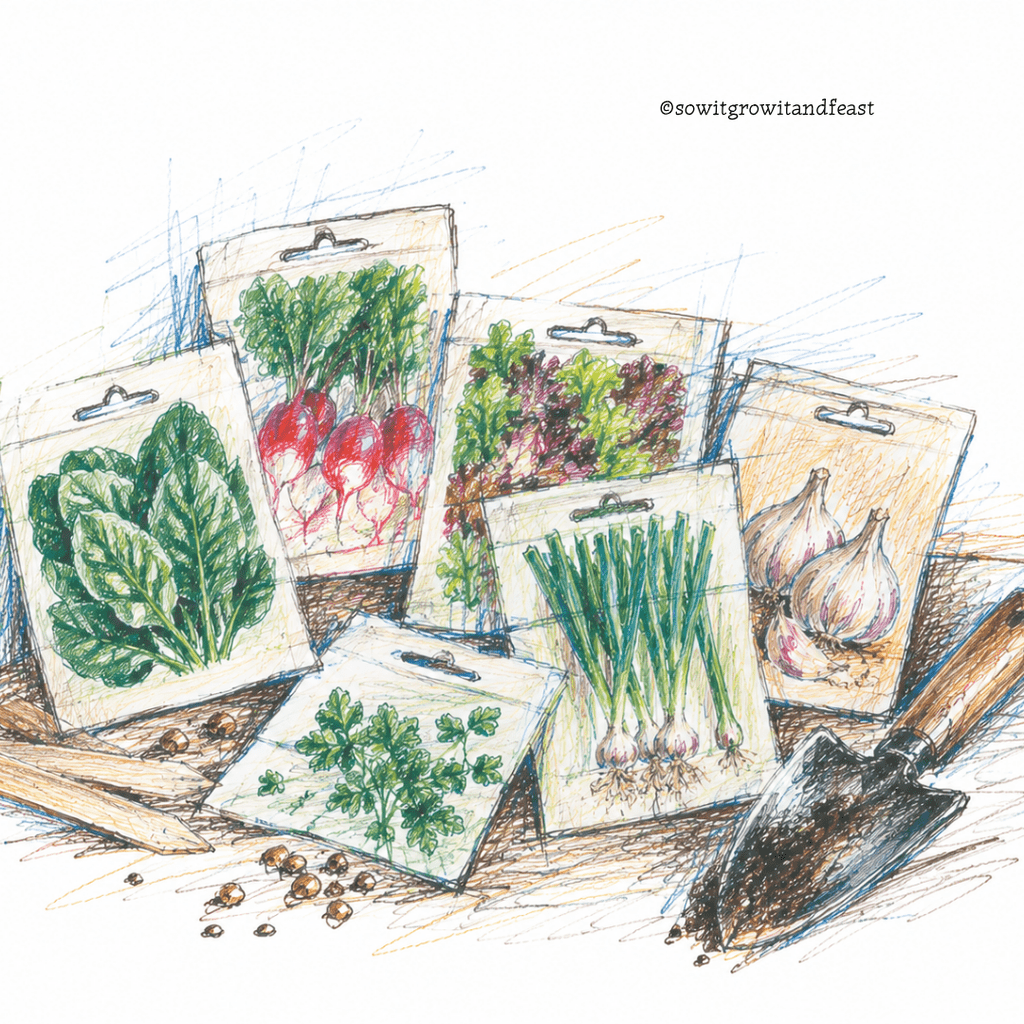
Is September too late to sow vegetables?
Not at all.
September sits between two seasons in the kitchen garden. Summer crops are reaching their generous peak just as autumn begins to make itself known.
That makes it one of the most abundant times of year in a British vegetable garden. Tomatoes, courgettes, beans and salads can still be producing while apples, pears, squash and leeks begin to take us towards autumn.
But the shortening days do change the way we sow.
At this time of year, it is worth concentrating on quick-growing leaves and roots, hardy salads and crops capable of coping with colder weather.
Some September sowings will give you something to eat within weeks. Others will establish quietly before winter and reward you later.
The important thing is not to expect September seeds to behave like seeds sown in May. There is less daylight ahead of them and temperatures will gradually fall, so growth becomes slower as autumn progresses.
For that reason, an early September sowing can have quite an advantage over one made at the very end of the month.
Spinach
If there is one vegetable that seems made for the gentler days of early autumn, it is spinach.
The fierce heat that can send spinach racing to seed during summer has passed, and the cooler conditions suit its leafy growth rather well.
Sow into moist, well-prepared soil, either in rows in the vegetable patch or in containers. If you have a greenhouse, cold frame or cloche, it is also worth making a protected sowing that can continue producing as the weather deteriorates.
Don’t be in too much of a hurry to take whole plants.
Pick a few outer leaves at a time and leave the centre to continue growing. A handful of young spinach leaves is useful for far more than salad: wilt them into pasta, add them to curries and soups, tuck them into an omelette or stir them through a pan of potatoes.
It is one of those crops that earns its space surprisingly quickly.
September sowing tip: choose varieties described as suitable for autumn or winter growing, particularly if you hope to overwinter the plants.
Rocket
After struggling through hot spells in summer, rocket often seems altogether happier as temperatures begin to fall.
Seeds germinate readily, the plants need very little room and you can begin picking the peppery young leaves remarkably quickly.
Sow a short row rather than emptying the packet all at once. A second small sowing a couple of weeks later can help extend the harvest.
Rocket also grows beautifully in pots, making it a particularly good choice if your growing space consists of a patio, balcony or doorstep rather than a large vegetable plot.
Harvest the younger leaves for salads, sandwiches and homemade pizzas. Larger leaves have a stronger flavour and are good stirred through pasta or wilted very briefly in a hot pan.
A pot of rocket close to the kitchen door is one of autumn’s small luxuries.
Winter lettuce
We tend to think of lettuce as belonging to long summer lunches, but the salad bowl needn’t disappear simply because autumn has arrived.
September is a useful month for sowing winter lettuces and hardy salad varieties.
These are quite different from the large, soft lettuces associated with summer. Choose varieties specifically intended for autumn and winter cultivation, and give them some shelter as conditions become colder.
A cold frame or unheated greenhouse is ideal, although cloches can make a considerable difference outdoors.
The growth will naturally slow as the days shorten, but that is no reason to abandon them. A few crisp leaves picked from the garden on a chilly day can feel every bit as satisfying as a basketful of summer produce.
Mizuna and oriental salad leaves
If your experience of home-grown salad begins and ends with lettuce, September is an excellent month to broaden the repertoire.
Mizuna is particularly useful. Its finely divided leaves have a fresh, slightly peppery flavour and can be harvested young for salads or allowed to grow larger for cooking.
You can also look for mixtures containing mustard leaves and other hardy oriental greens.
These crops make excellent use of the little spaces appearing around the vegetable garden as summer plants are cleared away.
Sow them in short rows or containers and harvest young leaves little and often.
A mixture of green and purple leaves can be beautiful as well as useful — a reminder that the productive garden need never be purely practical.
Radishes
Few vegetables provide gratification quite as quickly as a radish.
Their speed makes them particularly valuable as summer begins to slip away.
September sowings can provide crisp roots for autumn salads, and there are also winter radishes intended for later harvesting.
Sow thinly into moist soil and keep an eye on watering if September turns unexpectedly dry. Radishes grown steadily tend to be much more pleasant than those left to struggle in parched ground.
And don’t overlook the leaves. Young, healthy radish tops are edible too and can be added to soups, pesto and other cooked dishes.
This is also a good crop for children or new gardeners. There is something wonderfully encouraging about pulling a bright radish from what appeared to be an empty patch of soil only a few weeks earlier.
Spring onions
Spring onions are another useful crop to sow as summer gives way to autumn.
They occupy little ground and work well tucked into gaps between other vegetables or grown in containers.
Hardy varieties can be sown in September to establish before colder weather arrives, with the prospect of an earlier crop later on.
Sow the seed thinly in shallow drills and keep the soil moist while it germinates.
Their neat habit makes spring onions especially useful in a small vegetable garden, where every patch has to justify itself.
Turnips for young roots and leaves
Turnips deserve rather more affection than they generally receive.
Sown in September, they can be harvested young rather than left to become the enormous roots that may spring to mind when their name is mentioned.
Young turnips are sweeter and more delicate, and their leaves can also be cooked as greens.
They appreciate fertile, moisture-retentive soil and are another crop where quick, steady growth is preferable.
Harvest them small and try roasting the roots whole or adding them to an autumn tray of vegetables.
Mustard leaves
Mustard leaves bring a little heat to the autumn vegetable patch.
Sow them for young leaves rather than attempting to produce enormous plants. Their peppery flavour works particularly well mixed with milder lettuce and spinach.
Like many leafy crops, they can be grown in containers as easily as in the ground.
If you have only a few pots available, try sowing several complementary salad leaves together. A container filled with rocket, mizuna and mustard can provide repeated handfuls for the kitchen without needing a traditional vegetable bed at all.
Coriander
Coriander has a reputation for being troublesome, but sometimes the problem is simply that we insist on growing it when it would rather not be grown.
During hot weather it can rush into flower with frustrating speed. The cooler conditions of late summer and early autumn can therefore make September a useful time for another sowing.
Choose a sheltered position and sow little and often.
As light levels fall, a pot in a greenhouse or on a bright windowsill can help prolong the season.
Pick the leaves for curries, soups, chutneys and salads, and if a plant does eventually run to seed, don’t consider it a failure. The seeds are useful in the kitchen too.
Parsley
Parsley is patient.
It can take its time to germinate, which makes it less immediately gratifying than rocket or radish, but it is worth having around.
A September sowing can be made in pots and kept somewhere sheltered, particularly if you have a greenhouse or a bright indoor spot available.
Both flat-leaved and curly parsley are useful, although they bring slightly different characters to the kitchen. Snip leaves into soups, sauces and stews, scatter them over roasted vegetables or chop them with garlic and lemon zest for a simple finishing mixture.
A pot close to the kitchen is far more likely to be used than one hidden at the far end of the garden.
What about garlic and onions?
September isn’t only about sowing seed.
As autumn arrives, attention also turns towards overwintering onion sets and garlic. These are planted rather than sown in the usual sense, but they deserve a place in the September kitchen garden.
Where suitable for the variety and your local conditions, onion sets planted in autumn establish roots before winter and begin growing again as conditions improve.
Garlic similarly benefits from a long growing season, although planting times vary by variety and location.
Think of these crops as an investment in next year’s kitchen.
There is something deeply reassuring about putting a garlic clove into cool autumn soil knowing that, beneath the apparently quiet surface of the garden, next year’s harvest has already begun.
Where should you sow in September?
By September, the vegetable garden can look rather full.
Runner beans are still climbing their supports, courgette plants seem determined to occupy half the plot and tomatoes may still be ripening. But look more closely and spaces begin to appear.
A row of early potatoes has gone. Peas have finished. A tired lettuce has been removed. Perhaps a container that held summer salad is suddenly empty.
These small spaces are valuable.
Rather than thinking you need an entirely new bed for autumn sowing, use the gaps left behind by earlier crops.
Salad leaves, spinach, radishes and spring onions are particularly good for this.
Containers are equally useful. A large pot emptied of a summer crop can be refreshed with peat-free compost and put straight back to work.
If you have a greenhouse, September is also the time to begin thinking of it differently. Instead of being simply a home for tomatoes and cucumbers, it can become a sheltered winter larder filled with pots and rows of hardy leaves.
Preparing the soil for September sowing
September sowing doesn’t require elaborate preparation.
Clear away the remains of the previous crop and remove troublesome weeds. Gently loosen the surface if it has become compacted and add some well-rotted garden compost where the soil needs improving.
Avoid overfeeding leafy crops. Rich, heavily fertilised ground isn’t necessary for a quick row of rocket or radishes.
What matters more is creating a fine surface in which small seeds can establish and making sure the soil doesn’t dry out during germination.
Although autumn may be approaching, September can still produce warm, dry spells. Newly sown seed has only shallow access to moisture, so check the soil regularly.
Don’t sow everything at once
There is an understandable temptation at this time of year to sow generously.
Winter is coming, after all.
But a whole packet of rocket germinating simultaneously isn’t necessarily more useful than a short row.
For quick-growing salads, small and regular sowings are usually more practical. Sow enough for the next few weeks, then make another little row.
This succession sowing can provide a steadier supply and reduce waste.
As autumn progresses, however, remember that each later sowing will grow more slowly than the last. The calendar might suggest only a fortnight has passed, but the plants notice the diminishing daylight.
Give late sowings some protection
A September seedling has a different life ahead of it from one germinating in May.
Cold nights, heavy rain, wind, slugs and eventually frost can all make an appearance.
A little protection can therefore go a long way.
Cloches, cold frames and an unheated greenhouse can extend the growing season considerably. Even moving containers into a more sheltered position can help.
Protection doesn’t necessarily mean warmth. Often, simply keeping young leaves away from persistent rain, cold winds and the worst of the frost is enough.
Keep checking protected crops for slugs and snails, too. Tender young leaves can be particularly tempting when other food becomes scarce.
What can I sow in September in pots?
Quite a lot.
You don’t need an allotment — or even a vegetable patch — to continue sowing in September.
Try containers of:
- rocket
- spinach
- winter lettuce
- mizuna
- mustard leaves
- radishes
- spring onions
- coriander
- parsley
Choose pots with good drainage and use a good-quality peat-free compost.
One advantage of container growing at this time of year is flexibility. Pots can begin outside while conditions are mild and later be moved against a sheltered wall, beneath a cloche or into an unheated greenhouse when the weather changes.
A few pots near the back door can keep the kitchen supplied with fresh leaves surprisingly late into the year.
What not to sow in September
Knowing what not to sow is just as useful.
For most of the UK, September is too late to begin warmth-loving summer crops such as tomatoes, courgettes, cucumbers, French beans and runner beans from seed.
Their season is ending rather than beginning.
Instead of trying to persuade summer to continue indefinitely, work with the season that is arriving.
Choose hardy leaves, quick roots and overwintering crops.
Gardening becomes much easier when we stop fighting the calendar.
September sowing at a glance
If you’re standing in the shed with a seed box in your hands and simply want to know what to reach for, start with:
For autumn and winter leaves:
Spinach, winter lettuce, rocket, mizuna and mustard leaves.
For quick roots:
Radishes and young turnips.
For useful alliums:
Spring onions, with overwintering onion sets and garlic planted where appropriate.
For herbs:
Coriander and parsley, ideally with some shelter as autumn advances.
Exactly what succeeds will depend on where you garden. A sheltered plot on the south coast may remain productive considerably longer than an exposed garden further north or at altitude.
Treat sowing dates as a guide rather than an appointment.
The weather always has the final say.
A garden moving into autumn
There is a particular pleasure in sowing seeds in September.
Spring sowing is full of expectation. We imagine overflowing summer beds, bowls of strawberries and tomatoes warming in the sun.
September sowing feels quieter.
You are no longer racing towards summer. Instead, you are making small preparations for the darker months ahead: a row of spinach here, a pot of rocket there, perhaps some winter lettuce tucked safely beneath glass.
Around you, the garden is changing.
The beans are slowing. Apples are beginning to fall. Squashes are hardening their skins and the first yellow leaves gather beneath the trees.
Yet the vegetable garden isn’t finished.
Push a few seeds into the still-warm earth and, in a matter of weeks, there will be fresh green leaves among all those autumn colours.
And perhaps that is one of the loveliest things about growing food.
There is nearly always another season beginning, just as the last one appears to end.
Further Reading: Wonderful Ways to Use Fresh Garden Peas, Grow Your Own Food: Save Money & Eat Well
Follow us on Instagram, Threads, BlueSky, Twitter, Pinterest & Facebook
Not sure where to start? Take a look at our Grow Your Own Packs with detailed step by step instructions, seeds and 1 years online support.