Empty Vegetable Beds? What to Plant After Your Summer Crops

By late summer, the vegetable garden begins to acquire gaps.

The first potatoes have been lifted, leaving behind beautifully crumbly earth. Pea supports stand bare where only weeks ago they were tangled with flowers and pods. Broad beans have finished, lettuces have been eaten and, eventually, even the courgettes will surrender their patch.

At first, an empty vegetable bed can look rather final.

Another crop finished. Another little sign that summer is slipping away.

But bare soil in August, September or early autumn needn’t mark the end of the growing year. In many cases, it is an invitation to begin again.

The soil is still warm. There is moisture in the air. Seeds can germinate remarkably quickly, and plenty of vegetables and salads prefer the cooler days that follow summer.

So, before covering an empty bed and forgetting about it until spring, take another look.

There may be time for one more harvest.

And where there isn’t, you can still plant something that will protect and improve the soil for the year ahead.
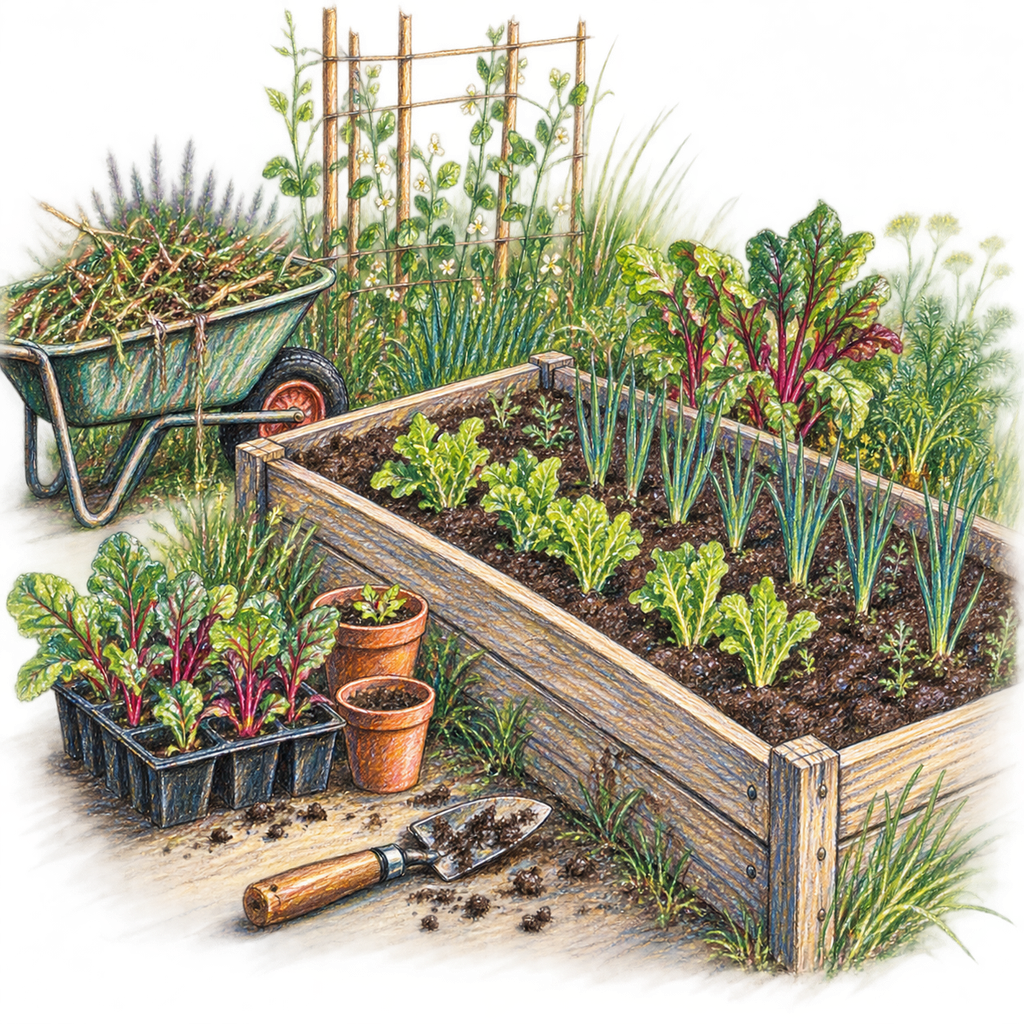
Colour Sketch of Raised Vegetable Bed.
© sowitgrowitandfeast

What can I plant after summer vegetables?

What you plant after a summer crop depends on three things: when the space becomes available, what was growing there before and what you want from the bed next.

A bed cleared in August offers considerably more possibilities than one becoming empty at the end of October.

During late summer and early autumn, you may still have time to sow quick-growing crops such as:

  • spinach
  • rocket
  • radishes
  • winter lettuce
  • mizuna
  • mustard leaves
  • spring onions
  • turnips
  • coriander

As autumn progresses, attention begins to move towards overwintering crops such as garlic and suitable onion sets, as well as green manures and soil improvement.

The important thing is not to sow simply because there is an empty space.

Think about what the season can realistically provide.

Autumn brings cooler temperatures and, more importantly, rapidly diminishing daylight. A seed may germinate beautifully in warm September soil but grow increasingly slowly as the days shorten.

The earlier you can make use of an empty summer bed, the greater your choice.

What to plant after potatoes

There is something particularly satisfying about the patch left behind after lifting potatoes.

The soil has already been thoroughly disturbed during harvesting, and after the final potato has been discovered — usually just when you are convinced there cannot possibly be another one — you are left with a useful piece of open ground.

If potatoes are lifted in summer, there can be plenty of time for another crop.

Try sowing spinach, rocket, radishes or autumn salad leaves.

These quick crops make good use of the remaining warmth without requiring another entire growing season.

Later potato harvests leave fewer options, but the bed needn’t remain forgotten. Autumn garlic may be suitable, or you can concentrate on covering and improving the soil ahead of next spring.

Before replanting, take a moment to remove any potatoes you missed. Volunteers appearing among next year’s vegetables are not always as charming as they sound.

What to plant after peas

Peas often leave the vegetable garden relatively early, making their old patch particularly valuable.

Once the last pods have been picked, cut the plants down and clear away the supports.

If the plants are healthy, the top growth can go onto the compost heap.

Peas belong to the legume family and form relationships with soil bacteria associated with nitrogen fixation. You may sometimes see advice to leave all their roots in the ground for this reason.

The reality is a little more complicated than the old gardening rule suggests, but there is certainly no need to painstakingly remove every healthy root.

Instead, clear the bed gently and put the space back to work.

Depending on the time of year, follow peas with salad leaves, spinach, chard, radishes or other quick-growing vegetables.

An early-cleared pea bed can be one of the best opportunities for succession sowing in the whole vegetable garden.

What to plant after broad beans

Broad beans tell a similar story.

They occupy a considerable amount of space while growing, so their departure can suddenly make the vegetable patch feel enormous.

Use that space.

If the beans finish while summer still has some way to run, you have a generous choice of follow-on vegetables.

Beetroot, chard, salads, radishes and other quick crops may all be possibilities, depending on how early the bed becomes available.

Later in the season, concentrate on spinach and hardy salad leaves.

The old broad bean plants themselves are excellent composting material if they are healthy. Chop the stems into smaller pieces before adding them to the heap and they will break down more readily.

Yesterday’s bean plants can eventually become tomorrow’s compost.

What to plant after onions and garlic

By the time onions and garlic are lifted, summer is usually well under way.

Once the bulbs are safely harvested and drying, their former bed presents another opportunity.

This is a particularly useful place for autumn salads, spinach, rocket and radishes.

The fine seeds of salad crops appreciate a reasonably well-prepared surface, so remove weeds and gently rake the top of the soil before sowing.

There is no need to dig the entire bed simply because a new crop is going in.

If the soil is in good condition, disturb it only as much as necessary.

A little garden compost can be added where needed, but avoid assuming every new crop requires a heavy feed.

Sometimes good soil needs less interference than we imagine.

What to plant after courgettes and summer squash

Courgettes are less considerate about leaving early.

They can occupy an enormous amount of ground and continue producing until cooler weather finally brings the season to a close.

By the time they are removed, the days may already be noticeably shorter.

That doesn’t necessarily mean the bed has to remain empty.

In early autumn, try spinach, winter lettuce or other hardy salad leaves, particularly if you can offer them some protection later.

If the courgette plant has exhausted the soil after months of enthusiastic growth, add well-rotted compost before planting the next crop.

And if it is simply too late for another useful vegetable crop, don’t force it.

Cover the soil, sow a suitable green manure or prepare the bed for winter.

Productivity isn’t measured only by the amount of food you can squeeze from a square metre of earth.

Looking after the soil is productive too.

What to plant after runner beans and French beans

Beans can remain productive well into early autumn, particularly in a mild year.

Keep picking while they continue cropping.

When production finally slows and the plants are finished, remove the supports and clear the top growth.

By this stage of the season, quick-growing leaves are usually more realistic than ambitious vegetable crops.

Spinach, winter salads and hardy oriental leaves may still be worth sowing, particularly under cover.

Alternatively, the old bean bed can become a home for autumn-planted garlic or overwintering onion sets, where suitable.

There is something pleasing about this transition.

One crop climbs skywards through summer; the next begins quietly beneath autumn soil.

Sow spinach in empty beds

Spinach is one of the most useful crops for filling spaces as summer vegetables disappear.

Cooler conditions suit it, and varieties intended for autumn growing can provide useful harvests beyond the main summer season.

Sow into moist soil in short rows.

As plants develop, harvest individual outer leaves rather than uprooting the whole plant. This allows the centre to continue producing.

If colder weather arrives, a cloche or cold frame can provide extra protection.

Spinach also earns its place in the kitchen.

Young leaves can be eaten raw, while larger ones disappear effortlessly into curries, soups, pasta, omelettes and stews.

An empty patch of earth can become supper surprisingly quickly.

Grow rocket for a quick autumn crop

Rocket is another crop that relishes the change of season.

In the heat of summer it can rush into flower. Cooler autumn conditions often encourage better leafy growth.

It is also quick.

That matters when daylight is disappearing.

Sow a small amount every couple of weeks rather than covering an entire bed. Even a row a metre long can produce plenty of leaves for salads and sandwiches.

Rocket is particularly useful for awkward little spaces.

A narrow gap between established crops, the edge of a raised bed or a container emptied of summer flowers can all become productive again.

Not every harvest needs its own vegetable bed.

Sow radishes between slower crops

Radishes are among the great gap-fillers of the vegetable garden.

Their roots develop quickly and require relatively little space, making them useful wherever a patch of soil becomes available.

Sow thinly and keep the soil evenly moist.

Harvest promptly once the roots are ready. Leaving them in the ground indefinitely rarely improves them.

Radishes can also be used between crops that will eventually need more room.

The radishes are harvested before their slower neighbours expand into the space.

It is a simple form of intercropping and an excellent way of making a small vegetable garden work harder.

Sow winter lettuce and hardy salad leaves

The end of summer doesn’t have to mean the end of home-grown salad.

Choose lettuce varieties intended for autumn and winter growing rather than relying on leftover packets of tender summer varieties.

Mizuna, mustard leaves and other hardy salad crops are also worth exploring.

Their colours and textures bring life to beds that might otherwise be empty, while their stronger flavours are well suited to autumn food.

Imagine a bowl of freshly picked leaves beside roasted beetroot, warm potatoes or a slice of homemade tart.

Autumn salad doesn’t have to pretend it is July.

It can taste entirely of its own season.

Plant garlic for next year’s harvest

Sometimes the best thing to plant in an empty autumn bed isn’t something you will eat this year.

Garlic is planted in autumn or winter, depending on variety and conditions, and spends the colder months establishing itself for the season ahead.

Choose healthy bulbs sold specifically for planting rather than simply pushing supermarket garlic into the vegetable patch.

Separate the bulb carefully into individual cloves shortly before planting and place each one at the recommended depth and spacing for the variety.

Then wait.

There is no instant harvest and little immediate drama.

But beneath the soil, roots begin to establish.

Months later, when the garden has travelled all the way through winter and spring, those individual cloves can have become complete bulbs.

Few crops demonstrate the gardener’s relationship with time quite as beautifully.

Consider overwintering onion sets

Suitable overwintering onion sets can also make productive use of beds vacated by summer crops.

Planted in autumn, they establish before winter and continue developing when conditions improve.

Choose varieties specifically intended for autumn planting.

Good drainage is important, particularly if your soil becomes wet and heavy during winter.

If necessary, use raised beds or choose another area where water is less likely to sit around the bulbs.

An empty bed isn’t automatically the right bed for every crop.

The soil still gets a vote.

Sow green manure when you don’t need another vegetable crop

There is a natural temptation to make every piece of soil produce food.

But sometimes the best crop isn’t destined for the kitchen.

Green manures are plants grown primarily to cover and improve the soil.

Depending on the species, they can help protect bare ground from winter weather, suppress weeds and add organic matter when they are eventually cut down.

They are particularly useful when a bed is going to remain empty for several months.

Choose the green manure according to the time of year, soil and length of time the bed will be vacant.

Also think about crop rotation.

Some green manures belong to the same plant families as vegetables you may want to grow later, which can matter when planning rotations.

Green manure may not provide a basketful of vegetables.

What it gives you instead is an investment in the ground from which those vegetables will eventually grow.

Or simply cover the soil

You don’t have to plant every empty bed.

If autumn is advanced or you have enough crops already, covering the soil can be an excellent choice.

A layer of well-rotted garden compost or other suitable organic mulch protects the surface and allows worms and other soil organisms to get on with their work.

By spring, the bed may need little more than light preparation before planting.

Bare soil is rarely the goal in nature.

Look beneath a woodland canopy and the earth is protected by leaves and decaying plant material. Gardens can borrow something from this habit.

Rather than thinking of an unplanted bed as wasted space, think of it as soil being prepared for what comes next.

Should you add compost before planting the next crop?

It depends.

If you’ve just removed a hungry crop such as courgettes or squash, adding some well-rotted compost may be useful.

If the previous crop was less demanding and your soil is already fertile and in good condition, there may be no need to add anything before sowing a quick row of autumn leaves.

This is where knowing your soil becomes valuable.

Is it light and prone to drying?

Heavy and slow to drain?

Rich in organic matter?

Compact after a season of walking and watering?

Gardening advice is useful, but the handful of soil in front of you is more useful still.

Feed the soil where it needs feeding rather than automatically reaching for fertiliser every time a plant comes out.

Do you need to practise crop rotation?

Crop rotation can be helpful, particularly where you grow vegetables from the same families year after year.

It can reduce the build-up of some soil-borne pests and diseases and helps avoid repeatedly growing similarly demanding crops in the same place.

But don’t allow an elaborate rotation plan to make a small garden unnecessarily difficult.

For a quick autumn crop of rocket or radishes in a newly empty gap, perfection isn’t required.

The more important principle is to avoid repeatedly growing crops susceptible to particular persistent problems in the same soil.

Keep simple notes about what grew where.

A photograph of the vegetable patch taken at different points during the year can be surprisingly useful too.

By next spring, when every bed is conveniently empty, it is remarkably easy to forget where everything was.

Don’t leave diseased plants behind

There is one important pause before replanting any empty vegetable bed.

Look at the crop you have just removed.

Was it healthy?

If it was, much of the plant material can usually head towards the compost heap.

If it was badly diseased, deal with it appropriately rather than casually digging affected material into the soil or adding unsuitable material to a home compost heap.

Also remove obvious weeds before sowing again.

A fresh row of spinach shouldn’t have to begin life competing with established couch grass or bindweed.

The transition between crops is an ideal moment to inspect the bed and deal with problems while you can actually see the soil.

Remember that autumn light matters

Warm soil can be deceptive.

A September afternoon may feel almost summery, and seeds can germinate quickly. But the plants are heading towards shorter days.

Light increasingly becomes the limiting factor.

This means a crop sown on 1 September and one sown on 30 September may behave quite differently, even if the weather feels similar.

As autumn advances, choose the brightest parts of the vegetable garden for crops you hope to harvest.

Avoid putting young seedlings where a shed, fence or evergreen hedge will cast deep winter shade.

The sun travels lower across the sky now.

Watch where it falls.

Protect late crops when necessary

As temperatures fall, a little shelter can extend the usefulness of your newly planted beds.

Cloches can protect rows of spinach and salads. Horticultural fleece can provide temporary protection during colder spells, while a cold frame or unheated greenhouse offers even greater shelter.

This doesn’t mean trying to create summer in November.

Hardy crops don’t need tropical conditions.

Often they simply benefit from protection against persistent rain, cold wind and frost.

The aim is to work with autumn, not disguise it.

Empty beds can become wildlife spaces too

Not every corner of the vegetable garden has to be relentlessly productive.

A bed may be cleared, but the wider garden still has inhabitants preparing for winter.

Leave some seed heads elsewhere for birds. Allow a quiet corner to remain less tidy. A small pile of woody stems or leaves can provide shelter for invertebrates.

The productive garden and the wildlife garden don’t need to exist separately.

Pollinators, birds, beetles and countless less noticeable creatures are part of the same garden that gives us beans, apples and tomatoes.

Making room for them is part of growing food well.

What should I plant in my empty vegetable bed?

If you’re looking at a newly cleared vegetable bed and wondering what should come next, use the season as your guide.

If the bed becomes empty in late summer:
Try spinach, chard, beetroot, radishes, rocket and other salad leaves, depending on the remaining growing time.

If it becomes empty in early autumn:
Concentrate on spinach, rocket, winter lettuce, mizuna, mustard leaves and other hardy, quick-growing crops.

For planting into autumn:
Consider garlic and suitable overwintering onion sets.

If you don’t need another food crop:
Sow an appropriate green manure or cover the soil with organic matter.

There isn’t one correct answer.

The best next crop is the one suited to your soil, your garden and the weeks of growing weather still ahead.

An empty bed is not an ending

There is something satisfying about clearing away a finished summer crop.

The tangled pea stems come down. The last potatoes are carried towards the kitchen. Bean canes are untied and stacked away.

For a moment, there is simply earth.

It can feel like the garden has given everything it has to give.

But kneel down and the soil may still be warm beneath your hand.

There is time yet.

Perhaps you make a shallow drill and sow a line of spinach. Perhaps a few garlic cloves are planted for next summer. Perhaps you spread compost over the surface and decide that this particular piece of earth has worked hard enough for one year.

All are forms of gardening.

Because an empty vegetable bed is never really empty.

It is a space between harvests.

One crop has finished its story, and beneath the changing autumn sky, the next one is waiting to begin.

Further Reading: Wonderful Ways to Use Fresh Garden Peas, Grow Your Own Food: Save Money & Eat Well, How to Keep Your Vegetable Garden Productive into Autumn, What to Sow in September: Vegetables, Salads & Herbs

Follow us on Instagram, Threads, BlueSky, Twitter, Pinterest & Facebook

Not sure where to start? Take a look at our Grow Your Own Packs with detailed step by step instructions, seeds and 1 years online support.
How to Keep Your Vegetable Garden Productive into Autumn

There comes a moment in the vegetable garden when you realise that summer is beginning to loosen its grip.

The mornings are cooler. Dew sits heavily on leaves and cobwebs. Shadows stretch further across the beds, and by evening there is sometimes just enough chill in the air to make you reach for another layer.

Yet the garden is far from finished.

Runner beans may still be dangling from their supports, courgettes continue to appear beneath enormous leaves and tomatoes are making the most of every warm afternoon. Elsewhere, leeks are thickening, kale is settling into its stride and squashes are quietly ripening beneath fading foliage.

Autumn is arriving, but that doesn’t mean the productive vegetable garden has to close its doors.

With a little care, some timely harvesting and a few well-chosen sowings, you can keep your vegetable garden productive well into autumn — and in some cases, throughout winter.

The trick is not to try to hold on to summer.

It is to grow with the season that comes next.

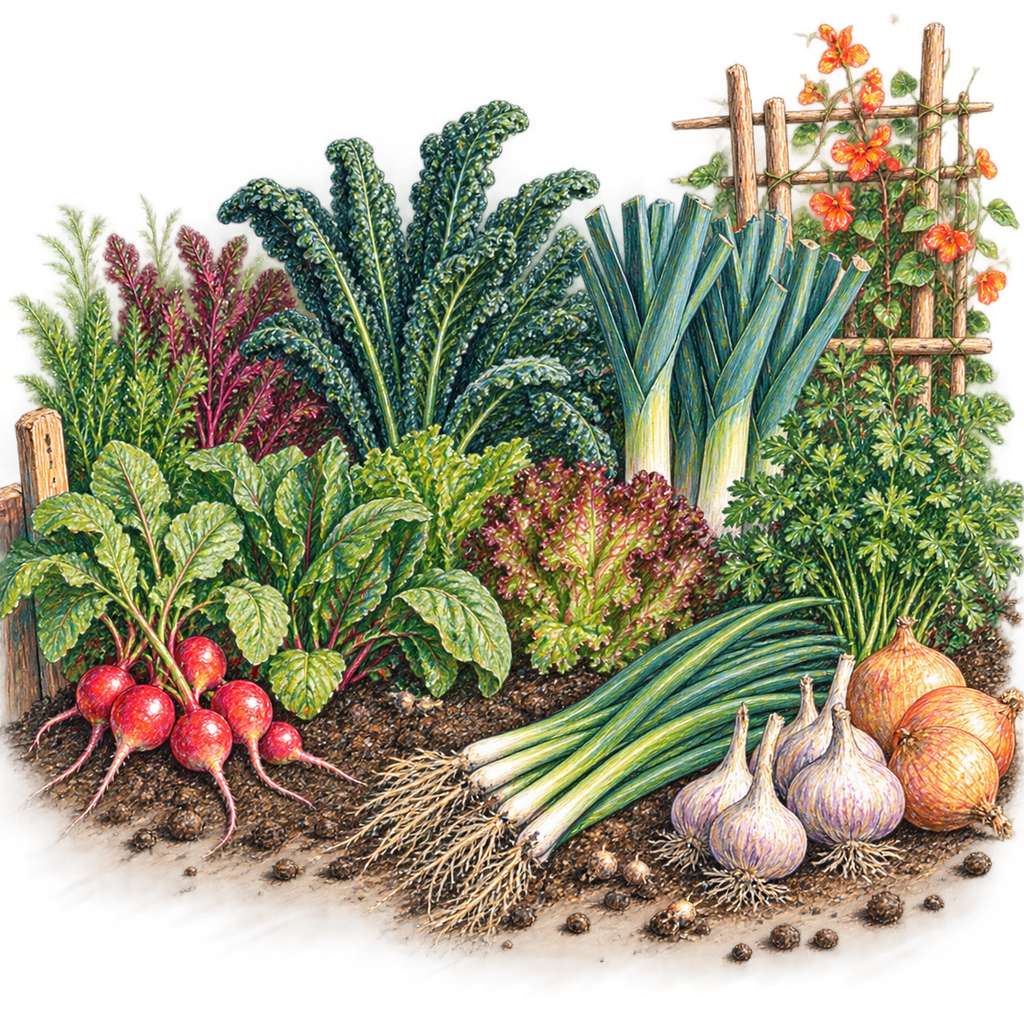
Colour sketch of September Harvest.
©sowitgrowitandfeast

Don’t clear the vegetable garden too quickly

September and October can bring on a sudden urge to tidy.

A yellowing leaf is spotted and before long the secateurs are out, plants are being pulled up and the vegetable patch is heading rapidly towards bare soil.

There is certainly plenty to clear in autumn, but there is no need to do it all at once.

Healthy plants that are still producing deserve to stay.

Runner beans, French beans, courgettes, chard and late tomatoes can all remain productive while conditions are favourable. Even a plant that looks a little tired may have another week’s worth of food left to give.

Harvest regularly and remove individual leaves that are yellowing, damaged or diseased rather than automatically clearing the whole plant.

Think of the autumn vegetable garden as a gradual changing of the guard.

Summer crops leave one by one, creating spaces for the plants that will carry the garden into its next season.

Keep picking to keep plants producing

One of the simplest ways to extend your vegetable harvest is also one of the most enjoyable:

Keep picking.

Runner beans and courgettes are particularly responsive to regular harvesting. Leave fruits to become large and mature and the plant begins putting its energy into producing seed. Pick them young and it has a reason to continue.

The same principle applies to many leafy vegetables.

Harvest the outer leaves of chard, spinach and kale while leaving the growing point intact. Rather than taking the whole plant, you can return repeatedly for smaller harvests.

Little and often is the rhythm of the autumn kitchen garden.

A handful of chard might go into tonight’s supper. A few beans can be added to tomorrow’s curry. Some spinach can disappear into an omelette.

The harvest basket may not be quite as overflowing as it was in August, but that doesn’t make these smaller pickings any less valuable.

Make use of every empty space

As summer crops finish, gaps begin appearing.

The place where potatoes grew is suddenly empty. Peas have long since disappeared. An exhausted courgette plant eventually reaches the compost heap.

Don’t think of these spaces as the end of the season.

Think of them as an opportunity.

September and early autumn can still be a useful time to sow spinach, rocket, winter lettuce, mizuna, mustard leaves, radishes and other quick or hardy crops, depending on your local conditions and the variety.

The soil retains some of its summer warmth, which can help seeds germinate quickly, while cooler weather suits many leafy crops.

Small sowings are often better than large ones.

A short row of spinach and a container of rocket may be considerably more useful than sowing an entire packet and discovering that everything is ready at once.

As daylight diminishes, growth will become slower, so earlier autumn sowings generally have an advantage.

Grow salads beyond summer

Salad has somehow acquired a reputation as summer food.

The vegetable garden knows otherwise.

Rocket, winter lettuce, mizuna, mustard leaves and spinach can all contribute fresh leaves as autumn progresses. Some will continue for surprisingly long periods when given protection.

These aren’t necessarily the large, soft lettuces of midsummer.

Autumn salads have more character.

There are peppery leaves, deep greens and crisp textures that sit happily alongside roasted beetroot, warm potatoes, toasted nuts, apples and other autumn ingredients.

If you have a greenhouse or cold frame, dedicate a little space to winter leaves once summer crops have finished.

A greenhouse that spent August overflowing with tomatoes can have an entirely different life in October.

Give autumn vegetables more light

By midsummer, shade can be a blessing.

By autumn, light becomes precious.

The sun sits lower in the sky and each day becomes shorter. Crops that tolerated a little shade in June may struggle there in October.

Look at your vegetable garden with autumn eyes.

Large, fading leaves can cast unnecessary shade over smaller crops. Remove old courgette or squash leaves where they are no longer helping the plant, particularly if they are damaged or affected by mildew.

Tie in sprawling growth where appropriate and keep weeds under control.

Containers of leafy vegetables can also be moved into brighter positions.

You cannot make autumn days longer, but you can help plants make better use of the light that remains.

Protect crops from colder nights

Eventually, autumn will remind us why it is autumn.

Night-time temperatures fall, winds strengthen and the first frost begins to appear in forecasts.

A small amount of protection can make a considerable difference.

Cloches can shelter rows of salads and young seedlings. A cold frame provides a useful halfway house between the garden and greenhouse. Horticultural fleece can offer temporary protection when colder nights threaten.

An unheated greenhouse is particularly valuable.

It won’t recreate summer, nor should it. What it can do is protect crops from cold winds, persistent rain and some of the harsher fluctuations in temperature.

That modest difference may be enough to give you several more weeks of useful growth.

Just remember to ventilate protected spaces on mild days. Damp, stagnant air creates problems of its own.

Keep an eye on slugs and snails

Cooler, damper weather can be very welcome after a dry summer.

Unfortunately, the slugs may agree.

Tender autumn seedlings and young salad leaves can disappear remarkably quickly, so check crops regularly.

Look beneath containers, boards and dense foliage where slugs and snails may shelter during the day.

Keeping the area around young crops reasonably clear can also make it easier to spot trouble.

There is little point carefully extending your growing season if the local molluscs are enjoying the harvest before you do.

Don’t forget to water

Autumn rain can create the impression that watering is no longer necessary.

Sometimes it is.

Sometimes it isn’t.

A dry September can leave newly sown seeds and young plants struggling, particularly in containers where compost dries much faster than garden soil.

Check rather than assume.

Push a finger into the soil or compost and see how it feels below the surface. Water when needed, preferably in the morning so that foliage and the surrounding ground are not sitting unnecessarily wet through cold nights.

Protected crops need particular attention.

Rain cannot reach the soil beneath a greenhouse roof or closed cold frame, however wet the rest of the garden might be.

Feed the crops that still need it

As summer fades, there is little value in feeding everything indiscriminately.

Many crops are coming naturally towards the end of their lives.

Others are still working.

Tomatoes carrying fruit, for example, may continue to benefit from appropriate feeding while they are actively growing and ripening. Container-grown vegetables are also more dependent on us because their roots cannot travel beyond the pot in search of nutrients.

For many established autumn and winter crops, however, the aim isn’t to encourage a sudden flush of soft growth as cold weather approaches.

Observe the plant rather than feeding simply because it is Saturday.

Autumn gardening rewards attention more than routine.

Look after your soil as crops finish

A productive vegetable garden isn’t only about what is growing above the ground.

Autumn is an important time to think about the soil beneath it.

Once a crop has finished, remove diseased material and troublesome perennial weeds. Healthy plant material can usually be composted, returning its goodness to the garden.

Bare beds can be covered with well-rotted compost or organic matter, depending on how you manage your soil.

You might also consider green manure for suitable empty ground. These crops are grown not primarily for eating but to cover and improve the soil.

Whatever method you choose, avoid leaving good garden soil forgotten simply because there isn’t currently a vegetable growing in it.

Today’s empty bed is next spring’s seedbed.

Plant garlic and overwintering onions

Some of autumn’s most productive gardening involves planting something you won’t harvest for months.

Garlic is a wonderful example.

Individual cloves disappear beneath the soil just as much of the garden is winding down. For weeks there may seem to be very little happening.

Yet roots are establishing beneath the surface.

Autumn-planted garlic has a long season ahead of it, and many varieties benefit from exposure to a period of cold weather.

Overwintering onion sets can also be planted in autumn where the variety and conditions are suitable.

There is a particular satisfaction in planting these crops.

At a time when leaves are falling and the garden appears to be retreating, you are already putting next year’s harvest into the ground.

Make your greenhouse earn its keep

If you’re fortunate enough to have a greenhouse, don’t lock the door after the tomatoes finish.

Clean away old plant material and give the space another purpose.

Pots and trays of winter lettuce, spinach, rocket and other hardy leaves can turn an autumn greenhouse into a remarkably useful extension of the kitchen garden.

It is also a good place to keep tender herbs going for longer.

An unheated greenhouse will still become cold in winter, so choose crops accordingly. Its great advantage isn’t tropical warmth but shelter.

Protection from heavy rain, wind and the worst of the weather can make all the difference to a hardy plant.

And there are few nicer gardening moments than opening a greenhouse door on a grey autumn morning and finding rows of fresh green leaves waiting inside.

Use containers to chase the autumn sun

Containers come into their own as the seasons change.

A vegetable growing in the ground stays where it was planted.

A pot doesn’t have to.

As the sun drops lower, move containers into the brightest available position. A sheltered south-facing wall can create a useful little microclimate, holding warmth and offering protection from cold winds.

Pots of parsley, coriander, rocket and spinach can be brought closer to the house or moved beneath cover.

This has another advantage.

When herbs and salads are three steps from the kitchen door rather than at the bottom of a dark, wet garden, you are much more likely to harvest them.

Sometimes productivity is as much about convenience as horticulture.

Harvest tomatoes before the cold gets them

Tomatoes can continue ripening into early autumn when the weather is kind.

But eventually there comes a point when waiting for another sunny week becomes optimistic.

Keep an eye on the forecast.

As temperatures fall and plants begin deteriorating, harvest the remaining tomatoes rather than allowing good fruit to be lost.

Green tomatoes needn’t be wasted.

Some will ripen indoors, while others can be turned into chutneys, relishes and other preserves.

This is part of the rhythm of productive autumn gardening: knowing when to keep going and when to bring the harvest safely inside.

Cure and store your harvest properly

Keeping the vegetable garden productive doesn’t only mean keeping plants alive outdoors.

The harvest can continue feeding you long after it has left the soil.

Onions, garlic, potatoes and winter squash can all store for useful periods when harvested and prepared correctly.

Squashes, for example, should be allowed to mature fully and develop firm skins before storage. Onions and garlic need appropriate drying and curing.

Store crops in conditions suited to them and check them regularly.

One damaged onion or squash can deteriorate surprisingly quickly, so remove anything beginning to spoil.

There is something deeply satisfying about stepping into a cool store in November and choosing an onion or squash that you grew months earlier.

The garden is still feeding you.

It has simply moved indoors.

Grow vegetables that actually enjoy autumn

One reason gardeners sometimes struggle to extend the season is that we try to persuade summer vegetables to survive indefinitely.

There is an easier way.

Grow plants that don’t mind the cold.

Leeks, kale, chard and other hardy crops can become some of the great stalwarts of the autumn and winter vegetable garden.

They won’t all grow vigorously throughout the darkest months. Growth slows considerably as light levels fall.

But established plants can stand in the ground ready to be harvested.

That changes the character of the vegetable patch.

Instead of trying to produce everything quickly, you begin creating a living winter store.

A row of leeks waiting beneath a cold sky is every bit as valuable as a glut of courgettes in July — perhaps more so when supper needs making on a wet November evening.

Keep harvesting herbs

The herb garden can remain useful well into autumn.

Parsley may continue producing fresh leaves, while hardy perennial herbs such as rosemary, thyme and sage can be picked through much of the year.

Tender herbs need more care.

Basil will quickly object to cold conditions, so harvest generously before temperatures fall too far. Coriander, on the other hand, often appreciates the cooler conditions of early autumn.

This is also a good time to preserve surplus herbs.

They can be dried, frozen or turned into herb butters and sauces, depending on the variety.

A productive garden doesn’t have to mean eating everything on the day it is picked.

Sometimes the most useful harvest is the one tucked away for later.

Start composting next year’s harvest

Autumn provides an abundance of compostable material.

Finished vegetable plants, annual weeds that haven’t set troublesome seed, fallen leaves and kitchen peelings can all contribute to the compost heap.

Mix softer green material with drier brown material rather than creating thick layers of one ingredient.

Then give it time.

Composting has none of the immediate excitement of picking tomatoes or pulling carrots, but it is one of the quiet engines of a productive garden.

The remains of this year’s crops gradually become the material that feeds next year’s soil.

Nothing illustrates the circular nature of gardening quite so neatly.

Make notes while the season is still fresh in your mind

Autumn is also a useful time to stop and look back.

Which tomato variety actually tasted best?

Did you grow far too many courgettes?

Were the beans planted too close together?

Which bed dried out fastest?

What did the slugs eat before you managed to?

Write it down.

By January, memories of the summer vegetable garden tend to become suspiciously rosy. We remember baskets of tomatoes and conveniently forget the six weeks spent battling aphids.

A few notes made now can transform next year’s garden.

Productivity isn’t always about squeezing another crop into the ground.

Sometimes it comes from learning what your particular patch of earth is trying to tell you.

What can you grow in an autumn vegetable garden?

If you’re planning a productive autumn vegetable garden in the UK, consider a mixture of crops that can be harvested now, sown for quick leaves or established for later.

Depending on the month, variety and conditions, your autumn garden might include:

  • spinach
  • rocket
  • winter lettuce
  • mizuna and mustard leaves
  • radishes
  • spring onions
  • chard
  • kale
  • leeks
  • parsley
  • coriander
  • garlic
  • overwintering onions

What works best will depend enormously on where you garden.

Autumn arrives differently in a sheltered southern garden than it does on an exposed northern allotment. Even two gardens in the same village can have quite different frost pockets, wind exposure and levels of sunlight.

Learn the small climate of your own garden.

It is one of the most useful things a gardener can do.

Let the garden change with the season

Perhaps the secret to keeping a vegetable garden productive into autumn is to stop expecting it to look like summer.

It will become quieter.

There will be fewer flowers humming with bees. The towering bean plants will eventually come down. The courgettes will stop and the tomato plants will finally be cleared away.

But quieter doesn’t mean empty.

There can be spinach beneath a cloche, leeks standing in neat rows and parsley beside the kitchen door. Garlic can be putting down roots beneath seemingly bare soil while a pumpkin harvested weeks earlier waits patiently in the pantry.

And on a bright autumn morning, when the grass is wet and the air has that unmistakable October coolness, there might still be a basket to carry into the garden.

It may come back with only a leek, a handful of leaves and a sprig or two of herbs.

But that is enough.

The vegetable garden is still doing what it has done all summer.

It is feeding you.

Only now, it is doing so at autumn’s slower pace.

Further Reading: Wonderful Ways to Use Fresh Garden Peas, Grow Your Own Food: Save Money & Eat Well

Follow us on Instagram, Threads, BlueSky, Twitter, Pinterest & Facebook

Not sure where to start? Take a look at our Grow Your Own Packs with detailed step by step instructions, seeds and 1 years online support.

What to Sow in September: Vegetables, Salads & Herbs

September has a habit of feeling like an ending.

There is a coolness to the mornings that wasn’t there a few weeks ago. Cobwebs begin to show themselves in the hedges, picked out with beads of dew, and the evenings seem to arrive a little sooner each day. In the vegetable garden, beans are still being gathered, courgettes continue to appear beneath their leaves and tomatoes make the most of the remaining warmth.

Yet, among all this harvesting, September is also a month for sowing.

The seed packets may have been pushed towards the back of the shed and the propagator put away months ago, but there is still time to begin another round of crops. In fact, the combination of soil warmed by summer and cooler, damper weather can make early autumn a particularly pleasant time to sow.

Choose the right vegetables, salads and herbs now and your garden can continue giving long after the last of the summer tomatoes has been picked.

So, before you tidy away the seed box for another year, let’s see what you can sow in September in the UK.

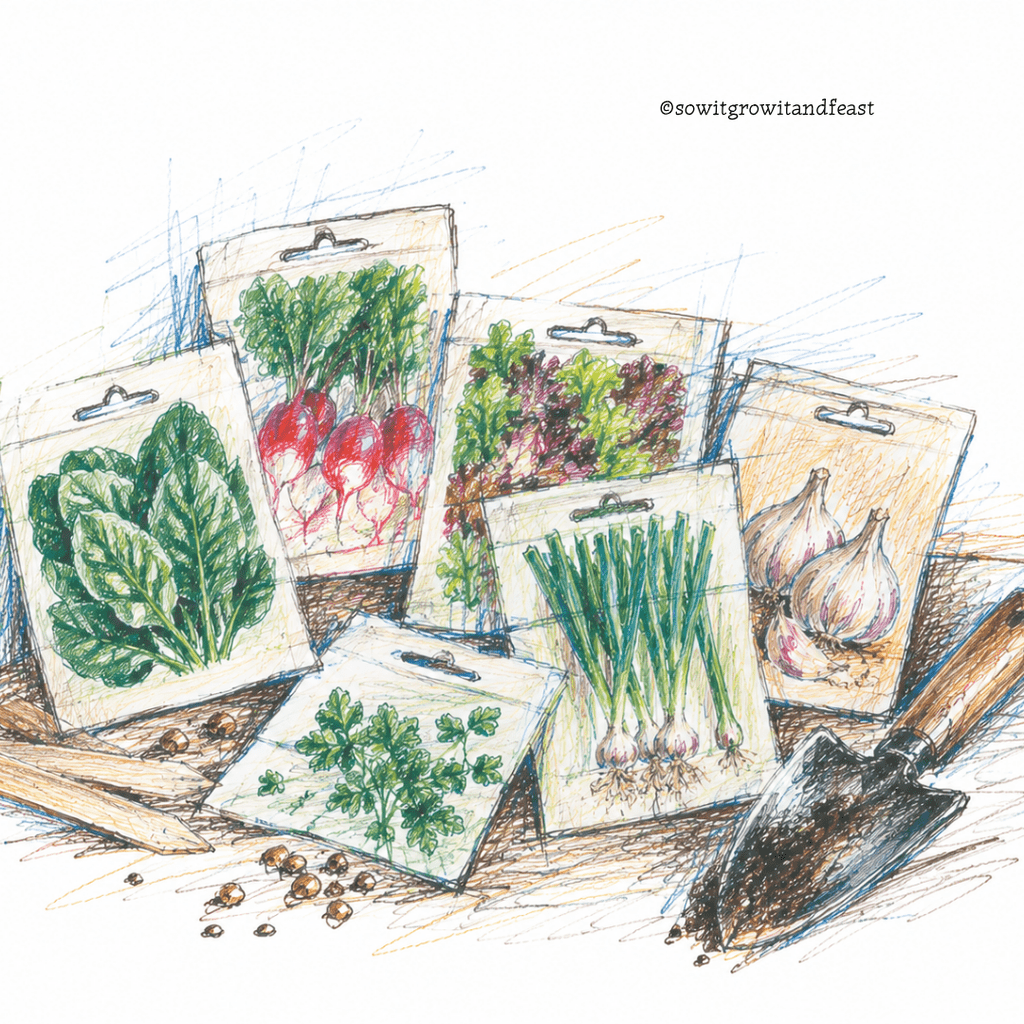
Colourful Sketch of September Seed Packs.
©sowitgrowitandfeast

Is September too late to sow vegetables?

Not at all.

September sits between two seasons in the kitchen garden. Summer crops are reaching their generous peak just as autumn begins to make itself known.

That makes it one of the most abundant times of year in a British vegetable garden. Tomatoes, courgettes, beans and salads can still be producing while apples, pears, squash and leeks begin to take us towards autumn.

But the shortening days do change the way we sow.

At this time of year, it is worth concentrating on quick-growing leaves and roots, hardy salads and crops capable of coping with colder weather.

Some September sowings will give you something to eat within weeks. Others will establish quietly before winter and reward you later.

The important thing is not to expect September seeds to behave like seeds sown in May. There is less daylight ahead of them and temperatures will gradually fall, so growth becomes slower as autumn progresses.

For that reason, an early September sowing can have quite an advantage over one made at the very end of the month.

Spinach

If there is one vegetable that seems made for the gentler days of early autumn, it is spinach.

The fierce heat that can send spinach racing to seed during summer has passed, and the cooler conditions suit its leafy growth rather well.

Sow into moist, well-prepared soil, either in rows in the vegetable patch or in containers. If you have a greenhouse, cold frame or cloche, it is also worth making a protected sowing that can continue producing as the weather deteriorates.

Don’t be in too much of a hurry to take whole plants.

Pick a few outer leaves at a time and leave the centre to continue growing. A handful of young spinach leaves is useful for far more than salad: wilt them into pasta, add them to curries and soups, tuck them into an omelette or stir them through a pan of potatoes.

It is one of those crops that earns its space surprisingly quickly.

September sowing tip: choose varieties described as suitable for autumn or winter growing, particularly if you hope to overwinter the plants.

Rocket

After struggling through hot spells in summer, rocket often seems altogether happier as temperatures begin to fall.

Seeds germinate readily, the plants need very little room and you can begin picking the peppery young leaves remarkably quickly.

Sow a short row rather than emptying the packet all at once. A second small sowing a couple of weeks later can help extend the harvest.

Rocket also grows beautifully in pots, making it a particularly good choice if your growing space consists of a patio, balcony or doorstep rather than a large vegetable plot.

Harvest the younger leaves for salads, sandwiches and homemade pizzas. Larger leaves have a stronger flavour and are good stirred through pasta or wilted very briefly in a hot pan.

A pot of rocket close to the kitchen door is one of autumn’s small luxuries.

Winter lettuce

We tend to think of lettuce as belonging to long summer lunches, but the salad bowl needn’t disappear simply because autumn has arrived.

September is a useful month for sowing winter lettuces and hardy salad varieties.

These are quite different from the large, soft lettuces associated with summer. Choose varieties specifically intended for autumn and winter cultivation, and give them some shelter as conditions become colder.

A cold frame or unheated greenhouse is ideal, although cloches can make a considerable difference outdoors.

The growth will naturally slow as the days shorten, but that is no reason to abandon them. A few crisp leaves picked from the garden on a chilly day can feel every bit as satisfying as a basketful of summer produce.

Mizuna and oriental salad leaves

If your experience of home-grown salad begins and ends with lettuce, September is an excellent month to broaden the repertoire.

Mizuna is particularly useful. Its finely divided leaves have a fresh, slightly peppery flavour and can be harvested young for salads or allowed to grow larger for cooking.

You can also look for mixtures containing mustard leaves and other hardy oriental greens.

These crops make excellent use of the little spaces appearing around the vegetable garden as summer plants are cleared away.

Sow them in short rows or containers and harvest young leaves little and often.

A mixture of green and purple leaves can be beautiful as well as useful — a reminder that the productive garden need never be purely practical.

Radishes

Few vegetables provide gratification quite as quickly as a radish.

Their speed makes them particularly valuable as summer begins to slip away.

September sowings can provide crisp roots for autumn salads, and there are also winter radishes intended for later harvesting.

Sow thinly into moist soil and keep an eye on watering if September turns unexpectedly dry. Radishes grown steadily tend to be much more pleasant than those left to struggle in parched ground.

And don’t overlook the leaves. Young, healthy radish tops are edible too and can be added to soups, pesto and other cooked dishes.

This is also a good crop for children or new gardeners. There is something wonderfully encouraging about pulling a bright radish from what appeared to be an empty patch of soil only a few weeks earlier.

Spring onions

Spring onions are another useful crop to sow as summer gives way to autumn.

They occupy little ground and work well tucked into gaps between other vegetables or grown in containers.

Hardy varieties can be sown in September to establish before colder weather arrives, with the prospect of an earlier crop later on.

Sow the seed thinly in shallow drills and keep the soil moist while it germinates.

Their neat habit makes spring onions especially useful in a small vegetable garden, where every patch has to justify itself.

Turnips for young roots and leaves

Turnips deserve rather more affection than they generally receive.

Sown in September, they can be harvested young rather than left to become the enormous roots that may spring to mind when their name is mentioned.

Young turnips are sweeter and more delicate, and their leaves can also be cooked as greens.

They appreciate fertile, moisture-retentive soil and are another crop where quick, steady growth is preferable.

Harvest them small and try roasting the roots whole or adding them to an autumn tray of vegetables.

Mustard leaves

Mustard leaves bring a little heat to the autumn vegetable patch.

Sow them for young leaves rather than attempting to produce enormous plants. Their peppery flavour works particularly well mixed with milder lettuce and spinach.

Like many leafy crops, they can be grown in containers as easily as in the ground.

If you have only a few pots available, try sowing several complementary salad leaves together. A container filled with rocket, mizuna and mustard can provide repeated handfuls for the kitchen without needing a traditional vegetable bed at all.

Coriander

Coriander has a reputation for being troublesome, but sometimes the problem is simply that we insist on growing it when it would rather not be grown.

During hot weather it can rush into flower with frustrating speed. The cooler conditions of late summer and early autumn can therefore make September a useful time for another sowing.

Choose a sheltered position and sow little and often.

As light levels fall, a pot in a greenhouse or on a bright windowsill can help prolong the season.

Pick the leaves for curries, soups, chutneys and salads, and if a plant does eventually run to seed, don’t consider it a failure. The seeds are useful in the kitchen too.

Parsley

Parsley is patient.

It can take its time to germinate, which makes it less immediately gratifying than rocket or radish, but it is worth having around.

A September sowing can be made in pots and kept somewhere sheltered, particularly if you have a greenhouse or a bright indoor spot available.

Both flat-leaved and curly parsley are useful, although they bring slightly different characters to the kitchen. Snip leaves into soups, sauces and stews, scatter them over roasted vegetables or chop them with garlic and lemon zest for a simple finishing mixture.

A pot close to the kitchen is far more likely to be used than one hidden at the far end of the garden.

What about garlic and onions?

September isn’t only about sowing seed.

As autumn arrives, attention also turns towards overwintering onion sets and garlic. These are planted rather than sown in the usual sense, but they deserve a place in the September kitchen garden.

Where suitable for the variety and your local conditions, onion sets planted in autumn establish roots before winter and begin growing again as conditions improve.

Garlic similarly benefits from a long growing season, although planting times vary by variety and location.

Think of these crops as an investment in next year’s kitchen.

There is something deeply reassuring about putting a garlic clove into cool autumn soil knowing that, beneath the apparently quiet surface of the garden, next year’s harvest has already begun.

Where should you sow in September?

By September, the vegetable garden can look rather full.

Runner beans are still climbing their supports, courgette plants seem determined to occupy half the plot and tomatoes may still be ripening. But look more closely and spaces begin to appear.

A row of early potatoes has gone. Peas have finished. A tired lettuce has been removed. Perhaps a container that held summer salad is suddenly empty.

These small spaces are valuable.

Rather than thinking you need an entirely new bed for autumn sowing, use the gaps left behind by earlier crops.

Salad leaves, spinach, radishes and spring onions are particularly good for this.

Containers are equally useful. A large pot emptied of a summer crop can be refreshed with peat-free compost and put straight back to work.

If you have a greenhouse, September is also the time to begin thinking of it differently. Instead of being simply a home for tomatoes and cucumbers, it can become a sheltered winter larder filled with pots and rows of hardy leaves.

Preparing the soil for September sowing

September sowing doesn’t require elaborate preparation.

Clear away the remains of the previous crop and remove troublesome weeds. Gently loosen the surface if it has become compacted and add some well-rotted garden compost where the soil needs improving.

Avoid overfeeding leafy crops. Rich, heavily fertilised ground isn’t necessary for a quick row of rocket or radishes.

What matters more is creating a fine surface in which small seeds can establish and making sure the soil doesn’t dry out during germination.

Although autumn may be approaching, September can still produce warm, dry spells. Newly sown seed has only shallow access to moisture, so check the soil regularly.

Don’t sow everything at once

There is an understandable temptation at this time of year to sow generously.

Winter is coming, after all.

But a whole packet of rocket germinating simultaneously isn’t necessarily more useful than a short row.

For quick-growing salads, small and regular sowings are usually more practical. Sow enough for the next few weeks, then make another little row.

This succession sowing can provide a steadier supply and reduce waste.

As autumn progresses, however, remember that each later sowing will grow more slowly than the last. The calendar might suggest only a fortnight has passed, but the plants notice the diminishing daylight.

Give late sowings some protection

A September seedling has a different life ahead of it from one germinating in May.

Cold nights, heavy rain, wind, slugs and eventually frost can all make an appearance.

A little protection can therefore go a long way.

Cloches, cold frames and an unheated greenhouse can extend the growing season considerably. Even moving containers into a more sheltered position can help.

Protection doesn’t necessarily mean warmth. Often, simply keeping young leaves away from persistent rain, cold winds and the worst of the frost is enough.

Keep checking protected crops for slugs and snails, too. Tender young leaves can be particularly tempting when other food becomes scarce.

What can I sow in September in pots?

Quite a lot.

You don’t need an allotment — or even a vegetable patch — to continue sowing in September.

Try containers of:

  • rocket
  • spinach
  • winter lettuce
  • mizuna
  • mustard leaves
  • radishes
  • spring onions
  • coriander
  • parsley

Choose pots with good drainage and use a good-quality peat-free compost.

One advantage of container growing at this time of year is flexibility. Pots can begin outside while conditions are mild and later be moved against a sheltered wall, beneath a cloche or into an unheated greenhouse when the weather changes.

A few pots near the back door can keep the kitchen supplied with fresh leaves surprisingly late into the year.

What not to sow in September

Knowing what not to sow is just as useful.

For most of the UK, September is too late to begin warmth-loving summer crops such as tomatoes, courgettes, cucumbers, French beans and runner beans from seed.

Their season is ending rather than beginning.

Instead of trying to persuade summer to continue indefinitely, work with the season that is arriving.

Choose hardy leaves, quick roots and overwintering crops.

Gardening becomes much easier when we stop fighting the calendar.

September sowing at a glance

If you’re standing in the shed with a seed box in your hands and simply want to know what to reach for, start with:

For autumn and winter leaves:
Spinach, winter lettuce, rocket, mizuna and mustard leaves.

For quick roots:
Radishes and young turnips.

For useful alliums:
Spring onions, with overwintering onion sets and garlic planted where appropriate.

For herbs:
Coriander and parsley, ideally with some shelter as autumn advances.

Exactly what succeeds will depend on where you garden. A sheltered plot on the south coast may remain productive considerably longer than an exposed garden further north or at altitude.

Treat sowing dates as a guide rather than an appointment.

The weather always has the final say.

A garden moving into autumn

There is a particular pleasure in sowing seeds in September.

Spring sowing is full of expectation. We imagine overflowing summer beds, bowls of strawberries and tomatoes warming in the sun.

September sowing feels quieter.

You are no longer racing towards summer. Instead, you are making small preparations for the darker months ahead: a row of spinach here, a pot of rocket there, perhaps some winter lettuce tucked safely beneath glass.

Around you, the garden is changing.

The beans are slowing. Apples are beginning to fall. Squashes are hardening their skins and the first yellow leaves gather beneath the trees.

Yet the vegetable garden isn’t finished.

Push a few seeds into the still-warm earth and, in a matter of weeks, there will be fresh green leaves among all those autumn colours.

And perhaps that is one of the loveliest things about growing food.

There is nearly always another season beginning, just as the last one appears to end.

Further Reading: Wonderful Ways to Use Fresh Garden Peas, Grow Your Own Food: Save Money & Eat Well

Follow us on Instagram, Threads, BlueSky, Twitter, Pinterest & Facebook

Not sure where to start? Take a look at our Grow Your Own Packs with detailed step by step instructions, seeds and 1 years online support.
What to Do in Your Vegetable Garden in September

September marks a gentle shift in the garden. The intense heat of summer begins to fade, replaced by the golden light and cooler air of early autumn. For vegetable gardeners, this isn’t an end but a transition, a busy and rewarding month filled with harvesting the last of the summer crops and planting for the cooler months ahead. It’s a time of abundance and preparation, offering a unique opportunity to extend your growing season well into winter.

This guide will walk you through the essential tasks for your vegetable garden this September. Discover which crops are ready to be harvested, what seeds you can still sow for a winter bounty and the key maintenance jobs that will set your garden up for success next spring. Let’s get our hands dirty and make the most of this beautiful gardening month.

Key Jobs for September

September is a month of transition, blending the final summer harvests with preparations for autumn and winter. Keeping on top of a few key tasks will ensure your plot stays productive and healthy.

Tidying and Clearing

As summer crops like courgettes, beans and peas finish producing, it’s time to clear them away. Removing old, spent plants is crucial for a few reasons. It prevents pests and diseases from overwintering in the decaying foliage and frees up valuable space for autumn and winter crops.

When you remove the plants, add any healthy material to your compost heap. Avoid composting anything that shows signs of disease, like mildew or blight, as the spores can survive and infect next year’s crops. For legumes like peas and beans, it’s a good practice to cut the stems at the base and leave the roots in the ground. These roots contain nitrogen-fixing nodules that will enrich the soil as they break down, providing a natural fertiliser for the next plants you grow in that spot.

Preparing Beds for Winter

Once a bed is clear, don’t leave it empty. Bare soil is vulnerable to erosion from winter rain and can lose valuable nutrients. You have a couple of excellent options for protecting and improving your soil over the colder months.

One of the best things you can do is sow a green manure. These are fast-growing plants like phacelia, winter tares, or grazing rye that you grow specifically to improve the soil. They act as a living mulch, suppressing weeds and protecting the soil structure. When you dig them back into the ground in spring, they add organic matter and nutrients, boosting your soil’s health for the coming season.

Alternatively, you can cover the empty beds with a thick layer of well-rotted manure, garden compost, or even a layer of cardboard topped with leaves. This mulch will protect the soil, prevent weed growth, and allow the worms and other soil life to slowly incorporate the organic matter, leaving you with beautifully fertile soil come spring.

Pest and Disease Control

The cooler, damper conditions of early autumn can encourage slugs and snails. Be vigilant around your new seedlings and leafy greens. You can use wildlife-friendly slug pellets, wool pellets, or create beer traps to protect your plants.

Also, keep an eye out for fungal diseases like downy mildew on your brassicas and powdery mildew on any remaining courgette or squash plants. Good air circulation is key, so ensure your plants aren’t overcrowded. Remove any affected leaves promptly to prevent the disease from spreading.

What to Sow in September

While it might feel like the growing season is winding down, September is the perfect time to sow a variety of hardy vegetables that will see you through the autumn and winter.

Winter Salads

Don’t say goodbye to fresh salads just yet. Many varieties thrive in cooler weather.

  • Lettuce: Sow hardy winter varieties like ‘Arctic King’ or ‘Winter Density’ directly into the ground or in pots. A cloche or cold frame will offer extra protection and extend your harvest.
  • Spinach: September is an ideal time to sow spinach for an autumn and winter crop. It grows well in cooler temperatures and can be harvested as individual leaves.
  • Rocket: This peppery leaf is incredibly fast-growing and hardy. Sow a row now, and you could be harvesting it in just a few weeks.

Hardy Greens and Brassicas

These vegetables are staples of the winter garden and should be planted now for a continuous supply.

  • Spring Cabbage: Plant out young spring cabbage plants that you sowed earlier in the summer. Choose a sunny, sheltered spot and firm the soil around them well to prevent wind rock.
  • Kale: If you haven’t already, you can still sow kale for a late crop of delicious and nutritious leaves.
  • Swiss Chard: A beautiful and productive crop, Swiss chard can be sown in September for harvesting through autumn and into winter in milder areas.

Onions and Garlic

Early autumn is the traditional time to get your onion sets and garlic cloves in the ground.

  • Winter Onions: Plant onion sets like ‘Radar’ or ‘Electric’ for an early crop next summer. Plant them in well-drained soil in a sunny spot, with just the tips showing above the surface.
  • Garlic: Choose a hardneck variety for the best results when planting in autumn. Break the bulb into individual cloves and plant them about 15cm apart and 5cm deep, with the pointy end facing up.

What to Harvest in September

September is a month of great abundance, where you can enjoy the fruits of your summer labour. Many crops will be at their peak, offering a delicious reward for your hard work.

Summer Favourites

The last of the summer crops are often the sweetest, having ripened in the long sunny days.

  • Tomatoes: Continue to harvest tomatoes as they ripen. As the month progresses and temperatures drop, you can pick any remaining green tomatoes and ripen them indoors on a sunny windowsill.
  • Courgettes and Squash: Keep picking courgettes regularly to encourage the plant to produce more. Winter squashes, like butternut and pumpkins, should be ready now. You’ll know they’re ripe when the skin has hardened, and the stem is dry.
  • French and Runner Beans: Harvest beans regularly to ensure a continuous supply. If you leave the pods on the plant for too long, it will stop producing new ones.

Root Vegetables

Many root vegetables planted in spring and early summer will be ready for lifting.

  • Maincrop Potatoes: Wait for the foliage to turn yellow and die back before lifting your maincrop potatoes. Choose a dry day and use a garden fork to carefully dig them up. Let them dry on the soil surface for a few hours before storing them in a cool, dark, and frost-free place.
  • Carrots and Beetroot: You can continue to harvest carrots and beetroot as you need them. They can be left in the ground, but be mindful of slugs.
  • Onions and Garlic: If you haven’t already, harvest your maincrop onions and garlic once the leaves have yellowed and flopped over. Dry them thoroughly before storing.

Autumn Fruits

Don’t forget the fruit!

  • Apples and Pears: Early and mid-season varieties will be ready for picking. Gently cup the fruit in your hand and give it a slight twist; if it comes away easily, it’s ripe.
  • Autumn Raspberries: These will continue to produce delicious fruit until the first frosts. Pick them regularly to enjoy at their best.

Looking Forward

September in the vegetable garden is a month of balance—a time for enjoying the last of the summer bounty while preparing for the seasons ahead. By clearing old crops, preparing your soil, and sowing hardy varieties, you can ensure your plot remains a source of fresh, homegrown food for months to come.

Take a moment to enjoy the crisp air and the satisfaction of a full harvest basket. Your garden has worked hard all summer, and now is the time to reap the rewards and gently guide it into its winter rest.

Further Reading: Plant Autumn Bulbs Now for a Beautiful Spring Garden, The Autumn Vegetable Garden, All About Seed Saving, All About Squashes, All About Marrows