There comes a moment in the vegetable garden when you realise that summer is beginning to loosen its grip.
The mornings are cooler. Dew sits heavily on leaves and cobwebs. Shadows stretch further across the beds, and by evening there is sometimes just enough chill in the air to make you reach for another layer.
Yet the garden is far from finished.
Runner beans may still be dangling from their supports, courgettes continue to appear beneath enormous leaves and tomatoes are making the most of every warm afternoon. Elsewhere, leeks are thickening, kale is settling into its stride and squashes are quietly ripening beneath fading foliage.
Autumn is arriving, but that doesn’t mean the productive vegetable garden has to close its doors.
With a little care, some timely harvesting and a few well-chosen sowings, you can keep your vegetable garden productive well into autumn — and in some cases, throughout winter.
The trick is not to try to hold on to summer.
It is to grow with the season that comes next.
Don’t clear the vegetable garden too quickly
September and October can bring on a sudden urge to tidy.
A yellowing leaf is spotted and before long the secateurs are out, plants are being pulled up and the vegetable patch is heading rapidly towards bare soil.
There is certainly plenty to clear in autumn, but there is no need to do it all at once.
Healthy plants that are still producing deserve to stay.
Runner beans, French beans, courgettes, chard and late tomatoes can all remain productive while conditions are favourable. Even a plant that looks a little tired may have another week’s worth of food left to give.
Harvest regularly and remove individual leaves that are yellowing, damaged or diseased rather than automatically clearing the whole plant.
Think of the autumn vegetable garden as a gradual changing of the guard.
Summer crops leave one by one, creating spaces for the plants that will carry the garden into its next season.
Keep picking to keep plants producing
One of the simplest ways to extend your vegetable harvest is also one of the most enjoyable:
Keep picking.
Runner beans and courgettes are particularly responsive to regular harvesting. Leave fruits to become large and mature and the plant begins putting its energy into producing seed. Pick them young and it has a reason to continue.
The same principle applies to many leafy vegetables.
Harvest the outer leaves of chard, spinach and kale while leaving the growing point intact. Rather than taking the whole plant, you can return repeatedly for smaller harvests.
Little and often is the rhythm of the autumn kitchen garden.
A handful of chard might go into tonight’s supper. A few beans can be added to tomorrow’s curry. Some spinach can disappear into an omelette.
The harvest basket may not be quite as overflowing as it was in August, but that doesn’t make these smaller pickings any less valuable.
Make use of every empty space
As summer crops finish, gaps begin appearing.
The place where potatoes grew is suddenly empty. Peas have long since disappeared. An exhausted courgette plant eventually reaches the compost heap.
Don’t think of these spaces as the end of the season.
Think of them as an opportunity.
September and early autumn can still be a useful time to sow spinach, rocket, winter lettuce, mizuna, mustard leaves, radishes and other quick or hardy crops, depending on your local conditions and the variety.
The soil retains some of its summer warmth, which can help seeds germinate quickly, while cooler weather suits many leafy crops.
Small sowings are often better than large ones.
A short row of spinach and a container of rocket may be considerably more useful than sowing an entire packet and discovering that everything is ready at once.
As daylight diminishes, growth will become slower, so earlier autumn sowings generally have an advantage.
Grow salads beyond summer
Salad has somehow acquired a reputation as summer food.
The vegetable garden knows otherwise.
Rocket, winter lettuce, mizuna, mustard leaves and spinach can all contribute fresh leaves as autumn progresses. Some will continue for surprisingly long periods when given protection.
These aren’t necessarily the large, soft lettuces of midsummer.
Autumn salads have more character.
There are peppery leaves, deep greens and crisp textures that sit happily alongside roasted beetroot, warm potatoes, toasted nuts, apples and other autumn ingredients.
If you have a greenhouse or cold frame, dedicate a little space to winter leaves once summer crops have finished.
A greenhouse that spent August overflowing with tomatoes can have an entirely different life in October.
Give autumn vegetables more light
By midsummer, shade can be a blessing.
By autumn, light becomes precious.
The sun sits lower in the sky and each day becomes shorter. Crops that tolerated a little shade in June may struggle there in October.
Look at your vegetable garden with autumn eyes.
Large, fading leaves can cast unnecessary shade over smaller crops. Remove old courgette or squash leaves where they are no longer helping the plant, particularly if they are damaged or affected by mildew.
Tie in sprawling growth where appropriate and keep weeds under control.
Containers of leafy vegetables can also be moved into brighter positions.
You cannot make autumn days longer, but you can help plants make better use of the light that remains.
Protect crops from colder nights
Eventually, autumn will remind us why it is autumn.
Night-time temperatures fall, winds strengthen and the first frost begins to appear in forecasts.
A small amount of protection can make a considerable difference.
Cloches can shelter rows of salads and young seedlings. A cold frame provides a useful halfway house between the garden and greenhouse. Horticultural fleece can offer temporary protection when colder nights threaten.
An unheated greenhouse is particularly valuable.
It won’t recreate summer, nor should it. What it can do is protect crops from cold winds, persistent rain and some of the harsher fluctuations in temperature.
That modest difference may be enough to give you several more weeks of useful growth.
Just remember to ventilate protected spaces on mild days. Damp, stagnant air creates problems of its own.
Keep an eye on slugs and snails
Cooler, damper weather can be very welcome after a dry summer.
Unfortunately, the slugs may agree.
Tender autumn seedlings and young salad leaves can disappear remarkably quickly, so check crops regularly.
Look beneath containers, boards and dense foliage where slugs and snails may shelter during the day.
Keeping the area around young crops reasonably clear can also make it easier to spot trouble.
There is little point carefully extending your growing season if the local molluscs are enjoying the harvest before you do.
Don’t forget to water
Autumn rain can create the impression that watering is no longer necessary.
Sometimes it is.
Sometimes it isn’t.
A dry September can leave newly sown seeds and young plants struggling, particularly in containers where compost dries much faster than garden soil.
Check rather than assume.
Push a finger into the soil or compost and see how it feels below the surface. Water when needed, preferably in the morning so that foliage and the surrounding ground are not sitting unnecessarily wet through cold nights.
Protected crops need particular attention.
Rain cannot reach the soil beneath a greenhouse roof or closed cold frame, however wet the rest of the garden might be.
Feed the crops that still need it
As summer fades, there is little value in feeding everything indiscriminately.
Many crops are coming naturally towards the end of their lives.
Others are still working.
Tomatoes carrying fruit, for example, may continue to benefit from appropriate feeding while they are actively growing and ripening. Container-grown vegetables are also more dependent on us because their roots cannot travel beyond the pot in search of nutrients.
For many established autumn and winter crops, however, the aim isn’t to encourage a sudden flush of soft growth as cold weather approaches.
Observe the plant rather than feeding simply because it is Saturday.
Autumn gardening rewards attention more than routine.
Look after your soil as crops finish
A productive vegetable garden isn’t only about what is growing above the ground.
Autumn is an important time to think about the soil beneath it.
Once a crop has finished, remove diseased material and troublesome perennial weeds. Healthy plant material can usually be composted, returning its goodness to the garden.
Bare beds can be covered with well-rotted compost or organic matter, depending on how you manage your soil.
You might also consider green manure for suitable empty ground. These crops are grown not primarily for eating but to cover and improve the soil.
Whatever method you choose, avoid leaving good garden soil forgotten simply because there isn’t currently a vegetable growing in it.
Today’s empty bed is next spring’s seedbed.
Plant garlic and overwintering onions
Some of autumn’s most productive gardening involves planting something you won’t harvest for months.
Garlic is a wonderful example.
Individual cloves disappear beneath the soil just as much of the garden is winding down. For weeks there may seem to be very little happening.
Yet roots are establishing beneath the surface.
Autumn-planted garlic has a long season ahead of it, and many varieties benefit from exposure to a period of cold weather.
Overwintering onion sets can also be planted in autumn where the variety and conditions are suitable.
There is a particular satisfaction in planting these crops.
At a time when leaves are falling and the garden appears to be retreating, you are already putting next year’s harvest into the ground.
Make your greenhouse earn its keep
If you’re fortunate enough to have a greenhouse, don’t lock the door after the tomatoes finish.
Clean away old plant material and give the space another purpose.
Pots and trays of winter lettuce, spinach, rocket and other hardy leaves can turn an autumn greenhouse into a remarkably useful extension of the kitchen garden.
It is also a good place to keep tender herbs going for longer.
An unheated greenhouse will still become cold in winter, so choose crops accordingly. Its great advantage isn’t tropical warmth but shelter.
Protection from heavy rain, wind and the worst of the weather can make all the difference to a hardy plant.
And there are few nicer gardening moments than opening a greenhouse door on a grey autumn morning and finding rows of fresh green leaves waiting inside.
Use containers to chase the autumn sun
Containers come into their own as the seasons change.
A vegetable growing in the ground stays where it was planted.
A pot doesn’t have to.
As the sun drops lower, move containers into the brightest available position. A sheltered south-facing wall can create a useful little microclimate, holding warmth and offering protection from cold winds.
Pots of parsley, coriander, rocket and spinach can be brought closer to the house or moved beneath cover.
This has another advantage.
When herbs and salads are three steps from the kitchen door rather than at the bottom of a dark, wet garden, you are much more likely to harvest them.
Sometimes productivity is as much about convenience as horticulture.
Harvest tomatoes before the cold gets them
Tomatoes can continue ripening into early autumn when the weather is kind.
But eventually there comes a point when waiting for another sunny week becomes optimistic.
Keep an eye on the forecast.
As temperatures fall and plants begin deteriorating, harvest the remaining tomatoes rather than allowing good fruit to be lost.
Green tomatoes needn’t be wasted.
Some will ripen indoors, while others can be turned into chutneys, relishes and other preserves.
This is part of the rhythm of productive autumn gardening: knowing when to keep going and when to bring the harvest safely inside.
Cure and store your harvest properly
Keeping the vegetable garden productive doesn’t only mean keeping plants alive outdoors.
The harvest can continue feeding you long after it has left the soil.
Onions, garlic, potatoes and winter squash can all store for useful periods when harvested and prepared correctly.
Squashes, for example, should be allowed to mature fully and develop firm skins before storage. Onions and garlic need appropriate drying and curing.
Store crops in conditions suited to them and check them regularly.
One damaged onion or squash can deteriorate surprisingly quickly, so remove anything beginning to spoil.
There is something deeply satisfying about stepping into a cool store in November and choosing an onion or squash that you grew months earlier.
The garden is still feeding you.
It has simply moved indoors.
Grow vegetables that actually enjoy autumn
One reason gardeners sometimes struggle to extend the season is that we try to persuade summer vegetables to survive indefinitely.
There is an easier way.
Grow plants that don’t mind the cold.
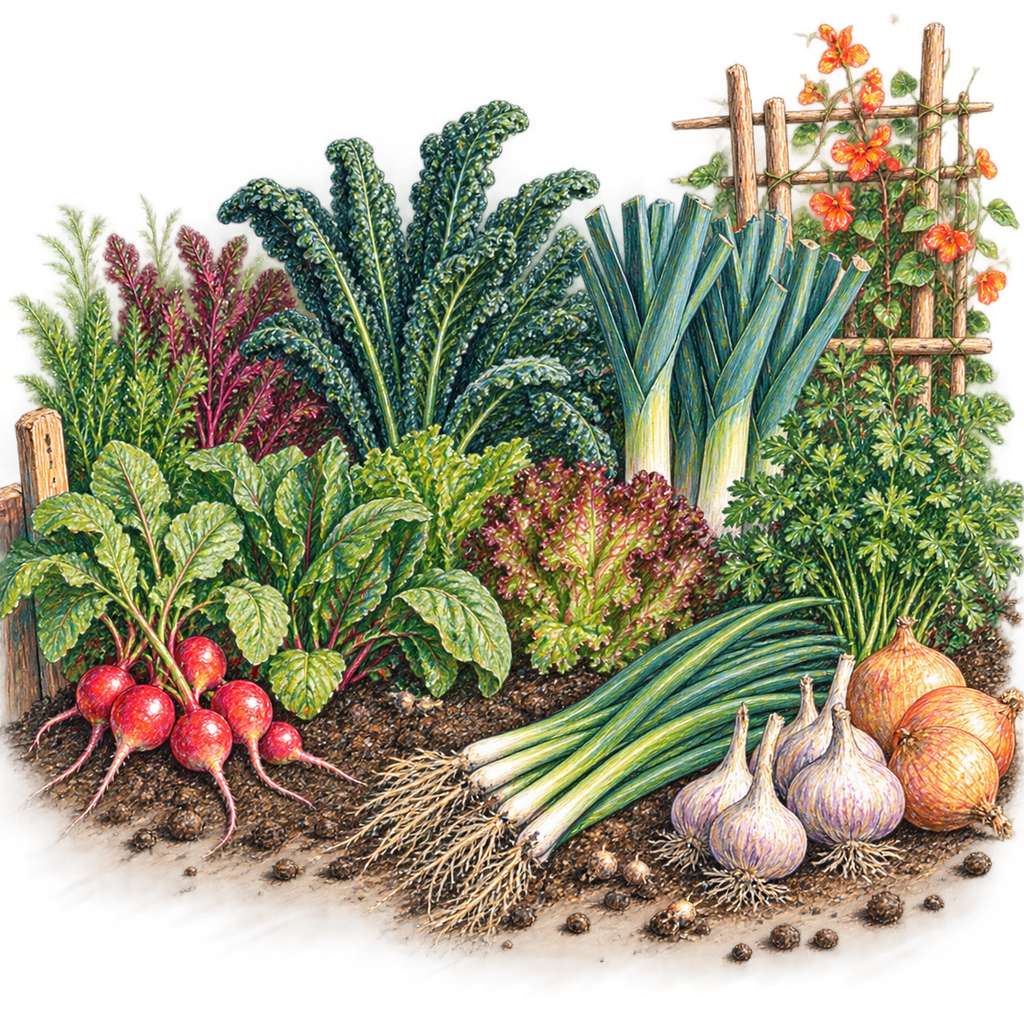
Leeks, kale, chard and other hardy crops can become some of the great stalwarts of the autumn and winter vegetable garden.
They won’t all grow vigorously throughout the darkest months. Growth slows considerably as light levels fall.
But established plants can stand in the ground ready to be harvested.
That changes the character of the vegetable patch.
Instead of trying to produce everything quickly, you begin creating a living winter store.
A row of leeks waiting beneath a cold sky is every bit as valuable as a glut of courgettes in July — perhaps more so when supper needs making on a wet November evening.
Keep harvesting herbs
The herb garden can remain useful well into autumn.
Parsley may continue producing fresh leaves, while hardy perennial herbs such as rosemary, thyme and sage can be picked through much of the year.
Tender herbs need more care.
Basil will quickly object to cold conditions, so harvest generously before temperatures fall too far. Coriander, on the other hand, often appreciates the cooler conditions of early autumn.
This is also a good time to preserve surplus herbs.
They can be dried, frozen or turned into herb butters and sauces, depending on the variety.
A productive garden doesn’t have to mean eating everything on the day it is picked.
Sometimes the most useful harvest is the one tucked away for later.
Start composting next year’s harvest
Autumn provides an abundance of compostable material.
Finished vegetable plants, annual weeds that haven’t set troublesome seed, fallen leaves and kitchen peelings can all contribute to the compost heap.
Mix softer green material with drier brown material rather than creating thick layers of one ingredient.
Then give it time.
Composting has none of the immediate excitement of picking tomatoes or pulling carrots, but it is one of the quiet engines of a productive garden.
The remains of this year’s crops gradually become the material that feeds next year’s soil.
Nothing illustrates the circular nature of gardening quite so neatly.
Make notes while the season is still fresh in your mind
Autumn is also a useful time to stop and look back.
Which tomato variety actually tasted best?
Did you grow far too many courgettes?
Were the beans planted too close together?
Which bed dried out fastest?
What did the slugs eat before you managed to?
Write it down.
By January, memories of the summer vegetable garden tend to become suspiciously rosy. We remember baskets of tomatoes and conveniently forget the six weeks spent battling aphids.
A few notes made now can transform next year’s garden.
Productivity isn’t always about squeezing another crop into the ground.
Sometimes it comes from learning what your particular patch of earth is trying to tell you.
What can you grow in an autumn vegetable garden?
If you’re planning a productive autumn vegetable garden in the UK, consider a mixture of crops that can be harvested now, sown for quick leaves or established for later.
Depending on the month, variety and conditions, your autumn garden might include:
- spinach
- rocket
- winter lettuce
- mizuna and mustard leaves
- radishes
- spring onions
- chard
- kale
- leeks
- parsley
- coriander
- garlic
- overwintering onions
What works best will depend enormously on where you garden.
Autumn arrives differently in a sheltered southern garden than it does on an exposed northern allotment. Even two gardens in the same village can have quite different frost pockets, wind exposure and levels of sunlight.
Learn the small climate of your own garden.
It is one of the most useful things a gardener can do.
Let the garden change with the season
Perhaps the secret to keeping a vegetable garden productive into autumn is to stop expecting it to look like summer.
It will become quieter.
There will be fewer flowers humming with bees. The towering bean plants will eventually come down. The courgettes will stop and the tomato plants will finally be cleared away.
But quieter doesn’t mean empty.
There can be spinach beneath a cloche, leeks standing in neat rows and parsley beside the kitchen door. Garlic can be putting down roots beneath seemingly bare soil while a pumpkin harvested weeks earlier waits patiently in the pantry.
And on a bright autumn morning, when the grass is wet and the air has that unmistakable October coolness, there might still be a basket to carry into the garden.
It may come back with only a leek, a handful of leaves and a sprig or two of herbs.
But that is enough.
The vegetable garden is still doing what it has done all summer.
It is feeding you.
Only now, it is doing so at autumn’s slower pace.
Further Reading: Wonderful Ways to Use Fresh Garden Peas, Grow Your Own Food: Save Money & Eat Well
Follow us on Instagram, Threads, BlueSky, Twitter, Pinterest & Facebook
Not sure where to start? Take a look at our Grow Your Own Packs with detailed step by step instructions, seeds and 1 years online support.