
Long before potatoes became a familiar sight on British dinner tables, our ancestors were growing and eating vegetables that have since almost disappeared from memory. Among them was skirret, a curious little root with a sweet flavour, an intriguing history and a name that sounds as though it belongs in a medieval fairy tale.
There is something rather wonderful about discovering a vegetable that was once considered perfectly ordinary, yet today is almost entirely unfamiliar.
We happily grow carrots, parsnips and potatoes, giving little thought to the plants that filled kitchen gardens centuries before our modern favourites arrived. Yet tucked away in the pages of old gardening books and historical cookery manuscripts are vegetables that deserve another look.
Skirret is one of them.
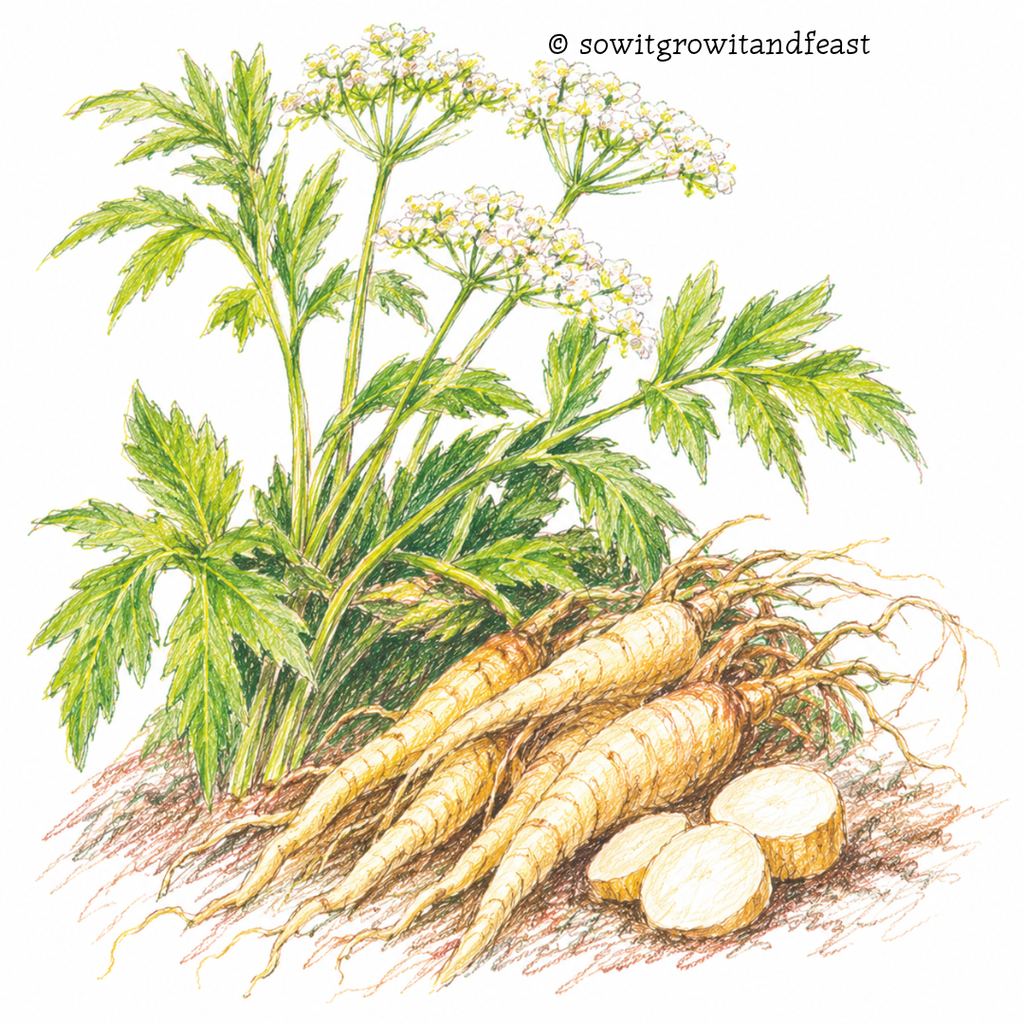
Known in some traditions as crummock or jellico, skirret (Sium sisarum) belongs to the carrot family, Apiaceae. Unlike the familiar carrot, which produces one substantial taproot, skirret develops a cluster of slender, pale roots beneath a crown of foliage.
It is these sweet, starchy roots that made the plant so desirable to earlier generations.
Once cultivated in European kitchen gardens and appreciated for its delicate flavour, skirret gradually fell from favour as other root vegetables became more widely grown.
Today, it is something of a curiosity.
But for gardeners interested in heritage vegetables, unusual edible plants and crops that can return year after year, skirret offers a particularly appealing opportunity to rediscover a little of our culinary past.
A Vegetable with a Remarkable History
Skirret has a long history of cultivation, with its origins generally traced to Asia before it became established in European gardens.
The Romans were familiar with a plant described as siser, traditionally associated with skirret.
The Roman emperor Tiberius is sometimes said to have been particularly fond of it, with accounts suggesting that supplies were obtained from territories along the Rhine.
It is an intriguing story, although the precise identification of ancient plants and the details of such historical accounts are not always certain.
What is clear is that skirret became a recognised vegetable in European cultivation.
By the medieval and early modern periods, it was familiar in British gardens and kitchens.
Its sweet roots were boiled, stewed, fried and used in a variety of dishes, sometimes alongside other root vegetables and occasionally in preparations that combined sweet and savoury flavours.
The name itself is thought to have connections with older Germanic words associated with sugar or sweetness, reflecting one of the vegetable’s most appealing characteristics.
Before the potato became firmly established in Britain, skirret was one of several root crops grown for the table.
It would be misleading to suggest that it was the principal root vegetable eaten throughout Europe, however. Turnips, parsnips, carrots and other crops were also important.
Nevertheless, skirret enjoyed a place in the kitchen garden that it has largely lost today.
Why Did Skirret Disappear?
The decline of skirret was probably not the result of one particular event.
As potatoes became increasingly important in European agriculture and diets, many older root vegetables became less widely cultivated.
Potatoes offered substantial yields, could be grown on a large scale and became a versatile staple food.
Skirret, by comparison, produces numerous relatively slender roots that require more preparation.
Some develop an unpleasant woody centre, and harvesting a useful quantity can be rather more fiddly than lifting a few potatoes.
For commercial growers, these characteristics are hardly ideal.
Over time, skirret became less common, eventually disappearing from most ordinary vegetable gardens.
Yet what makes a crop inconvenient for large-scale production does not necessarily make it unsuitable for the home gardener.
Indeed, there is something rather satisfying about growing a vegetable precisely because it is unusual.
What Does Skirret Taste Like?
The flavour of skirret is one of its greatest attractions.
The roots are naturally sweet, with a taste often described as somewhere between a carrot and a parsnip, although they have a character of their own.
When cooked, the flesh becomes tender and pleasantly starchy.
Some varieties or individual plants produce particularly sweet roots, while others are more subtle.
The flavour can be enjoyed in both savoury and sweet preparations, reflecting the way vegetables were often used in historical British cookery.
Skirret can be boiled, steamed, roasted or fried, depending on the quality and thickness of the roots.
Its sweetness makes it particularly appealing when paired with butter, herbs or gently warming spices.
It is not a vegetable likely to replace the potato on every Sunday lunch table, but it certainly deserves an occasional invitation.
Growing Skirret in a British Kitchen Garden
One of the most interesting things about skirret is that it is a hardy herbaceous perennial.
Unlike carrots or parsnips, which are usually grown as annual crops for their roots, skirret can remain in the garden for several years.
Each plant develops a crown from which leaves and stems emerge in spring.
Beneath the soil, a cluster of slender storage roots forms.
Over time, the crown can become larger, providing opportunities to divide the plant and establish new clumps.
This makes skirret particularly appealing to gardeners interested in perennial vegetables and less conventional kitchen garden crops.
Choosing the Right Position
Skirret grows best in fertile, moisture-retentive soil that drains reasonably well.
It appreciates a position in full sun or light shade, although good light generally encourages healthy growth.
The plant particularly benefits from consistent moisture during the growing season.
Dry conditions can reduce growth and may contribute to poor root quality.
Before planting, incorporate well-rotted compost to improve the soil’s structure and moisture retention.
Avoid ground that becomes severely waterlogged during winter.
Although skirret enjoys moisture, prolonged saturation can damage roots and crowns.
How Much Space Does It Need?
Skirret develops into a leafy plant with upright stems and delicate white flowers arranged in umbels, typical of the carrot family.
Mature plants can reach around 1–1.5 metres in height, depending on growing conditions.
Allow approximately 30–45 cm between plants, with additional room if you intend to maintain large perennial clumps.
It is worth choosing a position where the plant can remain undisturbed for several seasons.
A dedicated corner of the kitchen garden or perennial vegetable bed can work particularly well.
Growing Skirret from Seed
Skirret can be grown from seed, although germination is sometimes less straightforward than with familiar vegetables.
The seed may lose viability relatively quickly, so fresh seed from a reliable supplier is preferable.
Autumn sowing is one option.
Sowing outdoors in pots or a protected seedbed allows the seeds to experience natural winter temperatures, which may help overcome dormancy.
Alternatively, seed can be sown in spring, although germination may be slow or irregular.
Some growers use a period of cold, moist stratification to encourage germination.
However, it is worth following the instructions supplied with the seed, as requirements and germination rates can vary.
Sowing and Raising Young Plants
Sow the seeds shallowly in suitable seed compost and keep the growing medium consistently moist without allowing it to become waterlogged.
Place the pots somewhere sheltered and be patient.
Once seedlings are large enough to handle, transplant them carefully into individual pots if necessary.
Young plants can be moved into their final positions once they are well established and conditions are suitable.
During their first growing season, concentrate on encouraging strong roots and healthy foliage.
Although skirret may produce a modest harvest relatively early, allowing young plants time to establish can help them develop more substantial crowns.
Growing Skirret from Crowns
If you can obtain established skirret crowns, propagation becomes considerably easier.
Unfortunately, these are not as widely available as the crowns or tubers of more familiar perennial crops.
Specialist nurseries and growers of heritage vegetables are often the best places to look.
A mature plant produces a crown containing several growing points, with clusters of roots attached beneath.
When the plant is dormant, usually during late autumn or early spring, established crowns can be carefully lifted and divided.
Each division should have healthy buds and sufficient roots to support new growth.
Replant promptly into prepared soil and water well.
This method allows gardeners to maintain and gradually increase their stock without repeatedly relying on seed.
It also offers an opportunity to select plants that produce particularly good roots.
The Problem of Woody Roots
There is one characteristic of skirret that deserves mentioning before anyone becomes too enthusiastic about planting an entire bed.
Some roots develop a tough, woody core.
Unfortunately, this does not soften satisfactorily during cooking.
The result can be a root that looks perfectly promising but proves rather disappointing on the plate.
Woody cores are a recognised difficulty in skirret cultivation, and their occurrence appears to vary between individual plants and growing conditions.
Water stress may contribute to poor root development, while genetic differences between plants are also thought to play a part.
It is not safe to assume that woody roots occur only in young plants or that the problem will necessarily disappear as a plant matures.
Encouraging Better Roots
The most useful approach is to provide good growing conditions and observe which plants perform best.
Keep the soil consistently moist during dry weather.
Mulch around established plants with compost or other suitable organic matter to help retain moisture.
Avoid unnecessary competition from weeds.
When harvesting, assess the quality of the roots and retain the crowns of plants that consistently produce tender, worthwhile crops.
Over time, selecting and propagating the best-performing plants may help improve the quality of your harvest.
This is one of the pleasures of growing a less familiar vegetable: there is still room for experimentation and discovery.
When and How to Harvest Skirret
Skirret is generally harvested during its dormant period, from late autumn into winter, provided the ground is workable.
The roots can remain in the soil until needed, although prolonged waterlogging or severe freezing conditions may cause problems.
To harvest, carefully loosen the soil around the crown with a garden fork.
Lift the plant gently, taking care not to break too many of the slender roots.
A mature crown may carry numerous roots, but not all will be equally suitable for eating.
Select the firm, well-developed roots and trim them away.
If you wish to maintain the plant as a perennial, retain a healthy crown with sufficient roots and replant it promptly.
Water it in if conditions are dry.
This allows the plant to resume growth the following spring.
It is a wonderfully economical arrangement: part of the plant goes to the kitchen, while the rest returns to the garden.
Can You Eat the Shoots and Flower Stems?
Although skirret is principally grown for its roots, young shoots and immature flowering stems have also been described as edible in specialist accounts of perennial vegetables.
They are sometimes compared in flavour to carrots and can be cooked when young and tender.
However, this is a less familiar use of the plant, and there is much less widely available guidance on preparing these parts than on using the roots.
Only harvest them from plants that have been positively identified as Sium sisarum and obtained from a reliable edible-plant source.
This is particularly important because the carrot family contains several highly poisonous species, including hemlock and hemlock water-dropwort.
Never gather unidentified wild plants on the assumption that they resemble skirret.
For most gardeners, the roots remain the simplest and best-established edible part of the crop.
Bringing Skirret into the Kitchen
Once harvested, skirret roots should be washed thoroughly to remove soil from their irregular surfaces.
Trim away any damaged sections and inspect the roots for woody centres.
Thicker roots may need peeling, while smaller, tender roots can sometimes be cooked with minimal preparation.
The simplest approach is often the most rewarding.
Buttered Skirret with Garden Herbs
A gentle way to discover the flavour of this forgotten vegetable.
Ingredients
- 300 g tender skirret roots, cleaned and trimmed
- 25 g butter
- A little chopped fresh parsley or thyme
- Salt and freshly ground black pepper
- A squeeze of lemon juice, if desired
Method
- Inspect the roots and remove any tough, woody cores. Cut larger roots into similar-sized pieces.
- Place in a saucepan of lightly salted boiling water and simmer until tender. Cooking time will vary according to thickness.
- Drain thoroughly.
- Return to the warm pan with the butter and herbs.
- Toss gently until coated, season to taste and finish with a little lemon juice if desired.
Serve alongside roasted vegetables, fish or a traditional Sunday roast.
The gentle sweetness of the roots works particularly well with butter and fresh herbs.
Other Ways to Enjoy Skirret
Skirret can also be added to mixed roasted root vegetables, incorporated into soups or used in dishes inspired by historical recipes.
Its naturally sweet flavour lends itself to experimentation.
Try roasting tender roots with parsnips and carrots, or adding small pieces to a warming vegetable stew.
Where the roots are particularly sweet and tender, they can make an interesting addition to recipes that combine fruit, spices and root vegetables.
As with any unfamiliar crop, begin with a small harvest and discover which preparations you enjoy most.
Saving Skirret for Future Seasons
One of the most appealing things about perennial vegetables is the opportunity to maintain them over time.
Once you have established a productive skirret plant, you need not begin again from seed every year.
Healthy crowns can be retained and divided when necessary.
If several plants are grown, it is worth keeping notes about their performance.
Which produced the most substantial roots?
Which had the best flavour?
Were any particularly prone to woody centres?
By retaining the most successful plants, you can gradually develop a collection suited to your own garden.
Skirret can also flower and produce seed, although seedlings may vary in their characteristics.
For gardeners interested in heritage crops, this offers another opportunity to explore a vegetable that has received relatively little modern breeding attention.
Why Grow a Forgotten Vegetable?
It is tempting to think that the vegetables we grow today must be the best available, simply because they have become the most familiar.
Yet the history of food is full of plants that were once valued and later overlooked.
Sometimes they disappeared because another crop was easier to grow commercially. Sometimes tastes changed. Sometimes the practical demands of harvesting, storing or preparing them made them less attractive.
Skirret is a reminder that usefulness and popularity are not always the same thing.
It may never compete with potatoes for convenience, and it certainly requires a little more patience than pulling a carrot.
But it offers something different.
A connection with the gardens and kitchens of earlier centuries.
An opportunity to grow a hardy perennial vegetable with an unusual flavour.
And the pleasure of discovering a crop that few people now recognise.
There is something quietly satisfying about bringing such plants back into cultivation, not because they are fashionable, but because they deserve not to be forgotten.
A Little Piece of History Beneath the Soil
A kitchen garden is more than a place to produce food.
It is also a living record of the plants people have valued, cultivated and shared across generations.
Every vegetable has a story, although some have been told rather more often than others.
Skirret’s story stretches from ancient cultivation and the gardens of earlier Europe to the modern gardener searching for something a little different.
Its slender roots may not be particularly impressive at first glance. They require patience to grow, care to harvest and occasionally a little determination to prepare.
But perhaps that is part of their charm.
In a world where so much of our food is selected for uniformity, convenience and commercial productivity, there is room in the garden for vegetables that ask a little more of us.
And sometimes, the most interesting harvest is not the biggest or the easiest, but the one that reconnects us with something we had almost forgotten.
Further Reading: Why Growing Food Makes You Feel Better, Take the Guesswork Out of Growing Veg, How to Create a Garden That Feeds Your Family, How to Start a Vegetable Garden Now Ready for Spring
Follow us on Instagram, Threads, BlueSky, Twitter, Pinterest & Facebook
Not sure where to start? Take a look at our Grow Your Own Packs with detailed step by step instructions, seeds and 1 years online support.