
There is something rather special about stepping into the garden and gathering the ingredients for a meal.
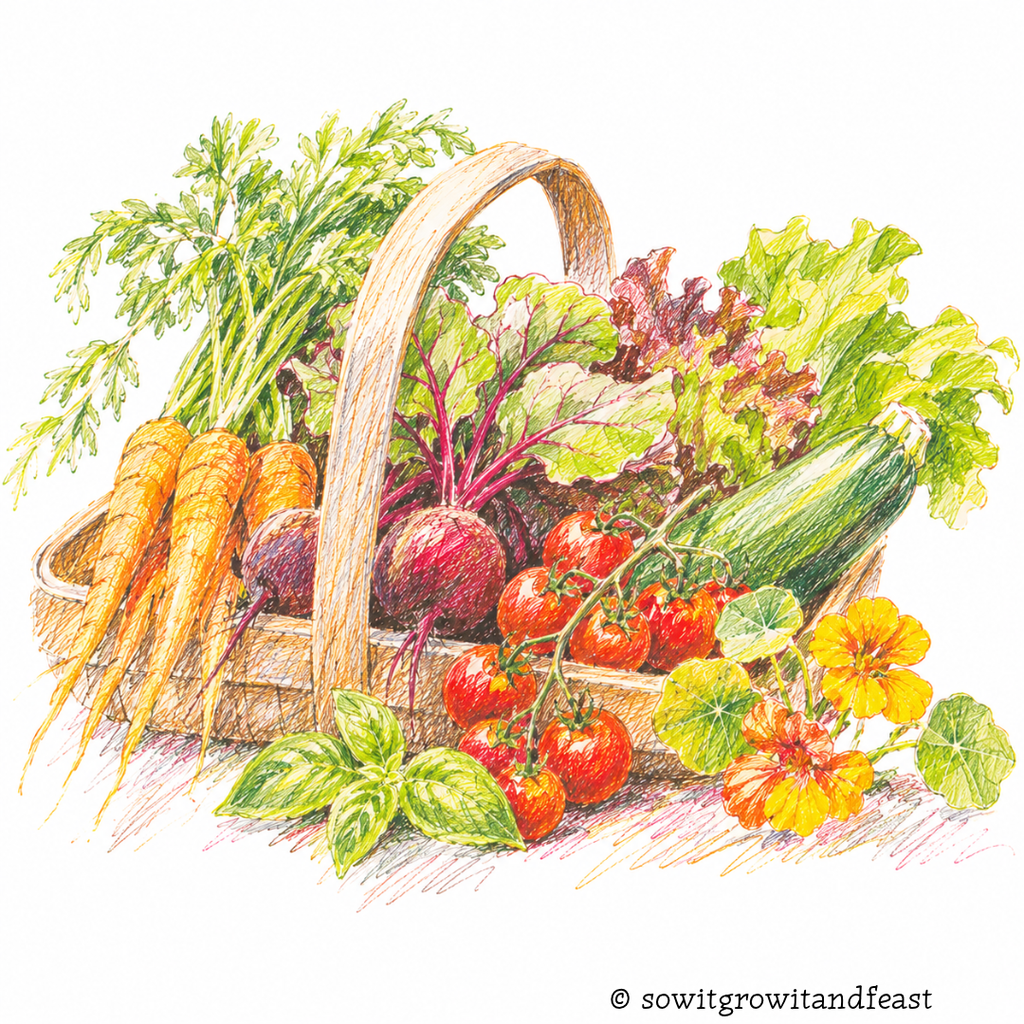
A handful of fresh basil, still fragrant from the afternoon sunshine. A cucumber with that wonderful crispness only a freshly picked one seems to possess. A few tomatoes, warm from the vine, destined for the kitchen but quite possibly eaten before they get there.
It is one of life’s quieter pleasures.
And perhaps that is what makes growing your own food so rewarding. It is not simply about producing vegetables or saving a few pounds on the weekly shop. It is about reconnecting with the seasons, understanding where our food comes from and discovering the satisfaction of nurturing something from seed to harvest.
You do not need an allotment, an enormous garden or even particularly green fingers.
A few pots on a sunny patio, a small raised bed or a collection of herbs on a windowsill can be enough to begin.
And once you have tasted that first home-grown harvest, you may find yourself looking at every spare corner of the garden with rather different intentions.
A Reason to Spend More Time Outdoors
Modern life has a remarkable ability to keep us indoors.
There is always something demanding our attention, another task to complete or a screen quietly persuading us that we ought to be doing something else.
Gardening offers a welcome change of pace.
Plants are wonderfully indifferent to our schedules. They grow according to the weather, the seasons and their own particular requirements.
And in tending to them, we begin to slow down too.
There is something absorbing about sowing seeds, watering young plants or gently removing weeds from around a row of carrots.
These are simple tasks, but they encourage us to pay attention to the world immediately around us.
The warmth of the soil.
The scent of rain.
The first appearance of a seedling that was nowhere to be seen the previous afternoon.
Research suggests that gardening can support mental wellbeing, with potential benefits for mood, stress and quality of life. The physical activity involved can also contribute to maintaining strength, mobility and general fitness.
Of course, gardening is not a substitute for medical treatment or a guarantee of better health.
But spending time outdoors, moving our bodies and engaging with the natural world can be a valuable part of a balanced lifestyle.
And unlike a gym membership, a vegetable patch occasionally rewards your efforts with something delicious.
The Wonderful Flavour of Freshly Picked Food
There is a reason gardeners become rather enthusiastic about their first home-grown tomato.
Flavour.
A tomato allowed to ripen fully on the plant can be wonderfully sweet and aromatic. Fresh peas eaten straight from the pod have a delicate sweetness, while newly harvested salad leaves offer a crispness that can be difficult to preserve during storage.
Growing your own food gives you the freedom to harvest crops when they are ready to eat.
Commercially grown vegetables are often selected for qualities such as uniformity, storage life and their ability to withstand transportation.
These are important considerations when food must travel through a supply chain.
But in your own garden, you can choose varieties primarily for flavour.
Perhaps an unusual heritage tomato, a particularly tender French bean or a variety of strawberry that is delicious but too delicate for commercial handling.
And because the distance from garden to kitchen may be only a few steps, you can enjoy produce at its freshest.
Is Home-Grown Food More Nutritious?
Freshness can influence the nutritional quality of some vegetables.
Certain vitamins, particularly vitamin C, may decline during prolonged storage, depending on the crop and conditions.
However, home-grown vegetables are not automatically more nutritious than those purchased from a supermarket.
Nutritional content depends on many factors, including variety, growing conditions, maturity, storage and preparation.
What growing your own does offer is the opportunity to enjoy a wider variety of fresh produce and perhaps eat more vegetables simply because they are readily available.
There is also something rather persuasive about a bowl of strawberries you have grown yourself.
They rarely need much encouragement to disappear.
Growing Your Own Can Help Save Money
With household budgets under pressure, the possibility of reducing food costs is understandably appealing.
And growing vegetables can certainly offer savings.
But it is worth approaching the subject realistically.
A vegetable garden is not automatically cheaper than buying produce, particularly when the initial cost of tools, compost, containers and other materials is taken into account.
The greatest savings often come from choosing productive crops, making use of existing resources and growing foods that you regularly buy.
Grow Crops That Offer Good Value
Some vegetables are particularly rewarding in terms of the harvest they can provide.
Cut-and-come-again lettuce can supply fresh leaves over several weeks when grown and harvested appropriately.
Runner beans can be wonderfully productive during summer, provided they receive suitable growing conditions and regular harvesting.
Courgettes are famous for their generosity. One or two healthy plants can produce a considerable harvest, sometimes rather more than anticipated.
Chard can provide leaves over a long period and is particularly useful when other salad crops have finished.
Herbs such as parsley, chives, mint and thyme can be valuable because fresh herbs are often relatively expensive to buy in small quantities.
Growing from seed, making your own compost and reusing suitable containers can help keep costs down.
And perhaps the most important consideration is to grow what you enjoy eating.
There is little financial benefit in producing an impressive quantity of vegetables that nobody particularly likes.
A Little More Independence
Growing your own food will not make most households self-sufficient.
Nor does it remove the need for supermarkets, farmers’ markets or other food producers.
But it can provide a useful supplement to the weekly shop.
During the growing season, you may find yourself buying fewer salad leaves, herbs, beans or courgettes.
And there is something satisfying about knowing that at least part of your supper has come from your own garden.
It is not complete independence.
But it is a small and worthwhile measure of self-reliance.
A Closer Connection to the Changing Seasons
One of the loveliest things about growing food is how it changes our relationship with the year.
We begin to notice things that might otherwise pass us by.
The first warmth in the soil during spring.
The longer evenings that encourage beans and courgettes into vigorous growth.
The changing light of late summer.
And the gradual slowing of the garden as autumn arrives.
Growing vegetables teaches patience in a world that often expects everything immediately.
A seed cannot be hurried simply because we would prefer an earlier harvest.
A tomato will ripen when the conditions are right.
And a courgette, rather inconveniently, may grow from a perfectly manageable size to something resembling a small submarine while we are away for the weekend.
There is a rhythm to gardening that encourages us to observe rather than control everything.
We learn to work with the weather, adapt to changing conditions and appreciate the natural cycles of growth.
Perhaps most importantly, we begin to understand the effort involved in producing food.
A carrot is no longer simply something purchased in a bag.
It represents weeks of growth, suitable soil, water, sunshine and the quiet work of countless organisms beneath the surface.
That understanding can change the way we value what we eat.
A Garden That Supports Wildlife
A vegetable patch is not just a place for growing food.
It can also become part of a wider living landscape.
Flowers attract visiting insects. Healthy soil supports earthworms and microorganisms. Birds may visit in search of food, while hedges and surrounding plants provide shelter for wildlife.
A productive garden need not be an immaculate collection of bare soil and perfectly straight rows.
In fact, a little diversity can be beneficial.
Allowing suitable herbs to flower, growing calendula or nasturtiums and including nectar-rich plants can provide resources for pollinating insects.
Some flowering plants may also attract beneficial insects that feed on garden pests.
Of course, wildlife does not always distinguish between what we have planted for ourselves and what we are happy to share.
Pigeons may develop an interest in young brassicas.
Slugs may discover the lettuce.
And birds occasionally seem convinced that newly sown seeds have been provided entirely for their benefit.
A little protection is sometimes necessary.
But a garden that welcomes wildlife while managing pests sensibly can be both productive and ecologically valuable.
Is Growing Your Own Food Better for the Environment?
Growing food at home can form part of a more sustainable lifestyle.
It may reduce the need for some packaging, provide opportunities to compost organic waste and encourage more thoughtful use of resources.
However, the environmental benefits depend on how the garden is managed.
Home-grown vegetables do not automatically have a smaller carbon footprint than commercially produced food.
Heated greenhouses, excessive watering, manufactured materials and unnecessary purchases can all increase the environmental impact of growing.
The aim should be to make sensible choices.
Make Your Own Compost
Composting suitable kitchen scraps and garden waste is one of the most useful practices in a productive garden.
Vegetable peelings, fallen leaves, grass clippings and other appropriate materials can gradually break down into compost.
This can help improve soil structure, contribute organic matter and reduce the amount of waste requiring disposal.
It is a wonderfully practical example of making use of what the garden already provides.
Collect Rainwater
A water butt connected to a suitable roof can provide a useful supply of rainwater for the garden.
Although it may not meet every watering need during a dry summer, it can help reduce reliance on mains water.
Mulching beds with suitable organic materials can also help conserve moisture.
Look After the Soil
Healthy soil is central to sustainable food growing.
Adding organic matter, avoiding unnecessary digging and preventing compaction can all support soil structure and biological activity.
Keeping soil covered with plants or suitable mulches can help reduce erosion and moisture loss.
And choosing crops appropriate to your local conditions can reduce the need for additional resources.
Sustainable gardening is rarely about one dramatic gesture.
It is usually the result of many small, thoughtful decisions made over time.
The Pleasure of Sharing a Harvest
There is something about growing food that encourages generosity.
Perhaps it begins with the first unexpected surplus.
A few extra courgettes.
More runner beans than the household can reasonably consume.
Or a particularly successful crop of tomatoes.
Before long, neighbours are receiving vegetables, friends are being offered seedlings and conversations begin with the familiar question:
“Would you like some courgettes?”
Occasionally, the answer is no.
Particularly by late August.
But sharing produce can be one of the most enjoyable parts of gardening.
It creates opportunities to exchange knowledge, discover new recipes and connect with others who enjoy growing food.
Seed swaps, community gardens and allotment associations can also bring people together.
Experienced gardeners often have a remarkable willingness to share advice, particularly when the subject turns to compost, tomatoes or the best way to discourage slugs.
And there is something rather lovely about food becoming a reason for conversation and connection.
From Garden to Kitchen
Growing your own food can also change the way you cook.
Instead of deciding what to eat and then buying the ingredients, you may begin with what is ready to harvest.
A handful of spinach becomes part of a simple supper.
A generous crop of tomatoes inspires a homemade sauce.
Fresh herbs find their way into salads, soups and dressings.
And an unexpected abundance of courgettes encourages increasingly inventive recipes.
This is seasonal eating in its most natural form.
The garden provides what is ready, and the kitchen responds.
It can also encourage us to waste less.
Vegetable trimmings may be suitable for stocks, surplus produce can be frozen or preserved using safe methods, and suitable uncooked scraps can return to the compost heap.
Not every harvest needs to be enormous.
Sometimes the greatest pleasure comes from adding a few freshly picked ingredients to an otherwise ordinary meal.
You Do Not Need a Large Garden to Begin
One of the most encouraging things about growing food is how little space it can require.
A sunny patio can accommodate pots of herbs, salad leaves and compact tomato varieties.
A balcony may provide enough room for suitable containers, provided weight restrictions, light and exposure are considered.
Even a bright windowsill can support some herbs and small quantities of salad crops.
If you have a little more room, a raised bed or small vegetable patch can provide opportunities to grow a wider selection.
The important thing is to begin at a scale you can comfortably manage.
Start with Something Simple
For a first attempt, consider growing a few crops that offer relatively quick or reliable rewards.
Radishes are particularly satisfying because some varieties mature in only a few weeks.
Lettuce can provide useful harvests from a small space.
Parsley and chives are valuable additions to the kitchen.
And a pot of mint can be wonderfully productive, although it is usually best kept contained unless you would like it to take possession of the entire garden.
You do not need to grow everything.
You simply need to grow something.
And learn from the experience.
The Quiet Satisfaction of Growing Something Yourself
Perhaps the greatest reward of growing food is not something that can be measured in pounds saved, kilograms harvested or vegetables eaten.
It is the sense of achievement that comes from nurturing something through the seasons.
There is the anticipation of sowing seeds.
The excitement of seeing the first shoots.
The occasional frustration when the weather refuses to cooperate.
And finally, the satisfaction of gathering a harvest.
Some years will be more productive than others.
There will be disappointments, unexpected successes and plenty of lessons learned along the way.
But even a modest vegetable patch can bring a remarkable amount of pleasure.
It offers a reason to spend time outdoors, an opportunity to understand the natural world and a closer connection to the food on our plates.
And perhaps that is what makes it so worthwhile.
Not the promise of perfect vegetables or complete self-sufficiency, but the experience of taking part in something that has sustained generations before us.
The simple act of planting, tending, harvesting and beginning again.
Every Harvest Begins with a Seed
There is no need to transform your entire garden overnight.
Begin with a pot of herbs.
A few rows of lettuce.
Perhaps a tomato plant in a sunny corner.
Discover what grows well, what you enjoy eating and how much time you like spending among the plants.
Your garden can develop gradually, season by season.
And before long, you may find that growing food has become about far more than the harvest itself.
It becomes part of the rhythm of everyday life.
A reason to step outside in the morning.
A small moment of calm at the end of the day.
A reminder that some of the most satisfying things in life require patience, care and a willingness to get our hands a little dirty.
Because the real joy of growing your own food is not simply what you take from the garden, but everything the garden gives you along the way.
Further Reading: Why Growing Food Makes You Feel Better, Take the Guesswork Out of Growing Veg, How to Create a Garden That Feeds Your Family, How to Start a Vegetable Garden Now Ready for Spring
Follow us on Instagram, Threads, BlueSky, Twitter, Pinterest & Facebook
Not sure where to start? Take a look at our Grow Your Own Packs with detailed step by step instructions, seeds and 1 years online support.