
There is a tendency, once winter settles in, to think that salads belong to another season. We put away thoughts of crisp lettuce, fresh herbs and colourful bowls of vegetables, turning instead to steaming soups, hearty casseroles and anything that can be eaten beside a warm radiator.
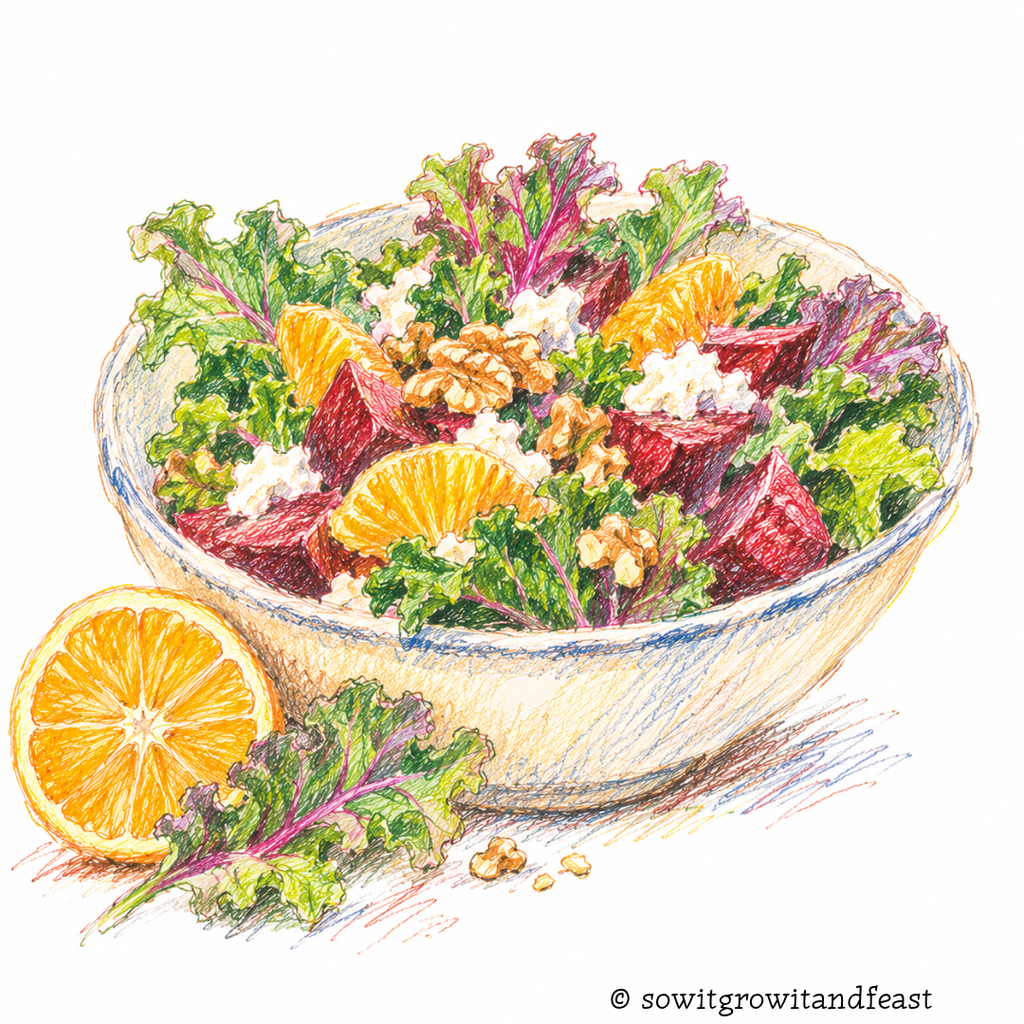
And understandably so.
When the days are short, the garden is damp and the prospect of stepping outside to gather a handful of leaves requires a certain amount of determination, a cold salad may not be the first thing that springs to mind.
But winter has its own wonderful ingredients.
There are the deep green leaves of kale, the earthy sweetness of beetroot, the sturdy heads of winter cabbage and the peppery bite of hardy salad leaves. Add a little warmth from roasted vegetables, the crunch of toasted nuts or the brightness of citrus fruit, and suddenly a winter salad becomes something altogether more inviting.
A good winter salad should feel generous rather than austere.
Something colourful, full of flavour and substantial enough to enjoy for lunch, or alongside a warming supper.
And if you have a kitchen garden, even a modest one, there may still be something worth gathering.
The Winter Kitchen Garden: More Than You Might Expect
The vegetable garden may appear quiet in winter, but beneath its rather subdued appearance there can still be plenty to enjoy.
Kale (Brassica oleracea Acephala Group) is one of the most reliable winter vegetables, with established plants often providing leaves through the colder months.
Chard (Beta vulgaris Cicla Group) can continue producing in mild conditions, although hard frosts may damage its foliage.
Winter spinach (Spinacia oleracea) and suitable hardy salad varieties can also provide welcome fresh leaves, particularly when established in autumn and given some protection.
Then there are the vegetables gathered earlier and stored for winter: beetroot, carrots, onions and other roots that bring colour and substance to the table.
Of course, the British winter garden is unlikely to provide everything needed for a salad.
Oranges and pomegranates are not generally waiting to be picked beside the Brussels sprouts.
But combining home-grown vegetables with seasonal produce from the greengrocer can make excellent sense.
The garden provides the foundation, while a few carefully chosen ingredients bring contrast, texture and flavour.
Here are five winter salads worth making.
1. Winter Greens, Orange and Toasted Pumpkin Seed Salad
Fresh, earthy and wonderfully colourful, this is a salad that brings a little brightness to the darkest days of winter.
Kale, chard and spinach are particularly useful at this time of year. Their flavours are more substantial than tender summer lettuce, making them excellent companions for sweet citrus fruit and crunchy seeds.
The orange brings freshness, while the pumpkin seeds add a pleasing nuttiness.
<text weight=”medium”>Serves 2 as a light lunch or 4 as a side dish</text>
Ingredients
- 100g mixed kale, chard and spinach leaves
- 1 large orange
- 2 tablespoons pumpkin seeds
- 2 tablespoons extra virgin olive oil
- 1 tablespoon balsamic vinegar
- 1 teaspoon honey, optional
- Sea salt and freshly ground black pepper
- A small handful of pomegranate seeds, optional
Method
- Wash the greens thoroughly and dry them well. Remove any tough stalks from the kale and chard, then tear the leaves into manageable pieces.
- If using mature kale, massage the leaves gently with a little olive oil for a minute or two to soften their texture.
- Toast the pumpkin seeds in a dry frying pan over a medium heat until lightly golden and fragrant. Set aside to cool.
- Peel the orange, removing as much white pith as possible, and cut into segments.
- Arrange the greens in a serving bowl and scatter over the orange segments, pumpkin seeds and pomegranate seeds, if using.
- Whisk together the remaining olive oil, balsamic vinegar and honey. Season to taste and drizzle over the salad just before serving.
From the garden: Kale, chard and winter spinach, where available.
A little extra: Crumbled feta or soft goat’s cheese makes this a more substantial lunch.
2. Warm Roasted Beetroot, Walnut and Goat’s Cheese Salad
There are few vegetables that reward a little patience quite like beetroot. Roasting transforms its earthy flavour into something rich, sweet and wonderfully comforting.
This is a particularly lovely salad for a cold afternoon.
The beetroot is served warm, the walnuts bring crunch and the goat’s cheese adds a gentle sharpness.
It feels rather indulgent for something built around a humble root vegetable.
<text weight=”medium”>Serves 2</text>
Ingredients
- 3 medium beetroot, approximately 400g
- 75g mixed winter salad leaves
- 60g soft goat’s cheese
- 30g walnuts
- 2 tablespoons olive oil
- 1 tablespoon balsamic vinegar
- 1 teaspoon honey
- A few sprigs of fresh thyme, optional
- Sea salt and freshly ground black pepper
Method
- Preheat the oven to 200°C, or 180°C fan.
- Wash the beetroot and trim the leaves, leaving a short length of stalk attached.
- Place the beetroot in a covered ovenproof dish with a little water and roast for approximately 45–75 minutes, depending on size, until tender when pierced with a knife.
- Allow to cool until comfortable to handle, then remove the skins and cut into wedges.
- Toast the walnuts briefly in a dry frying pan.
- Arrange the washed salad leaves on a serving plate and add the warm beetroot.
- Crumble over the goat’s cheese and scatter with walnuts.
- Whisk together the olive oil, balsamic vinegar and honey. Season and drizzle over the salad. Finish with fresh thyme if available.
From the garden: Stored beetroot, winter salad leaves and thyme.
A little extra: A handful of cooked lentils makes this a particularly satisfying lunch.
3. Winter Citrus, Fennel and Hazelnut Salad
Not every winter salad needs to be warm. Sometimes the most refreshing thing on a grey afternoon is a plate of something bright, crisp and full of contrast.
Oranges and grapefruit are wonderful companions for the delicate aniseed flavour of fennel.
Add toasted hazelnuts and a little olive oil, and the result is simple but rather elegant.
Although citrus fruits are imported into Britain, they can be particularly enjoyable during their main winter harvesting season in Mediterranean growing regions.
<text weight=”medium”>Serves 2–3</text>
Ingredients
- 2 oranges
- 1 pink grapefruit
- 1 small fennel bulb
- 50g winter lettuce or other suitable salad leaves
- 30g hazelnuts
- 2 tablespoons extra virgin olive oil
- 1 teaspoon lemon juice
- Sea salt and freshly ground black pepper
- A few fennel fronds, if available
Method
- Peel the oranges and grapefruit, removing the white pith, and slice into rounds or segments.
- Trim the fennel bulb and slice it as thinly as possible.
- Toast the hazelnuts in a dry frying pan, allow to cool and chop roughly.
- Arrange the washed salad leaves on a large plate.
- Layer the citrus fruit and fennel over the leaves.
- Scatter with the hazelnuts and fennel fronds.
- Mix the olive oil and lemon juice, season lightly and drizzle over the salad.
From the garden: Winter lettuce or other hardy salad leaves, where available.
A little extra: Thinly sliced red onion adds a pleasant sharpness.
4. Warm Quinoa, Kale and Roasted Vegetable Salad
Some winter days call for a salad that behaves rather more like a proper meal. Something warm, filling and substantial enough to satisfy an appetite sharpened by cold weather.
This is where quinoa comes into its own.
Its delicate, slightly nutty flavour works beautifully with roasted vegetables and winter greens.
It is also a useful way to make the most of whatever vegetables are waiting in the kitchen.
Carrots, beetroot, parsnips and squash can all work well.
<text weight=”medium”>Serves 2 generously</text>
Ingredients
- 120g dry quinoa
- 2 medium carrots
- 1 small parsnip
- 1 small red onion
- 75g kale
- 30g walnuts or pine nuts
- 2 tablespoons olive oil
- 1 tablespoon lemon juice
- 1 teaspoon Dijon mustard
- 1 teaspoon honey, optional
- Sea salt and freshly ground black pepper
Method
- Preheat the oven to 200°C, or 180°C fan.
- Peel the carrots and parsnip, then cut into small, even pieces. Slice the red onion into wedges.
- Toss the vegetables with one tablespoon of olive oil, season and spread across a roasting tray.
- Roast for approximately 25–35 minutes, turning occasionally, until tender and lightly caramelised.
- Meanwhile, rinse the quinoa thoroughly and cook according to the packet instructions.
- Remove the tough stems from the kale and chop the leaves.
- During the final few minutes of cooking, add the kale to the roasting tray with a little extra oil if needed, allowing it to soften without burning.
- Toast the walnuts or pine nuts in a dry frying pan.
- Whisk together the remaining olive oil, lemon juice, mustard and honey.
- Combine the warm quinoa, roasted vegetables and kale. Add the dressing and scatter over the toasted nuts.
Serve while still warm.
From the garden: Kale, carrots, parsnips and stored onions.
A little extra: Crumbled feta, chickpeas or cooked lentils can make the salad even more substantial.
5. Crunchy Broccoli, Apple and Sunflower Seed Salad
Broccoli is often destined for the saucepan, where it waits patiently beside the Sunday roast. But it has rather more to offer.
Finely chopped broccoli makes an excellent salad ingredient, bringing colour, texture and a fresh, slightly earthy flavour.
Combined with crisp apple, sunflower seeds and a creamy dressing, it becomes something unexpectedly delicious.
This is also a useful recipe for making the most of small broccoli florets and tender stems.
<text weight=”medium”>Serves 2–3</text>
Ingredients
- 250g broccoli
- 1 crisp eating apple
- 2 hard-boiled eggs
- 2 tablespoons sunflower seeds
- 3 tablespoons plain natural yoghurt
- 1 tablespoon mayonnaise
- 1 teaspoon Dijon mustard
- 1 teaspoon lemon juice
- Sea salt and freshly ground black pepper
Method
- Wash the broccoli thoroughly and divide into very small florets. Peel any tough outer skin from the stems and finely chop the tender centres.
- If you prefer a softer texture, blanch the broccoli briefly in boiling water, then cool rapidly and drain thoroughly. It can also be used raw.
- Core the apple and cut into small pieces, leaving the skin on if preferred.
- Peel the hard-boiled eggs and chop into quarters.
- Toast the sunflower seeds lightly in a dry frying pan.
- Mix the yoghurt, mayonnaise, mustard and lemon juice to make the dressing.
- Combine the broccoli and apple in a bowl, then fold through the dressing.
- Arrange the eggs on top, scatter with sunflower seeds and season to taste.
From the garden: Winter or early spring sprouting broccoli, depending on variety and growing conditions, or stored garden produce used alongside purchased broccoli.
A little extra: Finely shredded red cabbage adds colour and an excellent crunch.
Growing Your Own Winter Salad Ingredients
One of the pleasures of a winter kitchen garden is discovering just how much can be harvested when the main growing season has finished.
But successful winter growing begins long before winter arrives.
Many hardy vegetables need to be sown during summer or early autumn so that they are well established before temperatures and daylight levels fall.
Kale, winter spinach, hardy lettuce and some oriental salad leaves are particularly useful.
A cold frame, cloche or unheated greenhouse can offer additional protection, although growth will still slow considerably during the shortest days.
If you are planning a winter salad garden, think about the ingredients you most enjoy eating.
There is little point in growing six rows of kale if you only ever want a handful for the occasional salad.
A few carefully chosen crops are often far more useful than an ambitious collection of vegetables that nobody quite knows what to do with.
Making Winter Salads More Satisfying
A winter salad should never feel like a punishment for having enjoyed too many mince pies.
The best ones are generous, colourful and full of interesting textures.
Warm roasted vegetables bring sweetness and comfort.
Nuts and seeds provide crunch.
Cheese, eggs, pulses and grains can add substance.
And a good dressing brings everything together.
Try combining something earthy with something sweet, something soft with something crisp, and something rich with a little acidity.
It is a simple approach that works remarkably well.
There is also no need to follow recipes too rigidly.
If you have chard instead of kale, use it.
If the garden has produced more carrots than beetroot, roast those instead.
And if the walnuts have mysteriously disappeared from the cupboard, pumpkin seeds will do very nicely.
The most enjoyable cooking often begins with what is already available.
A Little Colour for the Colder Months
Winter has a quieter kind of abundance.
It may not offer the overflowing baskets of summer, but there is still much to appreciate.
The deep green of kale leaves touched by frost.
The rich purple of beetroot lifted from the soil.
The sweetness of stored carrots.
The bright contrast of citrus fruit on a grey afternoon.
These are ingredients worth celebrating.
And perhaps that is the real pleasure of winter salads.
They remind us that fresh, colourful food does not belong exclusively to summer.
With a little imagination, a handful of garden produce and a few additions from the kitchen, even the coldest day can offer something wonderfully fresh.
Because eating with the seasons is not about giving things up when summer ends. It is about discovering the different pleasures that each season brings to the table.
Further Reading: Why Growing Food Makes You Feel Better, Take the Guesswork Out of Growing Veg, How to Create a Garden That Feeds Your Family, How to Start a Vegetable Garden Now Ready for Spring
Follow us on Instagram, Threads, BlueSky, Twitter, Pinterest & Facebook
Not sure where to start? Take a look at our Grow Your Own Packs with detailed step by step instructions, seeds and 1 years online support.