There is something wonderfully reassuring about knowing that a little of what you eat has come from your own garden.
Perhaps it is the handful of parsley gathered for supper, the first ripe strawberry of summer or the satisfaction of lifting potatoes from soil you prepared months earlier. These are small moments, easily overlooked, yet they offer something increasingly valuable in a world where so much of our food arrives ready-picked, packaged and transported from somewhere else.
Growing your own food is hardly a new idea. Generations before us understood the value of a productive garden, not simply as a source of fresh vegetables, but as a way of making household resources stretch a little further.
Today, with food prices placing pressure on family budgets, growing concerns about the environment and a renewed interest in living more sustainably, those old-fashioned skills are finding a new audience.
And the lovely thing is that you don’t need an allotment, a greenhouse or even a particularly large garden to begin.
A sunny balcony, a few containers beside the back door or a modest vegetable bed can all provide the beginnings of something worthwhile.#
Knowing Where Your Food Comes From
We have become accustomed to buying food without giving much thought to the journey it has taken.
A bunch of carrots, a punnet of strawberries or a bag of salad leaves appears on the supermarket shelf, beautifully presented and ready to take home.
Yet behind every purchase lies a story of cultivation, harvesting, handling and transportation.
Growing some of our own food allows us to become part of that story.
We know when the seeds were sown, how the plants were cared for and what was used to encourage their growth. We can choose how to manage pests, improve the soil and feed our crops.
It is not that commercially grown food is inherently less safe or less wholesome. British food production operates within established safety standards, and professional growers possess considerable knowledge and expertise.
Rather, growing at home gives us a greater understanding of the work involved in producing food.
A tomato becomes more than something we buy.
It becomes the result of weeks of watering, watching, feeding and waiting for the first fruits to turn red.
And once you have spent an entire summer nurturing a tomato plant, you may find yourself looking at the price of a supermarket tomato rather differently.
Making the Household Budget Go a Little Further
There is no escaping the fact that food has become a significant expense for many households.
From everyday vegetables to fresh herbs and soft fruit, the cost of filling the shopping basket can soon mount up.
Growing your own food offers an opportunity to reduce some of that expenditure, although it pays to be realistic.
A vegetable garden is not entirely free. Seeds, compost, containers, tools and water all have their costs, particularly when establishing a new growing space.
But choose your crops carefully and the rewards can be considerable.
A packet of lettuce seeds can provide repeated harvests throughout the growing season.
Runner beans, once established, can produce generous quantities of pods over several weeks.
A healthy courgette plant can be remarkably productive, sometimes to the point where friends and neighbours begin avoiding eye contact for fear of being offered another one.
Herbs are particularly worthwhile.
Parsley, chives, thyme and rosemary can provide fresh flavour for countless meals, often at a fraction of the cost of repeatedly buying small supermarket packets.
The secret is to grow what you actually enjoy eating.
There is little point dedicating half the garden to beetroot if nobody in the household likes it.
A productive garden should complement the kitchen, not create an entirely new problem of what to do with vegetables nobody wants.
Rediscovering the Taste of Freshly Picked Food
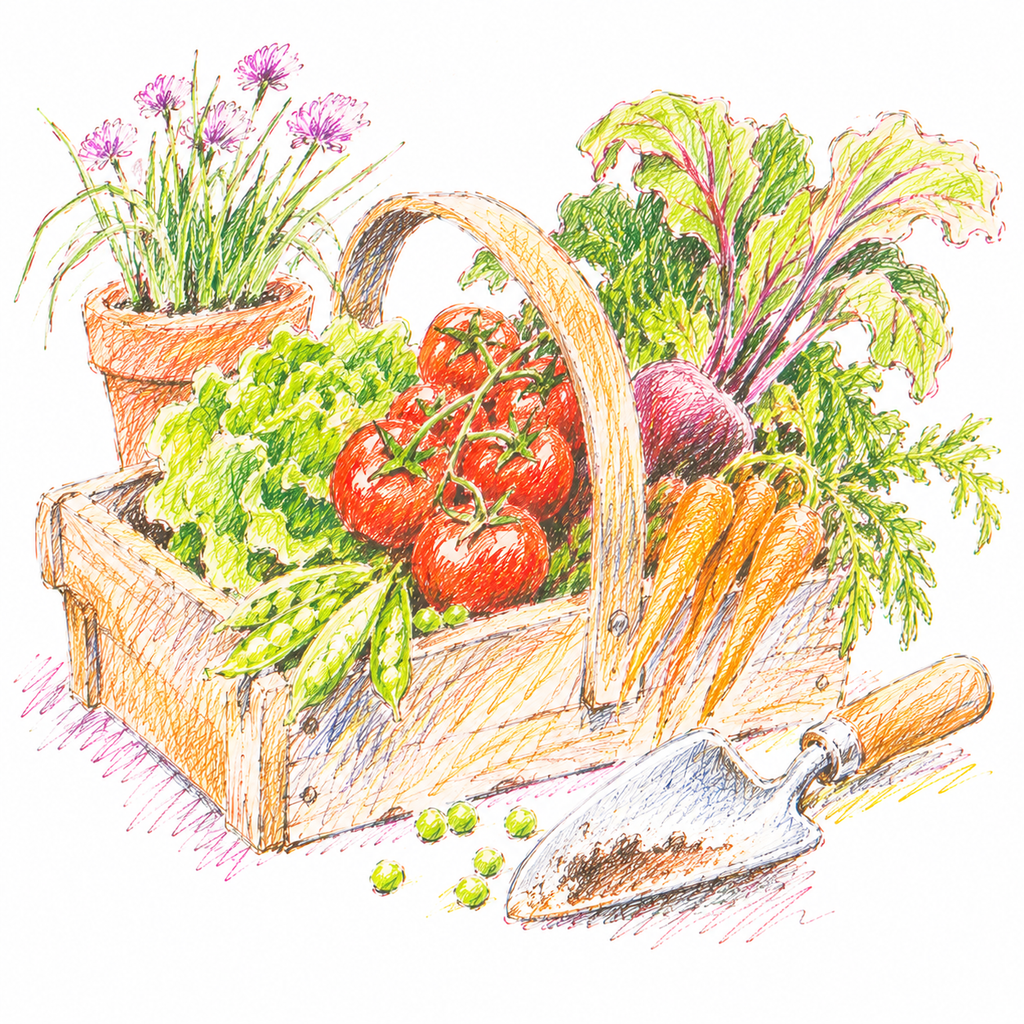
Anyone who has eaten a sun-warmed tomato straight from the plant will understand why gardeners become so enthusiastic about growing their own.
There is something rather special about food harvested at the moment it is ready.
A freshly picked pea has a sweetness that can fade after harvesting.
Strawberries allowed to ripen fully on the plant develop their characteristic fragrance and flavour.
Tender salad leaves, gathered just before lunch, have a freshness that is difficult to improve upon.
Of course, not every homegrown vegetable will taste better than its shop-bought equivalent. Variety, growing conditions, ripeness and storage all influence flavour.
But growing our own gives us the opportunity to choose varieties for taste rather than their ability to withstand transportation or remain attractive on a shelf.
It also encourages us to eat with the seasons.
Instead of expecting everything to be available throughout the year, we begin to anticipate particular harvests.
The first asparagus of spring.
Broad beans and peas in early summer.
Tomatoes and courgettes as the days grow warmer.
Apples, pumpkins and winter squash as autumn approaches.
Each season brings something different to the table.
And perhaps that anticipation is part of what makes homegrown food so enjoyable.
A Garden That Nourishes More Than the Appetite
Gardening has a way of drawing us outdoors, even when we had no particular intention of going there.
A quick visit to check the seedlings becomes half an hour of weeding.
Watering the tomatoes leads to noticing the first flowers on the beans.
And before long, we find ourselves standing in the garden, watching a bumblebee investigate the lavender, having completely forgotten what we originally came outside to do.
There are worse ways to spend an afternoon.
Growing food encourages gentle physical activity through sowing, planting, watering, weeding and harvesting.
These everyday tasks can contribute to maintaining strength, mobility and general fitness.
Time spent gardening may also support mental wellbeing.
Research has associated gardening with improvements in mood, reductions in perceived stress and a greater sense of satisfaction, although experiences and benefits vary between individuals.
Perhaps part of its appeal lies in the simple rhythm of the work.
Plants cannot be hurried into growing.
Seeds germinate when conditions are suitable, flowers appear in their own time and harvests arrive when they are ready.
Gardening asks us to pay attention to the present rather than continually rushing towards the next thing.
There is something quietly restorative about that.
Growing Food with a Lighter Footprint
The environmental benefits of growing food at home are often discussed, and with good reason.
A productive garden can reduce the need for some packaging, provide opportunities to compost organic waste and encourage more seasonal eating.
It can also support wildlife.
Flowering herbs attract bees and other pollinating insects, while healthy soil provides a home for earthworms and countless smaller organisms that help maintain its structure and fertility.
But sustainability is not simply a matter of replacing supermarket vegetables with homegrown ones.
How we garden matters.
A heated greenhouse, excessive watering or repeated purchases of materials may increase the environmental impact of a homegrown crop.
Likewise, food miles alone do not tell the whole story of a product’s carbon footprint. Production methods, heating, refrigeration and transport all contribute.
The most thoughtful approach is to grow with the seasons and make sensible use of available resources.
Collect rainwater where possible.
Make compost from suitable kitchen and garden waste.
Choose peat-free growing media.
Mulch exposed soil to help retain moisture and reduce weed growth.
And grow plants suited to the conditions you can provide.
A sustainable garden need not be elaborate.
Quite often, it is simply one that makes good use of what is already there.
A Little More Independence in an Uncertain World
Recent years have reminded us how closely connected our food supplies are to events taking place far beyond our own communities.
Unpredictable weather, international conflict, rising energy costs and disruptions to trade can all influence food production and prices.
A few vegetable beds will not make a household completely self-sufficient, nor can home gardening replace the work of farmers and the wider food industry.
But growing some of what we eat can provide a modest degree of independence.
It gives us practical skills, a better understanding of food production and the ability to supplement what we buy.
There is reassurance in knowing how to raise plants from seed, improve soil, preserve a harvest or make use of a small growing space.
These are skills that can be shared, developed and passed from one generation to the next.
And they remind us that self-reliance does not necessarily mean doing everything ourselves.
Sometimes it means knowing enough to contribute something useful.
You Don’t Need a Large Garden to Begin
One of the most common misconceptions about growing food is that it requires a substantial amount of space.
In reality, some of the most productive growing areas are surprisingly small.
A sunny windowsill can accommodate pots of herbs.
A balcony may have room for strawberries, salad leaves or compact tomato varieties.
A courtyard can become a productive growing space with carefully chosen containers and climbing supports.
Even a single raised bed can provide a succession of crops throughout the growing season.
The important thing is to choose plants suited to the available light, space and growing conditions.
For beginners, herbs and quick-growing salad crops are often a sensible starting point.
Radishes are relatively straightforward and quick to mature.
Cut-and-come-again lettuce can provide repeated pickings.
Spring onions are useful in the kitchen and take up little room.
Bush tomatoes can thrive in suitable containers, while climbing beans make excellent use of vertical space.
There is no need to grow everything at once.
In fact, starting with just a few crops often makes the experience far more enjoyable.
A small, well-tended growing space is usually more rewarding than an ambitious vegetable patch that becomes overwhelming by midsummer.
Sharing the Harvest and the Knowledge
Growing food has always been a wonderfully sociable activity.
Gardeners are rarely short of advice, particularly when it comes to the best way of growing tomatoes.
Ask three experienced gardeners how they feed their plants and you may receive four different answers.
Yet beneath those differing opinions lies a generous tradition of sharing knowledge.
Seeds are exchanged, spare plants are offered to neighbours and surplus harvests find their way into other people’s kitchens.
Community gardens and allotments provide opportunities to learn from others, particularly for those without suitable growing space at home.
Children, too, can gain enormously from becoming involved.
Watching a seed germinate, caring for a plant and eventually harvesting something edible helps develop an understanding of where food comes from.
It also teaches patience.
A valuable lesson in a world where so much is available at the touch of a button.
And there is something rather lovely about a child proudly presenting a handful of peas they have grown themselves.
Even if most of them never quite make it as far as the kitchen.
Growing Something More Than Food
Perhaps the greatest reward of growing our own food is not the money saved, the vegetables harvested or even the flavour of that first ripe strawberry.
It is the change in perspective.
We begin to notice the weather more carefully.
We understand why a dry spring matters, why healthy soil deserves protecting and why a late frost can be so disappointing.
We become more aware of the work involved in producing the food we eat and perhaps a little less inclined to waste it.
A crooked carrot is no longer something to reject.
It is simply a carrot that has grown around an obstacle, and it will taste perfectly good once washed and prepared.
Growing food reminds us that nature is rarely uniform, that perfection is unnecessary and that abundance often comes in unexpected forms.
There will be failures, of course.
Seeds that refuse to germinate.
Lettuce discovered by slugs before we have the opportunity to enjoy it.
Tomatoes that remain stubbornly green as autumn approaches.
But these disappointments are part of learning to garden.
And every season offers another opportunity to try again.
A Small Beginning, a Lasting Reward
You do not need to become self-sufficient to appreciate the value of growing your own food.
Nor must you transform your garden into a miniature farm.
Sometimes the greatest satisfaction comes from the smallest harvests.
A sprig of rosemary for the Sunday roast.
A handful of strawberries shared on a summer afternoon.
A bowl of freshly picked beans that requires nothing more than a little butter to become something delicious.
These ordinary pleasures have a way of making us feel more connected to the world around us.
They encourage us to live a little more seasonally, waste a little less and appreciate the extraordinary process by which the earth provides our food.
Growing your own is not about turning away from modern life. It is about bringing something valuable back into it.
A little knowledge, a little independence and the pleasure of creating something useful with our own hands.
And it all begins with something wonderfully simple.
A seed, a little soil and the willingness to see what grows.
Further Reading: Why Growing Food Makes You Feel Better, Take the Guesswork Out of Growing Veg, How to Create a Garden That Feeds Your Family, How to Start a Vegetable Garden Now Ready for Spring
Follow us on Instagram, Threads, BlueSky, Twitter, Pinterest & Facebook
Not sure where to start? Take a look at our Grow Your Own Packs with detailed step by step instructions, seeds and 1 years online support.