There is something rather satisfying about growing a vegetable that asks you to think a season or two ahead.
While tomatoes are basking in the summer sunshine and courgettes are producing more enthusiastically than anyone anticipated, broccoli is quietly getting on with the business of growing. Its broad, blue-green leaves spread across the vegetable patch, gathering strength for a harvest that may not arrive until autumn, winter or even the following spring.
It is a vegetable that rewards patience.
And when the moment finally comes to cut a firm, tightly packed head of Calabrese, or gather the first tender purple shoots after a long winter, the wait feels entirely worthwhile.
Broccoli is one of the most useful crops in the British kitchen garden. Nutritious, versatile and remarkably varied, it offers far more than the familiar green heads found on supermarket shelves.
With a little planning, you can grow different types to provide harvests across several seasons.
And once you have tasted broccoli picked fresh from your own garden, you may find yourself looking at that familiar supermarket vegetable rather differently.
Getting to Know Broccoli
Broccoli belongs to the brassica family, Brassicaceae, alongside cabbages, cauliflower, kale and Brussels sprouts.
Most cultivated forms are varieties of Brassica oleracea, a species that has given us an extraordinary collection of vegetables through centuries of selective breeding.
Although we often use the word broccoli to describe them all, there are important differences between the types commonly grown in Britain.
Understanding those differences is the first step towards choosing the right plants for your garden.
Which Broccoli Should You Grow?
One of the pleasures of growing your own vegetables is discovering varieties that rarely receive much attention in the shops.
Broccoli offers plenty of opportunities to experiment.
Calabrese – The Familiar Green Broccoli
<text color=”secondary” italic>Brassica oleracea Italica Group</text>
Calabrese is the vegetable most people picture when they think of broccoli.
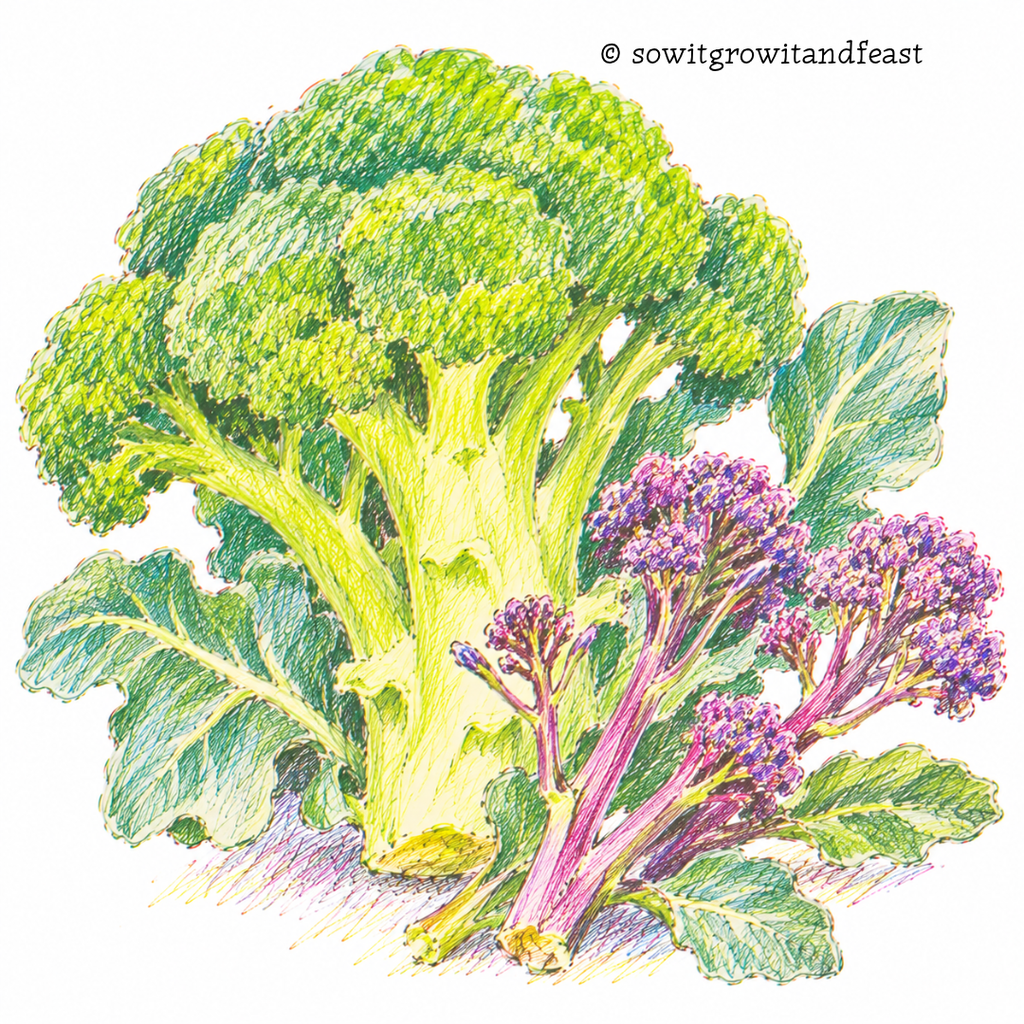
It produces a large central green head made up of tightly packed flower buds, supported by a substantial stem.
Unlike many traditional sprouting broccolis, Calabrese is generally grown as a relatively quick summer or autumn crop.
After harvesting the main head, some varieties produce smaller side shoots, extending the harvest for several weeks.
It is a useful choice if you want a dependable crop without waiting through winter.
Varieties worth considering include ‘Green Magic’ F1 and ‘Marathon’ F1, both popular for their well-formed heads.
Purple Sprouting Broccoli – A Springtime Favourite
<text color=”secondary” italic>Brassica oleracea Italica Group</text>
If Calabrese is the dependable summer vegetable, purple sprouting broccoli is one of the great pleasures of the late winter and early spring kitchen garden.
Its plants grow considerably larger, often spending much of the year developing strong stems and foliage before producing their harvest.
Traditional varieties are usually sown in spring or early summer, planted out during summer and harvested the following year.
When much of the vegetable garden is still recovering from winter, their slender purple shoots begin to appear.
It is a wonderful sight.
The florets are tender and sweet, and the stems are delicious when lightly steamed or roasted.
Varieties such as ‘Early Purple Sprouting’ and ‘Claret’ F1 are worth exploring, although harvesting times vary.
Romanesco – A Vegetable with a Rather Remarkable Appearance
<text color=”secondary” italic>Brassica oleracea Botrytis Group</text>
Romanesco is one of those vegetables that makes you stop and look twice.
Its lime-green head is composed of pointed, spiralling florets arranged in intricate repeating patterns.
It looks almost too beautiful to eat.
Botanically, Romanesco is generally classified with cauliflowers rather than true broccoli, although it is often sold as Romanesco broccoli.
It has a mild, slightly nutty flavour and a firmer texture than many traditional cauliflowers.
Romanesco prefers steady growing conditions and is commonly cultivated for autumn harvesting in Britain.
It can be a little more demanding than Calabrese, but the result is certainly worth the effort.
Broccoli Raab – Something a Little Different
<text color=”secondary” italic>Brassica rapa Ruvo Group</text>
Broccoli raab, also known as rapini or cime di rapa, is not the same species as ordinary broccoli.
It is more closely related to turnips.
Rather than producing a large central head, it is grown for its tender leaves, stems and small flowering shoots.
Its flavour is pleasantly bitter, making it particularly useful in Italian-inspired cooking.
Broccoli raab grows relatively quickly and is best cultivated during cooler weather, when it is less likely to bolt prematurely.
It is a lovely addition to the vegetable patch if you enjoy trying something beyond the familiar.
Why Grow Your Own Broccoli?
There are plenty of reasons to make room for broccoli in the garden.
For a start, it is wonderfully nutritious.
Broccoli provides vitamin C, vitamin K, folate and dietary fibre, alongside naturally occurring plant compounds known as glucosinolates.
When broccoli is chopped or chewed, some glucosinolates can be converted into compounds such as sulforaphane, which have attracted scientific interest for their potential biological effects.
However, broccoli is not a miracle food, and claims that it prevents or cures particular diseases go beyond what the evidence can reliably establish.
Its real value lies in being part of a varied, balanced diet rich in vegetables.
Then there is the pleasure of freshness.
Broccoli begins to lose quality after harvesting, particularly if it is stored for too long or allowed to become warm.
Growing your own means you can pick exactly what you need and bring it into the kitchen while it is still beautifully fresh.
And because you choose how your crop is grown, you can make decisions about soil care, compost, pest management and the use of garden resources.
There is also something quietly satisfying about growing a vegetable that might otherwise seem rather ordinary.
A head of broccoli looks considerably more impressive when you have watched it develop from a tiny seed.
When Should You Sow Broccoli in the UK?
The answer depends on which type you are growing.
This is where a little planning becomes particularly important.
Calabrese
Calabrese is generally sown from March to June, depending on the variety and intended harvesting period.
Early sowings can be started under cover, while later sowings can be made outdoors once conditions are suitable.
Plants usually mature during summer or autumn.
Purple Sprouting Broccoli
Traditional purple sprouting broccoli is commonly sown from March to May or June.
Young plants are established during summer and left to grow through autumn and winter.
Many varieties produce their main harvest between February and April the following year, although some crop earlier or later.
It requires patience, but that early spring harvest can be particularly welcome.
Romanesco
Romanesco is often sown during spring or early summer for autumn cropping.
It prefers relatively steady temperatures during head development, so check the recommended sowing and harvesting period for your chosen variety.
Broccoli Raab
Broccoli raab is generally best sown in spring or late summer for harvesting in cooler conditions.
It develops quickly and may be ready within approximately six to ten weeks, depending on the variety and weather.
The important lesson is that broccoli is not a single crop with one universal growing calendar.
Choosing the right variety for the season makes an enormous difference.
Choosing the Best Place to Grow Broccoli
Broccoli likes fertile soil, reliable moisture and plenty of light.
Most varieties perform best in a sunny position, although they can tolerate some light shade.
The soil should be reasonably moisture-retentive but well drained, with a pH generally around 6.5–7.5.
Brassicas are particularly sensitive to acidic soils where clubroot is present, so it is worth checking your soil pH if you have experienced problems with this disease.
Broccoli also benefits from firm soil.
Unlike some vegetables that enjoy freshly loosened ground, brassicas generally establish better when their roots have good contact with settled soil.
Preparing the Vegetable Bed
Begin by removing weeds and incorporating well-rotted garden compost if the soil needs improving.
If you practise no-dig gardening, a surface mulch of mature compost can provide a suitable growing medium while helping maintain soil structure.
Avoid adding large quantities of fresh manure immediately before planting.
Broccoli is a relatively hungry crop, but excessive feeding is not necessarily beneficial.
The aim is to provide fertile, balanced growing conditions that encourage steady development rather than sudden bursts of soft growth.
If your soil is acidic, a soil test will help determine whether liming is appropriate.
Do not add lime simply because you are growing brassicas. The existing soil pH and the needs of other crops should guide the decision.
How to Sow Broccoli Seeds
Broccoli is usually started in seed trays, modules or a nursery bed before being transplanted to its final position.
This is particularly useful for purple sprouting broccoli, which occupies a substantial amount of space once mature.
Sowing in Modules
Fill a seed tray or modules with peat-free seed compost.
Sow the seeds approximately 1–2cm deep, following the instructions on the packet.
Water gently and place somewhere bright and sheltered.
Most broccoli seeds germinate readily in moderately warm conditions, often within one or two weeks.
Once the seedlings have developed their first true leaves, thin them if necessary so that each module contains one strong plant.
Keep the compost moist but not waterlogged.
Planting Out
When the young plants are sturdy enough to handle and have developed several true leaves, they can be moved to their final growing position.
Harden off plants raised under cover by gradually introducing them to outdoor conditions.
Choose a mild day for planting if possible.
Water the plants beforehand, then set them into the soil at the spacing recommended for the variety.
Firm the soil gently around the roots and water thoroughly.
How Far Apart Should Broccoli Plants Be?
Spacing varies considerably.
Calabrese often needs approximately 40–60cm between plants, depending on the variety.
Traditional purple sprouting broccoli can become much larger and may need 60–90cm or more.
Romanesco also requires generous spacing, commonly around 45–60cm.
Broccoli raab is generally grown more closely together.
Giving plants sufficient room encourages good air circulation and allows the leaves to develop without excessive competition.
It may seem extravagant when the seedlings are small, but a mature purple sprouting broccoli plant can become a surprisingly substantial presence in the garden.
Caring for Broccoli Through the Growing Season
Once established, broccoli is relatively straightforward to maintain.
However, it does appreciate consistency.
Watering
Broccoli grows best when the soil remains evenly moist.
During prolonged dry weather, water thoroughly, particularly while plants are establishing and when heads or shoots are developing.
Irregular watering can stress plants and affect the quality of the harvest.
Rather than watering little and often, aim to moisten the root zone properly when irrigation is needed.
A layer of organic mulch can help retain moisture and suppress weeds.
Feeding
Broccoli needs adequate nutrients to support its substantial foliage and developing flower heads.
If your soil is fertile and has been regularly improved with compost, additional feeding may be limited.
On poorer soils, a suitable balanced fertiliser can help, following the manufacturer’s guidance.
Avoid applying large quantities of nitrogen without considering the condition of the soil.
Too much can encourage excessive leafy growth and may contribute to environmental nutrient losses.
Supporting Taller Plants
Purple sprouting broccoli can become tall and top-heavy, particularly in exposed gardens.
As autumn approaches, strong winds may loosen plants or cause them to lean.
Firming the soil around the base and providing sturdy stakes where necessary can help prevent damage.
In particularly windy positions, support is best installed before the worst weather arrives.
There is little pleasure in discovering that a plant you have nurtured for eight months has been flattened by a January gale.
Protecting Broccoli from Pests
Unfortunately, broccoli is popular with rather more creatures than the gardener.
As a member of the brassica family, it attracts several familiar pests.
The good news is that much of the damage can be prevented with simple physical protection.
Cabbage White Butterflies and Caterpillars
Large and small white butterflies lay eggs on brassica leaves.
Once the caterpillars hatch, they can make surprisingly short work of the foliage.
Fine insect-proof mesh, securely fitted over a suitable frame, is one of the most effective ways to protect plants.
Check that the mesh does not rest directly against the leaves, as butterflies may still be able to lay eggs through it.
Inspect plants regularly and remove eggs or caterpillars where practical.
Cabbage Root Fly
Cabbage root fly larvae feed on the roots of brassicas, causing wilting, stunted growth and sometimes plant death.
Protecting young plants with suitable insect-proof mesh or brassica collars can reduce the risk.
Once larvae are feeding underground, control becomes much more difficult.
Prevention is therefore particularly worthwhile.
Aphids
Aphids sometimes gather on broccoli leaves and developing shoots.
Small infestations can often be managed by removing affected growth or washing the insects away.
Encouraging ladybirds, hoverflies and lacewings can also help support natural control.
A garden containing flowers, hedges and varied habitats provides valuable resources for these beneficial insects.
Slugs and Snails
Young broccoli plants are vulnerable to slug and snail damage, particularly during damp weather.
Check seedlings regularly and protect them where necessary.
Established plants are usually more resilient, although severe infestations can still cause problems.
Common Broccoli Diseases
Healthy soil, good spacing and appropriate crop rotation can help reduce disease problems.
However, there are a few conditions worth recognising.
Clubroot
Clubroot is a serious soil-borne disease affecting brassicas.
It causes swollen, distorted roots and can lead to stunted growth, wilting and poor development.
The organism responsible can survive in soil for many years.
If clubroot is present, avoid moving contaminated soil between beds, improve drainage where necessary and consider resistant varieties.
Maintaining an appropriate soil pH can help reduce disease severity, but liming is not a guaranteed cure.
Downy Mildew
Downy mildew may cause yellowing patches and fungal growth on leaves, particularly in cool, damp conditions.
Good spacing, ventilation and avoiding prolonged wet foliage can help reduce the risk.
Brassica White Blister
White blister can cause raised white pustules and distorted growth on brassica leaves and stems.
Remove badly affected material and avoid overcrowding plants.
Where diseases recur, changing the growing position and choosing suitable resistant varieties may be helpful.
When Is Broccoli Ready to Harvest?
This is where understanding the different types becomes particularly important.
Harvesting Calabrese
Calabrese should be harvested when the central head is fully developed, firm and tightly packed.
The individual flower buds should still be closed.
If the buds begin to loosen or show yellow petals, the plant is moving towards flowering and the head may become less tender.
Use a sharp knife to cut the main stem below the head, leaving sufficient foliage on the plant to support any subsequent side shoots.
Some varieties will continue producing smaller shoots for several weeks.
Harvesting Purple Sprouting Broccoli
Purple sprouting broccoli is harvested differently.
Rather than waiting for one large head, pick the tender flowering shoots as they develop.
Cut the central shoot first, before the flower buds open.
This encourages the development of additional side shoots, which can be harvested regularly.
During productive periods, check the plants every few days.
The shoots are at their best when the buds are still tight and the stems are tender.
There is something particularly satisfying about harvesting purple sprouting broccoli in early spring, when the vegetable garden may otherwise have relatively little to offer.
Harvesting Romanesco
Harvest Romanesco when the head is well formed, firm and compact.
The distinctive pointed florets should remain tightly arranged.
Cut the head with a sharp knife, leaving a few surrounding leaves if you wish to protect it during handling.
Harvesting Broccoli Raab
Broccoli raab is usually harvested while the flower buds are still closed and the stems remain tender.
The young leaves, stems and buds can all be cooked.
Unlike Calabrese, it is grown for its leafy flowering shoots rather than a large central head.
How to Store Freshly Harvested Broccoli
Broccoli is best eaten as soon as possible after harvesting.
Its flavour and texture are at their finest when fresh, and the flower buds can deteriorate relatively quickly once cut.
If you are not using it immediately, refrigerate the harvest promptly.
Keep it in a suitable container or loosely closed bag in the vegetable drawer.
For the best quality, aim to use fresh broccoli within three to five days, although it may remain usable for longer under good storage conditions.
Freezing Broccoli
Freezing is an excellent way to preserve a generous harvest.
Cut the broccoli into evenly sized florets, wash thoroughly and blanch in boiling water.
Small florets generally need around three minutes, followed by immediate cooling in iced water.
Drain thoroughly, dry and pack into freezer-safe containers or bags.
Frozen broccoli is best used within approximately eight to twelve months for good quality.
It is particularly useful for soups, pasta dishes and vegetable bakes during the colder months.
Making the Most of Broccoli in the Kitchen
One of the advantages of growing broccoli is its versatility.
It can be steamed, roasted, stir-fried, added to soups or served simply with butter and a squeeze of lemon.
And there is no need to waste the stems.
The thicker stems of Calabrese are perfectly edible. Simply peel away any tough outer skin and slice the tender centre for cooking.
Young, healthy broccoli leaves can also be eaten, particularly when cooked like kale or cabbage.
Roasted Broccoli with Garlic and Lemon
Roasting brings out broccoli’s natural sweetness and gives the florets wonderfully crisp edges.
Ingredients
- 1 large head of Calabrese broccoli
- 2 tablespoons olive oil
- 2 garlic cloves, finely sliced
- Finely grated zest of half a lemon
- A squeeze of lemon juice
- Sea salt and freshly ground black pepper
Method
Preheat the oven to 200°C, or 180°C fan.
Cut the broccoli into evenly sized florets, slicing the peeled stem into smaller pieces.
Toss with olive oil and seasoning, then spread across a baking tray.
Roast for approximately 15 minutes before adding the sliced garlic.
Continue cooking for another 5–10 minutes, until the broccoli is tender with lightly crisp edges and the garlic is golden.
Finish with lemon zest and a squeeze of juice.
Serve immediately.
Purple Sprouting Broccoli with Butter and Toasted Almonds
Purple sprouting broccoli needs very little embellishment.
Ingredients
- 300g purple sprouting broccoli
- 25g butter
- 30g flaked almonds
- A squeeze of lemon juice
- Black pepper
Method
Trim any particularly tough ends from the broccoli stems.
Steam for approximately 4–6 minutes, depending on their thickness, until just tender.
Meanwhile, toast the almonds in a dry frying pan until lightly golden.
Melt the butter, add the cooked broccoli and toss gently.
Finish with the almonds, lemon juice and black pepper.
It makes a lovely accompaniment to a spring lunch, particularly when the broccoli has been picked only moments before cooking.
What to Grow After Broccoli
Once the final harvest has been gathered, the plants can be removed to make room for another crop.
Healthy leaves and stems can be chopped and added to the compost heap.
If you have experienced significant disease problems, dispose of affected material appropriately rather than risking contamination.
Broccoli is a brassica, so it is sensible to avoid repeatedly growing brassicas in the same bed.
A crop rotation system can help reduce the build-up of some pests and diseases, although it cannot eliminate every problem.
Depending on the season, the cleared space might be used for lettuce, beetroot, peas or another suitable crop.
It is one of the quiet pleasures of vegetable gardening: as one crop finishes, another begins.
The garden is never entirely standing still.
The Particular Reward of Growing Broccoli
Broccoli is not always the quickest vegetable to grow.
Some varieties demand months of patience, careful protection and a certain willingness to share the garden with caterpillars, however reluctantly.
But perhaps that is part of its appeal.
A purple sprouting broccoli plant, established during the warmth of summer and harvested as winter gives way to spring, tells the story of an entire growing season.
It has stood through autumn rain, winter frost and the occasional gale, gathering strength for a harvest that arrives just when fresh vegetables feel especially welcome.
Calabrese offers a different pleasure: the satisfaction of cutting a beautiful green head from the garden and carrying it straight into the kitchen.
And Romanesco reminds us that nature has an extraordinary talent for creating beauty in the most unexpected places.
Growing broccoli encourages us to think beyond the immediate harvest.
To plan ahead, care for the soil, protect the plants and appreciate the changing seasons.
And when the time finally comes to gather those first tender shoots, there is a satisfaction that no supermarket purchase can quite replicate.
So make a little room for broccoli in your vegetable garden.
Choose a variety that suits your space and the season, give it the conditions it needs, and allow it the time to grow.
Some of the best things in gardening, after all, are worth waiting for.
Further Reading: Why Growing Food Makes You Feel Better, Take the Guesswork Out of Growing Veg, How to Create a Garden That Feeds Your Family, How to Start a Vegetable Garden Now Ready for Spring
Follow us on Instagram, Threads, BlueSky, Twitter, Pinterest & Facebook
Not sure where to start? Take a look at our Grow Your Own Packs with detailed step by step instructions, seeds and 1 years online support.