
There is something rather extraordinary about a seed. Small enough to disappear into the palm of your hand, unremarkable to look at and yet holding the promise of something entirely different. A handful of salad leaves, a fragrant herb, a vase of summer flowers or perhaps the beginnings of a meal shared around the kitchen table.
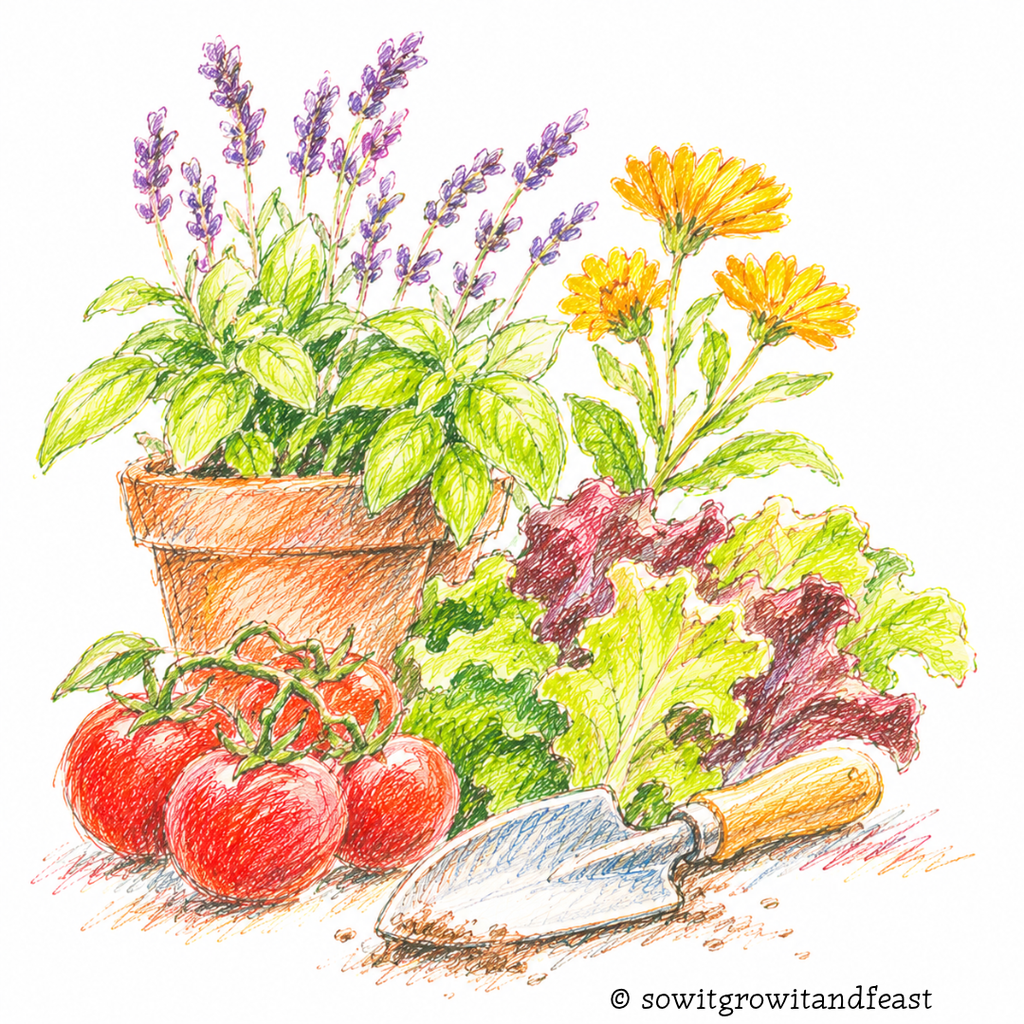
All from something so small.
Gardening has a wonderful way of reminding us that the most satisfying things in life often begin with a little patience.
The first shoots pushing through the compost. The excitement of discovering a flower bud. The pleasure of gathering something fresh from the garden and carrying it into the kitchen.
These are simple moments, but they have a value far beyond the harvest itself.
And you do not need an enormous garden, years of experience or an impressive collection of gardening equipment to enjoy them.
Sometimes all it takes is a few seeds, a little encouragement and the willingness to see what happens.
That is the idea behind Sow It, Grow It and Feast.
Helping more people discover the pleasure of growing their own food, herbs and flowers, and making the journey from seed to harvest something to enjoy rather than something to worry about.
From a Little Seed, Something Wonderful Can Grow
There was a time when growing food was an ordinary part of household life.
A few rows of vegetables, herbs near the kitchen door and perhaps a corner of the garden given over to flowers for cutting.
The garden provided ingredients for meals, flowers for the house and, occasionally, rather more runner beans than anyone knew what to do with.
Today, many of us are rediscovering the appeal of growing something for ourselves.
Perhaps it is the desire to eat more seasonally.
Perhaps it is the satisfaction of knowing where our food comes from.
Or perhaps it is simply the pleasure of spending time outdoors, watching the seasons unfold and discovering that a little attention can produce something quite remarkable.
Whatever brings us to gardening, the first steps can sometimes feel daunting.
When should the seeds be sown?
How much space will they need?
What happens if nothing grows?
And how do you know when something is ready to harvest?
The answer, of course, is that gardening is learned gradually.
Nobody begins knowing everything.
Even experienced gardeners have their failures, their surprises and their occasional disagreements with the weather.
The important thing is to begin.
What Is Sow It, Grow It and Feast?
Sow It, Grow It and Feast is built around a simple idea.
Growing something should be as enjoyable as using it.
Our thoughtfully assembled garden sets bring together seeds and practical guidance to help you explore different kinds of growing.
Some are designed around food.
Others celebrate herbs, flowers or plants traditionally associated with wellbeing.
Each offers a starting point for discovering something new, whether you have a vegetable garden, a sunny patio, a few containers or a small space that could benefit from a little greenery.
The aim is not to create a perfect garden.
It is to encourage curiosity, build confidence and enjoy the experience.
From the first seeds sown to the final harvest, every stage has something to offer.
And while we cannot promise that every seed will germinate or that the British weather will always cooperate, we can help make the journey a little easier to understand.
Growing Your Own Food: A Different Kind of Satisfaction
There is a particular pleasure in preparing a meal using ingredients you have grown yourself.
A handful of freshly picked lettuce.
A few ripe tomatoes still warm from the sunshine.
Some fragrant basil gathered moments before supper.
These things may seem small, but they change our relationship with food.
We become more aware of the seasons, more appreciative of the work involved in growing and perhaps a little more thoughtful about what we waste.
A tomato is no longer simply a tomato.
It is the seed you sowed in spring, the seedling you carefully watered and the plant you watched grow through the summer.
And somehow, that makes it taste all the better.
Feed Your Family
Our Feed Your Family garden sets celebrate the pleasure of growing ingredients for everyday meals.
Vegetables such as tomatoes, cucumbers and lettuce can become the starting point for a productive kitchen garden.
They also offer an opportunity to learn how different crops grow, when they are ready to harvest and how to make the most of what they produce.
Growing your own vegetables does not mean becoming entirely self-sufficient.
For most households, that would require considerably more land, time and effort than is practical.
But even a modest harvest can supplement the weekly shop and bring something fresh and satisfying to the table.
And there is something wonderfully reassuring about knowing that at least part of supper came from your own efforts.
A Salad Garden of Your Own
Few things capture the freshness of summer quite like a bowl of salad gathered from the garden.
Crisp lettuce, peppery rocket, tender leaves and fragrant herbs can turn even the simplest meal into something special.
Our Salad Patch garden sets offer a way to explore growing ingredients that can be harvested and enjoyed fresh.
Salad crops are particularly rewarding for beginners.
Many grow relatively quickly, and some can be harvested a few leaves at a time, allowing the plants to continue producing.
They are also well suited to smaller growing spaces.
A few containers on a sunny patio can provide useful harvests without the need for a traditional vegetable plot.
The secret is to sow little and often.
After all, there is only so much lettuce one household can reasonably eat in a week.
Growing Herbs for the Kitchen and Teapot
Herbs are among the most useful plants we can grow.
They bring fragrance to the garden, flavour to the kitchen and, in some cases, ingredients for a comforting herbal infusion.
A few pots near the kitchen door can be surprisingly productive.
And unlike a packet of supermarket herbs, a well-cared-for plant may continue providing fresh leaves throughout the growing season.
Grow Your Own Tea
Our Grow Your Own Tea garden sets celebrate plants traditionally used to make herbal infusions.
Chamomile, mint and lavender are familiar examples, each bringing its own distinctive fragrance and character.
There is something rather lovely about gathering a few leaves or flowers, bringing them indoors and preparing a cup of tea from plants you have nurtured yourself.
It encourages a slower pace.
A moment to step outside, notice what is growing and enjoy the simple ritual of preparing something fresh.
Of course, not every plant is suitable for consumption, and herbs should always be correctly identified before use.
Some may also be unsuitable during pregnancy, when taking particular medicines or for people with certain health conditions.
But with suitable edible varieties and a little knowledge, a herbal tea garden can be a delightful addition to a growing space.
Flowers: Growing Beauty to Bring Indoors
Not everything we grow needs to end up on the dinner table.
Sometimes the harvest is simply a handful of flowers.
A vase of freshly cut blooms can bring the garden indoors, carrying with it the colours and character of the season.
And there is something especially pleasing about arranging flowers you have grown yourself.
They need not be perfectly matched or professionally arranged.
A few stems gathered together can be every bit as beautiful as an elaborate bouquet.
Flourishing Flowers
Our Flourishing Flowers garden sets offer the opportunity to explore growing flowers for cutting and enjoying at home.
A cutting garden can be as modest or ambitious as space allows.
Even a small bed or collection of suitable containers can provide flowers during the growing season.
Many annual flowers are particularly rewarding because they grow, flower and complete their life cycle within one year.
Some also produce further blooms when flowers are cut regularly.
The result can be a changing display of colour throughout summer.
And if a few flowers are left for bees and other pollinating insects, the garden can provide pleasure for more than just the household.
Plants with a History of Healing
For centuries, people have grown plants for their fragrance, culinary uses and traditional associations with health and wellbeing.
Many of these plants have fascinating histories.
They appear in old herbals, cottage gardens and accounts of domestic life, offering a glimpse into how earlier generations understood and used the natural world.
Medicinal Marvels
Our Medicinal Marvels garden sets explore plants traditionally associated with herbal remedies and wellbeing.
Plants such as echinacea and aloe vera have long histories of use, although traditional use does not necessarily mean that a treatment is effective or safe.
Growing these plants can be an interesting way to learn about botanical history, cultivation and the relationship between people and plants.
However, a medicinal plant garden should not be regarded as a substitute for a first-aid kit or professional medical care.
Some plants can cause adverse reactions, interact with medicines or be harmful if used incorrectly.
Their value in the garden may lie just as much in their beauty, history and botanical interest as in any traditional use.
A Little Guidance Goes a Long Way
One of the greatest obstacles for new gardeners is not a lack of enthusiasm.
It is uncertainty.
There is an enormous amount of gardening information available, and it can sometimes be difficult to know where to begin.
Advice may differ according to climate, soil type, variety and growing conditions.
What works beautifully in a sheltered garden in Cornwall may be rather less successful in an exposed garden in Norfolk.
That is why practical guidance matters.
Our garden sets are designed to make the growing process more approachable, with information to help you understand the needs of the plants you are cultivating.
From sowing and planting to caring for young plants and recognising when something is ready to harvest, the aim is to help you develop confidence as you grow.
And confidence often begins with something very simple.
The first seed that germinates.
The first plant that flowers.
The first harvest you carry into the kitchen.
Once you have experienced that, it becomes rather difficult not to wonder what else you might grow.
A Thoughtful Gift That Keeps Growing
There are gifts that are enjoyed for a moment, and others that become part of a much longer story.
A garden set offers the promise of something still to come.
Seeds to sow.
Plants to nurture.
Flowers to gather.
Food to cook and share.
For someone who has always wanted to try gardening, it can provide the encouragement to begin.
For an experienced gardener, it may offer an opportunity to explore something different.
And for families, growing together can become a lovely shared activity.
Children can discover how seeds germinate, why plants need light and water, and how vegetables develop.
There will be successes and disappointments.
Occasionally, something may be eaten by a slug before anyone else gets the opportunity.
But even that is part of learning how gardens work.
The pleasure is not simply in the finished plant.
It is in everything that happens along the way.
Growing More Thoughtfully
Growing your own food and flowers can encourage a more thoughtful approach to the resources we use.
We begin to appreciate the importance of healthy soil.
We notice how much water plants need during dry weather.
We learn to recognise the insects visiting our flowers and the earthworms working beneath the surface.
And perhaps we become more aware of the relationship between the garden and the wider natural world.
A productive garden need not be expensive or complicated.
Reusing suitable containers, making compost, collecting rainwater and choosing plants appropriate to local conditions can all help reduce waste.
Growing at home is not automatically more environmentally friendly than buying produce, particularly when large amounts of energy or new materials are required.
But thoughtful growing practices can make a positive contribution.
And they encourage something valuable in their own right.
A greater understanding of how food and plants are produced.
From Seed to Something Worth Celebrating
Gardening has a way of making us notice things we might otherwise overlook.
The gradual lengthening of the days.
The warmth returning to the soil.
The first flowers opening.
The moment when a vegetable is finally ready to harvest.
It teaches patience, observation and the ability to accept that not everything will go according to plan.
A late frost may catch us by surprise.
A seed may fail to germinate.
A carefully nurtured plant may become an unexpected feast for the local wildlife.
But there is always something to learn.
And usually something new to try.
At Sow It, Grow It and Feast, that is what we hope to encourage.
Not simply the growing of vegetables, herbs and flowers, but the enjoyment of the whole experience.
The anticipation of sowing.
The satisfaction of nurturing.
The pleasure of harvesting.
And the simple joy of sharing what you have grown.
You do not need to begin with a grand plan.
A few seeds and a little curiosity are quite enough.
Because every garden, however small, begins with possibility. And sometimes the most wonderful things we grow are not simply the plants themselves, but the pleasure, knowledge and confidence we discover along the way.
Further Reading: Why Growing Food Makes You Feel Better, Take the Guesswork Out of Growing Veg, How to Create a Garden That Feeds Your Family, How to Start a Vegetable Garden Now Ready for Spring
Follow us on Instagram, Threads, BlueSky, Twitter, Pinterest & Facebook
Not sure where to start? Take a look at our Grow Your Own Packs with detailed step by step instructions, seeds and 1 years online support.