There is something rather lovely about a row of homemade pickles sitting on a kitchen shelf.
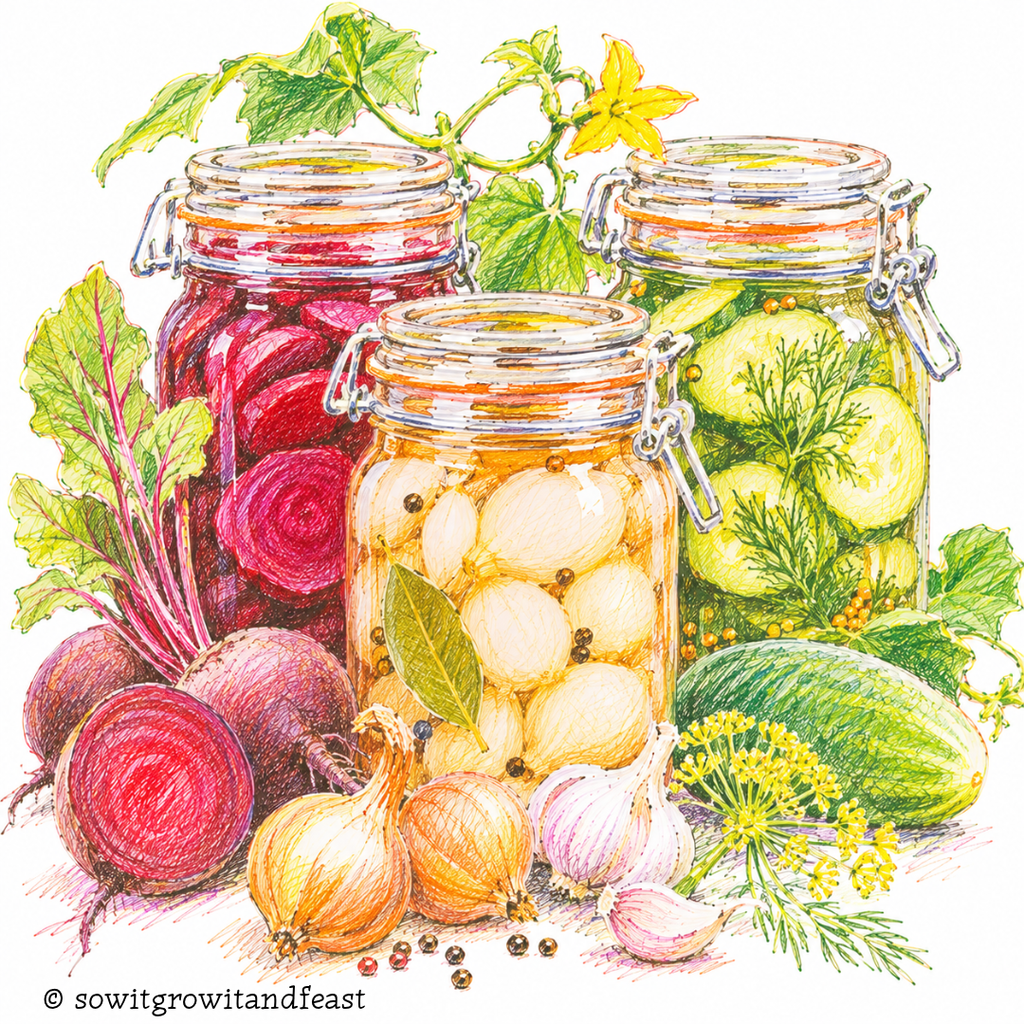
The deep purple of beetroot, the golden warmth of spiced onions, the delicate pink of pickled radishes and the bright greens of cucumbers. Each jar holds something of the garden, carefully gathered and prepared, ready to bring a little flavour to another day.
And there is something reassuring about that.
Especially in autumn, when the vegetable beds are beginning to empty, the mornings have acquired a definite chill and the last of the harvest is arriving in the kitchen.
Perhaps there are more cucumbers than anyone could reasonably eat. Perhaps the beetroot has grown beautifully, or the onions have rewarded your efforts with a particularly generous crop.
Or perhaps, despite your best intentions, you have discovered another courgette hiding beneath the leaves, now approaching the size of a small submarine.
This is where pickling comes into its own.
For generations, people have used vinegar, salt and fermentation to preserve vegetables, making the most of seasonal abundance and bringing welcome variety to meals when fresh produce was less readily available.
Today, we may have refrigerators, freezers and supermarkets, but the pleasure of pickling remains.
It is practical, economical and wonderfully satisfying.
And there is something rather special about opening a jar in the middle of winter and remembering the afternoon when its contents were still growing in the garden.
What Exactly Is Pickling?
At its simplest, pickling is a way of preparing food using acidity, either by adding vinegar or by allowing beneficial microorganisms to produce acid through fermentation.
The result is food with a distinctive sharpness, often balanced by sweetness, salt and spices.
But not all pickles are made in quite the same way.
There are two principal methods, and understanding the difference is important, particularly when it comes to safe storage.
Vinegar Pickling
This is the method most familiar in British kitchens.
Vegetables are combined with vinegar, often alongside sugar, salt, herbs and spices.
The vinegar provides the characteristic tangy flavour and, when used in a properly formulated recipe, helps create conditions that inhibit the growth of harmful microorganisms.
Think of traditional pickled onions, beetroot, red cabbage and gherkins.
Some vinegar pickles are designed to be kept in the refrigerator and eaten relatively soon after preparation.
Others are made using tested preserving recipes and an appropriate heat-processing method, allowing unopened jars to be stored safely at room temperature.
The distinction matters.
Simply pouring vinegar over vegetables and sealing a jar does not automatically make it safe for long-term cupboard storage.
Fermented Pickles
Fermentation takes a different approach.
Rather than relying on vinegar to provide acidity, vegetables are prepared under controlled conditions that encourage lactic acid bacteria to convert naturally occurring sugars into lactic acid.
This is how foods such as traditional sauerkraut and many fermented cucumber pickles are made.
The process creates their distinctive sour flavour.
Fermentation requires the correct salt concentration, suitable temperatures, clean equipment and careful attention to the process.
Vegetables must remain properly submerged, and the acidity must develop sufficiently for the finished product to be safe.
Some unpasteurised fermented vegetables contain live microorganisms, although not every fermented food necessarily provides clinically established probiotic benefits.
Both methods have their place.
For anyone beginning their preserving journey, refrigerated vinegar pickles are a particularly approachable place to start.
A Little History: Pickling Through the Ages
Pickling has a history stretching back thousands of years.
Long before modern refrigeration, people across different parts of the world developed ways of preserving food using salt, acidity, drying and fermentation.
These methods helped communities make use of seasonal harvests and reduce losses during periods when fresh food was scarce.
Pickled and fermented vegetables became important features of many culinary traditions.
In East Asia, a remarkable variety of vegetables have long been salted, fermented and seasoned.
Across Europe, cabbage, cucumbers and other vegetables became familiar preserved foods.
And in the Indian subcontinent, pickles known as achaar developed into an extraordinary family of condiments, prepared with different combinations of vegetables, fruits, spices, salt and oil.
The history of pickling is not one single story.
It is a collection of traditions shaped by local ingredients, climate, culture and necessity.
Pickling in Britain
In Britain, preserving was once an essential part of managing the household harvest.
Before refrigeration became commonplace, families needed ways to make seasonal produce last.
Vegetables were stored in cool places, fruit was bottled or made into preserves, and pickling offered another useful method of keeping food for later use.
Onions, walnuts, cucumbers, cabbage and beetroot became particularly familiar ingredients.
By the eighteenth and nineteenth centuries, recipes for pickles appeared regularly in household cookery books.
Mrs Beeton’s Book of Household Management, published in 1861, included a variety of pickling and preserving instructions, reflecting how important these skills were considered in Victorian households.
Spices such as cloves, mustard seeds, peppercorns and mace brought additional flavour to the preserving pan.
Over time, pickles became more than a practical way of storing vegetables.
They became an established part of British food culture.
A sharp pickled onion alongside mature Cheddar.
Beetroot tucked into a sandwich.
Piccalilli with cold meats.
Or a generous spoonful of red cabbage beside a winter supper.
These are familiar combinations for good reason.
The acidity of pickles provides a lovely contrast to rich, savoury foods.
And sometimes that little sharpness is exactly what a meal needs.
Why Pickle Your Own Vegetables?
There are plenty of practical reasons to make homemade pickles.
But I think one of the nicest is simply that it changes how we look at the harvest.
A cucumber is no longer just something to slice into a salad.
A beetroot is not limited to being roasted or boiled.
And a generous crop of onions becomes an opportunity rather than a storage problem.
Making the Most of Seasonal Abundance
Vegetable gardens have a habit of producing food in their own time.
You may spend weeks waiting for the first cucumber.
Then suddenly there are twelve.
Pickling allows you to use some of that abundance in a different way.
Reducing Food Waste
Sound vegetables that are surplus to immediate needs can often be used for pickling.
They should still be fresh, firm and free from rot or mould.
Preserving cannot make spoiled vegetables safe to eat.
Experimenting with Flavour
Homemade pickles offer wonderful opportunities to explore different flavour combinations.
Mustard seeds with onions.
Dill with cucumbers.
Ginger with beetroot.
Peppercorns and bay leaves with carrots.
Even a small change in the spices can create a very different result.
For refrigerated pickles, there is room to experiment within a reliable recipe.
For shelf-stable preserves, however, follow tested proportions and processing instructions rather than improvising the acidity.
A Connection to the Seasons
Perhaps most importantly, pickling encourages us to notice what is growing.
Spring radishes.
Summer cucumbers.
Autumn beetroot.
Winter cabbage.
Each vegetable has its moment, and each brings something different to the preserving jar.
What Can You Pickle from the Vegetable Garden?
One of the pleasures of pickling is the extraordinary variety of vegetables that can be used.
Some are traditional favourites.
Others may surprise you.
Cucumbers – Cucumis sativus
Cucumbers are among the most familiar vegetables for pickling.
Small, firm varieties are particularly well suited to making gherkins.
Fresh dill, mustard seeds and garlic are traditional flavourings.
For the best texture, use cucumbers as soon after harvesting as possible.
Onions – Allium cepa
Small pickling onions are a British favourite.
Their sharpness softens in vinegar, while spices add warmth and depth.
Shallots can also make excellent pickles.
Beetroot – Beta vulgaris
Beetroot brings wonderful colour to a jar.
Its natural sweetness works beautifully with the sharpness of vinegar.
Cooked beetroot can be sliced, diced or cut into wedges before pickling.
Carrots – Daucus carota subsp. sativus
Carrots are lovely when pickled.
Their sweetness and firm texture work well with ginger, coriander seeds and mustard seeds.
Slice them into thin rounds or slender batons.
Cauliflower – Brassica oleracea var. botrytis
Cauliflower is particularly good in mixed vegetable pickles and piccalilli.
Its florets absorb flavour while retaining a pleasant bite when properly prepared.
French Beans – Phaseolus vulgaris
Young, tender French beans can be pickled whole.
They work particularly well with garlic, dill and mustard seeds.
Radishes – Raphanus sativus
Radishes make wonderfully colourful quick pickles.
Thinly sliced red radishes can turn the surrounding vinegar a delicate pink.
They are especially good in salads and sandwiches.
Courgettes – Cucurbita pepo
Courgettes are useful when the summer harvest becomes particularly generous.
Slice them into thin rounds or ribbons.
Their mild flavour works well with mustard seeds, turmeric and onions.
Red Cabbage – Brassica oleracea var. capitata f. rubra
Pickled red cabbage is a traditional accompaniment to rich winter meals.
Its vivid colour and crisp texture make it particularly appealing.
Green Tomatoes – Solanum lycopersicum
Sound, mature green tomatoes can be used in suitable pickling recipes.
Their tart flavour and firm texture work particularly well with vinegar and spices.
Avoid using diseased fruit or very small, immature tomatoes.
And if your tomato plants have produced an abundance of green fruit at the end of the season, pickling is certainly worth considering.
Getting Started: The Equipment You Need
You do not need a kitchen full of specialist equipment to make refrigerated pickles.
A few basic items will do.
- Clean glass jars with suitable, undamaged lids
- A stainless-steel or enamel saucepan
- A sharp knife and chopping board
- Measuring jug and kitchen scales
- A clean spoon or funnel
- Fresh vegetables
- Vinegar of the acidity specified in your recipe
- Sugar, salt, herbs and spices as required
Avoid reactive cookware such as unlined aluminium, copper or iron, which can react with acidic ingredients.
For shelf-stable pickles, additional equipment and a validated heat-processing method may be required.
It is also important to follow the jar manufacturer’s guidance.
Not every decorative or reused jar is suitable for heat processing.
How to Make Refrigerated Pickles
For beginners, refrigerated vinegar pickles are a lovely introduction.
They are relatively quick to prepare, require no shelf-stable canning process and allow you to experiment with a small quantity of vegetables.
The following method is for refrigerated pickles only.
It is not intended to produce jars that can be stored unopened in a cupboard.
Step 1: Choose Your Vegetables
Select fresh, firm vegetables.
Wash them thoroughly under running water.
Trim away stalks and unwanted leaves, then prepare them according to the recipe.
Thin slices are particularly useful for quick pickles because the vinegar can penetrate them more readily.
Step 2: Prepare the Jars
Wash jars and lids thoroughly in hot, soapy water and rinse well.
Use clean, food-safe containers in good condition.
For refrigerated pickles, there is no need to rely on oven sterilisation or a vacuum seal to make the product shelf-stable.
The finished pickles must remain refrigerated.
Step 3: Prepare the Pickling Liquid
Use the quantities specified in your chosen recipe.
Vinegar provides acidity, while sugar, salt and spices contribute flavour.
For a cupboard-stored preserve, vinegar strength and the proportions of vinegar, water and vegetables are critical safety factors.
Never assume that a general vinegar-to-water ratio is safe for every vegetable or preservation method.
Step 4: Fill the Jars
Arrange the prepared vegetables in the clean jars.
Add herbs or spices if required.
Pour over the pickling liquid, ensuring the vegetables are submerged.
Leave enough space at the top to fit the lid securely.
Step 5: Refrigerate
Allow hot contents to cool promptly and refrigerate.
Keep the jars at 5°C or below.
Follow the storage time specified in your recipe.
If you are experimenting rather than following a tested refrigerated-pickle recipe, make only a small quantity and use it promptly rather than assuming it will keep for weeks.
And remember, a lid that appears to have sealed does not mean a homemade pickle is safe for cupboard storage.
Three Delicious Pickles to Make at Home
These recipes are designed for small batches, to be kept refrigerated and enjoyed promptly.
They are not tested shelf-stable preserving recipes.
1. Quick Pickled Red Onions
Bright, sharp and rather wonderful in a sandwich.
These are among the simplest pickles to make.
The onions soften slightly in the vinegar while retaining a pleasant crunch.
Their colour becomes a beautiful pink, making them a lovely addition to salads, sandwiches and savoury dishes.
Ingredients
- 2 medium red onions, thinly sliced
- 200ml cider vinegar, 5% acidity
- 100ml water
- 1 tablespoon caster sugar
- ½ teaspoon salt
- ½ teaspoon black peppercorns
- 1 small bay leaf
Method
- Place the sliced onions in a clean, heatproof glass jar or suitable container.
- Add the vinegar, water, sugar, salt, peppercorns and bay leaf to a saucepan.
- Warm gently, stirring until the sugar and salt dissolve.
- Bring briefly to a simmer.
- Pour the hot liquid over the onions, ensuring they are submerged.
- Allow to cool promptly, cover and refrigerate.
- Leave for at least a few hours, preferably overnight, before serving.
Keep refrigerated and use within 48 hours, or follow a tested refrigerated-pickle recipe for a longer specified storage period.
From the garden: Red onions are useful crops to grow from sets or seed. Suitable varieties can be harvested, cured and stored, providing a supply for autumn and winter cooking.
Serve with: Mature Cheddar, homemade burgers, roasted vegetables or a generous cheese sandwich.
2. Pink Pickled Radishes
A little jar of spring colour.
Radishes are among the most rewarding vegetables for beginners.
They germinate quickly, grow rapidly and can be ready to harvest within a matter of weeks, depending on the variety and conditions.
And if you have more than you can eat fresh, pickling offers another way to enjoy them.
Ingredients
- 250g fresh radishes, washed and thinly sliced
- 150ml white wine vinegar, 5% acidity
- 100ml water
- 1 tablespoon caster sugar
- ½ teaspoon salt
- ½ teaspoon mustard seeds
Method
- Trim the radishes and slice them thinly.
- Place in a clean, heatproof jar.
- Combine the vinegar, water, sugar, salt and mustard seeds in a saucepan.
- Warm gently until the sugar and salt dissolve.
- Bring briefly to a simmer, then pour over the radishes.
- Cool promptly, cover and refrigerate.
- Leave for several hours before serving.
Keep refrigerated and use within 48 hours.
From the garden: Sow radishes little and often during suitable growing conditions for a succession of crisp roots.
Serve with: Salads, sandwiches, grain bowls or alongside cold meats.
3. Quick Pickled Cucumber and Dill
Fresh, crisp and full of summer flavour.
There is something particularly satisfying about picking a cucumber from the greenhouse and turning it into a jar of pickles before the day is over.
Fresh dill brings a lovely fragrance, while mustard seeds provide a gentle warmth.
Ingredients
- 1 large cucumber, approximately 300g
- 200ml white wine vinegar, 5% acidity
- 100ml water
- 1 tablespoon caster sugar
- ½ teaspoon salt
- 1 teaspoon mustard seeds
- 2 sprigs fresh dill
- 1 small garlic clove, thinly sliced
Method
- Wash the cucumber and slice into thin rounds.
- Place in a clean jar with the dill and garlic.
- Combine the vinegar, water, sugar, salt and mustard seeds in a saucepan.
- Heat gently until dissolved, then bring briefly to a simmer.
- Pour the liquid over the cucumber.
- Cool promptly, cover and refrigerate.
- Leave for several hours before serving.
Keep refrigerated and use within 48 hours.
From the garden: Cucumbers appreciate warmth, fertile soil and consistent watering. Greenhouse varieties can be particularly productive in British gardens.
Serve with: Sandwiches, potato salad, cold meats or a simple summer lunch.
What About Traditional Pickled Onions and Beetroot?
Traditional British pickled onions and beetroot are often prepared with the intention of storing them for months.
They are certainly worth making.
But long-term preservation requires more than a familiar family recipe and a clean jar.
For shelf-stable pickles, use a scientifically tested recipe from a reputable food-preservation source.
Follow its instructions precisely, including:
- The type and quantity of vegetables
- Vinegar strength and liquid proportions
- Any required salting or pre-cooking
- Jar size and headspace
- The specified heat-processing method and time
- Storage instructions
Do not substitute ingredients or reduce the vinegar unless the tested recipe specifically allows it.
A traditional recipe may have been used successfully for generations, but that alone does not establish that it meets modern food-safety standards.
There is still plenty of pleasure in preserving.
It simply makes sense to preserve safely.
The Difference Between Pickling and Fermenting
Pickling and fermenting are sometimes spoken about as though they are the same thing.
They are related, but not identical.
In vinegar pickling, acidity is added directly.
In lactic acid fermentation, microorganisms produce acidity as part of the fermentation process.
Fermented vegetables can develop complex flavours that are quite different from vinegar pickles.
Sauerkraut is a familiar example.
Finely shredded cabbage is combined with a carefully measured amount of salt and fermented under controlled conditions.
The result is pleasantly sour and can be eaten as an accompaniment to a variety of dishes.
However, successful fermentation depends on following reliable guidance for salt concentration, temperature, oxygen exclusion and fermentation time.
If you would like to try fermenting, begin with a tested recipe rather than guessing at the quantities.
And do not assume that all fermented foods contain live beneficial microorganisms after processing or storage.
Are Pickled Vegetables Good for You?
Pickled vegetables can certainly form part of a varied, balanced diet.
They may retain useful amounts of fibre, minerals and some vitamins, although nutritional content varies according to the vegetable and preparation method.
Some vitamins, particularly those sensitive to heat and processing, may be reduced.
Vinegar pickles and fermented pickles also differ nutritionally.
Fermented vegetables that have not been heat-treated may contain live microorganisms, but their presence does not automatically mean a product has a proven probiotic health benefit.
It is also worth remembering that many pickles contain considerable amounts of salt, while sweet pickles may contain added sugar.
For most people, the best approach is simple.
Enjoy pickles as a flavourful accompaniment to meals rather than expecting them to provide extraordinary health benefits.
A spoonful of pickled beetroot can brighten a salad beautifully.
It does not need to perform miracles.
Growing a Garden for Pickling
If you enjoy making pickles, it is worth giving a little thought to your growing plans.
You do not need a large vegetable garden.
A few well-chosen crops can provide plenty of opportunities.
Spring
Radishes are an excellent early crop.
They grow quickly and are particularly useful for making small batches of colourful refrigerated pickles.
Summer
Cucumbers, courgettes and French beans become increasingly productive as the weather warms.
These are wonderful ingredients for pickling, particularly when the harvest begins arriving faster than you can eat it.
Autumn
Beetroot, onions, cauliflower and red cabbage are particularly useful.
They bring colour, flavour and texture to traditional British pickles.
And if your tomato plants are still carrying mature green fruit as the weather cools, there may be opportunities to use those too.
Winter
Stored onions and suitable winter vegetables can continue providing ingredients for the kitchen.
Red cabbage, in particular, is a lovely vegetable for winter cooking and pickling.
The key is to grow what you enjoy eating.
There is little point filling the garden with cucumbers if nobody in the household likes them.
Although that has never stopped an enthusiastic gardener before.
Delicious Ways to Enjoy Homemade Pickles
A jar of pickles deserves more than an occasional appearance at a summer barbecue.
They can bring brightness and contrast to all sorts of meals.
With cheese: Pickled onions and mature Cheddar are a traditional combination for good reason.
In sandwiches: Thinly sliced pickled cucumber or red onion can transform an ordinary sandwich.
Alongside roasted vegetables: A little acidity provides a lovely contrast to sweet roasted squash, carrots and parsnips.
With cold meats: Beetroot, onions and piccalilli are familiar accompaniments.
In salads: Pickled radishes add colour and a pleasant sharpness.
With homemade pies: A spoonful of pickle is particularly good with cheese and vegetable pasties.
On a ploughman’s lunch: Bread, cheese, salad, apple and pickles make a simple, satisfying meal.
Sometimes the smallest addition makes the greatest difference.
A Few Common Pickling Mistakes
Even simple recipes can go wrong occasionally.
Fortunately, many problems can be avoided with a little care.
Using Vegetables That Are Past Their Best
Pickling is a way to use surplus produce, not a way to rescue spoiled food.
Choose sound, fresh vegetables.
Discard anything showing signs of mould or decay.
Guessing at Vinegar Quantities
For shelf-stable preserves, the acidity of the finished product is essential to safety.
Never reduce the vinegar or increase the vegetables in a tested recipe without reliable guidance.
Assuming a Sealed Jar Is Safe
A vacuum seal is not proof that food has been processed safely.
The recipe and preservation method matter just as much as the lid.
Storing Refrigerated Pickles in the Cupboard
Quick pickles intended for refrigeration must stay refrigerated.
They are not interchangeable with properly processed shelf-stable preserves.
Making Too Much at Once
When experimenting with flavours, begin with a small batch.
It is much easier to discover that you dislike a particular combination when you have made one jar rather than twelve.
And far less awkward when you have already promised everyone homemade pickles for Christmas.
The Quiet Pleasure of Preserving the Harvest
There is something deeply satisfying about taking vegetables from the garden and giving them another life in the kitchen.
The first radishes of spring.
The cucumbers of high summer.
The beetroot and onions of autumn.
Each has its own season, its own character and its own place at the table.
Pickling allows us to appreciate those differences.
It encourages us to use what we grow, to waste less and to find pleasure in the simple business of preparing food.
And perhaps that is why the tradition has endured.
It is not simply about keeping vegetables for another day.
It is about making the most of the present one.
Gathering the harvest.
Washing the soil from freshly lifted roots.
Choosing herbs and spices.
And watching ordinary ingredients become something altogether more interesting.
Of course, not every jar needs to sit on a shelf for months.
Sometimes a small batch of pickled radishes, made in the morning and enjoyed with supper, is quite enough.
The pleasure is in the making as much as the eating.
And when you open a jar, whether tomorrow or later in the season, there is a little reminder of the garden that produced it.
The sunshine.
The rain.
The patient waiting.
And the small triumph of having grown something worth bringing into the kitchen.
Because preserving the harvest is not simply about saving food for later. It is about appreciating what the garden gives us, while we have it.
Sow it. Grow it. And feast on it.
Further Reading: Why Growing Food Makes You Feel Better, Take the Guesswork Out of Growing Veg, How to Create a Garden That Feeds Your Family, How to Start a Vegetable Garden Now Ready for Spring
Follow us on Instagram, Threads, BlueSky, Twitter, Pinterest & Facebook
Not sure where to start? Take a look at our Grow Your Own Packs with detailed step by step instructions, seeds and 1 years online support.