There is something wonderfully satisfying about digging potatoes.
The fork goes into the soil, the earth lifts and, one by one, pale or pink-skinned tubers begin to appear. There is always another hiding just beyond the first handful, tucked beneath a clod of soil or sitting slightly deeper than expected.
By late summer and early autumn, the potato patch can provide one of the most substantial harvests in the vegetable garden.
And unlike a bowl of raspberries or a basket of courgettes, this is a harvest that needn’t be eaten immediately.
Maincrop potatoes can be stored for months when they are harvested carefully and kept in the right conditions, carrying a little of the summer garden into roast dinners, soups, mash and jacket potatoes throughout winter.
But good storage begins before the potatoes ever reach the shed.
From knowing when to lift them to keeping out light, frost and damp, here’s how to store home-grown potatoes for winter.
Which potatoes are best for storing?
Not all potatoes are intended for long-term storage.
First early and second early potatoes are prized for their tender skins and fresh flavour, and are generally best eaten relatively soon after harvesting.
Maincrop potatoes are the ones to grow if you want a winter store.
They are left in the ground for longer, allowing the tubers to mature and develop firmer skins. This tougher skin is part of what helps them withstand several months in storage.
The RHS advises that maincrop potatoes can usually be stored successfully for several months, while early potatoes are better used fresh.
So if the dream is a sack of your own potatoes waiting in the shed when January arrives, choose suitable maincrop varieties from the outset.
Winter storage really begins at planting time.
When should you harvest potatoes for winter storage?
Maincrop potatoes are generally ready from late summer into autumn, depending on the variety, planting time and growing conditions.
Rather than relying entirely on the calendar, watch the plants.
As the season progresses, the foliage begins to yellow and die back. Once the plants have finished growing, allowing the potatoes a little extra time in the ground helps their skins mature.
The RHS recommends removing the top growth once it has yellowed, waiting around ten days and then lifting the tubers. Garden Organic similarly advises allowing mature maincrop potatoes time after the haulms have died back so that their skins are well developed before storage.
That mature skin makes an enormous difference.
A freshly formed potato with delicate skin is lovely on a summer plate.
It is less useful when you want it to survive until Christmas.
Choose a dry day for lifting potatoes
If possible, harvest potatoes during settled, dry weather.
It makes the whole business easier.
Dry soil falls away from the tubers more readily, the potatoes are cleaner and there is less moisture to deal with before storage.
Push a garden fork into the ground some distance away from the centre of the plant and lift gently.
Potatoes have an irritating habit of growing just where you were certain your fork wouldn’t land, so give the plant plenty of space.
Once the soil is loosened, search through it carefully by hand.
There is nearly always one more potato.
And often one more after that.
Handle potatoes carefully
Potatoes look robust.
They are not.
A jab from a garden fork, a cut from a spade or even rough handling can damage the skin and create an entry point for rot.
If you are growing potatoes specifically for winter storage, treat the harvest gently.
Don’t throw them into a bucket from a distance.
Don’t tip a full container roughly onto a concrete floor.
Lift, gather and place them down carefully.
The potatoes that survive winter best are generally the unblemished ones.
A little care on harvest day can mean several extra weeks in the store.
Let potatoes dry before storing them
Once lifted, allow the potatoes to dry.
On a dry harvesting day, they can be left on the soil surface for a few hours before being gathered in.
Both the RHS and Garden Organic recommend allowing freshly lifted potatoes to dry for several hours before storage.
You are not trying to bake them in hot sunshine for an entire afternoon.
The aim is simply to allow surface moisture to disappear and loose soil to dry enough to brush away easily.
Once the skins are dry, they are ready to be sorted.
Don’t wash potatoes before storing them
A muddy potato may not look particularly appealing, but resist the temptation to wash it.
Potatoes intended for long-term storage should be kept dry.
Instead, allow soil to dry naturally and then brush away loose earth gently with your hands or a soft brush.
A little dry soil clinging to the skin is far less troublesome than introducing water immediately before storage.
Wash the potatoes when you are ready to cook them.
Until then, let them remain reassuringly earthy.
Sort the harvest carefully
Before any potato goes into winter storage, inspect it.
This is one of the most important parts of the whole process.
Set aside potatoes that are:
- cut or pierced
- badly bruised
- damaged by pests
- showing soft patches or rot
- diseased
- green
Only sound, undamaged potatoes should go into long-term storage.
Garden Organic recommends selecting the best tubers for storage and using damaged ones promptly rather than putting them away with the rest of the crop.
A fork-damaged potato may still be perfectly good to eat that evening.
It simply doesn’t belong in a sack with twenty healthy potatoes for the next three months.
Think of sorting as dividing the harvest into two groups.
Eat now.
And eat later.
Neither pile needs to be wasted.
Never store green potatoes
Potatoes turn green when they are exposed to light.
The green colour itself comes from chlorophyll, but it is an important warning because light exposure can also cause levels of natural glycoalkaloids to increase.
Green potatoes should not be eaten.
This is one of the reasons potatoes must be stored in darkness.
Garden Organic specifically advises keeping potatoes dark to prevent greening, while the RHS recommends discarding green tubers.
If a potato has become significantly green, don’t simply assume peeling will make it suitable for the table.
It is better left out of the kitchen.
Where is the best place to store potatoes?
Home-grown potatoes need somewhere:
cool, dark, dry, frost-free and reasonably well ventilated.
For many gardeners, that means a shed, garage, cellar or suitable outbuilding.
The perfect location will depend on your home.
A shed can work beautifully through a mild autumn but become too cold during a severe winter. A garage may remain more stable but could be too warm if it adjoins a heated house.
The RHS suggests a dry, cool and frost-free location such as a garage.
Wherever you choose, the conditions matter more than the name of the building.
A potato has no particular attachment to sheds.
It simply wants darkness and a fairly steady cool temperature.
Why potatoes need to be stored in the dark
Leave a potato on a sunny windowsill and it begins to change.
The skin turns green and sprouts may begin to develop.
Light is therefore one of the great enemies of good potato storage.
Keep your crop completely dark.
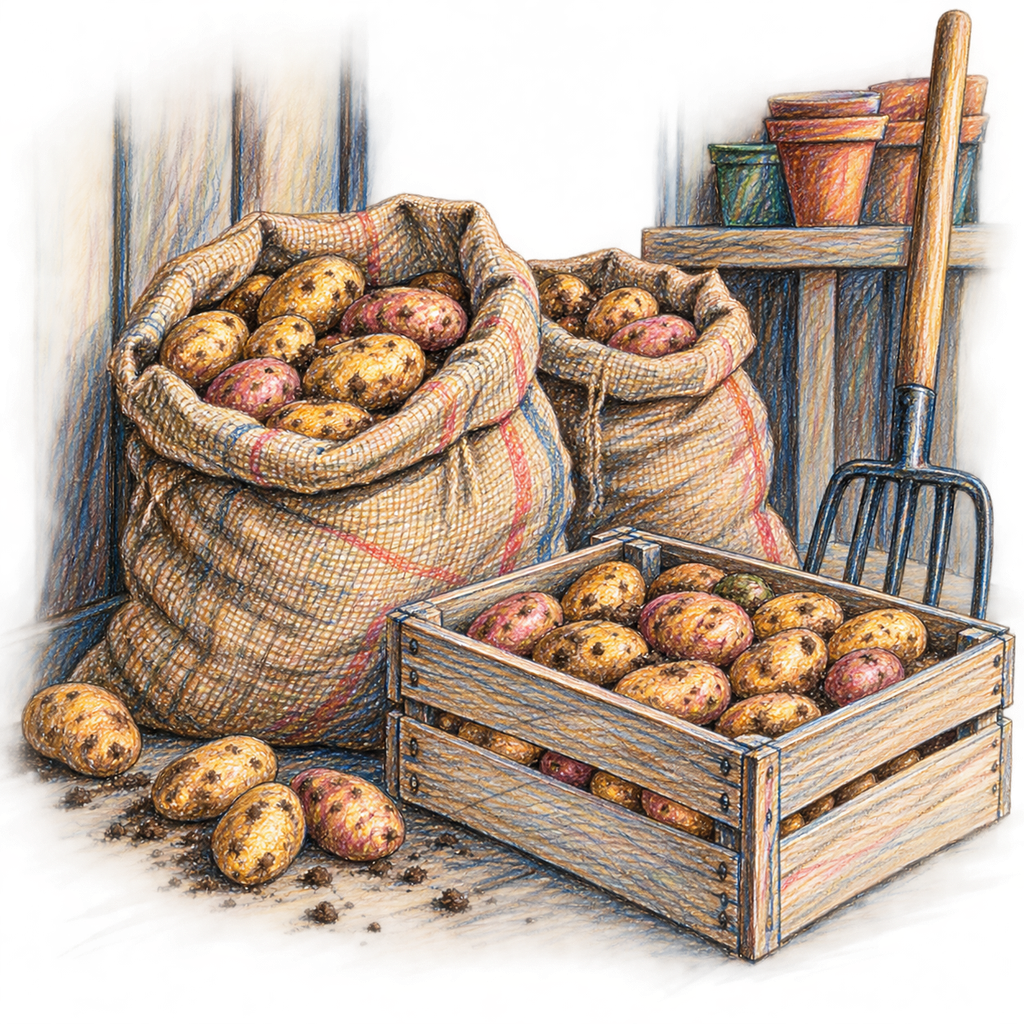
Paper sacks, hessian sacks, covered trays or suitable potato storage bags can all help.
Avoid transparent containers where light can reach the tubers.
Even in a dark shed, it is worth covering exposed potatoes rather than relying on the room itself remaining perfectly dark.
The aim is not dimness.
It is darkness.
What temperature should potatoes be stored at?
For domestic storage, think cool rather than freezing.
Garden Organic advises storing potatoes in the dark at around 5–10°C.
A cool, frost-free outbuilding can therefore work well.
The important thing is to avoid extremes.
Too warm and potatoes will tend to sprout and shrivel sooner.
Too cold and freezing can ruin them.
Storage conditions rarely remain absolutely constant in an ordinary home, but choosing the coolest sensible frost-free location will give you the best chance of keeping the harvest well.
Don’t allow potatoes to freeze
A sack of potatoes tucked into a shed may seem perfectly safe in October.
January can be another matter.
During prolonged freezing weather, sheds and unheated garages can become extremely cold.
Potatoes damaged by frost can develop an unpleasant texture and deteriorate rapidly.
Keep an eye on winter forecasts and insulate stored crops if necessary.
Boxes can be protected with layers of cardboard, hessian or other breathable insulating material, while keeping enough ventilation to prevent condensation.
If your usual storage area is likely to freeze badly, move the crop temporarily to a more suitable location.
A good potato store should be cool.
It should not resemble the inside of a freezer.
Paper or hessian sacks work well
There is no need for elaborate storage equipment.
The RHS recommends paper or hessian sacks, as well as slatted trays.
These traditional options work because they help exclude light while allowing some air movement.
Paper potato sacks are particularly convenient if you have a sizeable crop.
Hessian sacks are reusable and breathable.
Slatted trays make it easier to inspect individual potatoes, though they need to be kept properly covered from light.
Whatever you use, avoid packing potatoes into airtight plastic bags.
Moisture trapped in a sealed bag is not your friend.
Don’t overfill storage sacks
If you have harvested a bumper crop, it is tempting to put everything into one enormous sack.
Smaller quantities are often easier to manage.
A heavily filled sack creates pressure on the potatoes at the bottom and makes it more difficult to notice trouble developing inside.
Divide a large harvest between several sacks or boxes.
This makes them easier to move and easier to inspect.
If one group develops a problem, the whole harvest is less likely to be affected.
There is also something rather pleasing about seeing several modest sacks lined up after harvest.
It feels less like storing potatoes and more like stocking a very small farm shop.
Check stored potatoes regularly
Once the potatoes are safely put away, don’t forget about them.
Every few weeks, inspect the crop.
The RHS advises checking stored potatoes regularly for signs of rotting.
Remove anything that has become:
- soft
- wet
- mouldy
- badly sprouted
- rotten
- unpleasant-smelling
A single deteriorating potato can affect those around it.
Checking regularly also gives you a useful sense of how the crop is keeping.
If the potatoes are beginning to soften or sprout more quickly, start using them more generously.
Perhaps it is time for shepherd’s pie.
Why are my stored potatoes sprouting?
Potatoes are living tubers.
They haven’t forgotten how to grow simply because you put them in a sack.
Eventually, their natural dormancy begins to end and shoots appear.
Warmth encourages this process, which is why cool storage is important.
Light also causes problems and must be excluded.
Some varieties naturally store for longer than others, so the potato you grow can also influence how quickly sprouting begins.
By late winter and early spring, some sprouting and shrivelling becomes increasingly likely even under good domestic conditions.
The RHS suggests aiming to use stored maincrop potatoes before early spring, when they are more likely to sprout and shrivel.
A winter potato store is not meant to last forever.
It is there to bridge the seasons.
Can you eat potatoes that have started sprouting?
A small amount of sprouting doesn’t automatically mean a potato must be thrown away, provided the tuber is otherwise firm, sound and not green.
Garden Organic advises that shoots can be removed from non-green sprouting potatoes before preparing them normally.
However, use judgement.
A potato that has become heavily shrivelled, very soft, extensively green or rotten is not worth rescuing.
Good storage is partly about catching potatoes before they reach that stage.
Can potatoes be stored in the fridge?
For ordinary home-grown maincrop potatoes, the better approach is usually a suitably cool, dark domestic storage place rather than simply filling the fridge.
A large crop would quickly take over the refrigerator anyway.
More importantly, potatoes have their own particular storage requirements, and a traditional cool store allows you to manage a substantial harvest much more easily.
Think shed, frost-free garage or another cool dark location rather than the vegetable drawer.
Can you leave potatoes in the ground over winter?
Sometimes gardeners are tempted to treat the vegetable patch itself as storage.
In certain mild, well-drained conditions, potatoes may remain in the soil for a limited period.
But there are risks.
Wet winter ground can encourage rotting. Slugs and other pests may find the tubers. Hard frost can damage potatoes close to the surface.
The RHS notes that potatoes may sometimes be stored temporarily in the ground under protective covering in light soil and sheltered conditions, but advises lifting them in colder areas or wet, heavy soils.
For a dependable winter supply, lifting and storing the maincrop is generally the more practical choice.
What to do with damaged potatoes
A damaged potato isn’t necessarily a wasted potato.
If you accidentally put the fork through one while harvesting, take it indoors and use it first.
Cut away minor damage and cook the sound portion promptly.
A few casualties can become:
- mashed potato
- soup
- chips
- wedges
- fish pie topping
- potato cakes
- cottage pie
- leek and potato soup
Harvest day often ends with potatoes for supper for precisely this reason.
The damaged ones make the decision for you.
Keep potatoes away from light in the kitchen too
Careful winter storage can be undone surprisingly quickly once potatoes are brought indoors.
Don’t leave a week’s supply in a bright bowl on the kitchen worktop.
Take only what you need from the main store and keep those potatoes somewhere dark and cool until cooking.
It is easy to think of light exposure as a problem that occurs only while potatoes are growing.
It matters after harvest too.
Should potatoes be stored with onions?
Potatoes and onions are often harvested at a similar time.
That doesn’t mean they need to share the same storage container.
Both crops benefit from cool, dry storage, but piling them together makes it harder to inspect and manage each harvest properly.
Keep them in separate sacks or trays.
The same applies to apples and other stored crops.
An autumn store works best when everything has its own place.
Potatoes here.
Onions there.
Apples somewhere else.
It may not look quite like an old estate pantry, but the principle is much the same.
Label your stored potatoes
If you grow more than one variety, label the sacks.
It sounds unnecessary in September.
By February, it becomes surprisingly useful.
Write the variety and harvest date on each sack or attach a simple label.
You might also make a note of how well each variety stores.
Was one still firm in January while another sprouted before Christmas?
Did one variety remain excellent for roasting while another became rather floury?
These observations can help you choose next year’s seed potatoes.
The best variety isn’t always simply the one that produced the biggest crop.
It is the one that works for the way you actually eat.
How long will home-grown potatoes keep?
Properly stored maincrop potatoes can keep for several months.
Exactly how long depends on the variety, the condition of the crop at harvest and the storage environment.
Some will remain firm and useful well into winter.
Others begin sprouting sooner.
Rather than choosing an arbitrary expiry date, inspect them regularly and use the crop progressively.
If one sack is beginning to deteriorate faster than another, use that variety first.
By spring, your potato store should ideally be becoming empty.
Which is no bad thing.
The seed potatoes for the next crop will already be waiting for their turn.
The importance of growing good storing varieties
If winter storage matters to you, think about it when ordering seed potatoes.
Different varieties vary in yield, texture, disease resistance and storage ability.
An excellent salad potato isn’t necessarily an excellent keeper.
A good maincrop variety can give you a substantial harvest suitable for baking, roasting and mashing while also keeping well into the colder months.
This is particularly useful if you have enough garden or allotment space to grow several types.
Early potatoes provide that wonderful first harvest of summer.
Maincrops provide something different.
Security.
A crop that waits.
How to store potatoes for winter: a quick guide
If you simply want the essentials, remember:
Grow maincrop potatoes for storage.
Allow the crop to mature properly before lifting.
Harvest carefully in dry weather where possible.
Let the potatoes dry for a few hours.
Brush away loose soil rather than washing them.
Store only healthy, undamaged tubers.
Discard green potatoes.
Keep the crop cool, completely dark, dry and frost-free.
Use paper sacks, hessian sacks or suitable ventilated trays.
Check the potatoes every few weeks.
Remove any that begin to rot.
And use the crop gradually through winter before heavy sprouting begins in spring.
It isn’t complicated.
But each small step helps.
A winter harvest waiting in the dark
Perhaps the nicest thing about storing potatoes is that there is very little to see.
The excitement happens first.
You lift the plants on a bright autumn day and kneel among the broken soil, searching for every last tuber.
There are potatoes in baskets beside you and dry earth on your hands. Some are enormous. Others are hardly worth peeling. One has inevitably been speared clean through with the fork.
The good ones are dried, sorted and carried away.
Then the sacks disappear into the darkness of the shed.
And there they wait.
Outside, the vegetable patch changes completely.
The bean canes come down. Frost silvers the beds. Winter rain falls against bare soil and eventually the garden seems a very long way from the abundance of August.
But somewhere in the dark there is still a little store of that abundance.
On a cold evening you open the shed, reach into a sack and bring a handful of potatoes back towards the kitchen.
Perhaps they become crisp roast potatoes beside a Sunday lunch.
Perhaps they are mashed with butter.
Perhaps they simmer quietly with leeks into soup.
The plants themselves disappeared months ago, but the harvest continues.
That is the quiet pleasure of storing food well.
The vegetable garden keeps feeding you, even while it sleeps.
Further Reading: Wonderful Ways to Use Fresh Garden Peas, Grow Your Own Food: Save Money & Eat Well, How to Keep Your Vegetable Garden Productive into Autumn, What to Sow in September: Vegetables, Salads & Herbs
Follow us on Instagram, Threads, BlueSky, Twitter, Pinterest & Facebook
Not sure where to start? Take a look at our Grow Your Own Packs with detailed step by step instructions, seeds and 1 years online support.