
There is something wonderfully reassuring about an autumn afternoon spent in the kitchen.
Outside, the garden is beginning to lose its summer exuberance. Leaves gather along the paths, the air has a little more bite, and the vegetable beds are offering up the last of their generous harvests. Inside, the oven is warming, the chopping board is covered with freshly gathered vegetables, and the scent of rosemary and roasting garlic is beginning to fill the house.
This is the season of vegetable bakes.
Not particularly complicated cooking. Not dishes that require a cupboard full of unusual ingredients or an afternoon spent following elaborate instructions.
Just good, honest food.
Golden potatoes, sweet parsnips, earthy beetroot, tender leeks and great wedges of squash, brought together with herbs, a little cheese or perhaps a creamy sauce, then left to become something rather wonderful in the oven.
There is a certain magic in the transformation.
A collection of vegetables that might look fairly ordinary on the kitchen worktop emerges as a bubbling, golden dish that everyone wants to tuck into.
And if those vegetables have come from your own garden, so much the better.
Because there is something particularly satisfying about serving a meal that began months earlier with a handful of seeds, a little compost and a great deal of optimism.
So, as autumn settles in, let’s make the most of the harvest and explore some delicious vegetable bakes that deserve a place on the family table.
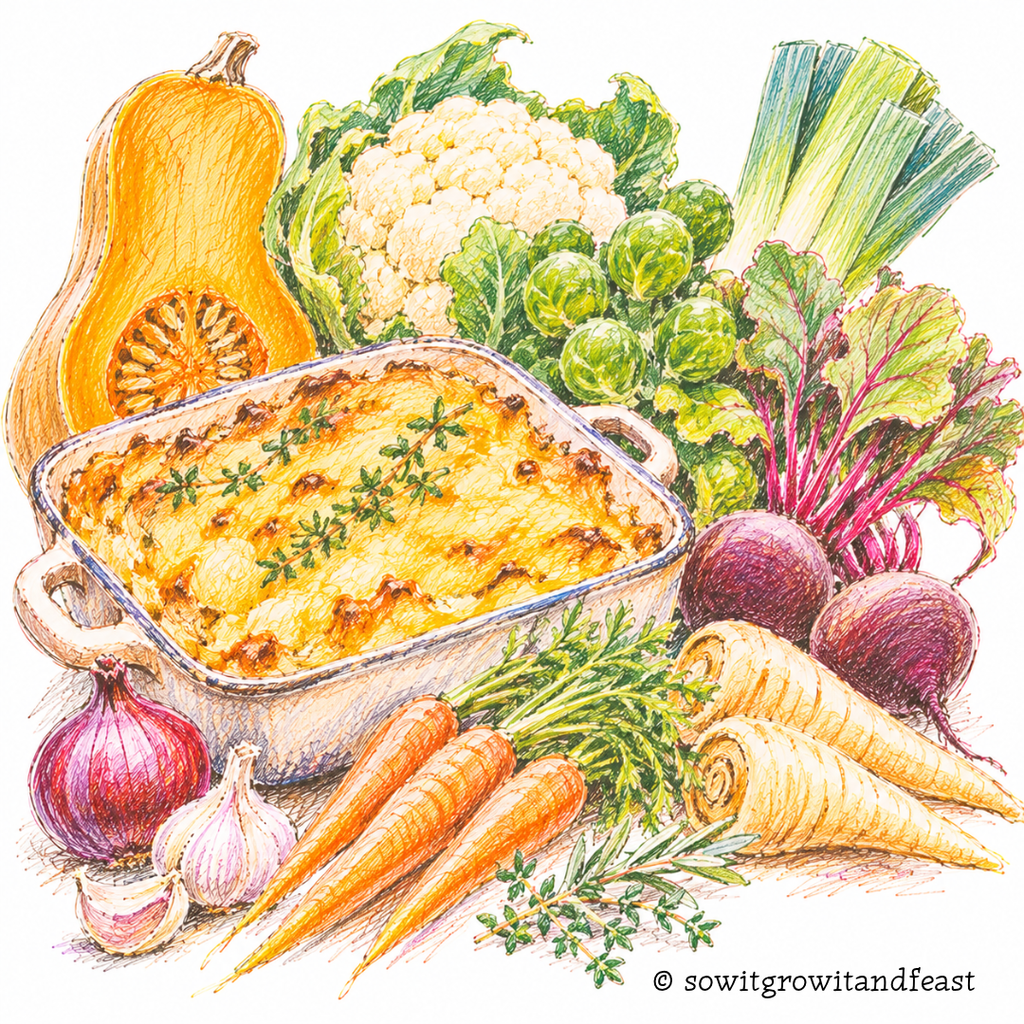
Why Autumn Vegetables Are Perfect for Baking
Autumn brings a wonderful change in the vegetables available to us.
The tender salads and delicate summer crops begin to give way to roots, brassicas, pumpkins and squashes.
These vegetables have something in common.
Many respond beautifully to the warmth of the oven.
Roasting encourages browning and caramelisation, developing deeper flavours and bringing out the natural sweetness of vegetables such as carrots, parsnips and squash.
Potatoes become golden and crisp at the edges.
Cauliflower develops a lovely nutty flavour.
Leeks soften into sweet, silky ribbons.
And beetroot becomes wonderfully tender and earthy.
But baking is not simply about flavour.
It is also an excellent way to make use of the vegetables we have grown, particularly when the harvest arrives in rather generous quantities.
A handful of carrots, two leeks, a small cauliflower and a few potatoes might not seem like the beginnings of a memorable meal.
Add a little stock, some herbs and a topping of cheese, however, and suddenly supper is looking rather promising.
A little about nutrition
Autumn vegetables provide a varied selection of nutrients.
Carrots and orange-fleshed squash contain beta-carotene, which the body can convert into vitamin A.
Brassicas such as Brussels sprouts and cauliflower contribute vitamin C, fibre and other nutrients.
Root vegetables provide different combinations of fibre, potassium and folate.
Lentils and beans add plant protein and further fibre.
No single vegetable provides everything we need, of course. The benefit comes from enjoying a variety of foods as part of a balanced diet.
And that is another reason to love a vegetable bake.
It is an opportunity to bring several different ingredients together in one delicious dish.
The Secret to a Really Good Vegetable Bake
Before we get to the recipes, there are a few useful things worth knowing.
Vegetables do not all cook at the same speed.
A thick piece of swede will take considerably longer to soften than a slice of courgette.
A potato needs more time than a tomato.
And a cauliflower floret can go from perfectly tender to disappointingly soft if left too long.
Fortunately, a little preparation makes all the difference.
Cut Vegetables Evenly
Try to cut vegetables into reasonably similar-sized pieces, particularly when they are going into the oven together.
This helps everything cook at a similar rate.
Give Dense Vegetables a Head Start
Potatoes, swede, carrots and parsnips sometimes benefit from being parboiled or roasted before being combined with softer ingredients.
This is particularly useful for layered bakes and gratins.
Do Not Overcrowd the Dish
Vegetables release moisture as they cook.
If a roasting tray is packed too tightly, they are more likely to steam than brown.
For roasted vegetable bakes, spread ingredients out where possible.
Use Herbs Generously
Autumn vegetables work beautifully with herbs.
Rosemary, thyme and sage are particularly good with root vegetables and squash.
Parsley and chives bring freshness to creamy dishes.
And garlic?
Well, garlic rarely needs much encouragement to join the party.
Finish with Something Golden
A little grated cheese, breadcrumbs, oats, seeds or chopped nuts can give a bake a lovely contrasting texture.
It is often the difference between a perfectly pleasant dish and one that has everyone scraping the last crispy bits from the edges.
Six Delicious Autumn Vegetable Bakes
These recipes celebrate the vegetables that make autumn cooking so satisfying.
Some are substantial enough to serve as a main meal, while others make wonderful accompaniments to a Sunday lunch.
All can be adapted according to what you have available.
1. Root Vegetable Gratin with Garden Herbs
Golden, creamy and wonderfully comforting.
<text color=”secondary” size=”sm”>Serves 6 | Preparation: 20 minutes | Cooking: 65–80 minutes</text>
There is something deeply comforting about a gratin.
Thin layers of vegetables, gently cooked in cream and garlic, with a golden crust of mature Cheddar.
It is the sort of dish that looks rather impressive when brought to the table, despite requiring very little complicated preparation.
And it is an excellent way to celebrate the autumn root vegetable harvest.
Ingredients
- 500g potatoes, peeled if preferred and thinly sliced
- 300g parsnips, peeled and thinly sliced
- 200g carrots, thinly sliced
- 300ml double cream
- 150ml whole milk
- 2 garlic cloves, crushed
- 2 teaspoons fresh thyme leaves
- 1 teaspoon finely chopped rosemary
- 100g mature Cheddar, grated
- A little butter for greasing
- Salt and freshly ground black pepper
Method
- Preheat the oven to 180°C, or 160°C fan. Lightly butter a medium-sized baking dish.
- Slice the potatoes, parsnips and carrots thinly and evenly, ideally around 2–3mm thick.
- Place the cream, milk, garlic, thyme and rosemary in a saucepan. Warm gently without boiling.
- Arrange the vegetables in overlapping layers in the baking dish, seasoning lightly between layers.
- Pour over the warm cream mixture, making sure it reaches between the vegetables.
- Cover the dish tightly with foil and bake for approximately 45 minutes.
- Remove the foil, scatter over the grated Cheddar and return to the oven for another 20–35 minutes.
- The gratin is ready when the vegetables are completely tender when pierced with a knife and the top is beautifully golden.
- Allow to stand for 10 minutes before serving.
From the garden: Potatoes, carrots and parsnips are excellent crops for autumn cooking. Parsnips can often remain in the ground through winter, while suitable potatoes and carrots can be stored after harvesting.
Make it your own: Replace some of the potatoes with celeriac or swede. Just ensure that any denser vegetables are sliced particularly thinly or given a brief head start before baking.
2. Roasted Butternut Squash, Sage and Feta Bake
Sweet squash, fragrant herbs and a little salty cheese.
<text color=”secondary” size=”sm”>Serves 4 | Preparation: 15 minutes | Cooking: 40–45 minutes</text>
Butternut squash is one of autumn’s great kitchen treasures.
Its golden flesh becomes beautifully sweet when roasted, and it works particularly well with the earthy fragrance of sage.
Add a little feta and some toasted pine nuts, and you have a dish that feels rather special without being remotely difficult.
Ingredients
- 1 large butternut squash, approximately 1kg prepared weight, peeled, deseeded and cubed
- 1 large red onion, cut into wedges
- 12 fresh sage leaves
- 3 tablespoons olive oil
- 100g feta cheese, crumbled
- 40g pine nuts
- Salt and freshly ground black pepper
Method
- Preheat the oven to 200°C, or 180°C fan.
- Place the cubed squash in a large roasting dish.
- Drizzle with the olive oil, season lightly and toss well.
- Roast for approximately 20 minutes.
- Add the red onion and sage leaves, turning everything gently.
- Return to the oven for another 15–20 minutes, until the squash is tender and beginning to caramelise.
- Scatter over the feta and pine nuts for the final 5 minutes of cooking, watching carefully to prevent the nuts burning.
- Serve warm, with the roasting juices spooned over the vegetables.
From the garden: Butternut squash is grown during the warmer months and harvested in autumn once mature. Properly ripened fruits can often be stored for several months, making them particularly useful for winter meals.
Make it a meal: Serve with lentils, couscous or a generous helping of wilted spinach.
3. Brussels Sprouts and Bacon Bake
A little indulgence for a much-misunderstood vegetable.
<text color=”secondary” size=”sm”>Serves 4–6 | Preparation: 15 minutes | Cooking: 30–35 minutes</text>
Brussels sprouts have suffered from a rather unfortunate reputation.
For some, they bring back memories of school dinners and vegetables that had been boiling for considerably longer than necessary.
But properly cooked sprouts are quite different.
Tender, slightly sweet and wonderfully nutty, they are particularly good when roasted or baked.
Add smoky bacon and a creamy cheese sauce, and even the most reluctant sprout eater may reconsider.
Although I cannot promise miracles.
Ingredients
- 750g Brussels sprouts, trimmed and halved
- 150g smoked bacon lardons
- 300ml cheese sauce
- 50g fresh breadcrumbs
- 25g butter, melted
- Freshly ground black pepper
Method
- Preheat the oven to 190°C, or 170°C fan.
- Bring a saucepan of water to the boil and blanch the Brussels sprouts for approximately 3–4 minutes.
- Drain thoroughly and allow excess moisture to evaporate.
- Meanwhile, cook the bacon lardons in a frying pan until lightly browned.
- Arrange the sprouts and bacon in a baking dish.
- Pour over the cheese sauce and stir gently to coat.
- Mix the breadcrumbs with the melted butter and scatter over the top.
- Bake for approximately 25–30 minutes, until bubbling and golden, and the sprouts are tender and bacon thoroughly cooked.
Serve immediately.
From the garden: Brussels sprouts are a wonderful winter crop, with many varieties harvested from autumn into winter. They prefer fertile, firm soil and may need staking in exposed gardens.
Vegetarian alternative: Leave out the bacon and add sautéed chestnut mushrooms or cooked chestnuts for a lovely earthy flavour.
4. Mixed Vegetable and Lentil Bake
A proper supper from the vegetable garden.
<text color=”secondary” size=”sm”>Serves 4–6 | Preparation: 20 minutes | Cooking: 50–60 minutes</text>
This is the sort of recipe that comes into its own when the garden is offering a little of everything.
A courgette that needs using.
A handful of tomatoes.
Two carrots.
Perhaps an aubergine from the greenhouse.
Add lentils, herbs and a little mozzarella, and suddenly you have a substantial meal that makes excellent use of the harvest.
It is also a useful bridge between the last summer vegetables and the arrival of autumn.
Ingredients
- 200g dried red lentils, rinsed
- 2 large carrots, finely diced
- 1 medium courgette, diced
- 200g cherry tomatoes, halved
- 1 small aubergine, cubed
- 1 onion, finely chopped
- 2 garlic cloves, crushed
- 500ml vegetable stock, plus extra if needed
- 2 tablespoons tomato purée
- 1 tablespoon olive oil
- 1 teaspoon dried oregano
- 1 teaspoon fresh thyme leaves
- 100g mozzarella, torn
- Salt and freshly ground black pepper
Method
- Preheat the oven to 190°C, or 170°C fan.
- Heat the olive oil in a large saucepan and gently cook the onion for approximately 5 minutes.
- Add the garlic, carrots and aubergine. Cook for another 5 minutes.
- Stir in the courgette, tomatoes, lentils, tomato purée, herbs and stock.
- Bring to a simmer and cook gently for approximately 10 minutes, stirring occasionally.
- Transfer the mixture to a deep baking dish.
- Cover tightly with foil and bake for 25–30 minutes.
- Check that the lentils are becoming tender and add a little extra hot stock if the mixture looks dry.
- Remove the foil, scatter over the mozzarella and bake uncovered for another 10–15 minutes, until the lentils are fully tender and the cheese is golden.
Allow to stand briefly before serving.
From the garden: This is a wonderful recipe for using the final courgettes, tomatoes and aubergines of the growing season. As autumn progresses, replace them with roasted squash, mushrooms or finely diced root vegetables.
Make it your own: Add cooked chickpeas or a handful of spinach for extra variety.
5. Cauliflower, Leek and Mushroom Cheese Bake
A familiar favourite with a little autumn character.
<text color=”secondary” size=”sm”>Serves 4–6 | Preparation: 20 minutes | Cooking: 30 minutes</text>
Cauliflower cheese is one of those dishes that rarely needs improving.
But there is something rather lovely about adding sweet leeks, earthy mushrooms and a crunchy topping.
It becomes a little more substantial, a little more interesting and particularly well suited to autumn cooking.
Ingredients
- 1 large cauliflower, broken into florets
- 200g leeks, thoroughly washed and sliced
- 150g chestnut mushrooms, sliced
- 400ml cheese sauce
- 75g mature Cheddar, grated
- 40g rolled oats
- 25g pumpkin seeds
- 1 tablespoon olive oil
- 1 tablespoon chopped fresh chives
- Freshly ground black pepper
Method
- Preheat the oven to 200°C, or 180°C fan.
- Steam the cauliflower for approximately 5–7 minutes, until just beginning to soften.
- Meanwhile, heat the olive oil in a frying pan.
- Add the leeks and mushrooms and cook gently until softened and most of their released moisture has evaporated.
- Arrange the cauliflower, leeks and mushrooms in a baking dish.
- Pour over the cheese sauce.
- Combine the grated Cheddar, oats and pumpkin seeds, then scatter over the top.
- Bake for approximately 20–25 minutes, until golden and bubbling and the cauliflower is tender.
- Finish with chopped chives and black pepper.
From the garden: Cauliflower and leeks can both be grown for autumn harvesting, although exact sowing and harvesting times depend on the varieties chosen.
Make it a meal: Serve with a baked potato, wholegrain bread or a green salad.
6. Sweet Potato and Black Bean Enchilada Bake
A colourful, warming dish for cooler evenings.
<text color=”secondary” size=”sm”>Serves 4 | Preparation: 20 minutes | Cooking: 50–55 minutes</text>
Not every autumn vegetable bake needs to follow a traditional British recipe.
Sweet potatoes, beans, peppers and warming spices make a wonderfully satisfying combination.
And while sweet potatoes can be challenging to grow in the British climate, they are certainly worth trying if you have a particularly warm, sheltered growing space.
Ingredients
- 600g sweet potatoes, peeled and diced
- 1 x 400g tin black beans, drained and rinsed
- 1 red pepper, diced
- 8 small corn tortillas
- 300ml enchilada sauce
- 150g grated Cheddar or another suitable melting cheese
- 1 tablespoon olive oil
- 1 teaspoon ground cumin
- 1 teaspoon smoked paprika
- Fresh coriander
- Lime wedges, to serve
Method
- Preheat the oven to 200°C, or 180°C fan.
- Place the diced sweet potatoes on a baking tray.
- Toss with the olive oil, cumin and smoked paprika.
- Roast for approximately 20–25 minutes, until tender.
- Meanwhile, lightly soften the diced pepper in a frying pan.
- Combine the cooked sweet potato, pepper and black beans.
- Spoon the mixture into the tortillas, roll them up and arrange seam-side down in a baking dish.
- Pour over the enchilada sauce and scatter with grated cheese.
- Reduce the oven temperature to 190°C, or 170°C fan, and bake for approximately 20–25 minutes until bubbling and heated through.
- Finish with chopped coriander and serve with lime wedges.
From the garden: Sweet potatoes are grown from slips and need a long, warm season. In Britain, a greenhouse, polytunnel or particularly sheltered position offers the best chance of success.
Make it your own: Replace the sweet potatoes with roasted butternut squash for a more traditional British autumn harvest.
Five More Vegetable Bake Combinations Worth Trying
Once you understand the basics, vegetable bakes become wonderfully flexible.
You can work with whatever is ready in the garden, rather than feeling obliged to follow a recipe exactly.
Here are a few more combinations to try.
Beetroot, Red Onion and Goat’s Cheese: Roast beetroot and red onion until tender, then scatter with goat’s cheese and fresh thyme. Return briefly to the oven until warmed through.
Potato, Leek and Mustard Gratin: Layer thinly sliced potatoes with gently softened leeks, a little wholegrain mustard and a creamy sauce. Bake until tender and golden.
Roasted Parsnip, Carrot and Honey Bake: Toss carrots and parsnips with olive oil, thyme and a little honey. Roast until beautifully caramelised.
Pumpkin, Spinach and Ricotta Bake: Combine roasted pumpkin with wilted spinach and ricotta. Finish with grated cheese and bake until bubbling.
Swede, Potato and Cheddar Bake: Layer thinly sliced swede and potatoes with stock, herbs and mature Cheddar. Cover for the first part of cooking to ensure the swede becomes tender, then uncover to brown the top.
The possibilities are almost endless.
And that is one of the loveliest things about growing your own vegetables.
The garden decides what is ready.
The cook simply has to make something delicious with it.
Planning an Autumn Vegetable Garden for Baking
If vegetable bakes are a favourite in your household, it is worth giving a little thought to what you grow.
Many of the best ingredients are crops that can be harvested during autumn or stored for winter use.
Root Vegetables
Carrots, parsnips, beetroot and swede are all excellent choices.
They bring sweetness, flavour and substance to baked dishes.
Sowing times vary, but many are started in spring or early summer for harvesting later in the year.
Brassicas
Cauliflower, Brussels sprouts and kale are particularly useful during autumn and winter.
They require fertile soil and protection from common pests, including pigeons and caterpillars.
Squashes and Pumpkins
These are grown during the warmer months and harvested in autumn.
Choose culinary varieties for the best flavour and texture.
Properly matured and stored fruits can provide delicious meals for months.
Leeks
Leeks are among the most useful crops for winter cooking.
Different varieties can provide harvests from late summer through winter.
They are wonderful in gratins, pies and creamy vegetable bakes.
Herbs
Rosemary, thyme and sage are particularly valuable for autumn cooking.
These hardy herbs bring fragrance and flavour to roasted vegetables.
A small herb bed near the kitchen can make an enormous difference to everyday meals.
Making the Most of Your Autumn Harvest
Autumn can be a wonderfully generous season.
Sometimes rather too generous.
There comes a point when the kitchen worktop is covered with vegetables, the fridge is full and you begin wondering whether there is such a thing as too much squash.
This is where vegetable bakes become particularly useful.
They allow you to combine small amounts of different vegetables into one substantial meal.
Use What Needs Eating First
Vegetables do not have to be perfectly shaped to be delicious.
A crooked carrot, a slightly oversized courgette or a knobbly celeriac can all be excellent ingredients.
Use sound produce, trim minor blemishes where appropriate and discard vegetables showing significant rot or mould.
Prepare Ahead
Many vegetables can be washed and chopped in advance.
Store prepared vegetables in suitable covered containers in the fridge and use promptly.
Potatoes and some other cut vegetables may discolour or deteriorate if prepared too far ahead, so plan accordingly.
Make Extra Portions
Many vegetable bakes can be prepared in larger quantities.
Allow cooked food to cool promptly and refrigerate within two hours.
Keep refrigerated leftovers at 5°C or below and use within 48 hours, or freeze for later.
Creamy sauces may sometimes separate after freezing, but the flavour is usually still good.
Keep a Few Favourite Combinations
There is something lovely about developing your own collection of family recipes.
Perhaps a squash bake becomes a regular Sunday dish.
Perhaps the first Brussels sprouts of winter always find their way into cauliflower cheese.
Over time, these small traditions become part of the rhythm of the seasons.
Bringing the Family Into the Kitchen
One of the pleasures of cooking with home-grown vegetables is that the story begins long before the oven is switched on.
Children can help sow seeds, water plants and watch vegetables develop.
Later, they can help gather the harvest and prepare it for cooking, with age-appropriate supervision.
There is something rather wonderful about showing a child the tiny seed from which a great pumpkin has grown.
Or explaining that the potatoes being washed for supper were hidden beneath the soil only an hour earlier.
Cooking together can also encourage curiosity about unfamiliar vegetables.
A child who has helped grow a cauliflower may be more interested in tasting it, although there are no guarantees.
Some children remain deeply suspicious of anything green.
That, too, is part of family life.
The important thing is creating opportunities to explore food without pressure.
Washing vegetables, scattering herbs, mixing ingredients and helping arrange a baking dish are all simple ways to become involved.
And the reward is something everyone can share.
The Quiet Pleasure of an Autumn Bake
There is a particular satisfaction in bringing a bubbling vegetable bake to the table.
Perhaps it is the warmth of the oven on a chilly evening.
Perhaps it is the scent of garlic, rosemary and roasting vegetables drifting through the house.
Or perhaps it is simply the pleasure of making something good from ingredients that have been grown with care.
Autumn invites us to cook a little differently.
The days are shorter, the garden is quieter and the meals we crave become warmer and more substantial.
It is a season for slowing down, making the most of what we have and finding pleasure in ordinary things.
A basket of freshly lifted potatoes.
A squash stored carefully since harvest.
A handful of thyme gathered from the garden.
And a dish of vegetables emerging from the oven, golden and fragrant, ready to be shared.
Not every ingredient needs to come from our own garden, of course.
A visit to the greengrocer, farm shop or local market can be just as inspiring.
What matters is appreciating the food available to us and taking a little pleasure in preparing it.
Because a good vegetable bake is about more than simply getting supper on the table.
It is about the changing seasons, the generosity of the harvest and the small satisfaction of turning humble ingredients into something worth gathering around.
And if there are leftovers for tomorrow?
Well, that is rather lovely too.
Sometimes the best meals are not the most elaborate. They are the ones that bring good ingredients, a warm kitchen and the people we care about together.
Sow it. Grow it. And feast on it.
Further Reading: Why Growing Food Makes You Feel Better, Take the Guesswork Out of Growing Veg, How to Create a Garden That Feeds Your Family, How to Start a Vegetable Garden Now Ready for Spring
Follow us on Instagram, Threads, BlueSky, Twitter, Pinterest & Facebook
Not sure where to start? Take a look at our Grow Your Own Packs with detailed step by step instructions, seeds and 1 years online support.