
There is a point in late summer when the hedgerows begin to change.
Blackberries deepen from hard green beads to glossy purple-black fruit. Apples start to loosen on the tree. The mornings feel cooler, the evenings draw in a little sooner and the kitchen begins to crave something warmer than strawberries and cream.
That is when crumble season truly begins.
A blackberry and apple crumble is one of those puddings that belongs completely to the British autumn. It is simple, generous and forgiving, made from ingredients that often seem to arrive at exactly the same moment.
Sharp blackberries collapse into their juices. Apples soften beneath them. The crumble topping turns golden and crisp, while the edges bubble up around the dish.
And then comes the difficult decision.
Custard, cream or ice cream?
There may be no correct answer.
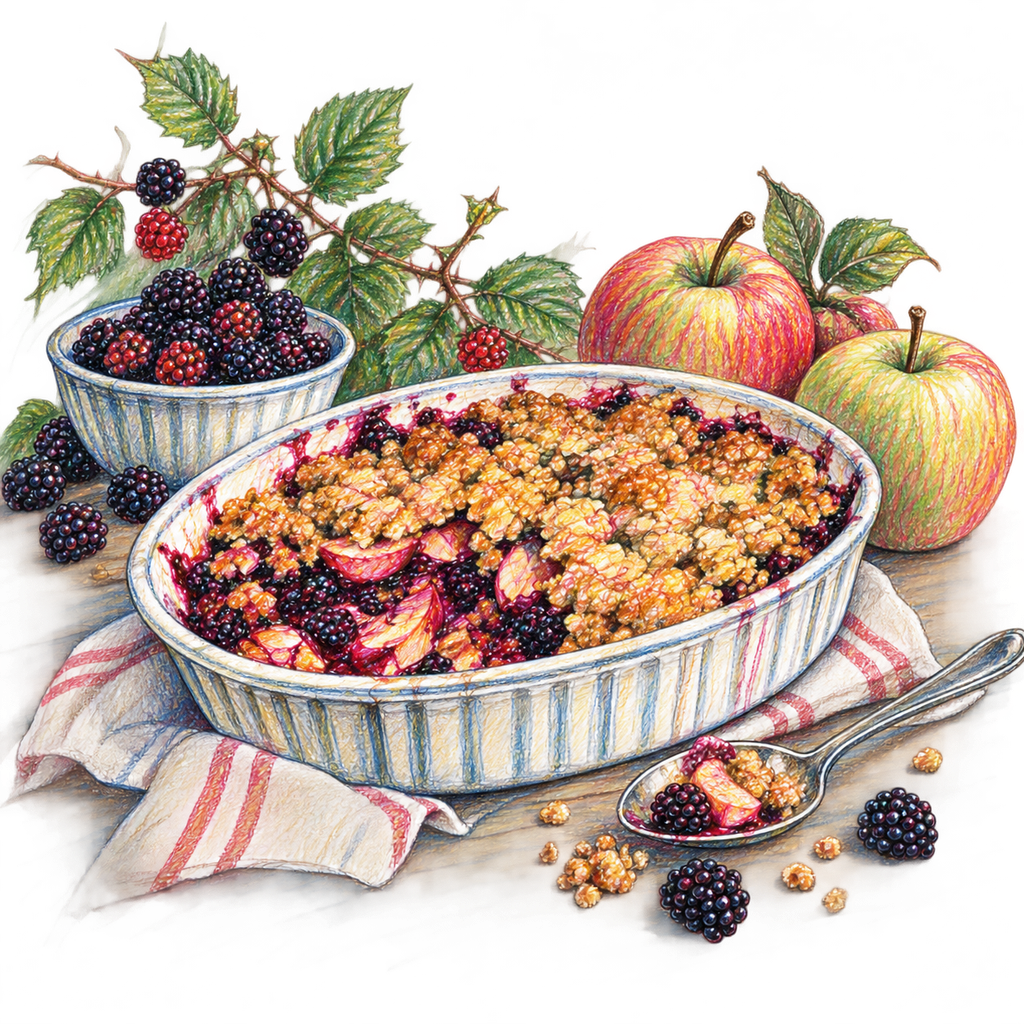
Why blackberry and apple work so well together
Blackberries and apples are natural companions.
Blackberries bring colour, perfume and a deep, slightly wine-like sharpness. Apples bring body, sweetness and that familiar orchard flavour that makes a crumble feel unmistakably autumnal.
On their own, blackberries can be quite juicy and sometimes rather sharp.
Apples help balance them.
The best crumble has contrast.
Soft fruit beneath. Crisp topping above. Sweetness, acidity and enough texture to stop the pudding becoming heavy.
That balance is what makes blackberry and apple crumble such an enduring favourite.
When are blackberries in season in the UK?
Wild blackberries usually begin ripening from late summer into early autumn, though the exact timing depends on weather and location.
Some hedgerows seem to turn dark almost overnight.
Others ripen gradually, with ripe blackberries appearing beside clusters that are still red and green.
This is part of the pleasure of picking them.
You rarely harvest everything at once.
Instead, you return to the same hedge every few days, gathering the berries that have reached their moment.
A ripe blackberry should come away easily with a gentle pull.
If it resists, leave it.
It will be better another day.
When are apples ready for crumble?
For crumble, you have more flexibility than you do with apples intended for long-term storage.
Slightly imperfect fruit is often ideal.
Windfalls, blemished apples and fruit with the odd bruise can all be used, provided any damaged areas are cut away and the fruit itself is sound.
Cooking apples such as Bramley are excellent because their sharpness balances the sugar and they soften beautifully.
But you can also use eating apples.
If your apples are naturally sweet, simply reduce the sugar a little.
Crumble is a very forgiving pudding.
That is one of its great virtues.
A pudding made for the harvest season
This is the sort of recipe that begins before you reach the kitchen.
Perhaps you have gathered blackberries on a walk.
Perhaps there is an apple tree in the garden dropping fruit onto the lawn.
Perhaps a neighbour has left a bag of apples at the gate.
Whatever the source, blackberry and apple crumble has the feeling of a pudding made from what the season has already given you.
It doesn’t require perfect fruit.
It doesn’t require complicated equipment.
And it doesn’t ask much of the cook.
A bowl.
A knife.
A baking dish.
A warm oven.
That is usually enough.
Blackberry and Apple Crumble Recipe
This recipe serves around 6 people.
Ingredients
For the fruit filling:
- 500g apples
- 250g blackberries
- 50g caster sugar
- 1 tablespoon plain flour
- 1 teaspoon ground cinnamon, optional
- 1 tablespoon lemon juice
For the crumble topping:
- 175g plain flour
- 100g cold unsalted butter
- 75g demerara sugar
- 50g rolled oats, optional
- a small pinch of salt
How to make blackberry and apple crumble
1. Prepare the apples
Heat the oven to 190°C, 170°C fan, Gas 5.
Peel and core the apples, then cut them into small slices or chunks.
Place them into a large baking dish.
Add the lemon juice, sugar, flour and cinnamon, if using, and toss gently so the apples are lightly coated.
The flour helps thicken the juices as the fruit cooks.
2. Add the blackberries
Gently rinse the blackberries if needed and allow them to drain well.
Scatter them over the apples.
Try not to stir them too aggressively.
Blackberries are delicate and will break down naturally in the oven.
A light mix is enough.
3. Make the crumble topping
Place the flour and salt into a large bowl.
Add the cold butter in small cubes.
Rub the butter into the flour using your fingertips until the mixture resembles coarse breadcrumbs.
Stir through the demerara sugar and oats, if using.
You are not looking for perfect uniformity.
A few larger buttery crumbs will make the topping more interesting.
4. Top the fruit
Scatter the crumble mixture evenly over the blackberry and apple filling.
Don’t press it down.
A loose topping cooks more evenly and gives you a better mixture of crisp edges and softer crumbs.
5. Bake
Place the dish into the oven and bake for around 35 to 45 minutes.
The crumble is ready when the topping is golden and the fruit is bubbling around the edges.
If the topping is browning too quickly, loosely cover the dish with foil for the remaining cooking time.
6. Let it rest
This may be the hardest part.
Allow the crumble to stand for 10 to 15 minutes before serving.
The fruit will be extremely hot when it first comes out of the oven, and resting also gives the juices a little time to settle.
Should you cook the apples first?
Usually, no.
If the apples are cut fairly small, they should soften nicely while the crumble bakes.
However, very firm cooking apples can sometimes benefit from a little head start.
If you prefer a very soft fruit layer, cook the apples gently in a saucepan with a splash of water for five minutes before assembling the crumble.
Then add the blackberries and topping as usual.
Both methods work.
The difference is simply texture.
How much sugar should you use?
This depends on the fruit.
Very sharp cooking apples and tart wild blackberries may need a little more sugar.
Sweeter dessert apples may need less.
Taste a small piece of apple before you begin.
If the fruit is already sweet, there is no need to bury it beneath sugar.
The best blackberry and apple crumble should still taste of fruit.
A little sharpness is part of its charm.
Can you use frozen blackberries?
Yes.
Frozen blackberries work very well in crumble.
There is usually no need to defrost them first.
Simply add them to the dish with the apples and allow a little extra baking time if necessary.
The filling may be slightly juicier, but that is rarely a problem.
In fact, freezing blackberries is one of the easiest ways to keep part of the late-summer harvest for winter puddings.
A bag of berries hidden at the back of the freezer can feel like a small gift in January.
Can you freeze blackberry and apple crumble?
Yes.
You can freeze crumble either baked or unbaked.
For an unbaked crumble, assemble the fruit and topping in a freezer-safe dish, wrap it well and freeze.
Bake from frozen, allowing extra time and checking that the centre is piping hot.
You can also freeze cooked leftovers.
Allow the crumble to cool completely before portioning and freezing.
It is a useful way to make the most of an abundant harvest without feeling obliged to eat the whole pudding in two days.
Though, admittedly, that is not always difficult.
Can you make crumble ahead of time?
Yes.
You can prepare the fruit and topping separately and keep them chilled until needed.
Assemble the crumble shortly before baking.
This helps preserve the texture of the topping.
If the crumble sits fully assembled for too long, the fruit juices can begin soaking into the crumbs.
It will still taste good, but the topping may be less crisp.
What is the best apple for blackberry and apple crumble?
Bramley apples are the classic choice.
They have plenty of acidity and soften beautifully during cooking.
But they are not essential.
Other cooking apples work well, and so do many eating varieties.
A mixture can be particularly good.
Try combining one sharp apple with one sweeter variety.
If you are using apples from your own garden and don’t know what variety they are, simply taste them.
A crisp, slightly sharp apple that softens when cooked will usually make an excellent crumble.
Should blackberries be washed before cooking?
If the berries are home-grown or foraged, it is sensible to check them carefully and rinse them gently before use.
Avoid leaving them soaking for too long, as blackberries absorb water easily and can become soft.
Place them in a colander, rinse gently and allow them to drain thoroughly.
Handle them lightly.
They bruise just as easily as they stain.
Foraging for blackberries safely
Blackberry picking is one of the simplest pleasures of early autumn, but a little common sense matters.
Choose berries from clean, accessible places away from heavy traffic, obvious contamination and areas that may have been sprayed.
Avoid taking every ripe berry from one spot.
Blackberries are an important food source for birds, insects and other wildlife.
Pick what you need and leave plenty behind.
The hedgerow is not simply a free supermarket.
It is a living habitat.
Why add oats to crumble topping?
Oats are optional, but they add a lovely nutty texture.
They also make the topping feel slightly more rustic and substantial.
If you prefer a classic fine crumble, leave them out.
If you like a chunkier topping with more bite, add a handful.
You can also include chopped hazelnuts or almonds, though the simplest version is often the best.
Flour, butter and sugar have served crumble perfectly well for generations.
A little cinnamon — or perhaps none at all
Cinnamon pairs beautifully with apples, but use it gently.
You want the spice to support the fruit, not dominate it.
A small teaspoon is usually enough for a family-sized crumble.
You can also leave it out completely.
Fresh blackberries have such a distinctive flavour that there is something to be said for allowing them to speak for themselves.
Other gentle additions might include a little ground ginger or a pinch of mixed spice.
But none are essential.
What to serve with blackberry and apple crumble
Crumble is excellent on its own.
But very few people stop there.
Warm custard is the traditional choice, especially once the evenings begin to cool.
Double cream gives a richer result.
Vanilla ice cream offers that particularly pleasing combination of hot fruit and slowly melting cold cream.
Crème fraîche is good if you want something slightly sharper.
There is no need to choose one permanently.
Autumn is long enough to try them all.
How to stop crumble topping going soggy
A good crumble topping should have some crispness.
There are a few simple ways to help achieve this.
Make sure the butter is cold when you rub it into the flour.
Do not press the topping firmly onto the fruit.
Avoid adding too much liquid to the filling.
And bake until the top is properly golden rather than merely pale.
If your fruit is particularly juicy, the tablespoon of flour in the filling will help thicken the juices.
You can also make the crumble in a wider, shallower dish, which gives more surface area for a crisp topping.
How to make blackberry and apple crumble more economical
Crumble is already one of the most economical puddings you can make.
It is particularly good for using fruit that might otherwise be wasted.
Windfall apples, slightly blemished fruit and blackberries picked from the garden can all become something far greater than the sum of their parts.
Oats can be added to the topping to stretch the flour a little further.
And if you have a large quantity of fruit, prepare extra filling and freeze it for another day.
The best seasonal cooking often begins with making proper use of what is already there.
What to do with leftover crumble
Leftover blackberry and apple crumble keeps well in the fridge for a couple of days.
Cover it once cool and reheat individual portions thoroughly when needed.
And although crumble is generally thought of as pudding, there is no law preventing a spoonful of cold fruit and crumble from appearing beside yoghurt the following morning.
Gardening days sometimes require a substantial breakfast.
Growing your own blackberries
If blackberry picking becomes an annual obsession, you may decide to grow your own.
Cultivated blackberry varieties can produce generous crops and are often easier to manage than vigorous wild brambles.
Many modern varieties are thornless, which makes harvesting considerably more civilised.
Give plants a sunny or lightly shaded position with good soil and enough space to train their long stems.
Blackberries fruit on established canes, so correct pruning and training are important for maintaining productive plants.
A well-managed blackberry plant can provide bowls of fruit for years.
Possibly more bowls than you were expecting.
Growing apples for autumn puddings
Apples are among the most rewarding fruit trees for a British garden.
Even relatively small spaces can accommodate trees grown on suitable rootstocks, and trained forms such as cordons and espaliers can make use of walls and fences.
If you are choosing a tree specifically for cooking, consider how you want to use the fruit.
Some varieties are excellent for pies and crumbles.
Others are better eaten fresh.
Many will do both.
Pollination requirements, final tree size, local conditions and disease resistance are all worth considering before planting.
The right tree can become part of the garden for decades.
From hedgerow and orchard to the kitchen
There is something deeply satisfying about making a pudding from fruit gathered close to home.
Perhaps the apples came from a tree you planted years ago.
Perhaps they came from an old tree that was there long before you arrived.
Perhaps the blackberries were gathered from a lane where you walk every autumn.
By the time the dish reaches the table, the ingredients carry more than flavour.
They carry a little of the season with them.
The cool morning when you picked the berries.
The stain on your fingers.
The apple that dropped into the grass while you stood beneath the tree.
That is what seasonal cooking does particularly well.
It connects the kitchen to everything happening outside it.
Frequently asked questions
Can I use eating apples instead of cooking apples?
Yes.
Eating apples work well in crumble, though they may remain firmer and can be sweeter than cooking apples.
Reduce the added sugar if necessary.
Can I use frozen blackberries?
Yes. Add them directly from frozen and allow a little extra cooking time if needed.
Do I need to peel the apples?
No, but many people prefer peeled apples in crumble because the filling becomes softer.
If the skins are thin and you like a more rustic texture, you can leave them on.
Why is my crumble watery?
Blackberries release plenty of juice as they cook.
Adding a small amount of flour to the fruit helps thicken the liquid.
Allowing the crumble to rest after baking also helps the filling settle.
How long does blackberry and apple crumble keep?
Once cooled, cover and refrigerate leftovers. Eat within a couple of days and reheat thoroughly before serving.
When summer becomes autumn
Blackberry and apple crumble sits neatly between two seasons.
The berries belong to the last generous days of summer, when hedges are still heavy with growth and the afternoons can feel warm.
The apples belong to what comes next.
To cool mornings.
Falling leaves.
Harvest baskets.
The first evenings when turning on the oven feels like a pleasure rather than a chore.
Bring the two together beneath a layer of golden crumble and you have something more than a pudding.
You have the moment the year begins to turn.
Outside, the blackberry leaves may already be tinged with red and a few apples may be lying beneath the tree.
Inside, there is a dish bubbling at the edges and the smell of butter, fruit and warm sugar drifting through the kitchen.
Some recipes belong to every season.
This one belongs to autumn.
Further Reading: Grow Your Own Food: Save Money & Eat Well, How to Keep Your Vegetable Garden Productive into Autumn, What to Sow in September: Vegetables, Salads & Herbs, Runner Bean Chutney: A Taste of the September Garden, How to Store Potatoes for Winter
Follow us on Instagram, Threads, BlueSky, Twitter, Pinterest & Facebook
Not sure where to start? Take a look at our Grow Your Own Packs with detailed step by step instructions, seeds and 1 years online support.