
There comes a moment in every tomato grower’s year when optimism begins to give way to negotiation.
All summer, we have watered, fed, supported and fussed over our tomato plants. We have watched the first flowers appear, celebrated the tiny green fruits and waited patiently for that glorious moment when they begin to ripen.
And then autumn arrives.
The mornings grow colder, the evenings draw in, and the tomato plants seem entirely unaware that their growing season is coming to an end.
There they are, still carrying clusters of perfectly formed green tomatoes, apparently convinced that summer will last forever.
You can almost hear them saying, “Just another week.”
Unfortunately, the British weather rarely takes requests.
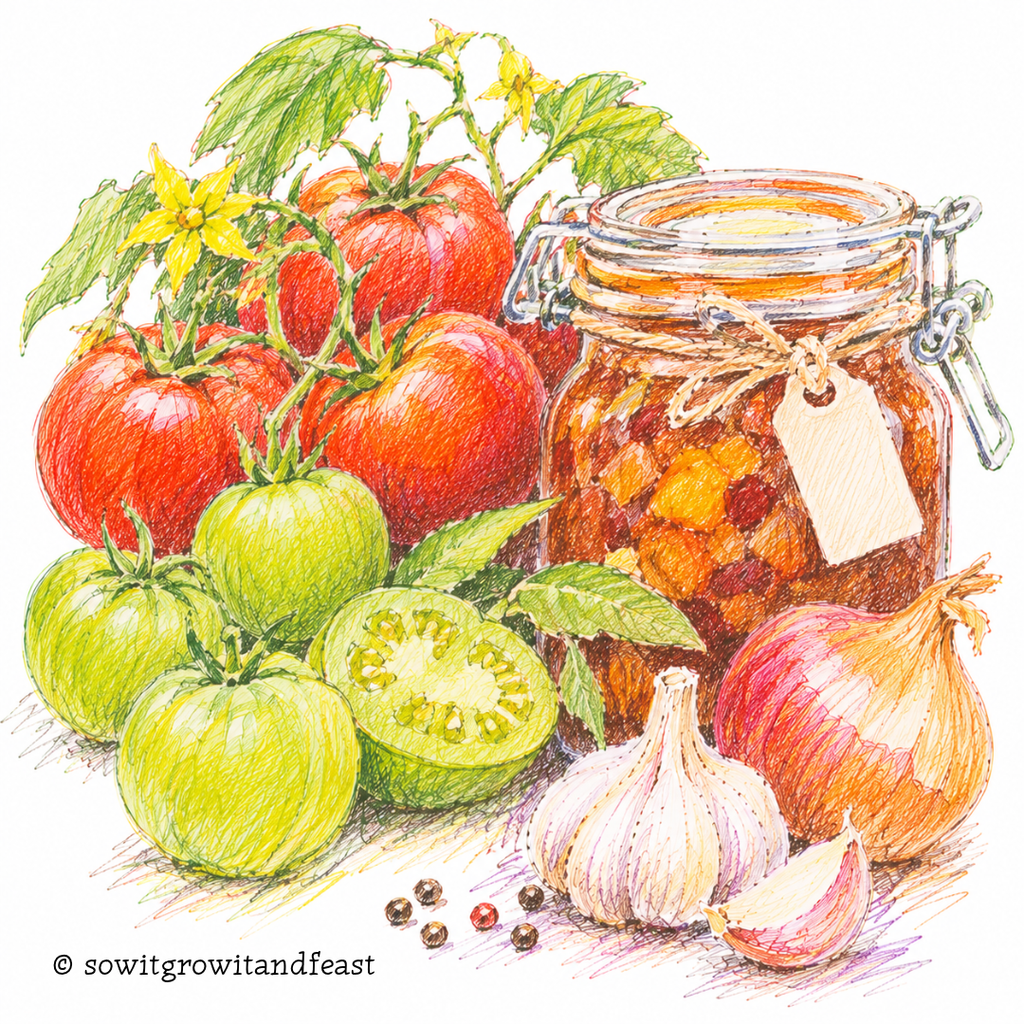
But before you consign those green tomatoes to the compost heap, there is good news. Many can be encouraged to ripen indoors, while others can be transformed into delicious chutneys, pickles and warming autumn dishes.
The trick is knowing which tomatoes are worth ripening, how to give them the best chance and when to accept that green is the colour they intend to remain.
Because even an unfinished tomato harvest can be a very good harvest indeed.
Why Do Tomatoes Stop Ripening in Autumn?
Tomatoes are warm-season plants, and although they can be wonderfully productive in British gardens, they are not particularly enthusiastic about cold weather.
During summer, warmth and light encourage vigorous growth, flowering and fruit development.
As autumn approaches, however, the conditions begin to change.
Temperature Makes All the Difference
Temperature is one of the most important factors affecting tomato ripening.
For many varieties, ripening progresses well at around 20–25°C.
As temperatures fall, the process slows.
When conditions become persistently cold, especially below approximately 10–13°C, ripening can be severely delayed.
At the other extreme, very high temperatures can also interfere with the development of normal fruit colour.
This explains why tomatoes sometimes remain stubbornly green during both cold autumn weather and unusually hot summer spells.
The plant may have produced perfectly healthy fruit, but the conditions are no longer ideal for ripening.
What Makes a Tomato Turn Red?
The familiar red colour of many tomatoes comes largely from a carotenoid pigment called lycopene.
As a red tomato ripens, chlorophyll breaks down and other pigments become more visible or accumulate.
The fruit also undergoes changes in texture, aroma, acidity and sweetness.
Not every tomato turns red, of course.
Some varieties ripen to yellow, orange, pink, purple or other colours, while certain green-when-ripe varieties remain green even when ready to eat.
It is always worth knowing which variety you have grown before deciding that it is refusing to ripen.
Does a Tomato Need Sunshine to Ripen?
This is where things become interesting.
Tomato plants need adequate light to grow and produce fruit, but a mature tomato does not require direct sunlight to complete the ripening process.
In fact, excessive direct sunlight can overheat fruit and cause sunscald.
Once a tomato has reached the appropriate stage of maturity, it can often ripen perfectly well indoors without sitting in a sunny window.
Warmth, fruit maturity and the natural ripening process matter more than direct sunshine at this stage.
The Plant Is Reaching the End of Its Season
By autumn, many tomato plants are beginning to decline naturally.
Leaves may be yellowing, growth is slowing and the plant has already invested considerable energy in producing fruit.
Disease can also become a problem, particularly in cool, damp conditions.
Tomato blight, caused by Phytophthora infestans, can spread rapidly in favourable weather and damage both foliage and fruit.
If blight is present, do not bring obviously infected fruit indoors to ripen.
The best approach is to harvest sound, mature tomatoes before prolonged cold or damaging frost arrives.
Which Green Tomatoes Will Ripen Indoors?
Before gathering every green tomato in sight, it is worth understanding one important distinction.
Not all green tomatoes are at the same stage of development.
Some are mature fruits that simply have not begun changing colour.
Others are still immature and may never ripen properly once removed from the plant.
Mature Green Tomatoes
A mature green tomato has reached approximately its full size.
It will generally feel firm, and its colour may have changed from a deep, dull green to a paler or slightly whitish green.
Depending on the variety, you may notice a subtle change in the appearance of the skin.
These are the tomatoes most likely to ripen successfully indoors.
Tomatoes Beginning to Change Colour
These are particularly promising.
A tomato showing the first hint of its mature colour has reached the breaker stage of ripening.
At this point, the fruit has begun its natural ripening process and can usually continue ripening after harvest under suitable conditions.
These are the ones I would bring indoors first.
Very Small, Immature Tomatoes
Tiny, hard, dark-green tomatoes are less likely to ripen successfully after picking.
They may soften or change colour slightly, but they often lack the maturity needed to develop a satisfactory flavour and texture.
It is tempting to rescue absolutely everything.
But sometimes the sensible approach is to concentrate on the fruit with the best chance of success.
Gardening involves a little optimism.
It also occasionally requires knowing when to stop.
Should You Leave Green Tomatoes on the Plant?
If the weather remains mild and the plants are healthy, there is no need to rush.
Tomatoes can continue ripening outdoors or in an unheated greenhouse during a favourable autumn.
However, as temperatures fall and daylight decreases, progress becomes slower.
A few simple steps may help the remaining fruit.
Remove New Flowers
Late flowers are unlikely to produce ripe tomatoes before the season ends.
Removing them can prevent the plant from investing further resources in new fruit that has little chance of maturing.
Remove Very Small, Unlikely Fruits
If the plant is carrying a large number of tiny tomatoes, removing those unlikely to mature may help you concentrate on the larger, more promising fruit.
Keep the Plant Healthy
Remove dead or diseased foliage carefully and maintain reasonable air circulation.
Avoid excessive watering as growth slows, but do not allow plants to become severely drought-stressed.
Protect Against Cold
Greenhouse-grown tomatoes may continue ripening longer than outdoor crops.
However, an unheated greenhouse offers limited protection once temperatures fall significantly.
If frost threatens, harvest sound, mature fruit rather than risk losing it.
Five Ways to Ripen Green Tomatoes Indoors
Once the tomatoes are harvested, the aim is to provide suitable conditions for ripening while preventing damage or decay.
For most mature green tomatoes, a temperature of around 18–21°C works well.
Choose a clean, dry place away from excessive heat and direct sunlight.
And remember to check them regularly.
One forgotten tomato can make a remarkable mess of an otherwise respectable harvest.
1. The Kitchen Worktop Method
Simple, straightforward and surprisingly effective.
This is my preferred method when there are only a few tomatoes to ripen.
Arrange mature green tomatoes in a single layer on a clean tray or shallow dish.
Leave a little space between the fruits so that air can circulate.
Keep them at normal room temperature, away from direct sunlight and radiators.
Check them every day or two.
Remove ripe tomatoes as they become ready and discard any showing signs of rot.
Best for: Small harvests and tomatoes already beginning to change colour.
2. The Paper Bag Method
Making use of a natural ripening hormone.
Tomatoes produce ethylene, a naturally occurring plant hormone involved in fruit ripening.
Certain other fruits, including ripe bananas and apples, also release ethylene.
Placing mature green tomatoes in a paper bag with a ripening banana or apple can help encourage the process.
How to do it:
- Choose sound, mature green tomatoes.
- Place a few in a clean paper bag.
- Add a ripening banana or apple.
- Fold the top loosely, allowing some air exchange.
- Keep at room temperature.
- Check daily and remove any fruit showing signs of spoilage.
Avoid packing the bag tightly.
The aim is to encourage ripening, not create a damp environment where mould can flourish.
Best for: A handful of mature green tomatoes you would like to ripen a little sooner.
3. The Cardboard Box Method
Particularly useful when the harvest is generous.
If you have gathered a substantial quantity of green tomatoes, a shallow cardboard box can be useful.
Line the bottom with clean paper and arrange the tomatoes in a single layer.
Avoid stacking them if possible.
Keep the box somewhere dry at a suitable room temperature.
You can loosely cover the box to reduce light exposure and help retain some ethylene, but do not seal it airtight.
Check the fruit frequently.
Remove ripe tomatoes and discard any that begin to deteriorate.
Best for: Larger harvests that need to be ripened gradually.
4. Ripening Tomatoes on the Vine Indoors
An old gardening tradition worth knowing about.
Some gardeners prefer to bring entire tomato trusses indoors rather than picking individual fruits.
Others lift whole plants and hang them upside down in a sheltered place.
The idea is to allow mature fruit to continue ripening while still attached to the stems.
However, once the plant has been uprooted, it is no longer taking up water and nutrients normally.
There is no reliable reason to assume this method will produce better-flavoured tomatoes than carefully harvested mature fruit.
It can also introduce diseased or decaying plant material into the storage area.
If you wish to try it, choose only healthy plants or trusses and inspect them regularly.
Best for: Gardeners who enjoy experimenting and have a suitable dry, frost-free space.
5. Ripening Tomatoes in Stages
The most practical approach for a mixed harvest.
Not every tomato needs to ripen at once.
Sort your harvest into groups.
Keep tomatoes already showing colour at room temperature for prompt ripening.
Place mature green tomatoes in shallow trays and inspect them regularly.
Use very immature tomatoes only where appropriate, rather than expecting them all to turn red.
This approach helps avoid the familiar situation where twenty tomatoes ripen on the same afternoon.
After weeks of refusing to cooperate, naturally.
How Long Does It Take Green Tomatoes to Ripen?
There is no fixed timetable.
A tomato already beginning to change colour may ripen within a few days.
A fully mature green tomato may take one to several weeks.
Some will never ripen satisfactorily.
Much depends on the variety, maturity, temperature and condition of the fruit when harvested.
The important thing is to keep checking.
If a tomato develops soft, sunken patches, mould, an unpleasant smell or other signs of decay, discard it.
Do not attempt to rescue rotten fruit by simply cutting away the damaged portion.
Will Indoor-Ripened Tomatoes Taste as Good?
This is a question worth asking.
Tomatoes that have developed fully on a healthy plant and begun ripening before harvest can often develop good flavour indoors.
However, fruit harvested too early may never achieve the same balance of sweetness, acidity and aroma.
The variety also makes an enormous difference.
A ripe home-grown cherry tomato can taste wonderfully sweet.
A large slicing tomato may have a completely different flavour profile.
And some tomatoes are simply better suited to cooking than eating raw.
If your indoor-ripened tomatoes are a little disappointing in a salad, do not despair.
Roasting them with garlic, herbs and olive oil can transform them into something delicious.
Not every tomato needs to be destined for a sandwich.
What to Do with Tomatoes That Stay Green
There comes a point when you realise that some tomatoes are simply not going to ripen.
Perhaps the weather turned too cold.
Perhaps they were picked too early.
Or perhaps they have spent three weeks on the kitchen worktop without showing the slightest interest in changing colour.
Fortunately, green tomatoes have a culinary tradition of their own.
Their firm texture and tart flavour can work beautifully in certain dishes.
There is, however, an important distinction.
Use sound, mature green tomatoes from ordinary edible tomato varieties, rather than very small, immature fruit or any showing signs of disease.
Green tomatoes contain naturally occurring glycoalkaloids, including alpha-tomatine, generally at higher levels in immature fruit than ripe fruit. Normal culinary use of mature green tomatoes in established recipes is different from eating large quantities of very immature tomatoes.
Avoid eating tomato leaves and stems, and do not assume cooking makes every potentially harmful plant compound disappear.
1. Traditional Green Tomato Chutney
The great British answer to an unfinished tomato harvest.
If there is one recipe that deserves a place in every tomato grower’s collection, it is green tomato chutney.
The firm, tart fruit works beautifully with apples, onions, vinegar, sugar and warming spices.
Slow cooking produces a rich, tangy accompaniment that is particularly good with cheese, cold meats and savoury pies.
A Simple Green Tomato Chutney
Ingredients
- 1kg sound, mature green tomatoes, chopped
- 500g Bramley apples, peeled, cored and chopped
- 500g onions, finely chopped
- 250g sultanas
- 500g light brown sugar
- 600ml malt vinegar, 5% acidity
- 1 tablespoon mustard seeds
- 1 teaspoon ground ginger
- 1 teaspoon salt
Method
- Place all the ingredients in a large, heavy-bottomed preserving pan.
- Heat gently, stirring until the sugar dissolves.
- Bring to a gentle simmer.
- Cook uncovered for approximately 2–3 hours, stirring regularly, until the vegetables soften and the mixture becomes thick.
- Transfer to suitable clean containers, cool promptly and refrigerate.
This is a refrigerated chutney recipe, not a tested shelf-stable preserve. Keep at 5°C or below and use within 48 hours, or freeze in suitable portions. For cupboard storage, follow a scientifically tested chutney recipe with its specified acidity and heat-processing instructions.
Serve with mature Cheddar and crusty bread.
It is difficult to think of a more satisfying way to rescue the last of the tomato harvest.
2. Crispy Fried Green Tomatoes
Golden, crunchy and wonderfully tangy.
Fried green tomatoes are particularly associated with cooking in the southern United States, although the dish has a broader culinary history.
Their firm texture makes mature green tomatoes well suited to slicing and frying.
Ingredients
- 3–4 large mature green tomatoes
- 75g plain flour
- 2 eggs, beaten
- 100g fine polenta or breadcrumbs
- Salt and freshly ground black pepper
- A little oil for shallow frying
Method
- Slice the tomatoes into rounds approximately 1cm thick.
- Pat dry with kitchen paper.
- Place the flour, beaten eggs and polenta or breadcrumbs in separate shallow dishes.
- Season the flour and crumbs.
- Dip each tomato slice first into flour, then egg and finally the crumb mixture.
- Heat a little oil in a frying pan.
- Fry the slices over a medium heat for approximately 3–4 minutes on each side, until golden and the tomatoes are tender.
- Drain briefly on kitchen paper.
Serve with a yoghurt and herb dip or alongside a fresh green salad.
They make a lovely lunch, particularly when the autumn garden is still providing a few salad leaves.
3. Green Tomato and Apple Pie
A rather unexpected autumn pudding.
This may sound unusual, but the tartness of green tomatoes can work surprisingly well in sweet dishes.
Combined with apples, sugar and warming spices, they make an interesting filling for a fruit pie.
Ingredients
- 400g mature green tomatoes, finely chopped
- 400g cooking apples, peeled, cored and sliced
- 100g soft brown sugar
- 1 teaspoon ground cinnamon
- A pinch of ground nutmeg
- 1 tablespoon cornflour
- 1 tablespoon lemon juice
- 500g ready-made shortcrust pastry
- A little milk or beaten egg for glazing
Method
- Preheat the oven to 190°C, or 170°C fan.
- Place the tomatoes, apples, sugar, cinnamon, nutmeg, cornflour and lemon juice in a bowl.
- Mix well and leave for approximately 10 minutes.
- Line a suitable pie dish with two-thirds of the pastry.
- Spoon in the filling.
- Roll out the remaining pastry and place it over the top.
- Seal the edges, cut a small steam hole and brush with milk or beaten egg.
- Bake for approximately 45–55 minutes, until the pastry is golden and the filling is bubbling and thoroughly cooked.
Allow to stand briefly before serving.
A little custard would not go amiss.
4. Pickled Green Tomatoes
Sharp, crisp and full of character.
Mature green tomatoes can also be pickled.
Their firm texture works well with vinegar, mustard seeds, peppercorns and other spices.
They make a tangy accompaniment to sandwiches, salads and cold meats.
For safe preservation, use a tested pickling recipe that specifies the correct vinegar acidity, proportions and processing method.
Do not improvise the vinegar-to-water ratio if you intend to store the jars at room temperature.
For an experimental quick pickle, keep the finished product refrigerated and follow a reliable refrigerated-pickle recipe.
5. Roasted Green Tomato Salsa
A savoury way to use the last of the harvest.
Green tomatoes can also be roasted with onions, garlic and chillies to create a tangy sauce.
The flavour is quite different from a salsa made with ripe red tomatoes.
It is sharper and more savoury, particularly good with roasted vegetables, beans or grilled foods.
Roast chopped mature green tomatoes with onion, garlic and a little chilli until softened.
Allow to cool slightly, then blend with fresh coriander, lime juice and seasoning.
Serve freshly made, or refrigerate promptly and use within 48 hours.
Can You Save Seeds from Green Tomatoes?
Seed saving is another way to make use of the harvest, but maturity matters.
Seeds taken from fully ripe, healthy tomatoes are generally the most reliable choice.
Seeds from immature green tomatoes may not have developed sufficiently to germinate well.
If you want to save seed for next year, choose ripe fruit from healthy, open-pollinated varieties.
Remember that seed saved from F1 hybrid varieties may produce plants that differ considerably from the parent.
And never save seed from fruit affected by disease.
Planning Next Year’s Tomato Crop
Every growing season teaches us something.
And a disappointing autumn tomato harvest can be particularly useful when planning for the following year.
If your tomatoes struggled to ripen, there are several things worth considering.
Choose Earlier-Ripening Varieties
Some tomatoes mature considerably sooner than others.
For outdoor growing in Britain, early varieties can be particularly useful.
Consider varieties such as ‘Sungold’ F1, ‘Gardener’s Delight’, ‘Outdoor Girl’ or ‘Latah’, choosing according to your growing conditions and preferences.
No variety can guarantee a perfect harvest in every British summer, but selecting suitable early crops improves your chances.
Avoid Sowing Too Early Without Enough Light
It is tempting to start tomatoes in January.
After all, the seed packets are sitting there, and spring feels a very long way away.
But seedlings grown too early without sufficient light can become weak and leggy.
For many home gardeners, sowing in March is a sensible starting point.
Give Outdoor Tomatoes the Warmest Position
Choose a sunny, sheltered growing area.
A south-facing wall can provide useful warmth and protection.
Avoid exposed positions where plants are constantly battered by wind.
Feed and Water Consistently
Irregular watering can lead to problems such as fruit splitting and blossom-end rot.
Maintain consistent moisture and feed appropriately once fruit begins developing.
Know When to Stop Encouraging New Growth
As the season progresses, particularly with cordon tomatoes, removing the growing tip at an appropriate stage can help limit further growth and concentrate the plant’s resources on existing trusses.
The timing depends on whether plants are growing outdoors or under cover and how many trusses have developed.
Bush tomatoes are generally managed differently and do not normally require the same routine side-shoot removal or stopping.
Keep a Garden Journal
Make a note of which varieties ripened earliest, which produced the best flavour and which struggled as autumn approached.
A few simple observations can be surprisingly useful.
Especially when the seed catalogues arrive and every tomato variety suddenly sounds irresistible.
The Last Harvest Is Still a Harvest
There is a certain sadness in clearing away the tomato plants at the end of the season.
For months, they have been part of the daily rhythm of the garden.
We have checked their growth, tied in their stems, watered them through dry spells and searched beneath the leaves for the first signs of ripening.
Then, almost without warning, the season is over.
The greenhouse becomes quieter.
The vegetable beds begin to empty.
And the last tomatoes are gathered into a bowl.
Some will ripen indoors, bringing a final taste of summer to the kitchen.
Others will remain green and find their way into chutneys, pies, pickles or savoury dishes.
And a few may simply have reached the end of their usefulness.
That is gardening.
Not every seed germinates.
Not every flower becomes a fruit.
And not every tomato turns red.
But there is something rather lovely about learning to make the most of what the season has given us, rather than dwelling on what it has not.
A bowl of green tomatoes is not necessarily a failed harvest.
It may simply be an invitation to try something different.
And perhaps that is one of the most valuable lessons of growing our own food.
The garden rarely follows our plans exactly.
Sometimes it surprises us with abundance.
Sometimes it tests our patience.
And sometimes it leaves us standing in the kitchen in October, wondering what on earth to do with three kilograms of green tomatoes.
Fortunately, there is almost always something delicious to be made.
Because the pleasure of growing food is not only in harvesting what we expected. It is also in discovering what we can do with everything else.
Sow it. Grow it. And feast on it.
Further Reading: Why Growing Food Makes You Feel Better, Take the Guesswork Out of Growing Veg, How to Create a Garden That Feeds Your Family, How to Start a Vegetable Garden Now Ready for Spring
Follow us on Instagram, Threads, BlueSky, Twitter, Pinterest & Facebook
Not sure where to start? Take a look at our Grow Your Own Packs with detailed step by step instructions, seeds and 1 years online support.