
There is something rather dangerous about looking at photographs of vegetable gardens.
Before long, you can become convinced that growing your own food requires six immaculate raised beds, a greenhouse, a potting shed and enough space for rows of potatoes disappearing towards the horizon.
It doesn’t.
If all you have is one raised bed, you have enough space to grow food.
Not everything, admittedly. A single bed probably isn’t going to keep a family supplied with potatoes for the year or provide enough pumpkins for an autumn feast.
But it can give you lettuce picked minutes before lunch. Radishes pulled from the soil while they’re still crisp and peppery. A handful of peas eaten beside the bed. Beetroot for roasting, herbs for the kitchen and perhaps a courgette that, by August, appears determined to take over the entire garden.
The secret isn’t having more space.
It’s learning how to use the space you have.
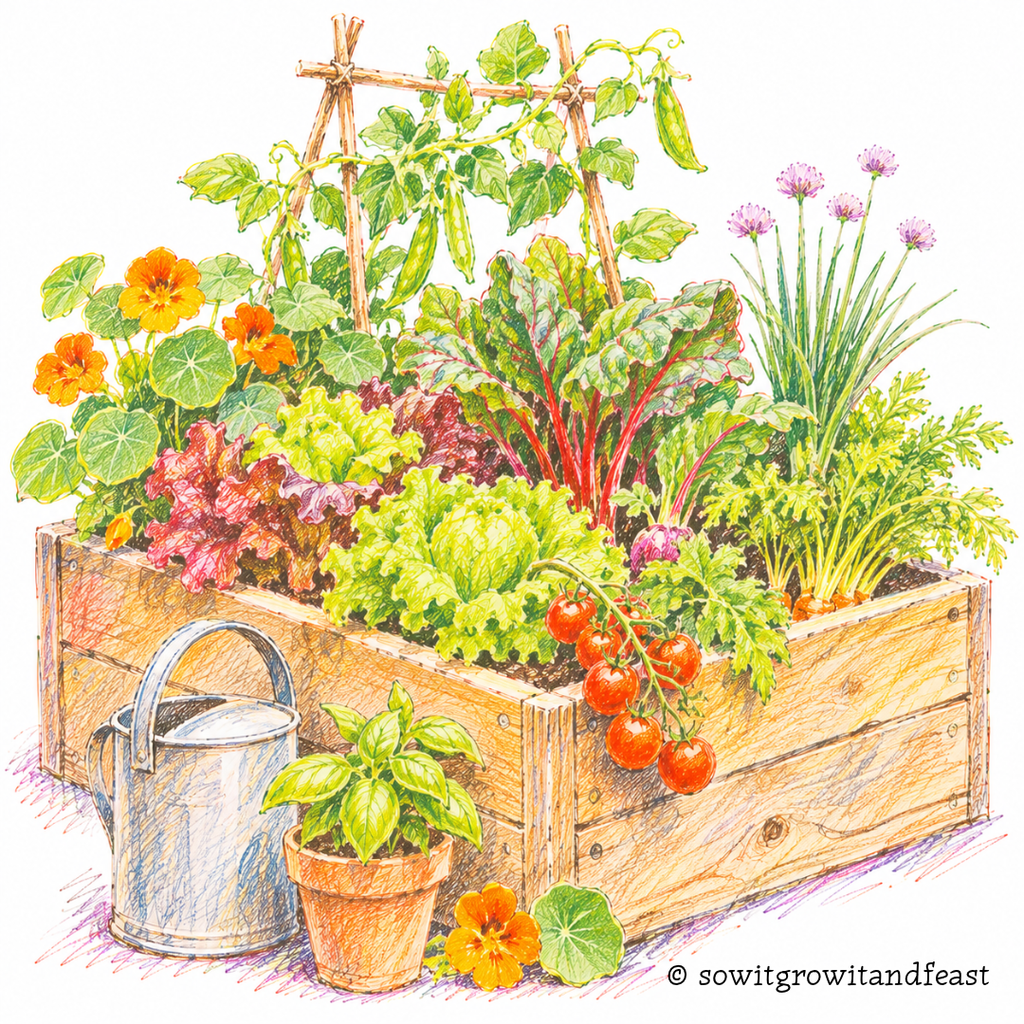
Is one raised bed enough to grow vegetables?
Absolutely.
In fact, if you’re new to growing your own food, starting with one raised bed can be one of the best ways to begin.
There is less ground to prepare, less watering to keep on top of and fewer weeds to deal with. You can concentrate on learning what grows well in your garden without suddenly finding yourself responsible for an entire allotment.
A small growing space also encourages you to think carefully about what earns its place.
Instead of planting a large quantity of one vegetable, you can grow smaller amounts of several crops and replace them as they finish.
That means one raised bed can produce something useful for much of the year.
The trick is to stop thinking of it as a bed you fill once in spring.
Think of it as a space that changes with the seasons.
First, how big is your raised bed?
Raised beds come in all shapes and sizes, but a common size for a home vegetable bed is around 1.2 metres wide and 2.4 metres long.
The width matters more than you might think.
You should be able to reach the middle comfortably from either side without standing on the soil. Avoiding unnecessary foot traffic helps prevent compaction and makes sowing, weeding and harvesting much easier.
If your bed is smaller, don’t worry.
The same principles still apply.
Even a bed measuring roughly one metre square can produce a surprising amount if you choose your crops carefully.
And if yours is larger, resist the urge to fill every centimetre immediately. Plants that look tiny in May can be elbowing one another aside by July.
Seed packets give spacing instructions for a reason.
Start with what you actually eat
Before choosing vegetables, open the fridge.
What do you buy regularly?
Salad leaves? Spring onions? Beetroot? Herbs? Carrots?
Those are the crops worth considering first.
It is remarkably easy to become seduced by seed catalogues and devote valuable space to something nobody in the household particularly wants to eat.
Growing your own food is satisfying.
Growing food that then sits unwanted in the fridge is less so.
With only one raised bed, every crop needs to earn its place.
That doesn’t mean you can’t experiment. Part of the pleasure of vegetable gardening is trying varieties you rarely see in the shops.
But build the bed around food you’ll actually look forward to harvesting.
Grow upwards as well as outwards
When ground space is limited, look up.
Climbing vegetables can produce a useful harvest while occupying relatively little room at soil level.
Peas are an obvious choice in spring and early summer. Give them pea sticks, netting or another suitable support and they’ll climb happily upwards.
Later in the season, climbing French beans can use vertical space particularly well.
Runner beans are another possibility, although vigorous varieties can become large for a very small bed.
Position tall crops carefully.
A row of climbing beans on the sunny side of the bed can shade everything behind it. Put taller plants towards the side where they won’t deprive shorter crops of valuable light.
A few canes and a little planning can effectively give your raised bed another dimension.
Salad leaves deserve a place
If space is precious, salad leaves are difficult to beat.
They grow quickly, don’t need enormous amounts of room and can be harvested little and often.
Instead of waiting for a lettuce to form one enormous head, try loose-leaf varieties that allow you to pick individual outer leaves while leaving the centre to continue growing.
Rocket, mizuna and other suitable salad leaves can also be useful.
The advantage isn’t simply speed.
It’s freshness.
A bag of supermarket salad begins deteriorating almost as soon as it is opened. Salad growing outside the kitchen door remains alive until the moment you pick it.
Take what you need.
Leave the rest growing.
For a small-space vegetable garden, that’s remarkably efficient.
Radishes fill the gaps
Radishes are excellent opportunists.
They grow quickly and can fit into spaces that will eventually be needed by slower vegetables.
Imagine you’ve planted young courgettes in late spring.
Those plants may eventually become enormous, but for the first few weeks there will be plenty of bare soil around them.
Rather than leaving that space empty, sow a short row of radishes.
With luck, you’ll be harvesting them before the courgette needs the room.
This idea – using quick crops between slower ones – is particularly useful when growing vegetables in a small raised bed.
The garden is constantly changing.
Use the gaps while they’re there.
Beetroot gives you two harvests
Beetroot is another good candidate for a raised bed.
The roots don’t take up huge amounts of space, and both the root and leaves are edible.
Young beetroot leaves can be added to salads, while larger leaves can be cooked much like chard.
Then, of course, there is the beetroot itself.
Roast it. Pickle it. Grate it raw. Turn it into soup.
You can also harvest some roots while they’re small rather than waiting for everything to reach maximum size. This gradually creates more room for those left behind.
Small vegetable gardens reward gardeners who harvest regularly.
Carrots can work beautifully
Raised beds can be excellent for carrots, particularly if the soil is deep, loose and relatively free from stones.
Carrots dislike freshly manured ground, which can encourage roots to fork, so don’t assume that adding lots of rich material immediately before sowing will improve the crop.
Instead, give them a fine, workable soil and sow directly where they are to grow.
Carrots don’t particularly enjoy being transplanted.
Sow thinly and avoid crushing the foliage unnecessarily once the plants are growing, as the scent can help attract carrot fly.
If carrot fly is troublesome in your area, fine insect-proof mesh can be useful.
Pulling the first carrot from a raised bed remains one of vegetable gardening’s small triumphs.
You never quite know what is going to emerge.
A courgette – but perhaps only one
Courgettes are famously generous.
One healthy plant can produce a considerable crop.
It can also occupy a considerable amount of space.
If you have just one modest raised bed, you probably don’t need three courgette plants.
One may be plenty.
Position it where its leaves can spill slightly over the edge rather than smothering everything around it.
While the plant is still small, use the surrounding ground for quick crops such as radishes and salad leaves.
Then let the courgette have more room as summer progresses.
And once harvesting begins, keep looking.
A perfectly manageable courgette can transform into something resembling a small marrow with astonishing speed.
Don’t forget spring onions
Spring onions are another useful crop for a small bed.
They take up relatively little space and can be sown in short rows between other vegetables.
You don’t need an entire regiment of them.
Sow small amounts at intervals and you’ll spread the harvest rather than having thirty spring onions ready on the same Tuesday.
This is known as successional sowing, and it is one of the most useful techniques for getting more from a small vegetable garden.
Little and often is usually better than everything at once.
Find room for herbs
Herbs are some of the most valuable things you can grow in a small space because even a modest amount can transform a meal.
Parsley is an obvious candidate.
Chives take up little room and return year after year.
Coriander can be sown in small batches, although it has an irritating habit of running to seed just as you decide you need it.
Basil can be wonderful in summer but wants warmth and is generally happier in a sheltered position.
Perennial Mediterranean herbs such as rosemary and sage can become sizeable shrubs, so I wouldn’t necessarily give them permanent residence in a small raised vegetable bed.
Grow those in pots nearby instead.
That’s an important small-space lesson.
Not everything has to go in the raised bed.
Use pots as an extension of the bed
One raised bed doesn’t mean one growing space.
A large pot beside it can hold a tomato.
Another can contain herbs.
Strawberries can grow in containers, and potatoes are perfectly capable of growing in large pots or bags.
This leaves the valuable raised-bed soil available for crops that make particularly good use of it.
If you’re deciding what to grow where, think about which vegetables genuinely need the bed and which will be perfectly happy elsewhere.
A sunny patio containing one raised bed and several well-chosen pots can become a surprisingly productive little kitchen garden.
What about tomatoes?
Tomatoes can certainly be grown in a raised bed, provided it is in a sunny, sheltered position.
The question is whether that’s the best use of your limited space.
A cordon tomato trained vertically can be reasonably economical with ground space, but tomatoes also grow very successfully in large containers.
If you have room for pots beside your raised bed, I’d be tempted to put tomatoes there and save the bed itself for salads, roots, peas, beans and other crops.
But gardening isn’t a mathematical exercise.
If the vegetable you most want to grow is a tomato, grow the tomato.
The best use of a raised bed is growing something that makes you want to go outside and pick it.
What shouldn’t you grow in one small raised bed?
Technically, you can grow an enormous range of vegetables in raised beds.
But some crops are less useful when space is very limited.
Maincrop potatoes, for example, can occupy a large area for a relatively long time. If you only have one bed, containers may be a better home for them.
Pumpkins and vigorous winter squash can send stems several metres across the garden. They are possible if you have room for the vines to trail outside the bed, but less appealing if space is tight.
Sweetcorn is generally best grown in a block rather than a single row because it relies on wind pollination, which can make it awkward in a tiny bed.
Large cabbages, cauliflowers and other long-season brassicas can also occupy substantial space for months.
None of these crops is forbidden.
The question is simply whether you want one plant occupying a large piece of your only bed when that same space could produce several quicker harvests.
The secret is to grow more than one crop in the same space
This is where a single raised bed becomes much more interesting.
Suppose you sow radishes in early spring.
You harvest them and plant out a courgette.
Salad leaves grow around it while the courgette is still small.
When summer crops finish, you sow something suitable for autumn.
Suddenly, that small patch of earth hasn’t produced one crop.
It has produced three or four.
This is sometimes called succession growing.
You don’t need a complicated chart to do it.
Whenever you harvest something, ask yourself one simple question:
What can go here next?
That question can transform how much food a small garden produces.
A simple plan for one raised bed
If you’re wondering what to grow in one raised bed, here’s one way the year could unfold.
In early spring, sow some radishes, carrots, beetroot, spring onions and salad leaves, with peas climbing up a support at the back of the bed.
As the radishes and early salads are harvested, new space begins to appear.
By late spring, a courgette can go into one corner.
When the peas finish, climbing French beans can take over their supports for summer.
Keep sowing small quantities of salad leaves and spring onions wherever suitable gaps appear.
As summer crops finish, the bed can change again.
Depending on the time of year and your local conditions, autumn sowings might include suitable spinach, hardy salad leaves or other crops intended for cooler conditions.
The exact planting plan matters less than the principle.
Never think of the bed as finished.
Keep feeding the soil
Growing several crops in the same bed means asking quite a lot from a relatively small volume of soil.
Look after it.
Adding well-rotted compost or other suitable organic matter helps maintain soil structure and fertility.
Different vegetables have different nutritional requirements, so avoid assuming that every crop simply needs more fertiliser.
Mulching around established plants can help the soil retain moisture during warm weather.
Most importantly, don’t allow the bed to become exhausted through neglect.
A productive raised bed isn’t simply a container full of soil.
It’s a living growing space that needs looking after.
Watering matters more in raised beds
Raised beds can dry out faster than surrounding ground, particularly during hot, windy weather.
Check the soil rather than watering automatically.
Push a finger below the surface. The top can look dry while the soil underneath still contains plenty of moisture.
When watering is needed, a thorough drink that reaches the root zone is generally more useful than repeatedly sprinkling the surface.
Watering in the morning or evening can also reduce losses through evaporation during hot weather.
And if you’re planning a new raised bed, put it somewhere reasonably close to a water source.
A watering can feels considerably heavier on the twentieth journey across the garden.
Don’t worry about making it perfect
A productive raised bed doesn’t need to look like a photograph.
There will be gaps.
Something will probably fail.
A pigeon may discover your peas. Slugs may develop an unexpected enthusiasm for your lettuce. One carrot will almost certainly emerge shaped like something that shouldn’t be shown in polite company.
That’s gardening.
What matters is noticing what works.
Perhaps your beetroot thrives while carrots struggle. Maybe salad leaves are wonderful in spring but miserable in midsummer. Perhaps climbing beans love the sunny side of the bed.
Next year, you’ll know more.
A small vegetable garden teaches you quickly because everything is close enough to watch.
One bed can still produce a feast
It is easy to measure a vegetable garden by its size.
How many beds?
How many rows?
How much ground?
But that’s rarely the most interesting measure.
A better question is what comes out of it.
A bowl of salad leaves.
Five beetroot roasting beside Sunday lunch.
A handful of peas that never make it into the kitchen because you eat them beside the bed.
Courgettes sliced into a summer supper.
A few carrots pulled from the soil with children watching to see what appears.
Spring onions chopped over dinner.
Beans picked while they’re still tender.
None of these requires an enormous vegetable garden.
They require some soil, some seeds and the willingness to begin.
So if one raised bed is all you have, don’t think of it as a limitation.
Fill it carefully.
Grow upwards.
Sow little and often.
Harvest regularly.
And whenever a space appears, plant something else.
You might be surprised by just how much food can come from one small patch of earth.
Further Reading: Why Growing Food Makes You Feel Better, Take the Guesswork Out of Growing Veg, How to Create a Garden That Feeds Your Family, How to Start a Vegetable Garden Now Ready for Spring
Follow us on Instagram, Threads, BlueSky, Twitter, Pinterest & Facebook
Not sure where to start? Take a look at our Grow Your Own Packs with detailed step by step instructions, seeds and 1 years online support.