
There is a particular moment in autumn when soup begins to feel less like a lunch option and more like a very good idea.
The mornings have turned chilly, the garden is beginning to settle into its slower rhythm, and the kitchen windows are misting over as something delicious bubbles away on the hob.
Outside, leaves gather along the paths and the last of the summer crops are giving way to the sturdy vegetables of autumn. Pumpkins sit among their fading foliage, carrots and parsnips wait beneath the soil, and leeks stand remarkably upright despite everything the weather has thrown at them.
It is the season of woolly jumpers, muddy boots and coming indoors to something warm.
And few things are more comforting than a bowl of homemade soup.
Soup is wonderfully forgiving. It welcomes the slightly crooked carrot, the enormous courgette that escaped your attention and the handful of vegetables left at the bottom of the fridge. It asks very little of us, yet can turn the simplest ingredients into something deeply satisfying.
For those of us who grow our own food, it is also one of the loveliest ways to celebrate the harvest.
A pumpkin that began life as a seed in April becomes supper in October. The leeks planted months ago find themselves gently simmering alongside potatoes. A handful of herbs gathered before the first frost brings the last fragrance of summer into the kitchen.
There is something rather special about that.
So, as the days shorten and the evenings draw in, let’s explore the vegetables that make autumn soups so delicious, how to grow them and a few recipes worth returning to throughout the colder months.
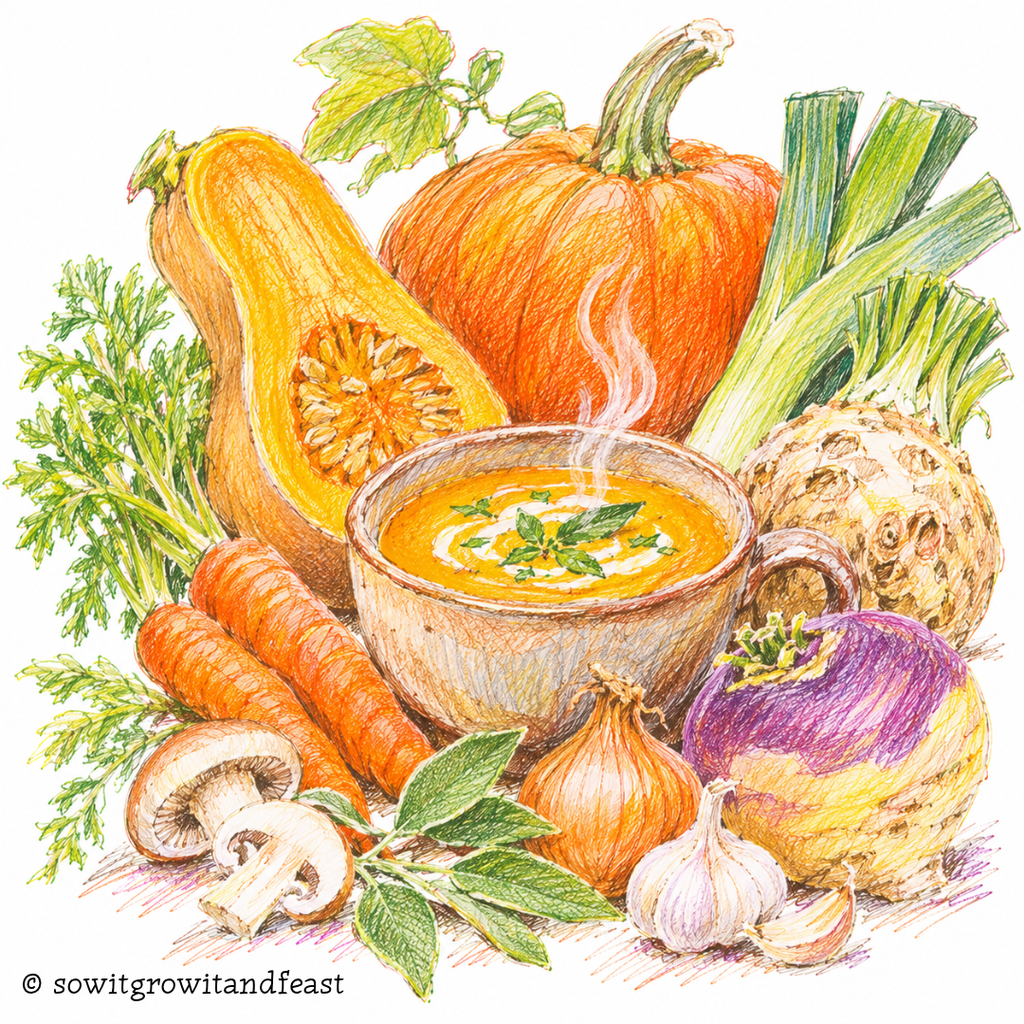
Why Autumn Is Such a Wonderful Season for Soup
Autumn brings a change in the way we cook.
During summer, meals often revolve around fresh salads, tender vegetables and ingredients that need very little preparation.
As temperatures fall, our attention turns towards roasting, simmering and slow cooking.
And the vegetables available at this time of year seem particularly well suited to it.
Squashes develop rich, sweet flavours when roasted. Root vegetables soften beautifully in stock. Leeks bring a gentle savoury sweetness, while mushrooms add depth and an earthy character.
Many autumn vegetables also store well, allowing us to enjoy the harvest long after the plants themselves have finished growing.
The pleasure of eating seasonally
Choosing seasonal vegetables is about more than simply following a calendar.
Produce harvested at the appropriate stage of maturity can offer excellent flavour and quality, particularly when it has travelled only a short distance from garden to kitchen.
Seasonal crops can also be good value when supplies are plentiful.
However, it would be misleading to suggest that seasonal vegetables are always more nutritious than those grown at other times. Nutritional content depends on the crop, variety, growing conditions, storage and preparation.
What matters most is enjoying a varied diet that includes plenty of vegetables.
And autumn certainly gives us plenty to choose from.
The Best Autumn Vegetables for Soup
Butternut Squash – Cucurbita moschata
Butternut squash is almost made for soup.
Its golden-orange flesh becomes beautifully tender when cooked, producing a naturally creamy texture without needing much cream at all.
Roasting brings out its sweetness and adds a slightly caramelised flavour.
Butternut squash provides fibre, potassium and carotenoids, including beta-carotene, which the body can convert into vitamin A.
Growing it: Sow seeds indoors in spring and plant outside once the danger of frost has passed. Give plants fertile soil, warmth, sunshine and plenty of space. Harvest mature fruits before frost and store sound, properly cured squash in suitable conditions.
In the soup pot: Pair with sage, rosemary, garlic, ginger or a little chilli.
Pumpkins – Cucurbita Species
Pumpkins are far too useful to be left entirely to Halloween.
Although large carving pumpkins can be rather watery and mild, smaller culinary varieties often have denser flesh and richer flavour.
Pumpkins vary botanically. Familiar cultivated types may belong to Cucurbita pepo, Cucurbita maxima or Cucurbita moschata.
Choose varieties bred for eating if soup is your priority.
Growing them: Start seeds in spring and give plants fertile soil, generous watering and sufficient room to spread. Allow fruits to mature fully before harvesting.
In the soup pot: Pumpkin works beautifully with roasted garlic, thyme, ginger, cumin and warming spices.
Carrots – Daucus carota subsp. sativus
Carrots bring sweetness, colour and body to autumn soups.
They are particularly useful because they work equally well as the main ingredient or as part of the flavour base.
Orange carrots contain beta-carotene and also provide fibre and potassium.
Growing them: Sow directly into fine, stone-free soil from spring into summer, choosing varieties suited to the season. Protect crops from carrot root fly where necessary.
In the soup pot: Combine with coriander, ginger, red lentils, parsnips or roasted peppers.
Parsnips – Pastinaca sativa
Parsnips are among the great pleasures of the winter vegetable garden.
Their sweet, earthy flavour becomes particularly lovely when roasted.
They provide fibre, folate and potassium, among other nutrients.
Growing them: Sow fresh seed directly outdoors in spring. Parsnips develop long roots and need a reasonably deep growing area. They can often remain in the ground through cold weather, provided conditions are suitable.
In the soup pot: Pair with apples, thyme, cumin, carrots or a little curry spice.
Swede – Brassica napus Napobrassica Group
Swede is one of those vegetables that deserves more appreciation.
It is hardy, useful and surprisingly sweet when cooked slowly.
Its golden flesh adds body to soup, while its slightly earthy flavour works beautifully with lentils and other root vegetables.
Swede provides fibre and vitamin C.
Growing it: Sow outdoors in late spring or early summer, depending on local conditions. Keep seedlings watered and protect from common brassica pests.
In the soup pot: Combine with carrots, onions, lentils, thyme and black pepper.
Leeks – Allium ampeloprasum Leek Group
There is something wonderfully dependable about leeks.
While many crops have finished, they remain standing in the vegetable garden, waiting patiently to be harvested.
Their flavour is milder than onions, becoming beautifully sweet when gently cooked.
Leeks provide fibre, folate and vitamin K, among other nutrients.
Growing them: Sow in spring and transplant young plants into their final positions during late spring or early summer. Choose varieties suited to autumn or winter harvesting.
In the soup pot: Leeks are excellent with potatoes, celeriac, mushrooms and thyme.
Celeriac – Apium graveolens var. rapaceum
Celeriac is not going to win many beauty competitions.
Its knobbly, rather untidy appearance does little to suggest the delicate flavour waiting beneath its skin.
But once peeled and cooked, it becomes wonderfully tender, with a subtle taste somewhere between celery, parsley and nuts.
Celeriac provides fibre, vitamin K and potassium.
Growing it: Start seeds indoors in late winter or early spring. Celeriac needs a long growing season, fertile soil and consistent moisture.
In the soup pot: Combine with leeks, potatoes, apples, thyme or a little nutmeg.
Mushrooms
Autumn is traditionally associated with mushrooms, particularly in woodland and hedgerow habitats.
Their earthy, savoury flavour adds wonderful depth to soups.
Cultivated chestnut, button and oyster mushrooms are excellent choices for home cooking.
Mushrooms can provide B vitamins and minerals, although nutritional values vary considerably between types and growing conditions.
A note on foraging: Never eat a wild mushroom unless its identity has been confirmed with complete confidence by someone suitably experienced. Some poisonous species closely resemble edible ones, and cooking does not necessarily make them safe.
For most home cooks, cultivated mushrooms are the sensible and delicious choice.
In the soup pot: Pair with leeks, onions, garlic, thyme, barley or lentils.
Three Warming Autumn Soup Recipes
These three soups celebrate the wonderful variety of vegetables available during autumn.
Each is straightforward to prepare, full of flavour and particularly good served with a generous slice of crusty bread.
1. Roasted Butternut Squash and Sage Soup
<text color=”secondary” size=”sm”>Serves 6 | Preparation: 20 minutes | Cooking: 45–50 minutes</text>
There is something almost irresistible about the smell of squash roasting in the oven.
As its edges begin to caramelise, the kitchen fills with a gentle sweetness that seems perfectly suited to autumn.
Fresh sage brings an earthy fragrance, while a little cream adds richness without overwhelming the flavour of the vegetables.
Ingredients
- 1 large butternut squash, approximately 1.2kg, peeled, deseeded and chopped
- 2 tablespoons olive oil
- 1 large onion, chopped
- 2 carrots, chopped
- 2 celery sticks, chopped
- 4 garlic cloves, crushed
- 1 litre vegetable or chicken stock, with extra if needed
- 10–12 fresh sage leaves
- 100ml double cream or coconut milk, optional
- Salt and freshly ground black pepper
- Toasted pumpkin seeds, to serve
Method
- Preheat the oven to 200°C, or 180°C fan.
- Place the chopped butternut squash on a baking tray. Drizzle with one tablespoon of olive oil, season lightly and toss to coat.
- Roast for approximately 30–35 minutes, turning once, until tender and beginning to caramelise.
- Meanwhile, heat the remaining olive oil in a large saucepan. Add the onion, carrots and celery. Cook gently for 8–10 minutes until softened.
- Add the garlic and most of the sage leaves, reserving a few for serving. Cook for another minute.
- Add the roasted squash and pour in the stock. Bring to a gentle simmer and cook for approximately 10–15 minutes.
- Remove from the heat and blend until smooth using a stick blender.
- Stir in the cream or coconut milk, if using. Add a little more stock if the soup is too thick.
- Season to taste and warm through gently.
Serve with toasted pumpkin seeds and a little finely chopped sage.
From the garden: If you have grown your own squash, save a few sound, mature fruits for winter cooking. There is something particularly satisfying about making soup in January from a squash harvested in October.
2. Hearty Lentil, Mushroom and Swede Soup
<text color=”secondary” size=”sm”>Serves 6–8 | Preparation: 20 minutes | Cooking: 50–60 minutes</text>
Not every soup needs to be smooth.
Sometimes the best ones are thick, rustic and full of vegetables, the sort that make a proper meal rather than a light starter.
This combination of mushrooms, swede and lentils is wonderfully sustaining.
The lentils provide plant protein and fibre, while the mushrooms bring a rich savoury flavour.
It is particularly good on those damp autumn evenings when the rain seems determined to continue indefinitely.
Ingredients
- 2 tablespoons olive oil
- 1 large onion, finely chopped
- 2 garlic cloves, crushed
- 250g chestnut mushrooms, sliced
- 400g swede, peeled and diced into small pieces
- 2 large carrots, diced
- 200g dried brown or green lentils, rinsed
- 1.5 litres vegetable stock, with extra if needed
- 1 teaspoon dried thyme
- 2 bay leaves
- 1 tablespoon soy sauce or tamari, optional
- A generous handful of fresh parsley, chopped
- Salt and freshly ground black pepper
Method
- Heat the olive oil in a large saucepan over a medium heat.
- Add the onion and cook gently for approximately 5–7 minutes until softened.
- Stir in the garlic and cook for another minute.
- Add the sliced mushrooms and increase the heat slightly. Cook for 5–8 minutes until they release their moisture and begin to brown.
- Add the diced swede and carrots. Stir well and cook for another few minutes.
- Add the rinsed lentils, stock, thyme and bay leaves.
- Bring to the boil, then reduce the heat and simmer gently for approximately 40–50 minutes, or until the lentils and vegetables are tender. Add extra stock or water if needed.
- Remove the bay leaves.
- For a thicker soup, blend a small portion and stir it back into the saucepan.
- Add the soy sauce, if using, and stir through the fresh parsley.
Season to taste and serve with wholemeal bread.
From the garden: Swede and carrots are useful autumn crops, while parsley can continue producing well into the cooler months in a sheltered position. A handful of freshly picked herbs makes an enormous difference to the finished soup.
3. Creamy Leek and Celeriac Soup with Nutmeg
<text color=”secondary” size=”sm”>Serves 6 | Preparation: 20 minutes | Cooking: 35–40 minutes</text>
This is a soup that feels rather elegant despite being made from some of the most ordinary-looking vegetables in the garden.
Leeks bring sweetness, celeriac provides a delicate earthy flavour, and a little nutmeg adds warmth.
The result is beautifully smooth and comforting.
It is also a very good way to introduce someone to celeriac without first showing them what it looks like.
Ingredients
- 3 large leeks, approximately 500g, trimmed, thoroughly washed and sliced
- 1 medium celeriac, approximately 600g, peeled and chopped
- 2 tablespoons butter or olive oil
- 1 onion, chopped
- 1 litre vegetable stock, with extra if needed
- 100ml single cream or an unsweetened plant-based alternative
- A small pinch of freshly grated nutmeg
- Salt and white or black pepper
- Fresh chives or parsley, to serve
Method
- Melt the butter or heat the olive oil in a large saucepan over a medium-low heat.
- Add the onion and sliced leeks.
- Cook gently for approximately 10–12 minutes, stirring occasionally, until soft but not browned.
- Add the chopped celeriac and stir well.
- Pour in the stock and bring to a gentle simmer.
- Cover and cook for approximately 20–25 minutes, or until the celeriac is completely tender.
- Remove from the heat and blend until smooth.
- Stir in the cream and a small pinch of nutmeg.
- Add a little extra stock if needed and season to taste.
- Warm gently before serving.
Finish with chopped chives or parsley.
From the garden: Leeks are particularly useful for winter harvesting, while celeriac can often be lifted in autumn and stored under suitable conditions. Together, they make an excellent soup when the garden has become quiet.
Five More Autumn Soup Combinations Worth Trying
Once you understand the basics of soup-making, recipes become wonderfully flexible.
You can work with whatever is ready in the garden, available at the market or waiting patiently in the vegetable drawer.
Here are five more combinations worth exploring.
Carrot, Parsnip and Ginger: Roast carrots and parsnips until their edges begin to colour, then simmer with onion, stock and freshly grated ginger. Blend until smooth.
Pumpkin, Red Lentil and Cumin: Combine pumpkin with red lentils, garlic, onion and a little ground cumin. The lentils thicken the soup naturally and add protein and fibre.
Leek, Potato and Thyme: A traditional favourite. Gently soften leeks in butter, add diced potatoes, stock and thyme, then simmer until tender. Blend all or part of the soup according to your preferred texture.
Roasted Beetroot and Apple: Roast beetroot until tender, then combine with softened onion, apple and vegetable stock. Blend for a beautifully coloured soup with a lovely balance of earthy and sweet flavours.
Mushroom, Barley and Rosemary: Cook mushrooms with onion and garlic, then add pearl barley, stock and a little rosemary. Simmer until the barley is tender for a hearty, rustic soup.
There is no need to make soup complicated.
Often, three or four well-chosen ingredients are quite enough.
How to Build a Good Soup Without a Recipe
One of the most useful things you can learn in the kitchen is how to make soup from what you already have.
Once you understand the basic method, you can adapt it to almost any seasonal harvest.
Start with something aromatic
Onions, leeks, garlic and celery provide a lovely foundation.
Cook them gently in a little butter or olive oil until softened.
This develops flavour before the main vegetables are added.
Choose your main vegetables
Squash, pumpkin, carrots, parsnips, swede, celeriac and potatoes all work well.
You can use one vegetable or combine several.
Try to balance sweetness with something savoury or earthy.
Add stock gradually
Vegetable or chicken stock adds flavour, but there is no need to drown the vegetables.
Begin with enough to cover them or nearly cover them, depending on the ingredients and the texture you want.
You can always add more later.
It is considerably harder to remove it once the soup has become too thin.
Simmer until tender
Cook gently until the vegetables are soft.
Avoid unnecessarily vigorous boiling, which can cause delicate ingredients to break down unevenly.
Decide on the texture
Some soups are best completely smooth.
Others benefit from a little texture.
You can blend the whole saucepan, blend only part of it or leave everything chunky.
There are no prizes for making every soup look identical.
Finish with flavour
A squeeze of lemon juice can brighten a rich soup.
Fresh herbs bring fragrance.
Black pepper, a little mustard, a spoonful of yoghurt or a drizzle of olive oil can make a remarkable difference.
Taste before serving.
Sometimes the smallest adjustment transforms the whole dish.
Growing Your Own Autumn Soup Garden
If you enjoy making soup, it is worth planning a little space specifically for the ingredients you use most often.
You do not need a large allotment.
Even a modest vegetable patch can provide an impressive selection of soup vegetables throughout the year.
Spring: Begin the Soup Garden
Spring is the time to sow many of the crops that will eventually find their way into autumn cooking.
Carrots, parsnips and leeks can all be started during spring, depending on the variety and local conditions.
Pumpkins and squash are usually sown under cover in April or May before planting outside once the risk of frost has passed.
Celeriac needs a longer growing season and is generally started earlier indoors.
Summer: Keep Everything Growing
Summer is when the soup garden begins to take shape.
Squash plants spread across the ground.
Leeks develop their long stems.
Root vegetables swell beneath the soil.
Keep plants watered during prolonged dry spells and mulch where appropriate to help conserve moisture.
Weed regularly, particularly around young root crops and leeks.
Autumn: Harvest and Enjoy
By autumn, much of the work has been done.
Pumpkins and squash are harvested before damaging frosts.
Carrots, swede and celeriac can be lifted as needed or stored according to the crop and conditions.
Many leek varieties can remain in the ground for winter harvesting.
And suddenly, the ingredients for supper are waiting just beyond the back door.
Making the Most of the Harvest
Autumn soup is also a wonderful way to reduce food waste.
Vegetables do not have to be perfectly shaped to taste delicious.
A crooked carrot, an unusually large parsnip or a slightly untidy celeriac can all make excellent soup.
The important distinction is between vegetables that are merely imperfect and those that are genuinely spoiled.
Use sound produce, trim away minor blemishes where appropriate and discard anything showing significant mould, rot or other signs of unsafe deterioration.
Make Your Own Vegetable Stock
Clean, sound vegetable trimmings can be useful for making stock.
Onion skins, carrot peelings, leek tops, celery leaves and herb stalks can all contribute flavour.
Avoid using mouldy or spoiled scraps.
Simmer suitable trimmings in water, strain and use the stock promptly or cool and freeze it safely.
Freeze Soup for Busy Days
Most vegetable soups freeze well.
Allow cooked soup to cool promptly, divide into shallow containers and refrigerate or freeze without unnecessary delay.
Label containers with the contents and date.
For best quality, many homemade vegetable soups are worth using within two to three months of freezing, although food kept continuously frozen at -18°C remains safe for longer.
Cream-based soups can sometimes separate after freezing, so you may prefer to add cream when reheating.
Store Your Autumn Vegetables Properly
Different vegetables need different storage conditions.
Mature winter squash can often be kept for several months in a suitable dry, well-ventilated place.
Root vegetables may be stored under cool conditions, depending on the crop.
Leeks can often remain in the ground during winter, although frozen or waterlogged soil can make harvesting difficult.
A little attention to storage means the autumn harvest can continue feeding us long after the garden has stopped producing new growth.
Making Soup a Little More Substantial
A bowl of vegetable soup can be a lovely light lunch.
But if you want something more filling, there are plenty of simple additions.
Lentils, beans and chickpeas contribute plant protein and fibre.
Pearl barley adds a wonderfully satisfying texture.
Potatoes, rice or small pasta shapes make soup more substantial.
A spoonful of yoghurt, grated cheese or toasted seeds can add richness and flavour.
And there is always bread.
A thick slice of wholemeal bread, preferably with a little butter, can turn a bowl of soup into a very satisfying meal.
Particularly after an afternoon spent outside in the garden.
A Little Food Safety Goes a Long Way
Homemade soup is excellent for preparing ahead, but it should be handled carefully.
Cool leftovers promptly and refrigerate them within two hours.
Keep refrigerated soup at 5°C or below and use within 48 hours, or freeze it for later.
When reheating, ensure the soup is steaming hot throughout. Stir well so that it heats evenly.
If using wild mushrooms, only cook those that have been identified with certainty as edible by a suitably knowledgeable person.
And if you are preserving soup for storage at room temperature, do not rely on ordinary bottling or water-bath methods. Most vegetable soups are low-acid foods and require a tested pressure-canning process to be safely shelf-stable.
For most home cooks, freezing is the simplest and safest preservation method.
The Quiet Pleasure of an Autumn Soup
There is something deeply comforting about soup-making at this time of year.
Perhaps it is the simplicity.
A few vegetables, a saucepan, some stock and a little time.
Or perhaps it is the way soup brings the growing season together.
The carrots sown in spring.
The squash that sprawled across the garden all summer.
The leeks that stood patiently through the autumn rain.
Each has its own story, its own season and its own place in the kitchen.
And when they come together in a bowl of soup, there is a quiet satisfaction that goes beyond the meal itself.
We have grown something.
We have harvested it.
And now we are enjoying it.
Of course, not every vegetable needs to come from our own garden. A visit to the greengrocer, farm shop or local market can be just as inspiring.
What matters is taking pleasure in the ingredients available to us and making something nourishing and delicious.
Autumn asks us to slow down a little.
The evenings arrive earlier, the garden becomes quieter and the pace of the year begins to change.
A pot of soup simmering on the hob seems a rather lovely way to welcome that change.
And if there is enough left for tomorrow’s lunch?
Even better.
Because sometimes the simplest pleasures are the most satisfying: a warm kitchen, a bowl of homemade soup and the knowledge that good food need not be complicated.
Sow it. Grow it. And feast on it.
Further Reading: Why Growing Food Makes You Feel Better, Take the Guesswork Out of Growing Veg, How to Create a Garden That Feeds Your Family, How to Start a Vegetable Garden Now Ready for Spring
Follow us on Instagram, Threads, BlueSky, Twitter, Pinterest & Facebook
Not sure where to start? Take a look at our Grow Your Own Packs with detailed step by step instructions, seeds and 1 years online support.