
There is something wonderfully enthusiastic about a squash plant.
One moment, it is a rather modest seedling, sitting quietly in its pot. A few weeks later, it has developed enormous leaves, bright yellow flowers and wandering stems that seem determined to claim considerably more of the vegetable garden than originally agreed.
And then come the fruits.
Tender green courgettes, sunshine-yellow patty pans, beautifully striped delicata squashes and pumpkins in every imaginable shade of orange, cream and green. Some are destined for the kitchen almost immediately, while others will sit patiently on a shelf, waiting to bring a little of summer’s abundance to the colder months.
Squashes are among the most generous crops we can grow. They are productive, wonderfully varied and surprisingly straightforward once their needs are understood.
Whether you have a spacious allotment, a modest vegetable patch or room for one carefully chosen plant, there is almost certainly a squash that will feel at home in your garden.
And with so many delicious ways to enjoy them, they are well worth making room for.
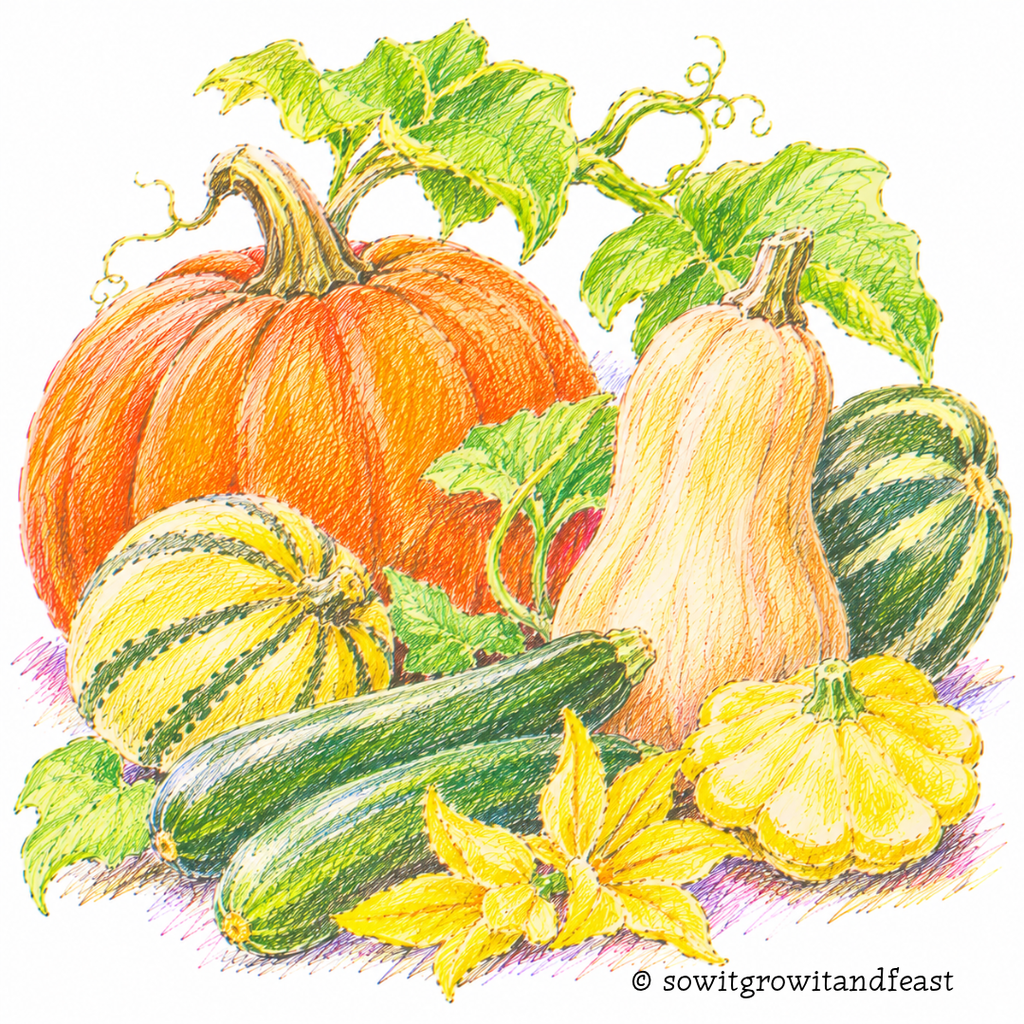
What Exactly Are Squashes?
Squashes belong to the gourd family, Cucurbitaceae, which also includes cucumbers, melons and gourds.
Most of the edible squashes familiar to British gardeners belong to the genus Cucurbita.
This includes courgettes, marrows, pumpkins, butternut squashes and many other varieties.
There are several cultivated species, each containing an extraordinary range of shapes, sizes and colours.
The three most familiar are:
- Cucurbita pepo – includes courgettes, marrows, patty pan squashes, acorn squashes and many pumpkins.
- Cucurbita maxima – includes many large pumpkins, hubbard squashes and kabocha-type varieties.
- Cucurbita moschata – includes butternut squashes and other varieties valued for their sweet flesh and keeping qualities.
Although these plants share many characteristics, they are not all grown or harvested in quite the same way.
Gardeners generally divide them into two practical groups: summer squashes and winter squashes.
Despite their names, both are warm-season crops.
The distinction lies mainly in when the fruits are harvested, their maturity and how they are used.
Summer Squashes: The Generosity of the Summer Garden
Summer squashes are harvested while their fruits are still immature.
Their skins are generally tender, their seeds soft and their flesh delicate.
They are best enjoyed fresh and do not have the long-storage qualities of mature winter squashes.
Courgettes – Cucurbita pepo
Courgettes are perhaps the most familiar summer squash in British vegetable gardens.
They are productive, easy to cook and available in an impressive variety of colours and shapes.
Traditional green courgettes remain popular, but yellow, pale green, striped and round varieties are equally worth growing.
A healthy plant can produce a generous succession of fruits throughout summer, particularly when harvested regularly.
Varieties worth considering include ‘Defender’ F1, ‘Black Beauty’ and the round-fruited ‘Tondo di Piacenza’.
Courgettes are delicious grilled, roasted, gently fried or grated into fritters.
They also have a remarkable ability to grow when nobody is looking.
A perfectly respectable courgette on Monday can become something approaching a marrow by Thursday.
Patty Pan Squashes – Cucurbita pepo
Patty pan squashes are among the most attractive vegetables in the kitchen garden.
Their flattened, scalloped fruits resemble little flying saucers, usually appearing in shades of yellow, cream or green.
They are best harvested young, when their skins are tender and their flavour is mild and slightly nutty.
Small fruits can be roasted whole, steamed or sliced into summer vegetable dishes.
Larger fruits can be hollowed out and stuffed.
Yellow Crookneck Squashes – Cucurbita pepo
These cheerful yellow squashes have distinctive curved necks and sometimes slightly bumpy skins.
Although more familiar in North American gardens, they can be grown in suitable British conditions.
Harvested young, their flesh is tender and mild.
They are particularly good sliced and gently fried with garlic, herbs and olive oil.
Marrows – Cucurbita pepo
Marrows are closely related to courgettes, and both belong to the same species.
Many courgettes become marrow-like when allowed to grow large, although traditional marrow varieties have also been bred specifically for their size, shape and growing characteristics.
Marrows generally have firmer skins and more developed seeds than young courgettes.
Their mild flesh is particularly suited to stuffing, baking, soups and chutneys.
Unlike true long-keeping winter squashes, ordinary vegetable marrows are not generally suitable for storing for several months.
They are best used reasonably soon after harvesting or preserved appropriately.
Winter Squashes: A Harvest for the Colder Months
Winter squashes are allowed to mature fully on the plant.
Their skins become firmer, their seeds mature and their flesh often develops a richer, sweeter flavour.
Many varieties can be stored for weeks or months after harvesting, although their keeping qualities vary considerably.
This makes them especially valuable in the autumn and winter kitchen.
Butternut Squash – Cucurbita moschata
Butternut squash is one of the best-known winter squashes.
Its distinctive pear-shaped fruits have pale tan skins and rich orange flesh.
The flavour is sweet and slightly nutty, becoming particularly delicious when roasted.
Butternuts are excellent in soups, curries, risottos and vegetable traybakes.
They require a relatively long, warm growing season, so British gardeners should choose suitable early-maturing varieties and provide a sunny, sheltered position.
‘Harrier’ F1 is one variety developed with shorter growing seasons in mind.
Acorn Squash – Cucurbita pepo
Acorn squashes are small, ribbed fruits, often dark green, although other colours are available.
Their flesh is mildly sweet and particularly good when baked.
They are useful for smaller households because individual fruits are generally a manageable size.
Cut them in half, remove the seeds and roast with herbs, butter or a savoury filling.
Acorn squashes generally have a shorter storage life than some other winter squash varieties.
Delicata Squash – Cucurbita pepo
Delicata squashes are beautifully striped, usually cream with green markings.
Their flesh is sweet and creamy, while their relatively thin skins are often tender enough to eat once cooked.
They are among the easiest winter squashes to prepare.
Simply slice into rings, remove the seeds and roast with olive oil and thyme.
Delicata squashes are delicious, but they are not usually the longest-keeping winter squash.
Kabocha Squash – Usually Cucurbita maxima
Kabocha-type squashes are prized for their dense, sweet flesh.
Many have dark green skins and deep orange interiors, although appearance varies between varieties.
Their texture can be pleasantly dry and almost chestnut-like when cooked.
They are particularly good roasted, steamed or added to curries.
Some varieties need a long, warm growing season, so choose carefully for British conditions.
Hubbard Squash – Cucurbita maxima
Hubbard squashes are substantial fruits, often with hard, irregular skins.
They may be blue-grey, green or orange, depending on the variety.
Their dense flesh is excellent for roasting, soups and purées.
They are particularly suitable for gardeners with generous growing space.
Pumpkins – Several Cucurbita Species
Pumpkins are not one single botanical species.
The name is commonly used for fruits belonging to several species, including Cucurbita pepo, Cucurbita maxima and Cucurbita moschata.
Although pumpkins are closely associated with Halloween, many varieties are excellent for eating.
Small culinary pumpkins can have sweet, richly flavoured flesh, making them particularly suitable for soups, pies and roasting.
For the kitchen, choose varieties specifically recommended for their eating qualities.
The largest pumpkin at the village show may be magnificent, but it is not necessarily the one you would choose for supper.
A Remarkable History: Squashes Through the Centuries
Squashes have a history stretching back thousands of years.
Archaeological evidence shows that plants belonging to the genus Cucurbita were among the earliest domesticated crops in parts of the Americas.
Different species were domesticated in different regions, including areas of present-day Mexico and South America.
These plants became important sources of food for numerous Indigenous communities.
Their flesh and seeds provided nourishment, while some mature varieties could be stored for later use.
The Three Sisters
One of the best-known traditional agricultural systems involving squash is the Three Sisters.
Developed and practised in different forms by Indigenous peoples of North America, this approach brings together maize, climbing beans and squash.
Each crop contributes something to the growing arrangement.
Maize provides height and can support climbing beans.
Beans form associations with nitrogen-fixing bacteria, helping them obtain nitrogen, although this does not mean they immediately fertilise neighbouring crops.
Squash spreads across the soil, shading the ground and helping to reduce weed growth and moisture loss.
Together, the crops make productive use of space.
They also complement one another nutritionally when eaten as part of a varied diet.
The Three Sisters is not one universal method, however. Different Indigenous communities developed growing practices suited to their own environments, crops and traditions.
In Britain, gardeners can experiment with adapted versions, although our cooler summers and shorter growing season may make some combinations less reliable.
Squashes Arrive in Europe
Following European contact with the Americas, squashes gradually spread into European cultivation during the sixteenth century and afterwards.
Over generations, gardeners selected varieties for their shape, colour, flavour, storage qualities and suitability for different climates.
Today, the range of cultivated squashes is extraordinary.
From tiny decorative fruits to enormous exhibition pumpkins, they demonstrate the remarkable diversity that can develop through centuries of cultivation.
How to Grow Squashes in the UK
Squashes are generally straightforward to grow once their basic needs are understood.
They enjoy warmth, sunshine, fertile soil and consistent moisture.
Their greatest challenge in Britain is often the length and reliability of the growing season.
Late spring frosts can damage young plants, while cool summers may slow the development of winter squash fruits.
Choosing suitable varieties and giving plants a good start can make all the difference.
When to Sow Squash Seeds
In most parts of Britain, April and May are suitable months for sowing squash seeds indoors.
The precise timing depends on your location and growing conditions.
Sowing too early can produce large seedlings before outdoor conditions are suitable.
For many gardeners, late April or early May is a sensible starting point.
Starting Seeds Indoors
Fill individual pots with peat-free seed compost.
Sow one seed per pot, approximately 2–3cm deep.
Place the pots somewhere warm, ideally around 18–21°C.
Keep the compost moist but not waterlogged.
Seeds usually germinate within approximately five to ten days under suitable conditions.
Once the seedlings appear, provide plenty of light to encourage sturdy growth.
Squashes develop quickly, so avoid leaving them in small pots for too long.
Sowing Directly Outdoors
Squash seeds can also be sown directly into prepared garden soil.
Wait until the danger of frost has passed and the ground has warmed sufficiently.
In many parts of Britain, this means late May or early June.
Direct sowing can work particularly well for courgettes and other relatively quick-growing varieties.
Winter squashes requiring a long growing season often benefit from being started indoors.
Preparing the Soil
Squashes are vigorous plants with substantial appetites.
Their large leaves, long stems and developing fruits require fertile soil and adequate moisture.
Choose a sunny, sheltered position with well-drained but moisture-retentive soil.
Before planting, incorporate plenty of well-rotted garden compost or manure into the growing area.
Organic matter helps improve soil structure and supports moisture retention during dry weather.
Avoid placing fresh manure directly around young roots.
Squashes develop extensive root systems, so improving a generous area of soil is generally more useful than creating a small pocket of compost.
How Much Space Do Squashes Need?
This depends on the variety.
Bush courgettes may need approximately 90–120cm between plants.
Trailing winter squashes can require considerably more space, often 1.5–2m or beyond, depending on their vigour.
Some produce stems several metres long.
Always check the spacing recommendations supplied with your seeds.
It is worth remembering that one healthy, well-spaced plant will often produce more successfully than several struggling in overcrowded conditions.
Planting Squashes Outdoors
Before planting indoor-raised seedlings into the garden, they need time to adjust to outdoor conditions.
This is known as hardening off.
Over approximately seven to ten days, gradually expose plants to outdoor temperatures, sunlight and breezes.
Begin by placing them outside during mild daytime conditions and bringing them under cover at night.
Increase their exposure gradually.
Once the risk of frost has passed, plant them into their prepared growing positions.
Handle the roots carefully and water thoroughly after planting.
Young plants may benefit from temporary protection during unusually cool or windy weather.
Can You Grow Squashes in Containers?
Yes, particularly compact summer squash varieties.
Bush courgettes and some smaller squash varieties can grow successfully in large containers.
Choose a substantial pot, ideally holding at least 40–60 litres of compost for a vigorous bush plant, with larger containers often providing better results.
Ensure there are adequate drainage holes.
Use a good-quality peat-free growing medium suitable for vegetables.
Position the container somewhere sunny and sheltered.
Container-grown squashes require more frequent watering and feeding than plants established in garden soil.
Trailing winter squashes are generally less suited to ordinary containers because of their size and extensive root systems.
If space is limited, look for varieties specifically described as compact or bush-growing.
Watering Squash Plants
Squashes have broad leaves and can lose considerable amounts of water during warm weather.
Consistent moisture is especially important while plants are flowering and developing fruits.
Water thoroughly during dry spells, directing moisture towards the soil rather than unnecessarily soaking the foliage.
A mulch of well-rotted compost or another suitable organic material can help conserve moisture and suppress weeds.
There is no fixed amount of water suitable for every squash plant.
Requirements vary according to the weather, soil type, plant size and stage of growth.
The aim is to maintain steady growth without allowing the roots to sit in waterlogged conditions.
Feeding Squashes
Squashes benefit from fertile soil, but more fertiliser does not always mean more fruit.
Plants grown in well-prepared garden soil may need relatively little supplementary feeding.
Container-grown plants often require more regular nutrients.
Once flowering begins, a suitable liquid feed formulated for fruiting vegetables can be used according to the manufacturer’s instructions.
Avoid excessive nitrogen feeding, which can encourage abundant foliage at the expense of fruit production.
Healthy roots, sufficient moisture and successful pollination are just as important.
Understanding Squash Flowers
One of the loveliest features of squash plants is their flowers.
Large, golden-yellow blossoms appear among the leaves throughout summer.
Most squash plants produce separate male and female flowers on the same plant.
Male flowers grow on slender stalks.
Female flowers have a small swelling immediately behind the blossom, which develops into the fruit after successful pollination.
Bees and other insects usually transfer pollen between the flowers.
Why Are My Squashes Not Developing?
It is quite normal for squash plants to produce flowers without immediately setting fruit.
Early in the growing season, male flowers often appear before female flowers.
Poor weather can also reduce pollinator activity.
If a female flower is not adequately pollinated, the small developing fruit may yellow, shrivel and drop away.
This is particularly common during prolonged cool or wet weather.
Hand Pollinating Squashes
Where natural pollination is poor, pollen can be transferred by hand.
Use a small, soft brush to collect pollen from a freshly opened male flower.
Gently transfer it to the stigma of a freshly opened female flower of the same species.
This is best done during the morning when the flowers are open.
Hand pollination can be particularly useful during periods of limited insect activity.
Common Squash Pests and Problems in Britain
Squashes are generally productive plants, but they can encounter a few difficulties during the growing season.
Slugs and Snails
Young seedlings are particularly vulnerable to slug and snail damage.
Protect newly planted squashes and inspect them regularly.
Once established, vigorous plants are usually better able to tolerate some feeding.
Powdery Mildew
Powdery mildew is common on courgettes and other squashes, particularly later in summer.
It appears as a white, powdery coating on the leaves.
Severe infections can reduce plant vigour.
Good spacing, adequate watering and avoiding unnecessary plant stress can help.
Remove badly affected foliage where appropriate, but avoid stripping the plant of too many healthy leaves.
Aphids
Aphids may gather on tender shoots and leaves.
Small populations are often controlled naturally by ladybirds, hoverfly larvae and other beneficial insects.
Encouraging a wildlife-friendly garden can help maintain these natural predators.
Poor Fruit Development
Small squash fruits sometimes begin developing but then yellow and rot.
Poor pollination is one possible cause.
Irregular moisture, low temperatures and other growing stresses may also contribute.
Check the growing conditions before assuming the problem is caused by disease.
Bitter Squashes: An Important Safety Warning
Squashes can occasionally contain elevated levels of cucurbitacins, naturally occurring bitter compounds that can cause serious gastrointestinal illness.
This is uncommon in commercially bred edible varieties but can occur, particularly where seed has been saved from uncontrolled crosses involving ornamental gourds or other unsuitable plants.
Never eat a squash that tastes unusually bitter.
Discard the entire fruit.
Cooking does not reliably remove these compounds.
For edible crops, purchase seeds from reputable suppliers and take care when saving your own.
Harvesting Summer Squashes
Summer squashes are best harvested while young and tender.
Courgettes are commonly picked when approximately 10–20cm long, depending on the variety.
Patty pan squashes are generally most tender when relatively small.
Regular harvesting encourages continued fruit production.
If fruits are allowed to mature fully, plants may direct more energy towards seed development and produce fewer new fruits.
Check plants frequently during warm weather.
A courgette can grow remarkably quickly, particularly after rain.
Harvesting Winter Squashes
Winter squashes require a little more patience.
They are generally harvested in autumn once the fruits have matured and developed their characteristic colouring and firm skins.
The exact timing depends on the species, variety and growing conditions.
Signs of maturity may include:
- The fruit reaching its expected mature size and colour.
- A skin that has become firm and resists light pressure from a fingernail.
- A stalk that has begun to become woody or corky, depending on the variety.
- The plant naturally beginning to decline towards the end of the growing season.
Harvest before frost damages the fruits.
Use clean secateurs or a sharp knife, leaving a short section of stalk attached.
Avoid lifting fruits by their stalks, as damage can encourage decay during storage.
Handle them carefully.
Even a small bruise can shorten their keeping life.
Curing and Storing Winter Squashes
One of the great pleasures of growing winter squashes is being able to store part of the autumn harvest.
However, not all varieties keep equally well.
Some are best eaten within a few weeks, while others can remain sound for several months under suitable conditions.
Curing Winter Squashes
Many mature winter squashes benefit from a period of curing after harvest.
This allows the skin to harden further and helps minor superficial injuries dry.
For suitable varieties, curing usually involves keeping the fruits somewhere warm, dry and well ventilated for approximately seven to fourteen days.
A warm greenhouse can be useful in suitable weather, provided temperatures do not become excessive and the fruits are protected from damp and cold nights.
Not all winter squashes should be cured in the same way.
Acorn squash, for example, is generally not cured like butternut squash because prolonged warm curing can reduce its eating quality and storage life.
Always consider the requirements of the particular variety.
Where to Store Winter Squashes
Once cured, suitable winter squashes should be stored somewhere cool, dry, frost-free and well ventilated.
Temperatures around 10–15°C are often appropriate for many varieties.
Avoid damp sheds, freezing conditions and prolonged refrigeration of whole winter squashes.
Place fruits so they are not touching where practical.
Inspect them regularly and use any showing signs of softening or decay promptly.
Storage life varies considerably.
Butternuts and some hard-skinned varieties may keep for several months, while delicata and acorn squashes generally have shorter keeping periods.
Freezing and Preserving Squashes
Freezing is an excellent way to preserve surplus squash for use in cooked dishes.
Winter squash can be cooked, mashed or puréed before freezing.
It can also be prepared in pieces using an appropriate blanching or cooking method.
Summer squash can be frozen, although its high water content means the texture will soften after thawing.
Frozen courgettes are therefore particularly useful in soups, stews, sauces and baking.
Cool cooked squash promptly before freezing and use suitable freezer-safe containers.
Can Squash Be Bottled or Canned?
Squash is a low-acid vegetable, so ordinary boiling-water bottling is not a safe method for preserving plain squash.
Home canning of squash purée is not recommended because its density can prevent reliable heat penetration.
Where pressure canning is practised, only properly tested methods for suitable cubed winter squash should be followed.
For most British home gardeners, freezing is the simpler and more dependable method of preserving cooked squash.
Are Squashes Good for You?
Squashes can make a valuable contribution to a varied, balanced diet.
Their nutritional composition varies according to species, variety and maturity.
Winter squashes with deep orange flesh are often particularly rich in carotenoids, including beta-carotene.
The body can convert beta-carotene into vitamin A, which contributes to normal vision, immune function and the maintenance of healthy skin.
Squashes can also provide vitamin C, potassium and dietary fibre.
Summer squashes generally contain more water and are lower in energy than many mature winter varieties.
Winter squashes tend to contain more carbohydrate because their flesh develops greater amounts of starch and natural sugars.
Both groups are useful additions to everyday meals.
Perhaps their greatest nutritional advantage is their versatility.
They make it easy to include a wider variety of vegetables in soups, curries, traybakes and other home-cooked dishes.
Cooking with Summer Squashes
Summer squashes have tender flesh and mild flavours.
They are particularly suited to quick cooking methods.
Courgettes with Garlic and Garden Herbs
Slice courgettes into rounds or half-moons.
Heat a little olive oil in a frying pan and cook the courgettes until lightly golden.
Add crushed garlic towards the end of cooking.
Finish with freshly chopped parsley, basil or thyme.
A squeeze of lemon brings everything together.
This is a lovely accompaniment to grilled fish, roast chicken or a simple summer supper.
Roasted Patty Pan Squashes
Halve or quarter young patty pan squashes, depending on their size.
Toss with olive oil, black pepper and a little chopped thyme.
Roast at 200°C, or 180°C fan, until tender and lightly golden.
Scatter with grated Parmesan just before serving.
Their delicate, slightly nutty flavour works beautifully with the cheese.
Courgette Fritters
Grate two medium courgettes.
Sprinkle lightly with salt and leave for approximately fifteen minutes.
Squeeze out the excess moisture.
Combine with an egg, a few tablespoons of plain flour, chopped spring onions and fresh herbs.
Fry small spoonfuls in a little oil until golden on both sides and cooked through.
Serve with natural yoghurt and lemon.
Cooking with Winter Squashes
Winter squashes have richer, sweeter flavours and generally firmer flesh.
Roasting is one of the best ways to bring out their natural sweetness.
Roasted Butternut Squash with Sage
Ingredients
- 1 medium butternut squash
- 2 tablespoons olive oil
- A handful of fresh sage leaves
- 2 garlic cloves
- Salt and black pepper
Method
Preheat the oven to 200°C, or 180°C fan.
Peel the squash if preferred, remove the seeds and cut into even-sized pieces.
Toss with olive oil, garlic and seasoning.
Spread in a roasting tin.
Roast for approximately 30–40 minutes, turning occasionally, until tender and golden.
Add the sage leaves during the final part of cooking so they become crisp without burning.
Serve alongside roast vegetables, grains or a Sunday lunch.
Warming Squash, Ginger and Coconut Soup
Ingredients
- 800g prepared butternut or another suitable winter squash
- 1 onion
- 2 garlic cloves
- 1 tablespoon grated fresh ginger
- 1 tablespoon vegetable oil
- 600ml vegetable stock
- 200ml coconut milk
- Black pepper
- Fresh coriander, optional
Method
Heat the oil in a large saucepan.
Add the chopped onion and cook gently until softened.
Stir in the garlic and ginger.
Add the diced squash and vegetable stock.
Simmer until the squash is completely tender.
Blend until smooth.
Stir in the coconut milk and warm through gently.
Season to taste and finish with fresh coriander if desired.
It is a lovely soup for those first chilly autumn evenings.
Roasted Delicata Squash Rings
Delicata squash is particularly easy to prepare because its skin is often tender enough to eat when cooked.
Wash the squash and cut it into rings approximately 1–2cm thick.
Remove the seeds.
Toss with olive oil, thyme and black pepper.
Roast at 200°C, or 180°C fan, until golden and tender.
Serve with lentils, leafy greens or crumbled cheese.
Can You Eat Squash Seeds?
Yes, the seeds of known edible squash varieties can be roasted and eaten.
However, their size and texture vary.
Some have relatively tough outer shells, while others are more suitable for eating whole.
Remove the seeds from the fruit and separate them from the surrounding fibres.
Wash and dry thoroughly.
Toss with a little oil and seasoning.
Roast until crisp, stirring occasionally to prevent burning.
Allow to cool before eating.
Seeds can be scattered over soups and salads or enjoyed as a savoury snack.
Only use seeds from known edible squash varieties, and discard any fruit that tastes unusually bitter.
Saving Squash Seeds for Next Year
Seed saving can be rewarding, but squashes require particular care.
Many varieties within the same Cucurbita species can cross-pollinate.
For example, courgettes, acorn squashes and some pumpkins belong to Cucurbita pepo and may cross with one another.
The fruit produced in the current season retains the characteristics of the mother plant, but seeds from that fruit may produce very different plants the following year.
Crosses involving ornamental gourds or unsuitable plants can sometimes result in bitter, potentially toxic fruits.
For reliable seed saving, growers need to understand species compatibility and use appropriate isolation or controlled pollination methods.
F1 hybrid varieties also do not reliably produce offspring identical to the parent.
For most home gardeners, purchasing fresh seed from a reputable supplier is the simplest approach.
Growing Squashes in Smaller Gardens
Although many squashes are vigorous plants, you do not necessarily need an enormous allotment to enjoy them.
The secret is choosing the right variety.
Compact bush courgettes are ideal for raised beds and large containers.
Small-fruited winter squashes may be suitable for training along sturdy supports, provided their growing habit allows it.
Growing Squashes Vertically
Some trailing squashes can be trained upwards.
This can help make better use of limited growing space.
Choose a strong trellis or framework capable of supporting the mature plant and its fruits.
Smaller-fruited varieties are generally more suitable for vertical growing.
Larger fruits may need individual slings for support, while very heavy varieties are best grown at ground level.
Always consider the eventual weight of the crop.
A fully developed squash plant is rather more substantial than it appears when first planted in May.
Ten Creative Ways to Use Squashes Beyond the Kitchen
Squashes are wonderfully decorative as well as productive.
Their colours, shapes and textures make them particularly attractive during autumn.
Here are ten ways to enjoy them beyond everyday cooking.
- Create an autumn harvest display. Arrange pumpkins and winter squashes with dried seedheads, branches and seasonal foliage.
- Carve pumpkin lanterns. Use battery-operated lights rather than naked flames for a safer seasonal decoration.
- Decorate a harvest table. Small pumpkins and colourful squashes make beautiful natural centrepieces.
- Make temporary serving bowls. Hollowed-out edible squashes can hold suitable foods for short periods, provided they are cleaned and handled hygienically.
- Explore botanical drawing. The unusual shapes and colours of squashes make wonderful subjects for sketching and painting.
- Create children’s seasonal crafts. Paint or decorate the outside of squashes using suitable materials.
- Use seeds for educational projects. Even where seeds are unsuitable for growing edible crops, they can be useful for supervised learning activities.
- Keep a squash-growing diary. Photograph and measure developing fruits to follow their remarkable growth.
- Compost suitable leftovers. Chop waste into small pieces and mix it with dry composting materials.
- Share the harvest. Offer surplus edible squashes to neighbours, friends or community food projects where accepted.
Ordinary edible squashes should not be confused with hard-shelled ornamental gourds.
They generally contain too much moisture to make durable rattles, permanent bowls or long-lasting garden ornaments.
Likewise, luffa sponges come from plants in the genus Luffa, not Cucurbita, although both belong to the wider gourd family.
Making the Most of Your Squash Harvest
A successful squash harvest begins long before the first fruit is picked.
It starts with choosing a variety suited to your garden, preparing the soil and giving young plants the warmth they need.
Through summer, it continues with watering, feeding and watching the flowers develop.
Then comes the pleasure of harvesting.
Tender courgettes for a summer supper. Golden butternuts for roasting. Beautifully striped delicata squashes to enjoy as autumn settles in.
If you are new to growing squashes, begin with just one or two varieties.
A bush courgette is an excellent introduction because it grows quickly and produces regularly.
Once you have gained confidence, try a winter squash.
Choose one suited to the British climate and give it a sunny position with plenty of space.
Keep a record of which varieties perform well, how long they take to mature and how successfully they store.
Every growing season offers something new to learn.
The Quiet Satisfaction of the Squash Harvest
By the time autumn arrives, a squash patch can look rather extraordinary.
The once-neat rows have disappeared beneath broad leaves and wandering stems. Some plants are beginning to fade, while others still carry the last golden flowers of the season.
Among the foliage sit the fruits of several months’ work.
Green, orange, cream and gold.
Some small enough to hold in one hand, others requiring a little more determination to carry indoors.
There is something deeply satisfying about gathering these vegetables before the first frost.
They represent the warmth of summer, the care given during dry spells and the quiet patience of waiting for a crop to mature.
And when the evenings begin to draw in, there is a particular pleasure in taking a home-grown squash from its shelf and turning it into something warming for supper.
A bowl of soup. A tray of roasted vegetables. A simple meal shared around the kitchen table.
The squash is a generous plant, both in the garden and on the plate.
It asks for warmth, space and a little attention, then rewards us with food that can carry the flavours of summer well into autumn.
And perhaps that is the real joy of growing squashes: knowing that, even as the garden settles towards winter, a little of its summer abundance is still waiting in the kitchen.
Further Reading: Why Growing Food Makes You Feel Better, Take the Guesswork Out of Growing Veg, How to Create a Garden That Feeds Your Family, How to Start a Vegetable Garden Now Ready for Spring
Follow us on Instagram, Threads, BlueSky, Twitter, Pinterest & Facebook
Not sure where to start? Take a look at our Grow Your Own Packs with detailed step by step instructions, seeds and 1 years online support.