
Strawberries warm from the sun. A bowl of raspberries that somehow never quite makes it back to the kitchen. Shiny red peppers, handfuls of cherries, rosy apples and tomatoes in every imaginable shade of scarlet.
And then there’s beetroot.
Anyone who has ever prepared beetroot while wearing a white top will already know that red fruit and vegetables aren’t shy about announcing themselves.
But those wonderful colours aren’t there simply to make our dinner look pretty.
The reds, pinks and deep purples we see in fruit and vegetables come from naturally occurring plant pigments and compounds, including lycopene and anthocyanins. Different red foods also provide varying amounts of fibre, vitamin C, folate, potassium and other nutrients.
That’s one reason we’re encouraged to eat a varied diet containing plenty of fruit and vegetables.
But there’s another reason I particularly like red foods.
Many of them are remarkably easy to grow.
From a pot of strawberries by the back door to radishes squeezed into a spare patch of soil, raspberries along a fence or tomatoes ripening in the greenhouse, you don’t need an enormous vegetable garden to put something home-grown and red on your plate.
So rather than thinking of red foods as something we should eat, let’s look at what makes them interesting, what we can grow ourselves and — most importantly — what we can do with them when they’re ready to pick.
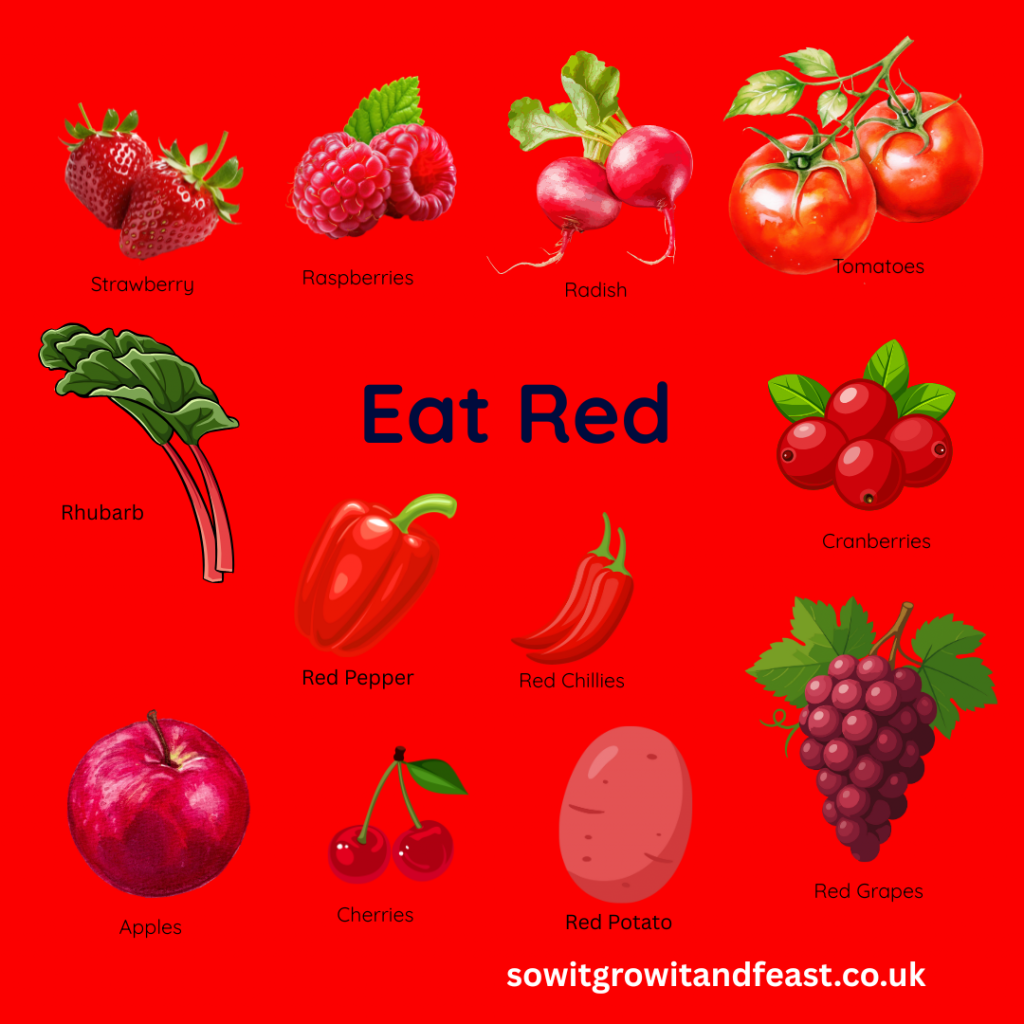
Why Are Red Fruits and Vegetables Red?
The colour of fruit and vegetables comes from naturally occurring plant pigments.
Two you’ll often hear mentioned in connection with red produce are lycopene and anthocyanins.
Lycopene is a carotenoid responsible for the red and pink colour of foods such as tomatoes and watermelon.
Anthocyanins are another group of plant pigments. Depending on the food and its chemistry, they can produce shades ranging from red and pink through to purple and blue. You’ll find them in foods including berries, cherries and some varieties of apple.
These compounds are often described as antioxidants because of the way they interact with oxidation in the body.
But there’s no need to turn every tomato into a medicine.
Fruit and vegetables contain complicated mixtures of nutrients and plant compounds, and eating a wide variety of them is much more useful than pinning miraculous properties on one particular ingredient.
And frankly, there are plenty of good reasons to eat a ripe home-grown strawberry without asking it to improve anything at all.
Tomatoes
If I could persuade someone to grow just one edible plant, tomatoes would be high on the list.
A tomato picked warm from the plant tastes completely different from one that’s travelled halfway across Europe in a refrigerated lorry.
Tomatoes contain lycopene, the pigment responsible for much of their red colour, as well as vitamin C, potassium and folate.
Interestingly, processing and cooking tomatoes can make lycopene easier for our bodies to absorb, so fresh tomatoes aren’t the only ones worth eating. Tomato sauces, soups and roasted tomatoes all have a place at the table.
Sow it
Tomatoes are usually sown indoors in late winter or early spring in Britain because they need a long growing season.
Grow it
Give them warmth, plenty of light, regular watering and feeding once the fruits begin to develop.
You don’t need a greenhouse. Many varieties grow happily in a sunny sheltered spot outside, and compact varieties can be grown in pots.
Feast
When they’re coming faster than you can eat them, roast a tray with garlic and herbs, make tomato sauce for the freezer or turn them into soup.
And the very best ones?
Eat them immediately.
Strawberries
There are few gardening pleasures quite like spotting the first properly red strawberry of summer.
Strawberries provide vitamin C, fibre and folate and contain anthocyanins and other naturally occurring plant compounds.
They’re also one of the easiest fruits to grow when space is limited.
Grow it
Strawberries will grow in the ground, pots, containers and hanging baskets, making them ideal for smaller gardens and patios.
Keep an eye on them as the fruit ripens because birds and slugs are remarkably good at identifying the perfect strawberry approximately five minutes before you do.
Feast
Eat them straight from the plant, add them to breakfast, make strawberry compote or freeze extras for smoothies and puddings later in the year.
Although I have yet to experience the mythical phenomenon known as “too many strawberries”.
Raspberries
Raspberries are another excellent fruit to grow at home because they’re expensive to buy and spectacular when freshly picked.
They’re naturally high in fibre and provide vitamin C and manganese, as well as anthocyanins and other polyphenols.
Summer-fruiting and autumn-fruiting varieties mean it’s possible to enjoy home-grown raspberries over a surprisingly long season.
Grow it
Give raspberries a sunny position and reasonably fertile soil. Most varieties will need some support, although once established they can reward you with fruit for years.
Feast
Eat them fresh, scatter them over porridge or yoghurt, make jam or freeze them individually on a tray before transferring them to a bag.
They’re excellent straight from the freezer too.
Not that I would know anything about standing in front of an open freezer eating frozen raspberries.
Beetroot
Beetroot deserves far more attention in the vegetable garden.
It’s easy to grow, doesn’t require enormous amounts of space and gives you two things to eat: the roots and the young leaves.
Beetroot provides folate, manganese and potassium and is naturally rich in compounds called dietary nitrates.
And then, of course, there’s that extraordinary colour.
Sow it
Beetroot can be sown directly outside from spring onwards. Sow small amounts every few weeks rather than the entire packet at once and you’ll have a steadier supply.
Grow it
Thin seedlings if necessary and keep them watered during dry weather. Don’t wait for every root to become enormous — smaller beetroot can be beautifully tender.
Feast
Roast it, pickle it, grate young beetroot raw into salads or combine roasted beetroot with feta, walnuts and leaves.
And remember that the young leaves are edible too.
Red Peppers and Chillies
A green pepper and a red pepper can actually be the same fruit at different stages of ripeness.
As many peppers mature, their colour changes and their flavour becomes sweeter.
Red peppers are particularly rich in vitamin C and also contain carotenoids. Chillies contain capsaicin, the compound responsible for their heat.
Sow it
Peppers and chillies need a long growing season, so start them indoors early in the year.
Grow it
They like warmth and sunshine and grow very well in pots, greenhouses and sunny sheltered positions.
Feast
Roast red peppers until sweet and soft, add them to salads, soups and pasta sauces or preserve a glut.
Chillies can be used fresh, dried or frozen — which is useful because one enthusiastic chilli plant can produce a rather alarming amount of fruit.
Radishes
If patience isn’t your greatest gardening virtue, grow radishes.
Some varieties can be ready to harvest only a few weeks after sowing, making them particularly satisfying for new gardeners and children.
Radishes provide vitamin C and fibre, along with a range of naturally occurring plant compounds.
Sow it
Sow little and often from spring onwards.
Grow it
Keep them watered. Dry conditions can make the roots woody or excessively peppery.
Because they’re quick-growing and don’t need much room, they’re brilliant for filling little gaps between slower-growing vegetables.
Feast
Slice them into salads, add them to sandwiches or try roasting them.
And don’t automatically throw away the leaves. Young radish leaves can be eaten too.
Cherries
Unlike radishes, cherries require rather more patience.
But a cherry tree in blossom is beautiful before it has produced a single fruit.
Cherries contain fibre, vitamin C and potassium, as well as anthocyanins and other plant compounds.
If space is limited, look for trees grown on dwarfing rootstocks, which can make growing fruit trees in smaller gardens much more practical.
Just remember that birds adore cherries every bit as much as we do.
Possibly more.
Red Apples
Not every apple is red, of course, but rosy-skinned varieties certainly earn their place here.
Apples provide fibre and vitamin C, and much of their fibre and many of their plant compounds are found in or close to the skin.
They’re also one of the great seasonal pleasures of the British garden.
An apple eaten straight from the tree on an autumn afternoon is a completely different experience from one that’s spent months in storage.
If you have room for a tree, choose carefully. The right rootstock can make the difference between a manageable garden tree and something requiring an orchard.
And if you end up with more apples than you can possibly eat, there are worse problems to have.
Apple crumble springs immediately to mind.
Rhubarb
Botanically, rhubarb is a vegetable, although we generally treat it as a fruit in the kitchen.
It provides fibre, potassium and vitamin K, but I mainly grow it because there are few things more cheering than seeing those first pink stalks pushing their way out of the soil.
Rhubarb is perennial, so once established it can return year after year.
And an important note: eat the stalks, not the leaves. Rhubarb leaves should not be eaten.
Feast
Rhubarb crumble is the obvious answer, but try roasting it too. It’s delicious with yoghurt, porridge or granola.
You can also turn a good harvest into compote, jam or chutney.
Watermelon
Watermelon isn’t the easiest thing to grow outdoors in the British climate, but adventurous gardeners with a greenhouse or very warm sheltered position may enjoy trying.
Its pink-red flesh gets its colour partly from lycopene, and — unsurprisingly given its name — watermelon has a very high water content.
Sometimes growing something slightly ridiculous simply to see whether you can is part of the fun of gardening.
Cranberries and Pomegranates
Not everything on the red plate needs to come from your garden.
Cranberries and pomegranates contain a variety of polyphenols and other plant compounds and can bring sharpness, sweetness and colour to winter food.
Fresh cranberries are particularly useful for sauces and baking, while pomegranate seeds are wonderful scattered over salads, roasted vegetables and grain dishes.
Growing your own should never become a competition to achieve total self-sufficiency.
Grow what works for you.
Buy the rest.
Grow a Red Garden
If you’re new to growing food, you don’t need to attempt everything on this list.
Start with three.
For example:
Strawberries + tomatoes + radishes.
All three can be grown in containers, which means you could create a tiny edible red garden on a patio, balcony or sunny doorstep.
If you have more room, add raspberries, beetroot and a redcurrant bush.
Before long you’ll start noticing how the seasons move through your red harvest.
Radishes appear quickly in spring.
Strawberries arrive with early summer.
Tomatoes and raspberries take us through the warmer months.
Then apples and beetroot carry us towards autumn.
That’s one of the pleasures of growing food: you don’t simply eat with the seasons.
You watch them happen.
What to Do With a Red Harvest
There is a particular point in the growing year when pride in your productive vegetable garden can turn into mild panic.
You’ve grown it.
It’s ready.
And now there’s rather a lot of it.
This is where the feast part matters.
Freeze raspberries and strawberries.
Turn tomatoes into sauce.
Roast and pickle beetroot.
Dry or freeze chillies.
Make apple sauce, chutney or crumble.
Preserve what you can’t eat now and share some with friends, neighbours and family.
Growing food isn’t just about producing vegetables.
It’s about enjoying them.
Eat the Rainbow — But Grow It Too
There’s good sense behind the familiar advice to eat plenty of different fruits and vegetables.
Different plants provide different combinations of fibre, vitamins, minerals and naturally occurring plant compounds, which is why variety matters more than concentrating on one supposedly “super” food.
But I’d add something else.
Try growing some of that rainbow yourself.
Sow a row of radishes.
Plant a strawberry in a pot.
Grow a tomato by the back door.
Put a raspberry cane against the fence.
Then wait.
Because however nutritious something may be, there’s another benefit to growing food that’s rather harder to measure.
The pleasure of walking outside, spotting something ripe and thinking:
I grew that.
And then eating it.
That’s the good bit.
Further Reading: Why Orange Foods Deserve a Place on Your Plate, Why Eating Green Is Good For You, Why You Should Eat More Purple, Grow Your Own: Best Fruits for Your Garden, The Importance of Growing Your Own Food
Follow us on Instagram, Threads, BlueSky, Twitter, Pinterest & Facebook
Not sure where to start? Take a look at our Grow Your Own Packs with detailed step by step instructions, seeds and 1 years online support.