Before you throw away that yoghurt pot, empty loo roll tube or battered old baking tin, take another look. It might just have a second life waiting for it in the garden.
There is something rather wonderful about sowing seeds.
A little compost, a handful of seeds and the quiet expectation that, given the right conditions, something remarkable will happen.
And while garden centres offer an impressive assortment of seed trays, propagators and beautifully coordinated pots, the truth is that growing plants from seed needn’t involve buying very much at all.
Some of the most useful seed-sowing containers are already sitting in our recycling boxes, kitchen cupboards and garden sheds.
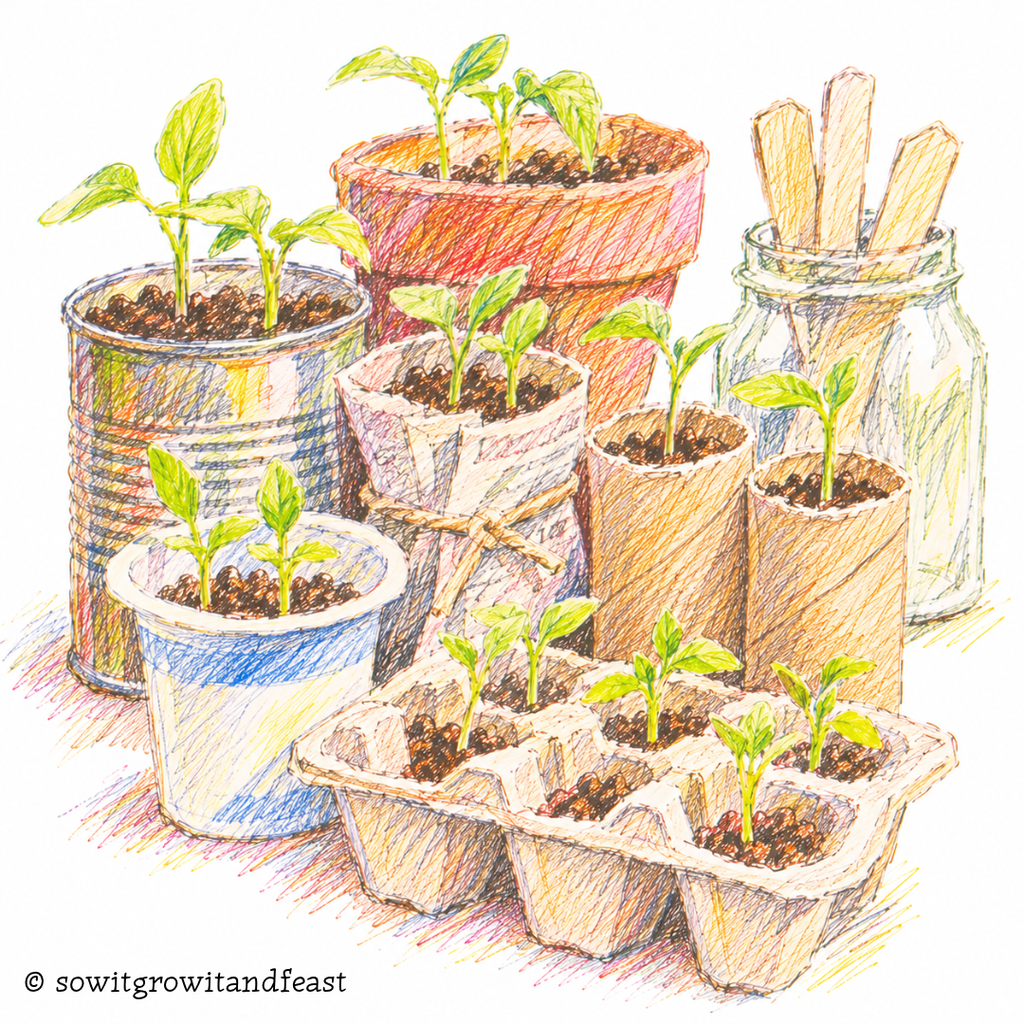
An empty yoghurt pot can become a temporary home for a young tomato plant. Yesterday’s newspaper can be folded into a perfectly serviceable seed pot. Even a cardboard loo roll tube has a rather promising future once its original purpose has been fulfilled.
Repurposing everyday objects is not simply about saving money, although that is certainly welcome. It encourages us to look at familiar things differently, to make better use of resources and to rediscover a little of the resourcefulness that previous generations took for granted.
After all, gardeners have been finding inventive uses for old containers long before upcycling became a fashionable word.
So, before you invest in another collection of plastic seed trays, have a rummage through what you already own.
You might be surprised by what you find.
A Few Things to Remember Before You Begin
Almost anything that can hold compost has the potential to become a seed-sowing container, but there are a few practical considerations.
Drainage is essential. Most seedlings dislike sitting in waterlogged compost. Containers need holes in their bases so excess water can escape.
Cleanliness matters. Wash previously used containers thoroughly, particularly those that have held food, to reduce the risk of mould and disease.
Size makes a difference. Small seeds can begin life in shallow containers, while larger seeds and vigorous seedlings need sufficient room for their developing roots.
Choose materials carefully. Avoid containers that previously held hazardous chemicals, and be cautious with sharp metal edges, cracked glass and materials that may deteriorate outdoors.
And remember that not everything described as biodegradable breaks down quickly enough for delicate young roots to grow through it.
Sometimes removing the container before planting is the kinder option.
With those small considerations in mind, there are plenty of possibilities.
1. Newspaper Pots – Yesterday’s News, Tomorrow’s Seedlings
There is something particularly satisfying about turning an old newspaper into a home for new plants.
Newspaper pots are inexpensive, lightweight and surprisingly easy to make.
Using a wooden pot maker, a small jar or a suitable cylindrical object, wrap strips of ordinary newspaper around the form and fold the bottom to create a base.
Fill with moist seed compost and sow as usual.
These pots are particularly useful for seedlings that dislike having their roots disturbed, although they need careful handling because damp newspaper gradually loses its strength.
When planting out, make sure the paper is thoroughly wet and tear away the base or sides if necessary to allow roots to spread freely.
Avoid glossy, heavily coated paper.
A little ingenuity, a few folds and yesterday’s headlines become the beginnings of tomorrow’s harvest.
2. Toilet Roll Tubes – Small but Surprisingly Useful
Few household items have enjoyed quite such an unexpected gardening career as the humble cardboard loo roll tube.
Its tall, narrow shape makes it useful for starting larger seeds, including peas and beans, which develop substantial roots relatively quickly.
Stand the tubes upright in a waterproof tray, fill them with seed compost and sow one or two seeds in each.
Keep them supported so they don’t fall over as the cardboard softens.
Because the tubes have no solid base, excess water can drain away, although they must be lifted carefully.
When the seedlings are ready for planting, remove or tear open the cardboard if it remains firm, particularly around the base.
And don’t leave seedlings growing in them for too long.
Cardboard has a habit of collapsing just when you least expect it.
3. Tin Cans – From Kitchen Cupboard to Growing Space
Empty food tins can make sturdy containers for growing seedlings and small plants.
Baked bean tins, soup tins and other food cans are particularly useful once thoroughly washed.
Create drainage holes in the base using suitable tools and take care to smooth or cover any sharp edges.
Fill with compost and use them for sowing seeds or growing young plants.
Their durability means they can often be reused over several seasons, although metal containers may become hot in strong sunshine and can eventually rust.
A collection of plain tins can look rather attractive arranged along a greenhouse shelf.
Sometimes the simplest things have the most character.
4. Egg Boxes – Little Compartments for Little Beginnings
Cardboard egg boxes seem almost designed for seed sowing.
Their individual compartments are ideal for starting small quantities of seeds, particularly when space is limited.
Fill each section with seed compost, sow your seeds and place the box on a waterproof tray.
Cardboard absorbs moisture readily, so check regularly to ensure the compost doesn’t dry out.
The compartments are relatively shallow, making them best suited to seedlings that will be transplanted while still young.
Although cardboard will eventually decompose, it is usually better to remove or carefully open the compartments before planting to avoid restricting root growth.
A dozen tiny seedlings growing in an old egg box is a lovely reminder that gardening needn’t be complicated.
5. Coffee Tins – A Second Helping of Usefulness
Those sturdy tins that once held coffee can be far too useful to discard.
With suitable drainage holes, they make practical containers for seedlings and young plants.
Their generous depth can accommodate developing roots, while the rigid sides make them easy to move around.
Smaller coffee tins are useful for individual plants, while larger ones can accommodate several seedlings before they are potted on.
As with other metal containers, watch for overheating in direct sunshine and protect yourself from sharp edges.
A simple label tied around the tin is often all the decoration required.
6. Plastic Bottles – A Mini Greenhouse in the Making
Clear plastic drinks bottles can be transformed into useful miniature propagators.
Cut a clean bottle into two sections.
The lower half can become a small growing container once drainage holes have been added.
The upper half can then be placed over it to create a protective cover.
This helps retain humidity around germinating seeds and young seedlings.
Remove the bottle cap or lift the cover periodically to provide ventilation.
Once seedlings emerge, they need plenty of light and good airflow.
Take care not to leave covered bottles in strong sunshine, where temperatures can rise surprisingly quickly.
A miniature greenhouse is useful.
A miniature oven is rather less so.
7. Yoghurt Pots – The Gardener’s Old Favourite
If there were an award for the most useful item in the household recycling collection, the yoghurt pot would be a strong contender.
Lightweight, readily available and easy to clean, these little containers are ideal for sowing individual seeds or potting on small seedlings.
Simply make several drainage holes in the base and fill with suitable compost.
Larger yoghurt pots are particularly useful for tomatoes, chillies and other plants that need a little more room as they develop.
They can often be washed and reused repeatedly.
And unlike some elaborate gardening equipment, they are unlikely to cause much distress if one disappears beneath the potting bench.
8. Eggshells – Nature’s Own Tiny Containers
Eggshells are often suggested as miniature seed pots, and they certainly have a certain charm.
Carefully remove the top of an eggshell, rinse it and make a small drainage hole if possible.
Fill with compost and sow a small seed.
However, their limited size means seedlings will need transplanting relatively quickly.
Eggshells also break down much more slowly than many people imagine, so they should not be relied upon to disappear into the soil once planted.
If using them, gently crack and remove the shell when transplanting.
The shells can then be crushed and added to the compost heap.
An interesting little experiment, particularly for children, although not necessarily the most practical choice for raising large numbers of plants.
9. Food Trays – Too Useful to Throw Away
The plastic trays used for mushrooms, fruit and other foods can be excellent substitutes for conventional seed trays.
Choose clean, sturdy containers and make drainage holes where necessary.
Shallow trays work well for sowing small seeds that will be pricked out later.
Deeper containers are useful for seedlings requiring additional root space.
Clear plastic food packaging can sometimes be reused as a propagator cover, provided adequate ventilation is maintained.
Reusing existing plastic is often preferable to purchasing something new for the same purpose.
And if a container eventually becomes damaged, check whether your local recycling collection accepts it.
10. Ice Cream Tubs – A Sweet Idea for Seed Sowing
Once the ice cream has disappeared, the empty tub can begin a rather more productive chapter.
Larger plastic tubs provide plenty of space for sowing several rows of seeds.
Make drainage holes in the bottom and fill with seed compost.
They are particularly useful for growing salad seedlings, herbs and other plants that will be transplanted later.
The rigid sides make them easy to move, while their depth provides more root space than many shallow food trays.
Just remember to label the contents.
Finding a tub marked Vanilla in the greenhouse is unlikely to be especially helpful when you’re trying to identify your seedlings.
11. Milk Cartons – Two Useful Ideas in One
Empty milk cartons are wonderfully versatile.
Plastic cartons can be cut down to create small planting containers, with drainage holes added to the base.
Their square shape makes them particularly useful for arranging neatly together on a windowsill or greenhouse bench.
Alternatively, a clean plastic milk bottle can become a gentle watering container.
Make several small holes in the lid, fill the bottle with water and use it to sprinkle moisture over newly sown seeds.
This can be particularly useful when a conventional watering can delivers more water than delicate seedlings need.
12. Old Teacups – A Little Character on the Windowsill
Every household seems to acquire the occasional mismatched teacup.
Perhaps it belonged to an old dinner service, survived a house move or simply lost its saucer somewhere along the way.
Rather than discarding it, consider giving it a place among your plants.
Teacups can make attractive holders for small nursery pots or seed containers.
Because most lack drainage holes, they are generally better used as decorative outer containers rather than planting directly into them.
Place a smaller pot inside and remove it for watering.
A collection of mismatched cups filled with young herbs can look particularly charming on a bright kitchen windowsill.
13. Baking Tins – From Cakes to Crops
An old baking tin may have reached the end of its culinary career, but that doesn’t necessarily mean it has no further use.
Metal cake tins, loaf tins and baking trays can provide sturdy growing containers.
Deep tins are useful for individual plants, while shallow trays can accommodate groups of seedlings.
Ensure suitable drainage and avoid using badly corroded containers.
Be mindful that metal heats quickly in sunshine and may dry out compost faster than expected.
An old loaf tin filled with young lettuce plants is an appealing example of giving something familiar a completely different purpose.
14. Ice Cube Trays – Tiny Spaces for Tiny Seeds
An old ice cube tray can provide a collection of small compartments for germinating seeds.
However, most ice cube trays are shallow and lack drainage.
If the material allows, carefully make small holes in the base.
Otherwise, use the tray only for very short-term germination before transferring seedlings into more suitable pots.
The compartments can dry out quickly, so moisture levels need regular attention.
They are not ideal for plants that develop large roots, but can be useful for experimenting with small quantities of seeds.
And unlike ice cubes, seedlings should never be forced out of their compartments.
A gentle touch is rather more appropriate.
15. Old Shoes and Wellies – A Quirky Garden Experiment
A worn-out pair of wellington boots can certainly attract attention when transformed into a planter.
Their height provides useful depth, although drainage is essential.
Make holes in the soles and fill with suitable compost.
They are generally better suited to ornamental plants or established herbs than to raising large numbers of delicate seedlings.
Choose footwear made from materials that are safe and suitable for growing plants, and avoid anything that is badly degraded or contaminated.
An old pair of children’s wellies planted with flowers can make a cheerful feature.
Just make sure they really are finished with them first.
16. Coconut Shells – A Natural-Looking Alternative
Coconut shells can be repurposed as small, rustic planting containers.
Clean the shell thoroughly, create a drainage hole and fill with seed compost.
Their rounded shape means they may need to be supported in a tray to prevent them rolling over.
Although coconut shell is a natural material, it is extremely slow to decompose.
Seedlings should therefore be removed from the shell before planting out.
Coconut shells are more useful as reusable containers than as biodegradable pots.
And, of course, repurposing one you already have makes rather more environmental sense than buying coconuts solely for their shells.
17. Jam Jars – Better as Propagators Than Pots
Glass jam jars are often suggested for growing seeds, but there is an important drawback.
They have no drainage holes.
Adding pebbles to the bottom does not solve this problem, because excess water still has nowhere to escape.
Instead, consider using clean jam jars for other useful gardening purposes.
They can hold cuttings while roots develop in water, store saved seeds once thoroughly dry or act as decorative holders for small pots.
They can also be used for certain sprouting projects, provided appropriate food hygiene practices are followed.
Sometimes the most sustainable approach is not forcing an object into a role it doesn’t suit, but finding a better use for it.
18. Biscuit Tins – A Touch of Vintage Practicality
Those old biscuit tins that seem to accumulate in cupboards can be surprisingly useful in the garden.
With drainage holes added, deeper tins can become containers for sowing seeds or growing small plants.
Shallower tins may be more suitable for holding individual seed pots together.
Take care with sharp edges and watch for rust.
If the tin is particularly attractive or valuable, it may be better preserved for storing seed packets, labels or other gardening essentials.
There is something pleasingly traditional about a battered biscuit tin filled with seed packets and handwritten labels.
A little like the gardening cupboards of previous generations.
19. Mushroom Tubs – Ready-Made Seed Trays
Mushroom packaging is often an excellent size for seed sowing.
These shallow plastic tubs can accommodate several rows of seeds and are usually easy to stack when empty.
Wash them thoroughly and make drainage holes in the base.
Fill with compost, sow your seeds and place the tub on a suitable tray.
Because they are relatively shallow, seedlings should be transplanted before their roots become overcrowded.
For anyone sowing small quantities of lettuce, brassicas or herbs, they are a practical alternative to buying new seed trays.
20. Old Colanders – Drainage Already Included
An old colander may be one of the few kitchen items that arrives with its drainage system already installed.
The numerous holes make it suitable for growing plants, although compost may escape through larger openings.
A piece of suitable reusable mesh can help retain the growing medium without blocking drainage.
Colanders are generally better suited to growing established herbs or shallow-rooted plants than starting tiny seedlings.
Their open structure can also cause compost to dry out quickly, particularly in warm or windy weather.
But for an old kitchen utensil that has finally retired from draining pasta, it can make a rather characterful planter.
Are Recycled Seed Pots Always the Most Sustainable Choice?
Reusing everyday objects can reduce waste and avoid the need to purchase new gardening equipment.
But not every repurposed container is equally practical or environmentally beneficial.
Some materials deteriorate quickly, others are difficult to clean and a few simply don’t provide suitable growing conditions.
A container that becomes waterlogged, overheats or restricts root growth may result in unhealthy seedlings and wasted compost.
It is also worth remembering that durable seed trays, used carefully over many years, can be an excellent choice.
The aim is not to avoid every purpose-made gardening product.
It is to make thoughtful decisions about what we already have, what we genuinely need and how long something can remain useful.
A yoghurt pot reused for several seasons may be a better option than a decorative container that lasts only a few weeks.
And sometimes the most sustainable gardening equipment is simply the equipment we already own.
The Pleasure of Making Do and Making Something Grow
There is a wonderful tradition of resourcefulness in British gardening.
Old windows become cold frames.
Broken pots find new uses as drainage covers.
Branches become plant supports.
And empty containers are saved because, as every gardener knows, they might come in useful one day.
Occasionally, that day actually arrives.
Sowing seeds in repurposed containers is a small expression of that practical creativity.
It encourages us to see potential where we might otherwise see waste.
It saves money, reduces unnecessary purchases and reminds us that growing plants does not have to be expensive or complicated.
Most importantly, it keeps our attention where it belongs: on the seeds, the soil and the extraordinary process of watching something grow.
Because whether a seed begins life in a beautifully made terracotta pot or an old yoghurt container, its needs remain much the same.
A little warmth.
Some moisture.
Enough light.
And the time to develop into something wonderful.
The real value is not in the container we choose, but in the life we encourage to grow within it.
So before the recycling goes out this week, take another look.
There might just be the beginnings of next season’s garden hiding among the empties.
Further Reading: The Benefits of Growing your own Vegetables, Grow Your Savings The Smart Way Leverage Your Garden to Combat Rising Food Prices, Growing Food in Your Garden: A Beginner’s Guide to Feeding Your Family
Follow us on Instagram, Threads, BlueSky, Twitter, Pinterest & Facebook
Not sure where to start? Take a look at our Grow Your Own Packs with detailed step by step instructions, seeds and 1 years online support.