
“Eat your greens.”
It’s probably one of the first pieces of nutritional advice most of us heard.
Usually while staring suspiciously at a pile of cabbage.
But our parents and grandparents did have a point.
Spinach, peas, broccoli, beans, courgettes, kale, cabbage, lettuce, apples, herbs and all the other foods at the green end of the rainbow provide us with different combinations of fibre, vitamins, minerals and naturally occurring plant compounds.
And from a gardener’s point of view, there’s something else rather wonderful about green food.
An awful lot of it is very easy to grow.
You can grow salad leaves on a windowsill, herbs by the back door, peas in a pot and courgettes on a patio. Give over a little more space and you could be picking beans, broccoli, cabbages and apples too.
So rather than looking at individual green foods as remedies for tiredness, inflammation, bloating or anything else, let’s look at them for what they are.
Good food.
Food we can sow, grow, pick and turn into something delicious.
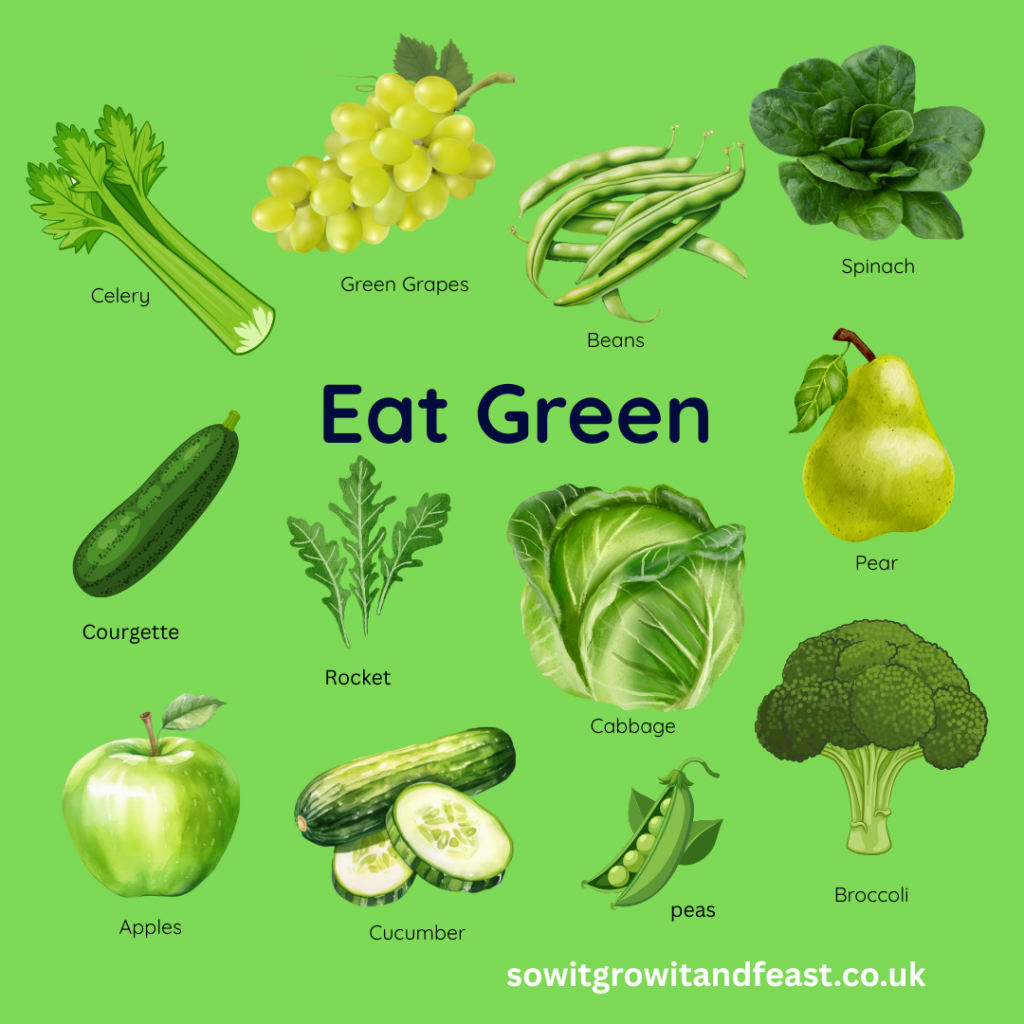
Why Are Fruits and Vegetables Green?
Plants owe much of their green colour to chlorophyll.
Chlorophyll plays an essential role in photosynthesis — the process plants use to capture energy from light.
But green fruits and vegetables contain far more than chlorophyll.
Depending on what you’re eating, they can provide fibre, folate, vitamin C, vitamin K, potassium, calcium, iron and a wide range of naturally occurring plant compounds.
Leafy vegetables can also contain carotenoids such as lutein and beta-carotene. We tend to associate carotenoids with yellow and orange foods, but in green leaves their colour is masked by all that chlorophyll.
The nutritional make-up of a cucumber is very different from that of broccoli or spinach, which is why the important word is variety.
Eat different plants.
And if you can, grow a few of them too.
Spinach
Spinach has acquired a rather heroic reputation over the years.
Popeye probably has something to answer for.
It does contain iron, although plant-based iron isn’t absorbed by the body as readily as iron from some animal sources. Spinach also provides folate, vitamin K and carotenoids, among other nutrients.
But forget bulging cartoon muscles.
Spinach is worth growing simply because it’s quick, useful and tastes particularly good when picked young.
Sow it
Spinach can be sown directly outside and is particularly happy in the cooler parts of the growing season.
Sow small amounts regularly rather than the entire packet at once.
That way you’re more likely to have a steady supply of tender leaves rather than enough spinach to feed the entire street for three days.
Grow it
Keep plants watered because hot, dry conditions can encourage spinach to bolt — producing flowers rather than continuing to make lots of lovely leaves.
Young leaves can be harvested for salads, while larger ones are excellent for cooking.
Feast
Wilt spinach into pasta, curries and soups, add young leaves to salads or simply cook it briefly with a little butter.
An enormous pan of spinach will collapse into approximately three forkfuls.
This is completely normal.
Peas
Fresh peas eaten straight from the pod are one of the great arguments for growing your own food.
They barely need to make it as far as the kitchen.
Peas provide fibre, protein, vitamin C, folate and other vitamins and minerals.
But their real selling point is flavour.
A freshly picked pea is sweet, crisp and completely different from one that’s been sitting around for days.
Sow it
Peas can be sown from spring, with exact timing depending on the variety and conditions.
You can also grow pea shoots indoors or outside if you want something particularly quick to harvest.
Grow it
Most peas appreciate something to climb.
Twiggy sticks, netting or supports all work well.
Keep them watered once flowering and pod production begin, particularly during dry spells.
Feast
Eat young peas raw, cook them briefly, stir them through risotto or pasta, or make pea and mint soup.
And don’t forget pea shoots and tendrils.
They’re delicious too.
Courgettes
Courgettes are a wonderful crop.
Right up until the point when you’ve eaten courgettes for breakfast, lunch and dinner and somebody cheerfully informs you there are another six ready to pick.
One or two healthy plants can be astonishingly productive.
Courgettes provide fibre, potassium and vitamin C, and their high water content makes them a useful and versatile summer vegetable.
Sow it
Sow courgettes indoors in spring or directly outside once conditions are sufficiently warm.
Grow it
Give them fertile soil, sunshine, regular watering and plenty of room.
Pick the fruits while they’re relatively small.
Leave one unnoticed beneath a leaf for several days and it may turn into something resembling a small submarine.
Feast
Grill them, roast them, grate them into fritters, spiralise them, add them to pasta or bake them into cakes.
When the inevitable glut arrives, make chutney.
Every courgette grower eventually reaches the chutney stage.
Green Beans
There is something enormously satisfying about walking outside and picking tonight’s dinner.
Green beans — whether climbing French beans, dwarf beans or runner beans picked young — are one of those crops that can give you harvest after harvest.
They provide fibre, folate and vitamin C, among other nutrients.
Sow it
Beans like warmth, so sowing generally begins in spring once conditions are suitable.
They can be started under cover for planting out later.
Grow it
Climbing beans need sturdy support.
And I do mean sturdy.
A mature row of beans covered in leaves and pods can become surprisingly heavy.
Keep picking regularly and the plants should continue producing.
Feast
Cook beans until tender and serve simply with butter, toss them through salads or add them to pasta dishes.
If you’ve got a glut, blanching and freezing them is one of the easiest ways to save some for later.
Broccoli
Broccoli is one of those vegetables that’s worth understanding because there isn’t just one kind.
There’s calabrese, which gives us the familiar large green heads, and sprouting broccoli, which produces smaller shoots over a longer period.
Broccoli provides fibre, vitamin C, folate and vitamin K, as well as naturally occurring compounds called glucosinolates.
Sow it
Sowing times vary considerably according to the type and variety, so check the seed packet.
Some broccoli is harvested within the same growing season. Other types require considerably more patience.
Grow it
Brassicas generally appreciate fertile, firm soil.
Unfortunately, we’re not the only creatures who like eating them.
Cabbage white caterpillars and pigeons can make short work of unprotected plants, so netting can be invaluable.
Feast
Steam it, roast it, stir-fry it or add it to pasta.
And eat the stalk.
Peel away any tough outer layer and you’ll find the centre is perfectly edible.
Throwing it away is wasting one of the best bits.
Kale
Kale has gone from humble winter vegetable to fashionable ingredient and back again.
Through all of this, it has remained what it always was: a very useful garden crop.
Kale provides fibre, vitamin C, vitamin K and carotenoids, along with other nutrients.
It’s also wonderfully hardy.
Sow it
Kale is generally sown in spring or early summer for harvesting later in the year, although timings vary by variety.
Grow it
Give plants good soil and protect them from the usual brassica-loving wildlife.
One of kale’s great advantages is that it can stand outside through cold weather, providing fresh leaves when much of the vegetable garden has gone quiet.
Feast
Strip away tough stalks and steam, sauté or roast the leaves.
Kale also works beautifully in soups, pasta and dishes with beans.
And yes, you can make kale crisps.
No, you don’t have to pretend they’re exactly the same as crisps.
Cabbage
Cabbage doesn’t always get the appreciation it deserves.
Perhaps school dinners have a lot to answer for.
But a cabbage grown well and cooked properly is an entirely different thing from something boiled into submission.
Green cabbage provides fibre, vitamin C, folate and vitamin K.
And by choosing varieties carefully, it’s possible to harvest cabbage at different times of year.
Sow it
There are spring, summer, autumn and winter cabbages, so check the variety before sowing.
Grow it
Cabbages appreciate fertile, firm soil and consistent growing conditions.
Protect them from caterpillars and pigeons.
Slugs may also express an interest.
Gardening is essentially the process of growing food while negotiating with everything else that would also like to eat it.
Feast
Shred cabbage into slaws, stir-fry it, steam it briefly or add it to soups.
Just don’t boil it until the entire house smells of cabbage.
We’ve moved on.
Brussels Sprouts
Brussels sprouts may be one of Britain’s most divisive vegetables.
I’m firmly in favour — provided they’re treated properly.
They’re members of the brassica family and provide fibre, vitamin C, folate and vitamin K, along with various plant compounds.
Sow it
Brussels sprouts require a fairly long growing season, so they’re generally sown in spring for harvesting later in the year.
Grow it
Give them firm, fertile soil and enough room.
Tall plants may need staking in exposed positions.
As with other brassicas, protect them from pigeons and caterpillars where necessary.
Feast
Steam them briefly, roast them until the edges caramelise or shred and stir-fry them.
If your only experience of Brussels sprouts is a grey-green vegetable boiled for half an hour on Christmas morning, I’d argue you haven’t really met a Brussels sprout yet.
Lettuce and Salad Leaves
If you’re completely new to growing food, start here.
You don’t need a vegetable garden.
You don’t even need a garden.
Many salad leaves can be grown in pots, troughs and window boxes, and some are ready to harvest remarkably quickly.
Leafy salads provide varying amounts of folate, vitamin K and other nutrients depending on the varieties you’re growing.
Sow it
Sow small amounts every few weeks for a succession of leaves.
Cut-and-come-again mixtures are particularly useful because you can harvest young leaves and allow the plants to regrow.
Grow it
Keep plants watered and watch for slugs and snails.
During very hot weather, a little shade can help prevent some varieties from bolting.
Feast
Pick what you need immediately before eating.
That’s one of the simplest luxuries a garden can provide.
Rocket
Rocket is almost ridiculously easy to grow.
It germinates quickly, doesn’t need much room and gives salads that wonderful peppery bite.
Like other members of the brassica family, rocket contains glucosinolates and provides nutrients including vitamin K and folate.
Sow it
Sow directly outside or in containers from spring onwards.
Make small repeat sowings to keep fresh leaves coming.
Grow it
Keep rocket watered.
Hot, dry weather encourages plants to bolt and can make the leaves much stronger in flavour.
Feast
Add it to salads, scatter it over pizza after cooking or stir it through pasta.
Homemade rocket pesto is also an excellent answer to an unexpectedly enthusiastic crop.
Cucumbers
There is something immensely satisfying about finding a cucumber hiding beneath a mass of leaves.
Particularly because it can apparently go from tiny to enormous overnight.
Cucumbers have a very high water content and provide small amounts of several vitamins and minerals.
Sow it
Start cucumbers in warmth during spring.
Choose varieties according to whether you plan to grow them in a greenhouse or outdoors.
Grow it
They like warmth, regular watering and feeding once they’re producing fruit.
Avoid letting plants repeatedly dry out.
Feast
Eat them fresh, add them to salads, make tzatziki or pickle smaller cucumbers.
If you’ve never eaten a cucumber minutes after picking it, try it.
The flavour may surprise you.
Celery
Celery has a reputation for being slightly demanding to grow.
The reputation isn’t entirely undeserved.
But home-grown celery can be crisp, aromatic and very satisfying.
Celery provides fibre, potassium and folate, among other nutrients, and has a very high water content.
Sow it
Celery needs a long growing season and is usually started under cover.
The tiny seeds need patience.
Grow it
Modern self-blanching varieties make life considerably easier than traditional trench celery.
The clue to good celery is water.
Don’t let plants struggle in dry soil if you want tender stems.
Feast
Eat celery raw, add it to soups and stews or use it as part of the classic base of onion, carrot and celery for sauces and slow-cooked dishes.
The leaves are useful too.
Asparagus
Asparagus is a crop for gardeners prepared to wait.
Plant an asparagus bed and you’re making an investment in future dinners.
Once established, though, a good bed can continue producing for many years.
Asparagus provides fibre, folate and several vitamins and minerals.
Grow it
Choose a permanent sunny position with well-drained soil.
Prepare it properly before planting because asparagus doesn’t appreciate being moved around.
New beds need time to establish before you begin harvesting heavily.
Patience really is part of the recipe.
Feast
Fresh asparagus needs very little.
Steam it, roast it or griddle it.
Add butter or olive oil and perhaps a squeeze of lemon.
When you’ve waited years for something to grow, covering it in an elaborate sauce seems almost rude.
Green Apples and Pears
Not everything green comes from the vegetable patch.
Apple and pear trees can turn even a relatively small garden into a productive one.
Both fruits provide fibre and vitamin C, along with various naturally occurring plant compounds.
Grow it
The important thing when choosing a fruit tree isn’t just the variety.
It’s the rootstock.
Rootstock influences how large the mature tree will become, so choose one appropriate for the space you have.
Also check pollination requirements. Some varieties are self-fertile, while others benefit from a compatible tree flowering nearby.
Feast
Eat them straight from the tree, bake them, poach pears, make apple sauce or turn a glut into chutney, crumble or preserves.
An apple picked from your own tree and eaten in the garden takes some beating.
Herbs
Parsley, basil, mint, chives, coriander, dill and countless other herbs deserve a place in the green garden too.
Nutritionally, herbs contain various vitamins and plant compounds, but their greatest contribution to dinner is flavour.
And they’re among the easiest edible plants to squeeze into small spaces.
Grow it
A few pots near the kitchen door can transform the way you cook.
Just be careful with mint.
Plant it in the ground and it may decide that what you actually wanted was a mint garden.
Keeping it contained in a pot saves future negotiations.
Feast
Use herbs generously.
Make pesto.
Chop parsley over vegetables.
Add mint to peas.
Put basil with tomatoes.
Sometimes the difference between something tasting worthy and something tasting wonderful is simply a handful of fresh herbs.
What About Avocado and Kiwi?
Not every green food needs to come from your garden.
Avocados provide mostly unsaturated fats, along with fibre, folate and potassium.
Kiwi fruit provides vitamin C and fibre among other nutrients.
Kiwi vines can actually be grown in Britain in suitable conditions, although they need space, support and some thought about pollination depending on the variety.
Avocados are a rather less realistic prospect if your ambition is a reliable British harvest.
And that’s fine.
Growing your own food doesn’t have to mean trying to become completely self-sufficient.
Grow what suits your garden. Buy what doesn’t.
Grow a Green Garden
If you’ve never grown food before, green is perhaps the easiest place to begin.
You could start with just:
Salad leaves + peas + courgettes.
All three are relatively straightforward and can be grown without an enormous vegetable garden.
Have more room?
Add:
Beans + broccoli + kale.
And if you’re planning for the future:
Plant an apple tree or an asparagus bed.
Before long, you’ll have green food appearing through much of the year.
And you’ll start experiencing one of the nicest things about growing your own.
Dinner sometimes begins with walking outside to see what’s ready.
What to Do With a Green Harvest
There comes a moment every summer when the garden changes from:
“Is anything ever going to grow?”
to:
“What on earth are we going to do with all this?”
This is when the feast part becomes particularly useful.
Freeze beans and peas.
Turn rocket and herbs into pesto.
Make courgette chutney.
Use cucumbers for pickles.
Freeze spinach for cooking.
Turn apples into sauce or crumble.
And give some away.
Nobody who grows courgettes should be afraid of appearing at a neighbour’s door carrying vegetables.
They’ll understand eventually.
Eat the Rainbow — But Grow It Too
Eating plenty of different fruits and vegetables gives us a varied mixture of fibre, vitamins, minerals and naturally occurring plant compounds.
Green foods are a wonderfully diverse part of that picture.
But spinach doesn’t need to promise us boundless energy.
Celery doesn’t need to “detox” us.
Cucumber doesn’t have to give us younger-looking skin.
And broccoli doesn’t need to solve a particular health problem before it earns a place on the plate.
Food doesn’t need miraculous claims to be good for us.
Grow some peas because peas eaten straight from the pod are delicious.
Grow salad because you can pick it five minutes before dinner.
Grow a courgette because watching something that started as one small seed produce an absurd quantity of food is still a little bit magical.
Sow it. Grow it. Pick it. Feast on it.
That’s more than enough reason to eat your greens.
Further reading: Why You Should Eat More Purple, Why Eating Green Is Good For You, Eat the Rainbow: The Power of Red, Why Orange Foods Deserve a Place on Your Plate, The Incredible Benefits of Growing Your Own Food
Follow us on Instagram, Threads, BlueSky, Twitter, Pinterest & Facebook
Not sure where to start? Take a look at our Grow Your Own Packs with detailed step by step instructions, seeds and 1 years online support.