By late summer, the vegetable garden begins to acquire gaps.
The first potatoes have been lifted, leaving behind beautifully crumbly earth. Pea supports stand bare where only weeks ago they were tangled with flowers and pods. Broad beans have finished, lettuces have been eaten and, eventually, even the courgettes will surrender their patch.
At first, an empty vegetable bed can look rather final.
Another crop finished. Another little sign that summer is slipping away.
But bare soil in August, September or early autumn needn’t mark the end of the growing year. In many cases, it is an invitation to begin again.
The soil is still warm. There is moisture in the air. Seeds can germinate remarkably quickly, and plenty of vegetables and salads prefer the cooler days that follow summer.
So, before covering an empty bed and forgetting about it until spring, take another look.
There may be time for one more harvest.
And where there isn’t, you can still plant something that will protect and improve the soil for the year ahead.
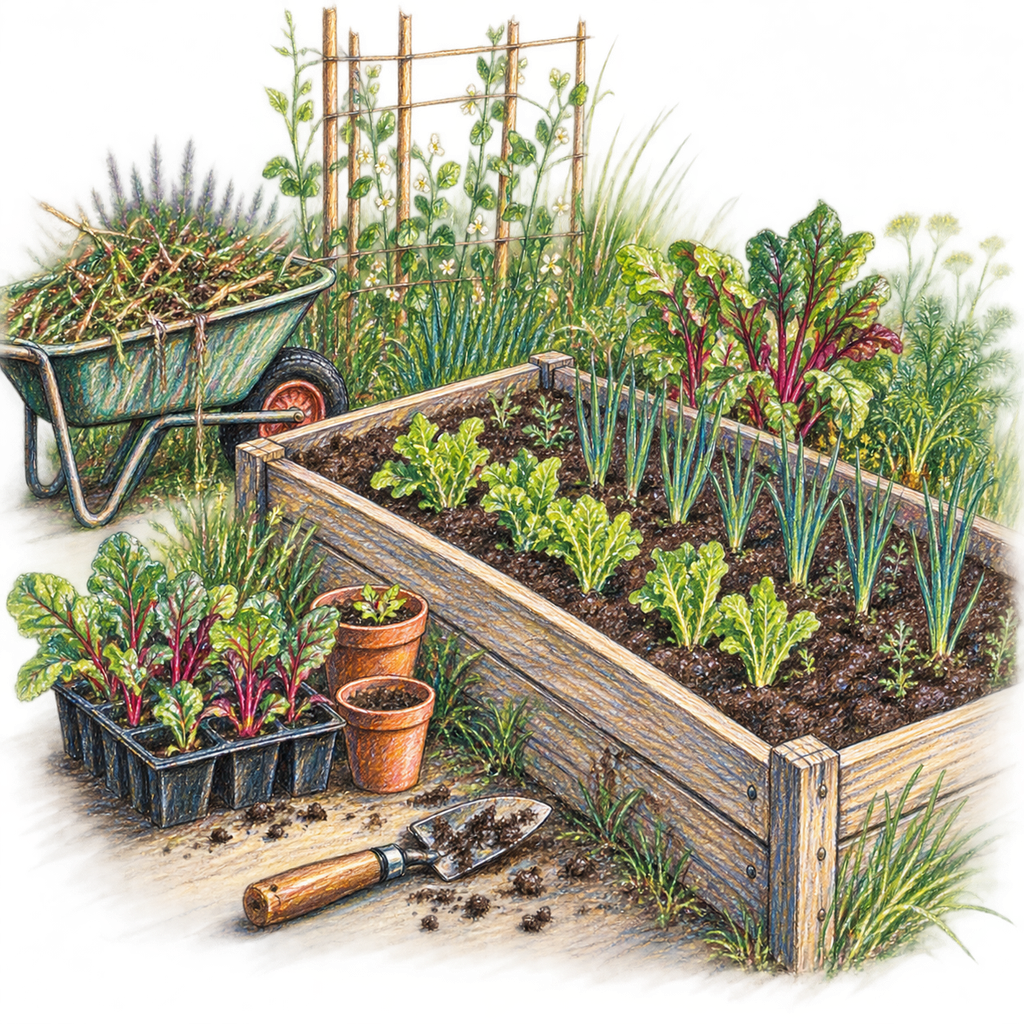
What can I plant after summer vegetables?
What you plant after a summer crop depends on three things: when the space becomes available, what was growing there before and what you want from the bed next.
A bed cleared in August offers considerably more possibilities than one becoming empty at the end of October.
During late summer and early autumn, you may still have time to sow quick-growing crops such as:
- spinach
- rocket
- radishes
- winter lettuce
- mizuna
- mustard leaves
- spring onions
- turnips
- coriander
As autumn progresses, attention begins to move towards overwintering crops such as garlic and suitable onion sets, as well as green manures and soil improvement.
The important thing is not to sow simply because there is an empty space.
Think about what the season can realistically provide.
Autumn brings cooler temperatures and, more importantly, rapidly diminishing daylight. A seed may germinate beautifully in warm September soil but grow increasingly slowly as the days shorten.
The earlier you can make use of an empty summer bed, the greater your choice.
What to plant after potatoes
There is something particularly satisfying about the patch left behind after lifting potatoes.
The soil has already been thoroughly disturbed during harvesting, and after the final potato has been discovered — usually just when you are convinced there cannot possibly be another one — you are left with a useful piece of open ground.
If potatoes are lifted in summer, there can be plenty of time for another crop.
Try sowing spinach, rocket, radishes or autumn salad leaves.
These quick crops make good use of the remaining warmth without requiring another entire growing season.
Later potato harvests leave fewer options, but the bed needn’t remain forgotten. Autumn garlic may be suitable, or you can concentrate on covering and improving the soil ahead of next spring.
Before replanting, take a moment to remove any potatoes you missed. Volunteers appearing among next year’s vegetables are not always as charming as they sound.
What to plant after peas
Peas often leave the vegetable garden relatively early, making their old patch particularly valuable.
Once the last pods have been picked, cut the plants down and clear away the supports.
If the plants are healthy, the top growth can go onto the compost heap.
Peas belong to the legume family and form relationships with soil bacteria associated with nitrogen fixation. You may sometimes see advice to leave all their roots in the ground for this reason.
The reality is a little more complicated than the old gardening rule suggests, but there is certainly no need to painstakingly remove every healthy root.
Instead, clear the bed gently and put the space back to work.
Depending on the time of year, follow peas with salad leaves, spinach, chard, radishes or other quick-growing vegetables.
An early-cleared pea bed can be one of the best opportunities for succession sowing in the whole vegetable garden.
What to plant after broad beans
Broad beans tell a similar story.
They occupy a considerable amount of space while growing, so their departure can suddenly make the vegetable patch feel enormous.
Use that space.
If the beans finish while summer still has some way to run, you have a generous choice of follow-on vegetables.
Beetroot, chard, salads, radishes and other quick crops may all be possibilities, depending on how early the bed becomes available.
Later in the season, concentrate on spinach and hardy salad leaves.
The old broad bean plants themselves are excellent composting material if they are healthy. Chop the stems into smaller pieces before adding them to the heap and they will break down more readily.
Yesterday’s bean plants can eventually become tomorrow’s compost.
What to plant after onions and garlic
By the time onions and garlic are lifted, summer is usually well under way.
Once the bulbs are safely harvested and drying, their former bed presents another opportunity.
This is a particularly useful place for autumn salads, spinach, rocket and radishes.
The fine seeds of salad crops appreciate a reasonably well-prepared surface, so remove weeds and gently rake the top of the soil before sowing.
There is no need to dig the entire bed simply because a new crop is going in.
If the soil is in good condition, disturb it only as much as necessary.
A little garden compost can be added where needed, but avoid assuming every new crop requires a heavy feed.
Sometimes good soil needs less interference than we imagine.
What to plant after courgettes and summer squash
Courgettes are less considerate about leaving early.
They can occupy an enormous amount of ground and continue producing until cooler weather finally brings the season to a close.
By the time they are removed, the days may already be noticeably shorter.
That doesn’t necessarily mean the bed has to remain empty.
In early autumn, try spinach, winter lettuce or other hardy salad leaves, particularly if you can offer them some protection later.
If the courgette plant has exhausted the soil after months of enthusiastic growth, add well-rotted compost before planting the next crop.
And if it is simply too late for another useful vegetable crop, don’t force it.
Cover the soil, sow a suitable green manure or prepare the bed for winter.
Productivity isn’t measured only by the amount of food you can squeeze from a square metre of earth.
Looking after the soil is productive too.
What to plant after runner beans and French beans
Beans can remain productive well into early autumn, particularly in a mild year.
Keep picking while they continue cropping.
When production finally slows and the plants are finished, remove the supports and clear the top growth.
By this stage of the season, quick-growing leaves are usually more realistic than ambitious vegetable crops.
Spinach, winter salads and hardy oriental leaves may still be worth sowing, particularly under cover.
Alternatively, the old bean bed can become a home for autumn-planted garlic or overwintering onion sets, where suitable.
There is something pleasing about this transition.
One crop climbs skywards through summer; the next begins quietly beneath autumn soil.
Sow spinach in empty beds
Spinach is one of the most useful crops for filling spaces as summer vegetables disappear.
Cooler conditions suit it, and varieties intended for autumn growing can provide useful harvests beyond the main summer season.
Sow into moist soil in short rows.
As plants develop, harvest individual outer leaves rather than uprooting the whole plant. This allows the centre to continue producing.
If colder weather arrives, a cloche or cold frame can provide extra protection.
Spinach also earns its place in the kitchen.
Young leaves can be eaten raw, while larger ones disappear effortlessly into curries, soups, pasta, omelettes and stews.
An empty patch of earth can become supper surprisingly quickly.
Grow rocket for a quick autumn crop
Rocket is another crop that relishes the change of season.
In the heat of summer it can rush into flower. Cooler autumn conditions often encourage better leafy growth.
It is also quick.
That matters when daylight is disappearing.
Sow a small amount every couple of weeks rather than covering an entire bed. Even a row a metre long can produce plenty of leaves for salads and sandwiches.
Rocket is particularly useful for awkward little spaces.
A narrow gap between established crops, the edge of a raised bed or a container emptied of summer flowers can all become productive again.
Not every harvest needs its own vegetable bed.
Sow radishes between slower crops
Radishes are among the great gap-fillers of the vegetable garden.
Their roots develop quickly and require relatively little space, making them useful wherever a patch of soil becomes available.
Sow thinly and keep the soil evenly moist.
Harvest promptly once the roots are ready. Leaving them in the ground indefinitely rarely improves them.
Radishes can also be used between crops that will eventually need more room.
The radishes are harvested before their slower neighbours expand into the space.
It is a simple form of intercropping and an excellent way of making a small vegetable garden work harder.
Sow winter lettuce and hardy salad leaves
The end of summer doesn’t have to mean the end of home-grown salad.
Choose lettuce varieties intended for autumn and winter growing rather than relying on leftover packets of tender summer varieties.
Mizuna, mustard leaves and other hardy salad crops are also worth exploring.
Their colours and textures bring life to beds that might otherwise be empty, while their stronger flavours are well suited to autumn food.
Imagine a bowl of freshly picked leaves beside roasted beetroot, warm potatoes or a slice of homemade tart.
Autumn salad doesn’t have to pretend it is July.
It can taste entirely of its own season.
Plant garlic for next year’s harvest
Sometimes the best thing to plant in an empty autumn bed isn’t something you will eat this year.
Garlic is planted in autumn or winter, depending on variety and conditions, and spends the colder months establishing itself for the season ahead.
Choose healthy bulbs sold specifically for planting rather than simply pushing supermarket garlic into the vegetable patch.
Separate the bulb carefully into individual cloves shortly before planting and place each one at the recommended depth and spacing for the variety.
Then wait.
There is no instant harvest and little immediate drama.
But beneath the soil, roots begin to establish.
Months later, when the garden has travelled all the way through winter and spring, those individual cloves can have become complete bulbs.
Few crops demonstrate the gardener’s relationship with time quite as beautifully.
Consider overwintering onion sets
Suitable overwintering onion sets can also make productive use of beds vacated by summer crops.
Planted in autumn, they establish before winter and continue developing when conditions improve.
Choose varieties specifically intended for autumn planting.
Good drainage is important, particularly if your soil becomes wet and heavy during winter.
If necessary, use raised beds or choose another area where water is less likely to sit around the bulbs.
An empty bed isn’t automatically the right bed for every crop.
The soil still gets a vote.
Sow green manure when you don’t need another vegetable crop
There is a natural temptation to make every piece of soil produce food.
But sometimes the best crop isn’t destined for the kitchen.
Green manures are plants grown primarily to cover and improve the soil.
Depending on the species, they can help protect bare ground from winter weather, suppress weeds and add organic matter when they are eventually cut down.
They are particularly useful when a bed is going to remain empty for several months.
Choose the green manure according to the time of year, soil and length of time the bed will be vacant.
Also think about crop rotation.
Some green manures belong to the same plant families as vegetables you may want to grow later, which can matter when planning rotations.
Green manure may not provide a basketful of vegetables.
What it gives you instead is an investment in the ground from which those vegetables will eventually grow.
Or simply cover the soil
You don’t have to plant every empty bed.
If autumn is advanced or you have enough crops already, covering the soil can be an excellent choice.
A layer of well-rotted garden compost or other suitable organic mulch protects the surface and allows worms and other soil organisms to get on with their work.
By spring, the bed may need little more than light preparation before planting.
Bare soil is rarely the goal in nature.
Look beneath a woodland canopy and the earth is protected by leaves and decaying plant material. Gardens can borrow something from this habit.
Rather than thinking of an unplanted bed as wasted space, think of it as soil being prepared for what comes next.
Should you add compost before planting the next crop?
It depends.
If you’ve just removed a hungry crop such as courgettes or squash, adding some well-rotted compost may be useful.
If the previous crop was less demanding and your soil is already fertile and in good condition, there may be no need to add anything before sowing a quick row of autumn leaves.
This is where knowing your soil becomes valuable.
Is it light and prone to drying?
Heavy and slow to drain?
Rich in organic matter?
Compact after a season of walking and watering?
Gardening advice is useful, but the handful of soil in front of you is more useful still.
Feed the soil where it needs feeding rather than automatically reaching for fertiliser every time a plant comes out.
Do you need to practise crop rotation?
Crop rotation can be helpful, particularly where you grow vegetables from the same families year after year.
It can reduce the build-up of some soil-borne pests and diseases and helps avoid repeatedly growing similarly demanding crops in the same place.
But don’t allow an elaborate rotation plan to make a small garden unnecessarily difficult.
For a quick autumn crop of rocket or radishes in a newly empty gap, perfection isn’t required.
The more important principle is to avoid repeatedly growing crops susceptible to particular persistent problems in the same soil.
Keep simple notes about what grew where.
A photograph of the vegetable patch taken at different points during the year can be surprisingly useful too.
By next spring, when every bed is conveniently empty, it is remarkably easy to forget where everything was.
Don’t leave diseased plants behind
There is one important pause before replanting any empty vegetable bed.
Look at the crop you have just removed.
Was it healthy?
If it was, much of the plant material can usually head towards the compost heap.
If it was badly diseased, deal with it appropriately rather than casually digging affected material into the soil or adding unsuitable material to a home compost heap.
Also remove obvious weeds before sowing again.
A fresh row of spinach shouldn’t have to begin life competing with established couch grass or bindweed.
The transition between crops is an ideal moment to inspect the bed and deal with problems while you can actually see the soil.
Remember that autumn light matters
Warm soil can be deceptive.
A September afternoon may feel almost summery, and seeds can germinate quickly. But the plants are heading towards shorter days.
Light increasingly becomes the limiting factor.
This means a crop sown on 1 September and one sown on 30 September may behave quite differently, even if the weather feels similar.
As autumn advances, choose the brightest parts of the vegetable garden for crops you hope to harvest.
Avoid putting young seedlings where a shed, fence or evergreen hedge will cast deep winter shade.
The sun travels lower across the sky now.
Watch where it falls.
Protect late crops when necessary
As temperatures fall, a little shelter can extend the usefulness of your newly planted beds.
Cloches can protect rows of spinach and salads. Horticultural fleece can provide temporary protection during colder spells, while a cold frame or unheated greenhouse offers even greater shelter.
This doesn’t mean trying to create summer in November.
Hardy crops don’t need tropical conditions.
Often they simply benefit from protection against persistent rain, cold wind and frost.
The aim is to work with autumn, not disguise it.
Empty beds can become wildlife spaces too
Not every corner of the vegetable garden has to be relentlessly productive.
A bed may be cleared, but the wider garden still has inhabitants preparing for winter.
Leave some seed heads elsewhere for birds. Allow a quiet corner to remain less tidy. A small pile of woody stems or leaves can provide shelter for invertebrates.
The productive garden and the wildlife garden don’t need to exist separately.
Pollinators, birds, beetles and countless less noticeable creatures are part of the same garden that gives us beans, apples and tomatoes.
Making room for them is part of growing food well.
What should I plant in my empty vegetable bed?
If you’re looking at a newly cleared vegetable bed and wondering what should come next, use the season as your guide.
If the bed becomes empty in late summer:
Try spinach, chard, beetroot, radishes, rocket and other salad leaves, depending on the remaining growing time.
If it becomes empty in early autumn:
Concentrate on spinach, rocket, winter lettuce, mizuna, mustard leaves and other hardy, quick-growing crops.
For planting into autumn:
Consider garlic and suitable overwintering onion sets.
If you don’t need another food crop:
Sow an appropriate green manure or cover the soil with organic matter.
There isn’t one correct answer.
The best next crop is the one suited to your soil, your garden and the weeks of growing weather still ahead.
An empty bed is not an ending
There is something satisfying about clearing away a finished summer crop.
The tangled pea stems come down. The last potatoes are carried towards the kitchen. Bean canes are untied and stacked away.
For a moment, there is simply earth.
It can feel like the garden has given everything it has to give.
But kneel down and the soil may still be warm beneath your hand.
There is time yet.
Perhaps you make a shallow drill and sow a line of spinach. Perhaps a few garlic cloves are planted for next summer. Perhaps you spread compost over the surface and decide that this particular piece of earth has worked hard enough for one year.
All are forms of gardening.
Because an empty vegetable bed is never really empty.
It is a space between harvests.
One crop has finished its story, and beneath the changing autumn sky, the next one is waiting to begin.
Further Reading: Wonderful Ways to Use Fresh Garden Peas, Grow Your Own Food: Save Money & Eat Well, How to Keep Your Vegetable Garden Productive into Autumn, What to Sow in September: Vegetables, Salads & Herbs
Follow us on Instagram, Threads, BlueSky, Twitter, Pinterest & Facebook
Not sure where to start? Take a look at our Grow Your Own Packs with detailed step by step instructions, seeds and 1 years online support.