
There is something inherently cheerful about yellow food.
A bowl of lemons on the kitchen table. Sweetcorn dripping with butter. Golden tomatoes warm from the greenhouse. A perfectly ripe banana. Yellow peppers, squash, courgettes and those little yellow raspberries that look as though someone forgot to colour them in.
Yellow might not get quite as much attention as green when we’re talking about vegetables, but there’s plenty to explore at the sunny end of the fruit and vegetable rainbow.
And quite a lot of it can be grown at home.
Some yellow foods contain plant pigments called carotenoids, although not every yellow fruit or vegetable gets its colour in the same way. They also provide varying amounts of vitamin C, vitamin A precursors, potassium, fibre, folate and other nutrients.
But rather than treating individual foods as remedies for particular health problems, I think there’s a much more enjoyable way to look at them.
Grow a variety. Eat a variety. And enjoy what’s in season.
So, let’s explore some of the yellow foods we can grow, pick and eat — along with a few we might have to leave to growers in rather warmer parts of the world.
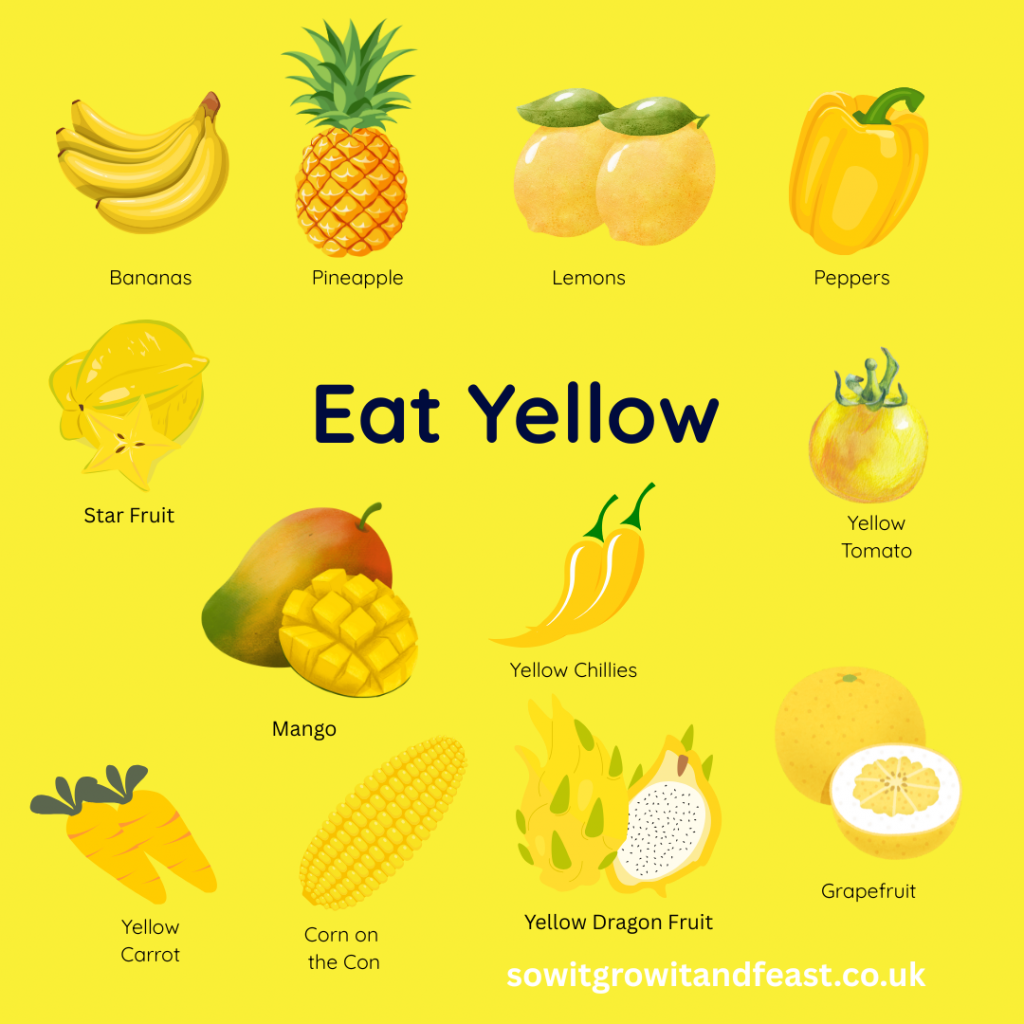
Why Are Some Fruits and Vegetables Yellow?
The colour in fruit and vegetables comes from naturally occurring plant pigments.
One group you’ll often encounter in yellow and orange produce is the carotenoids.
These include beta-carotene, lutein and zeaxanthin. Beta-carotene can be converted by the body into vitamin A, while lutein and zeaxanthin are found in high concentrations in parts of the eye.
But colour isn’t a precise guide to what’s inside a particular fruit or vegetable.
A yellow pepper doesn’t contain exactly the same nutrients as a banana simply because they’re the same colour.
That’s really the point of eating the rainbow.
Different fruits and vegetables give us different combinations of fibre, vitamins, minerals and plant compounds.
And they make dinner considerably more interesting.
Yellow Peppers
If you’ve ever left a green pepper on the plant and watched it gradually change colour, you’ll know that peppers don’t necessarily start life yellow, orange or red.
The colour develops as the fruit ripens.
Yellow peppers provide plenty of vitamin C, along with carotenoids and other plant compounds.
They’re also sweet, crunchy and incredibly versatile in the kitchen.
Sow it
Peppers need a long growing season, so sow the seeds indoors early in the year somewhere warm.
They can be a little slow to get going.
Don’t give up on them.
Grow it
Peppers love warmth and sunshine. A greenhouse is ideal, but they can also grow well in pots in a sunny, sheltered position.
Keep them watered and feed regularly once fruits begin forming.
Then comes the difficult part.
Waiting for them to turn yellow.
Feast
Eat them raw in salads, roast them until soft and sweet, add them to pasta sauces or stuff them and bake them.
If you’ve grown several plants and they all decide to ripen simultaneously, roasted peppers can also be frozen for later.
Yellow Tomatoes
Red tomatoes may be the familiar choice, but tomatoes come in a glorious range of colours.
Yellow varieties can be particularly beautiful.
You can grow tiny golden cherry tomatoes, plum varieties and enormous beefsteak tomatoes in shades ranging from pale lemon to deep gold.
Their nutritional profile varies by variety, but tomatoes generally provide vitamin C, potassium, folate and a range of carotenoids.
For me, though, the main reason to grow yellow tomatoes is flavour.
Sow it
Sow tomatoes indoors in late winter or early spring.
Grow it
Give them plenty of light and warmth, then gradually acclimatise plants to outdoor conditions before putting them outside once the danger of frost has passed.
Depending on the variety, they’ll grow happily in greenhouse borders, growbags, pots and sunny outdoor beds.
Feast
Mix yellow tomatoes with red ones for one of the easiest beautiful summer salads imaginable.
Add olive oil, basil, a little salt and perhaps some mozzarella.
When you’ve grown something that tastes that good, there’s really no need to interfere with it very much.
Yellow Courgettes
I have a particular fondness for yellow courgettes.
They’re grown in much the same way as green ones, but their bright colour makes them wonderfully easy to spot beneath the leaves.
Anyone who has discovered a green courgette approximately the size of a marrow hiding under a plant will appreciate this advantage.
Courgettes provide fibre, vitamin C and potassium, among other nutrients.
Sow it
Sow courgettes indoors in spring or directly outside once conditions are warm enough.
One or two healthy plants can produce an impressive amount of food.
Possibly too impressive by August.
Grow it
Give courgettes rich soil, plenty of water and enough room to spread.
Pick them regularly while they’re relatively small and the plant should continue producing.
Feast
Slice them into pasta, grill them, roast them, grate them into fritters or turn them into courgette cake.
And when everyone in the household says, “Not courgettes again”, start making chutney.
It’s practically a gardening tradition.
Sweetcorn
There are few things more satisfying than growing your own sweetcorn.
Partly because the plants become so magnificently tall, and partly because freshly picked sweetcorn can be extraordinarily sweet.
Sweetcorn provides carbohydrate and fibre as well as folate and some B vitamins. Yellow varieties also contain carotenoids including lutein and zeaxanthin.
Sow it
Sweetcorn likes warmth, so sow indoors in spring or directly outside once the soil has warmed.
Grow it
Plant sweetcorn in a block rather than a long single row.
It’s wind-pollinated, so growing plants together improves the chances of the pollen reaching neighbouring plants and producing well-filled cobs.
Feast
The sooner you eat sweetcorn after picking, the better.
Boil or grill the cobs and add butter.
That’s it.
Sometimes the feast part really doesn’t need to be complicated.
Yellow Carrots
Carrots weren’t always orange.
They come in purple, white, red and yellow varieties too, and growing a mixture is an easy way to make an ordinary crop more interesting.
Yellow carrots provide fibre and contain carotenoids, although the amounts and types vary between different varieties.
Sow it
Carrots are best sown directly where they’re going to grow because they dislike root disturbance.
Sow thinly into fine soil and keep the area watered while the seeds germinate.
Grow it
Carrot root fly can be troublesome, so avoid crushing the foliage unnecessarily when thinning and consider growing resistant varieties or using a physical barrier.
Carrots also grow surprisingly well in deep containers.
Feast
Roast them, grate them into salads, add them to soups and stews or simply steam them and add butter.
Home-grown carrots also have the advantage of coming in shapes never encountered in a supermarket.
Some require a little imagination.
Butternut Squash
Technically a fruit, although firmly treated as a vegetable in the kitchen, butternut squash is one of autumn’s great comfort foods.
Its golden flesh contains beta-carotene, which the body can convert into vitamin A, along with fibre, potassium and vitamin C.
Sow it
Start squash seeds somewhere warm in spring.
Grow it
Give the plants space.
Then give them a little more space.
Squashes have an impressive ability to head off across the vegetable garden in whatever direction you least expected.
They like fertile soil, sunshine and regular watering.
Allow the fruits to ripen fully and cure them properly after harvesting and many squash varieties will store for months.
Feast
Roast butternut squash with herbs, make soup, stir it into risotto or add it to curries.
Growing food that stores well is particularly satisfying because you’re still eating from the garden long after the growing season has slowed down.
Golden Raspberries
Yes, raspberries come in yellow.
Golden raspberries are varieties of raspberry that produce pale yellow or golden fruit rather than the familiar red.
They’re beautiful, delicious and just unusual enough to make people ask what on earth you’re growing.
Like red raspberries, they provide fibre, vitamin C and a range of plant compounds.
Grow it
Autumn-fruiting golden raspberries can be particularly straightforward to manage.
Give them sunshine, decent soil and support where necessary.
Once established, raspberry plants can produce fruit for years.
Feast
Eat them straight from the cane.
If sufficient quantities actually reach the kitchen, they’re lovely with yoghurt, porridge or puddings and can be frozen for later.
That’s quite a big “if”.
Lemons
Now we reach something a little more ambitious for the British gardener.
Lemons are rich in vitamin C and contain several plant compounds, including flavonoids.
They’re useful in almost everything from salad dressings and marinades to cakes, puddings and drinks.
But despite what you may have read online, you don’t need lemon water to “detox” your body.
That’s a job your liver and kidneys are already rather good at.
What lemons are very good at is making food taste wonderful.
Grow it
Lemon trees can be grown in Britain, but they need protection.
A pot is usually the most practical option because the plant can spend warmer months outside and be moved somewhere bright and frost-free during winter.
Growing your own lemon isn’t necessarily the easiest route to self-sufficiency.
But picking a lemon from your own tree in Britain feels disproportionately exciting.
Feast
Squeeze them over salads and vegetables, use the zest in baking, make lemon curd or add them to marinades.
And if life gives you lemons…
Well, you know the rest.
Bananas
You can grow a banana plant in Britain.
Producing a useful crop of edible bananas is another matter entirely.
Bananas provide carbohydrate, fibre, potassium and vitamin B6, among other nutrients.
They’re convenient, inexpensive and easy to eat, which is probably reason enough for their enduring popularity.
For most of us, however, bananas belong firmly in the feast rather than grow category.
Slice them over porridge, freeze ripe bananas for smoothies or use those alarmingly brown ones in banana bread.
A brown banana is not necessarily a failed banana.
Sometimes it’s simply cake waiting to happen.
Pineapple
Pineapple provides vitamin C and manganese and contains an enzyme mixture called bromelain.
You’ll sometimes see sweeping claims made about bromelain and digestion or inflammation. It’s more sensible to regard pineapple as what it is: a nutritious fruit that can form part of a varied diet, rather than a treatment for anything.
You can actually grow a pineapple plant from the leafy crown of a shop-bought fruit.
Whether you’ll eventually harvest a pineapple from it in Britain is considerably less certain.
But gardening would be rather dull if we only grew things guaranteed to succeed.
Grapefruit
Grapefruit provides vitamin C, fibre and several plant compounds.
It has also acquired a long-standing reputation as a “weight-loss food”, but no individual fruit has magical fat-burning properties.
There’s another important reason grapefruit deserves a little caution.
Grapefruit can interact with some medicines, changing the amount of medication that enters the bloodstream. Anyone taking medication that’s affected by grapefruit should follow the advice provided with it or speak to a pharmacist or healthcare professional.
For the rest of us, it’s simply a beautifully sharp citrus fruit.
Sometimes breakfast is enough of a job for a grapefruit.
Star Fruit
Star fruit — or carambola — is a tropical fruit that looks particularly impressive when sliced crossways into little stars.
It provides vitamin C, fibre and various plant compounds.
It’s unlikely to become a productive garden crop in Britain, but it’s an interesting addition to the yellow rainbow when you come across it.
There is, however, an important caveat: people with kidney disease may be advised to avoid star fruit because it contains substances their kidneys may not clear effectively.
This is a good reminder that “natural” doesn’t automatically mean suitable for everyone.
Grow a Little Patch of Sunshine
If you’d like to grow some yellow food yourself, don’t try to grow everything.
Start with what suits your space.
For a small garden or patio, try:
Yellow tomatoes + yellow courgettes + yellow peppers.
Have a little more room?
Add sweetcorn and a squash.
Fancy something permanent?
Plant a golden raspberry.
Suddenly you’ve got an edible patch producing yellow food from summer well into autumn.
And that’s where eating seasonally becomes much more interesting.
You aren’t choosing yellow tomatoes because somebody told you they’re a “superfood”.
You’re eating them because there are twenty-seven ripe ones in the greenhouse.
What to Do With a Yellow Harvest
Growing food has a habit of producing either absolutely nothing or far more than any reasonable household could possibly eat.
Rarely does the vegetable garden provide exactly three courgettes at convenient weekly intervals.
So when the yellow harvest arrives, make the most of it.
Roast peppers and freeze them.
Turn courgettes into fritters, pasta sauces and chutney.
Freeze tomatoes whole for cooking later.
Cure and store squash.
Freeze raspberries.
Enjoy sweetcorn as soon as you pick it.
And give some away.
One of the loveliest things about growing food is being able to knock on someone’s door and say:
“Would you like some of these?”
Eat the Rainbow — But Grow It Too
Eating a varied selection of fruit and vegetables gives us a broad mixture of fibre, vitamins, minerals and naturally occurring plant compounds.
Yellow foods are simply one part of that bigger picture.
You don’t need lemon water to detox your liver.
You don’t need grapefruit to boost your metabolism.
And no single pepper, pineapple or banana is going to transform your health.
Food doesn’t need those sorts of promises to be worthwhile.
Grow what you can.
Buy what you can’t.
Eat plenty of different plants.
And when you pick a yellow tomato you’ve grown from a seed, slice it open while it’s still warm from the sun and eat it standing in the garden.
You’ll understand exactly why I think we should eat more yellow.
Not because it’s miraculous.
Because it’s delicious.
Further reading: Why You Should Eat More Purple, Why Eating Green Is Good For You, Eat the Rainbow: The Power of Red, Why Orange Foods Deserve a Place on Your Plate, The Incredible Benefits of Growing Your Own Food
Follow us on Instagram, Threads, BlueSky, Twitter, Pinterest & Facebook
Not sure where to start? Take a look at our Grow Your Own Packs with detailed step by step instructions, seeds and 1 years online support.