
Purple carrots pulled from the soil. Shiny aubergines hanging from the plant. Blackberries staining your fingers. Great ruffled red cabbages, purple sprouting broccoli and bowls of dark, sweet plums.
Purple fruit and vegetables are certainly good at getting noticed.
And they aren’t purple simply for our benefit.
Many get their extraordinary colour from naturally occurring plant pigments called anthocyanins. These belong to a larger family of plant compounds called flavonoids and can produce colours ranging from red and purple through to deep blue.
Purple foods also provide different combinations of fibre, vitamins, minerals and other plant compounds.
But there’s no need to turn them into miracle foods.
Rather than eating blueberries because they’re going to “boost your brain” or beetroot because it’s going to “detox your liver”, there’s a much simpler reason to put more colour on our plates.
Different plants give us different nutrients. Variety is a good thing.
And from a gardener’s point of view, purple crops are enormous fun to grow.
So let’s look at what we can sow, what we can grow and — the important bit — what we can feast on afterwards.
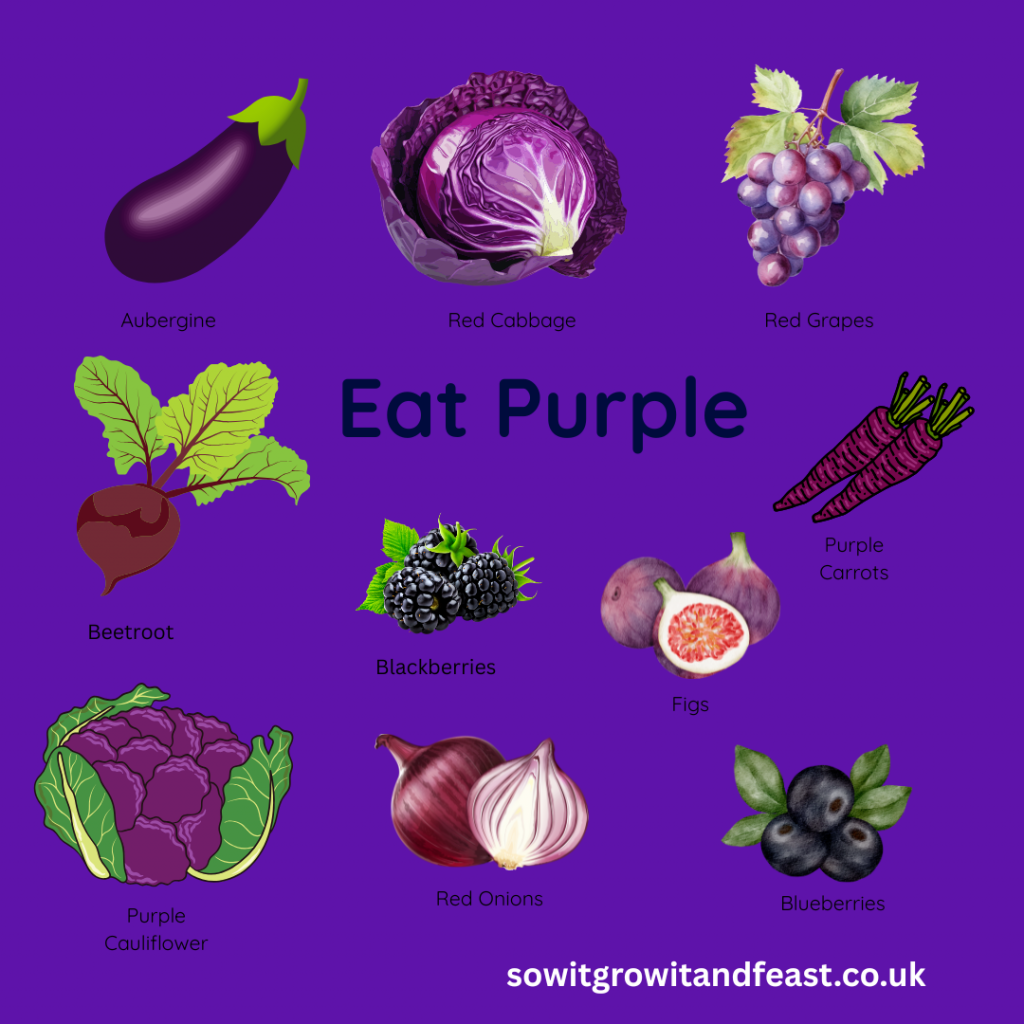
Why Are Some Fruits and Vegetables Purple?
That deep purple, blue or almost black colour often comes from anthocyanins.
Anthocyanins are naturally occurring pigments found in plants. They’re responsible for the colour of foods including blackberries, blueberries, blackcurrants, red cabbage and many purple varieties of vegetables.
They’re also antioxidants, which means they can interact with processes involving oxidation in the body.
There’s a growing body of research looking at anthocyanins and other plant compounds, but that doesn’t mean we need to assign every purple vegetable a particular illness to prevent or health problem to solve.
Food is much more complicated than that.
And so are we.
The useful message is wonderfully simple:
Eat lots of different plants.
If some of them happen to be purple, all the better.
Aubergines
Few vegetables look quite as glamorous in the garden as an aubergine.
Those glossy purple fruits hanging beneath large leaves look almost too perfect to be real.
Almost.
Aubergines provide fibre and small amounts of various vitamins and minerals. Their purple skin contains anthocyanins, including a pigment called nasunin.
But the main reason to grow aubergines is culinary.
A freshly picked aubergine can become an extraordinary number of good things.
Sow it
Aubergines need a long growing season, so sow them early indoors somewhere warm.
They’re not a crop to rush.
Grow it
A greenhouse or polytunnel gives you the best chance of a good harvest in much of Britain, although they can also grow outside in particularly warm, sunny and sheltered positions.
They’re also very happy in large pots.
Give them warmth, sunshine, regular watering and feeding once the fruits begin developing.
Feast
Roast them, grill them, add them to curries or make ratatouille, parmigiana or baba ganoush.
Aubergines absorb flavours beautifully, particularly olive oil, garlic, tomatoes, herbs and spices.
Suddenly growing three plants doesn’t seem excessive at all.
Purple Carrots
Carrots haven’t always been orange.
Purple carrots have a very long history, and growing them is an easy way to make an everyday vegetable feel rather more exciting.
Depending on the variety, they may be purple all the way through or have a purple exterior surrounding an orange, yellow or white centre.
Purple carrots provide fibre and various carotenoids, while purple varieties can also contain anthocyanins.
Sow it
Sow carrots directly where they’re going to grow.
They dislike having their roots disturbed, so transplanting isn’t generally worth the trouble.
If you have heavy or stony soil, try growing them in a deep container instead.
Grow it
Keep the soil moist while the seeds germinate.
Carrot root fly can be troublesome, so consider resistant varieties, fine mesh or other physical barriers if it’s a problem where you garden.
Then comes the good bit.
Pull one up.
You never quite know what shape is going to emerge.
Feast
Roast purple carrots, grate them into salads, add them to soups or simply steam them.
One warning: some purple varieties are enthusiastic about sharing their colour with everything else in the pan.
Consider yourself warned.
Beetroot
Is beetroot red?
Is it purple?
Burgundy?
I’m not sure it matters.
It certainly belongs at this end of the rainbow.
Beetroot provides folate, manganese and potassium and naturally contains dietary nitrates. Its intense colour comes from pigments called betalains, rather than anthocyanins.
That’s a useful reminder that foods of similar colours aren’t necessarily nutritionally identical.
Sow it
Beetroot is wonderfully straightforward to grow from seed.
Sow directly outside from spring onwards and make smaller sowings every few weeks if you’d like a succession of roots rather than thirty-seven beetroot becoming ready simultaneously.
Grow it
Keep plants watered during dry spells and harvest some while the roots are still young and tender.
Don’t forget the leaves.
Young beetroot leaves are edible and can be used in salads or cooked similarly to chard.
Feast
Roast beetroot, pickle it, grate young roots into salads or pair it with feta, goat’s cheese, walnuts or horseradish.
Just don’t prepare it immediately before going somewhere important wearing white.
Red Cabbage
It is called red cabbage.
It is quite clearly purple.
Gardening is full of these little mysteries.
Red cabbage contains fibre, vitamin C and vitamin K, among other nutrients, and its colour comes from anthocyanins.
It’s also an excellent vegetable for the cooler months.
Sow it
Depending on the variety, cabbage can be sown at different points during the year.
Choose a variety suited to when you want to harvest it rather than assuming all cabbages behave in the same way.
Grow it
Cabbages like fertile, firm soil.
Protect young plants from pigeons and keep an eye out for cabbage white butterflies, whose caterpillars can turn a beautiful cabbage into lace with remarkable efficiency.
Feast
Shred red cabbage into winter salads and slaws or cook it slowly with apple and spices.
Pickling is another excellent option if you’ve got more than you can use immediately.
A jar of jewel-coloured pickled cabbage is a rather good thing to have waiting in the fridge.
Purple Sprouting Broccoli
Purple sprouting broccoli is one of my favourite crops because it arrives when the vegetable garden can otherwise feel rather quiet.
After months of waiting, those purple shoots begin appearing in late winter and spring.
Suddenly the garden is feeding you again.
It provides fibre, vitamin C, vitamin K and folate, along with a variety of naturally occurring plant compounds.
Sow it
Purple sprouting broccoli requires patience.
It’s usually sown months before you expect to harvest it, which means you’re giving valuable vegetable-garden space to something that appears to be doing very little for quite a long time.
Trust the process.
Grow it
Give plants fertile soil and enough room to develop.
Protect them from pigeons and caterpillars where necessary and support tall plants in exposed gardens.
Feast
Pick the shoots regularly and more should follow.
Steam them, roast them or sauté briefly with garlic and olive oil.
Don’t overcomplicate it.
One of the great pleasures of seasonal growing is waiting months for something and then eating it as simply as possible.
Blackberries
Blackberries are the fruit that prove you don’t always have to sow something to enjoy a harvest.
Come late summer, Britain’s hedgerows can be full of them.
Their dark colour comes from anthocyanins, and blackberries provide fibre, vitamin C and vitamin K among other nutrients.
You can also grow cultivated varieties at home, including thornless types that are considerably kinder to your arms.
Grow it
Blackberries and hybrid berries generally appreciate sunshine and some support.
Cultivated varieties can produce larger fruits than their wild relatives and can be trained neatly against wires or fences.
If you’re picking wild blackberries, make sure you’re somewhere you’re permitted to forage and that you can confidently identify what you’re collecting.
Feast
Eat them with yoghurt, make crumble, turn them into jam or freeze them.
To freeze berries individually, spread them on a tray first and transfer them to a container once frozen.
This prevents the entire harvest becoming one enormous blackberry iceberg.
Blackcurrants
Blackcurrants have one of those flavours that instantly tastes of summer.
They’re particularly rich in vitamin C and contain fibre and anthocyanins.
They’re also a very useful fruit to grow because an established bush can provide crops for years.
Grow it
Blackcurrants prefer reasonably fertile, moisture-retentive soil and will crop best with a decent amount of sun.
Once established, pruning out some of the older wood encourages fresh productive growth.
Feast
Fresh blackcurrants can be quite sharp, which is exactly what makes them so good for cooking.
Turn them into compote, jam, cordial, puddings or sauces.
They also freeze beautifully.
Blueberries
Despite having blue in the name, I’m claiming blueberries for the purple end of our edible rainbow.
Their blue-purple colour comes largely from anthocyanins.
Blueberries also provide fibre, vitamin C, vitamin K and manganese.
The important thing to know if you want to grow them is that blueberries are acid-loving plants.
Grow it
If your garden soil isn’t acidic, don’t try to persuade it otherwise.
Grow blueberries in containers filled with an ericaceous growing medium.
Rainwater is preferable for watering where possible, particularly in hard-water areas.
Growing more than one compatible variety can also improve pollination and extend the harvest.
Feast
Eat blueberries straight from the bush, scatter them over breakfast, bake them into muffins or freeze them.
Like strawberries, they have a mysterious habit of disappearing between garden and kitchen.
Purple Potatoes
Cutting open a purple potato for the first time is quite a surprise.
Some varieties have coloured skins but ordinary pale flesh. Others are spectacularly purple all the way through.
Purple-fleshed potatoes contain anthocyanins alongside the carbohydrate, fibre, potassium and vitamin C associated with potatoes more generally.
Grow it
Purple potatoes are grown in much the same way as other potatoes.
Plant seed potatoes in the ground, large containers or potato bags and earth up the plants as they grow.
Choose varieties according to whether you want first earlies, second earlies or maincrop potatoes.
Feast
Roast them, boil them or turn them into mash.
Some retain their colour better than others during cooking.
Purple mashed potato may take the family by surprise.
I consider that an advantage.
Purple Cauliflower
If you think cauliflower is boring, grow a purple one.
Purple cauliflower gets its colour from anthocyanins and provides fibre, vitamin C, folate and other nutrients.
It’s grown in much the same way as more familiar white varieties.
Grow it
Cauliflowers appreciate fertile soil and consistent growing conditions.
They can be slightly demanding, particularly if growth is interrupted by drought or other stresses.
But producing a perfect purple cauliflower from your own garden is enormously satisfying.
Feast
Roast it.
Cauliflower transformed by a hot oven, olive oil and seasoning is a completely different proposition from the over-boiled cauliflower some of us remember from childhood.
It also works beautifully in curries, salads and vegetable bakes.
Purple Asparagus
Purple asparagus is one for the patient gardener.
Like green asparagus, it is a perennial crop. Establish a bed successfully and it can produce spears for many years.
The purple colouring comes from anthocyanins, and the spears provide fibre, folate and other vitamins and minerals.
Grow it
Asparagus wants a permanent home in well-drained soil.
Prepare the ground carefully because this isn’t a crop you’ll want to move next year.
And don’t expect an immediate feast.
Young asparagus beds need time to establish before being harvested heavily.
Feast
When those first proper harvests finally arrive, keep things simple.
Steam, roast or griddle the spears and add butter, olive oil or a squeeze of lemon.
You’ve waited years for them.
They deserve centre stage.
Plums
A plum tree can be one of the great pleasures of a productive garden.
Depending on the variety, the fruit might be red, yellow, green or deep purple.
Purple-skinned plums provide fibre and contain a range of plant compounds, including anthocyanins in the coloured skin.
Grow it
Choose the variety and rootstock according to the space you have available.
Some plums are self-fertile, while others crop better with a suitable pollination partner nearby, so check before buying.
Then hope the tree doesn’t decide to produce its entire annual crop during the one week you’ve gone on holiday.
Feast
Eat ripe plums straight from the tree, bake them, poach them or turn them into jam and chutney.
A plum crumble is also an excellent answer to most autumn questions.
Figs
Figs aren’t always obviously purple, but many familiar varieties ripen to beautiful shades of deep purple or burgundy.
They provide fibre, potassium and other nutrients.
They’re also a fascinating fruit to grow in Britain.
Grow it
Figs often crop particularly well when their roots are restricted.
That’s why you’ll frequently see them grown against sunny walls with their roots contained or planted in large pots.
Give them the warmest, sunniest position you can.
Feast
A perfectly ripe fig needs very little interference.
Eat it fresh, add it to salads or serve with yoghurt or cheese.
If you’re lucky enough to have too many, make jam or chutney.
Red Onions
Yes, another supposedly red vegetable that’s actually purple.
Red onions contain various sulphur compounds and flavonoids, including the flavonoid quercetin, and provide some fibre and vitamin C.
More importantly for the kitchen, they’re wonderfully versatile.
Sow it
You can grow onions from seed or sets.
Sets are particularly straightforward if you’re new to growing onions.
Grow it
Give them a sunny position and reasonably well-drained soil.
Once the foliage begins to die back and the bulbs are mature, harvest and dry them properly if you want to store them.
Feast
Slice them raw into salads, roast them, pickle them or slowly cook them until soft and sweet.
Quick-pickled red onions are one of those ridiculously simple things that make almost everything else on the plate look more impressive.
Grow a Purple Patch
One of the pleasures of growing your own food is discovering that vegetables don’t have to look like the versions we’re accustomed to seeing in supermarkets.
Carrots can be purple.
Cauliflowers can be purple.
Potatoes can be purple.
Asparagus can be purple.
Even Brussels sprouts can be purple.
If you’re new to growing food, though, don’t attempt everything at once.
Try:
Purple carrots + beetroot + blackberries.
Have a little more room?
Add:
Red cabbage + purple potatoes + blackcurrants.
And if you’re prepared to play the long game:
Plant some purple asparagus.
That’s a wonderfully colourful little edible garden.
What to Do With a Purple Harvest
Eventually, every productive gardener encounters the same problem.
You wanted home-grown food.
You now have rather a lot of home-grown food.
This is when the feast part of Sow It Grow It and Feast earns its keep.
Freeze blackberries, blueberries and blackcurrants.
Pickle red onions and cabbage.
Turn plums into jam or chutney.
Roast beetroot.
Store suitable potatoes.
Make blackberry crumble.
And give some away.
A bag of home-grown produce handed over the garden fence is one of life’s small pleasures.
Eat the Rainbow — But Grow It Too
There’s good sense behind the familiar advice to eat a wide variety of fruit and vegetables.
Different plants give us different combinations of fibre, vitamins, minerals and naturally occurring plant compounds.
Purple foods are one interesting part of that bigger picture.
They don’t need to detox our liver.
They don’t need to give us younger-looking skin.
And we don’t need to eat a handful of berries expecting them to transform our memory, blood sugar or energy levels.
Food doesn’t have to behave like medicine to be worth growing and eating.
So plant the purple carrot.
Grow the blackberry.
Wait patiently for the plum tree.
And when something is finally ready, pick it and take it into the kitchen.
Because the really lovely thing about eating the rainbow is discovering that you can grow quite a lot of it yourself.
Sow it. Grow it. And then feast.
Keeping your blood sugar levels stable is vital for your overall health. The fibre and compounds in purple foods can help.
Further Reading: Why You Should Eat More Purple, Why Eating Green Is Good For You, Eat the Rainbow: The Power of Red, Why Orange Foods Deserve a Place on Your Plate, The Incredible Benefits of Growing Your Own Food
Follow us on Instagram, Threads, BlueSky, Twitter, Pinterest & Facebook
Not sure where to start? Take a look at our Grow Your Own Packs with detailed step by step instructions, seeds and 1 years online support.