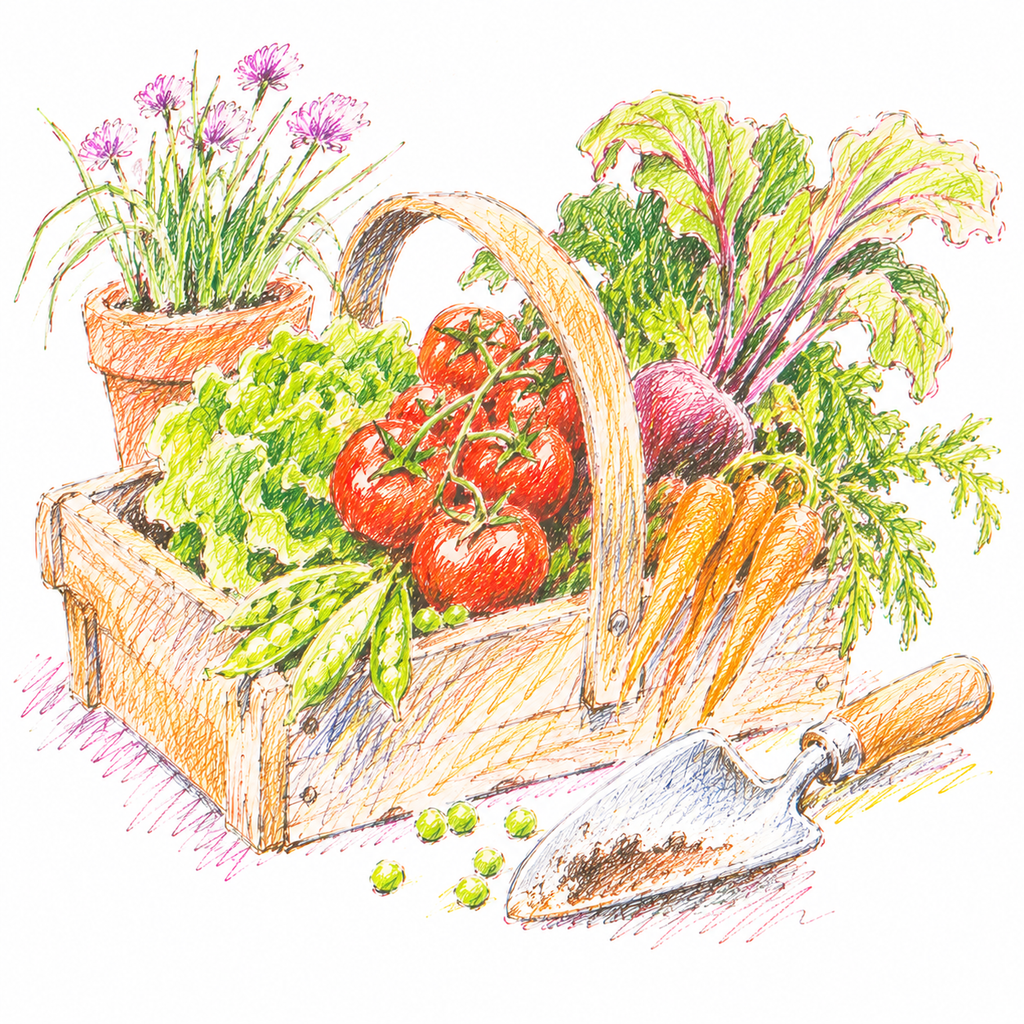
Eat the Orange Rainbow: Sow It, Grow It and Feast on Colour

There is something wonderfully cheerful about orange food.

A basket of freshly lifted carrots, their roots still carrying a little garden soil. A cluster of golden tomatoes ripening in the greenhouse. A pumpkin sitting proudly among the fading leaves of autumn, or great wedges of butternut squash roasting in the oven with garlic and rosemary.

Orange is not a colour that slips quietly into the background.

It brings warmth to the vegetable garden, colour to the kitchen and a welcome brightness to our plates, particularly as the days begin to shorten.

And there is more to these beautiful fruits and vegetables than their appearance.

Many contain naturally occurring plant pigments called carotenoids, including beta-carotene, which our bodies can convert into vitamin A.

But before we start declaring carrots miraculous, pumpkins medicinal and sweet potatoes the answer to every imaginable health concern, there is something worth remembering.
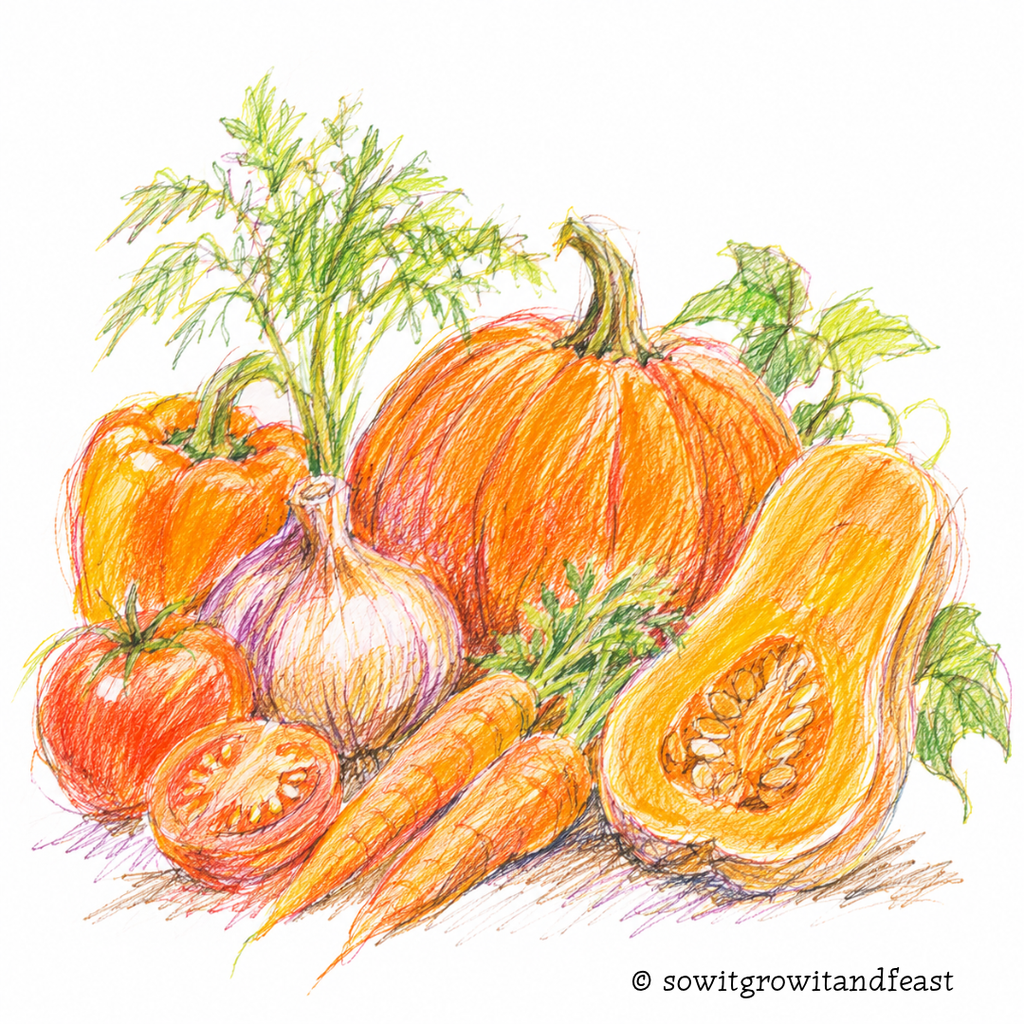
Colourful Sketch of all things Orange from the garden

No single fruit or vegetable can provide everything we need.

Different plants contain different combinations of vitamins, minerals, fibre and other naturally occurring compounds. Eating a variety of them is far more useful than searching for one supposed superfood.

And for those of us who enjoy growing our own food, there is an additional pleasure.

We can choose what goes on our plates long before it reaches the kitchen.

We can sow it, grow it, harvest it and enjoy it at its freshest.

So, from familiar carrots to rather more ambitious apricots, let’s explore the orange fruits and vegetables worth making room for in the British garden.

Why Are Some Fruits and Vegetables Orange?

Much of the orange colouring found in fruits and vegetables comes from a group of natural pigments known as carotenoids.

These pigments help plants capture and manage light and contribute to the colours of many flowers, fruits and roots.

One of the best-known carotenoids is beta-carotene.

It is found in foods including carrots, sweet potatoes, pumpkins and many winter squashes.

The body can convert beta-carotene into vitamin A, which contributes to normal vision, immune function and the maintenance of healthy skin.

Other carotenoids include alpha-carotene, lutein, zeaxanthin and beta-cryptoxanthin.

Different plants contain different combinations of these compounds.

Not every orange food is particularly rich in beta-carotene, however, and colour alone is not a reliable measure of nutritional value.

Oranges, for example, are especially valued as a source of vitamin C, while the golden-orange colour of turmeric comes largely from curcuminoid pigments rather than carotenoids.

This is one reason variety matters.

A colourful plate is not a guarantee of perfect nutrition, but including a wide range of vegetables and fruits is a sensible and enjoyable approach to eating well.

And growing them is considerably more interesting than simply reading their nutritional labels.

Carrots – Daucus carota subsp. sativus

<italic>The dependable favourite of the kitchen garden.</italic>

Carrots seem the obvious place to begin.

They are so closely associated with orange that it is easy to forget they also come in purple, yellow, red and white.

The familiar orange carrot is particularly rich in beta-carotene and also provides dietary fibre.

It is one of the most versatile crops we can grow, equally at home in summer salads, winter stews and Sunday roasts.

And there is a particular satisfaction in pulling a carrot from the soil.

Even when it turns out to have three legs and a rather unfortunate resemblance to a pair of trousers.

Sow It

Carrots are best sown directly into their final growing position because their developing taproots do not respond well to disturbance.

Begin sowing suitable varieties in spring, once the soil is workable, and continue with smaller sowings into summer.

Sow thinly in shallow drills, approximately 1cm deep.

Choose an open, sunny position with reasonably fine, stone-free soil.

If your garden has heavy clay or particularly stony ground, shorter-rooted varieties may be more successful.

Carrots can also grow well in deep containers.

Grow It

Keep the soil consistently moist during germination.

Once established, water during prolonged dry spells rather than little and often.

Carrot root fly is one of the main problems affecting British crops.

The female flies lay eggs near the plants, and the larvae tunnel into the roots.

Fine insect-proof mesh, fitted securely before the flies become active, is one of the most reliable forms of protection.

Avoid unnecessary thinning where possible, and remove unwanted seedlings carefully.

Feast

Carrots are delicious raw, steamed, roasted or added to soups.

Try roasting them with olive oil, thyme and a little honey until their edges begin to caramelise.

Young carrot tops can also be eaten when healthy and properly washed.

Their flavour is quite strong, but a small handful can make an interesting addition to pesto or herb sauces.

Not everything green and leafy needs to go straight onto the compost heap.

Pumpkins – Cucurbita Species

<italic>The glorious giants of the autumn harvest.</italic>

Few crops capture the changing seasons quite like pumpkins.

Their broad leaves and wandering stems dominate the summer vegetable garden, while their colourful fruits seem to announce the arrival of autumn.

Although we commonly call pumpkins vegetables, botanically they are fruits.

The name pumpkin is used for several species within the genus Cucurbita, including Cucurbita pepo and Cucurbita maxima.

Many culinary varieties have richly coloured orange flesh containing carotenoids, including beta-carotene.

But pumpkins are not all alike.

Some are grown primarily for carving, while others are selected for their sweet, dense flesh.

For cooking, choose a variety recommended for its eating qualities.

Sow It

Sow pumpkin seeds indoors during late April or early May.

Use individual pots filled with peat-free seed compost and keep them somewhere warm.

Plant outside once the risk of frost has passed, usually towards the end of May or in early June, depending on local conditions.

Grow It

Pumpkins need fertile soil, sunshine and plenty of space.

A vigorous trailing variety can travel several metres across the garden.

Give plants consistent moisture during dry weather, particularly while fruits are developing.

Mulching can help conserve soil moisture.

Allow fruits to mature fully before harvesting, and lift them before damaging frosts arrive.

Suitable mature varieties can be cured and stored for several months, although keeping qualities vary.

Feast

Roast pumpkin with garlic, rosemary and olive oil.

Blend it into warming soups, add it to curries or stir roasted pieces through risotto.

The seeds of known edible varieties can also be cleaned and roasted.

And if you grow a particularly enormous pumpkin, remember that you do not have to turn the entire thing into soup.

Your freezer may have other plans.

Butternut Squash – Cucurbita moschata

<italic>A little stored sunshine for the winter kitchen.</italic>

Butternut squash is one of those vegetables that seems perfectly designed for autumn.

Its pale skin conceals rich golden-orange flesh, which becomes beautifully sweet when roasted.

It contains carotenoids, including beta-carotene, alongside fibre and other nutrients.

One of its greatest advantages is its keeping quality.

A properly matured and cured butternut can remain useful long after the summer vegetable garden has finished producing.

Sow It

Start seeds indoors in late April or early May.

Butternut squashes need a relatively long, warm growing season, so choose early-maturing varieties suited to British conditions.

Grow It

Plant into fertile, well-drained soil in a sunny, sheltered position.

Water consistently during dry spells.

Butternut plants can be vigorous, so allow plenty of growing space.

Some smaller-fruited varieties can be trained over sturdy supports, although developing fruits may need additional support.

In cooler parts of Britain, a sheltered microclimate or growing under cover can improve the chances of a successful harvest.

Feast

Cut butternut squash into wedges and roast with thyme and garlic.

Add it to soups, curries, pasta dishes and risottos.

It is also delicious mashed with butter and black pepper.

Roasted squash can be refrigerated promptly and used over the following few days, or frozen for longer storage.

A little preparation can turn one squash into several very different meals.

Orange Tomatoes – Solanum lycopersicum

<italic>Summer sunshine in a single bite.</italic>

Tomatoes are not always red.

There are yellow, green, purple, dark-skinned and beautifully orange varieties, each offering different flavours and textures.

Orange tomatoes contain various carotenoids, although their precise composition depends on the variety.

Some orange varieties contain relatively high amounts of beta-carotene, while others have different pigment profiles.

They also provide nutrients including vitamin C and potassium.

But the greatest pleasure of growing unusual tomatoes is discovering their flavour.

Some are sweet and delicate.

Others are rich, tangy and wonderfully aromatic.

And a bowl containing several different colours is one of the loveliest sights on a summer kitchen table.

Sow It

Sow tomato seeds indoors from late winter into early spring, depending on whether they will be grown in a greenhouse or outdoors.

For many British gardeners, March is a practical month to begin.

Provide warmth for germination and plenty of light once seedlings appear.

Grow It

Choose varieties suited to your growing conditions.

Some tomatoes perform best under glass, while others can crop successfully outdoors in sunny, sheltered positions.

Water consistently and use a suitable tomato feed once fruits begin developing.

Tall cordon varieties need supporting and usually require regular removal of sideshoots.

Bush varieties generally need less pruning.

Feast

Combine orange tomatoes with red and yellow varieties.

Add torn basil, a little olive oil and freshly ground black pepper.

Serve with good bread.

Sometimes the simplest summer lunch is also the best.

If you have a glut, roast the tomatoes or turn them into sauce for freezing.

Orange Sweet Peppers – Capsicum annuum

<italic>Sweet, crisp and wonderfully colourful.</italic>

Sweet peppers are among the most attractive crops to grow under glass.

Their fruits often begin green before ripening to red, yellow, orange or another colour, depending on the variety.

Orange peppers are a useful source of vitamin C and contain a range of plant pigments.

They are also wonderfully versatile in the kitchen.

Raw, they are crisp and refreshing.

Roasted, they become soft, sweet and richly flavoured.

Sow It

Peppers need a long growing season, so begin sowing indoors during late winter or early spring.

Germination is most reliable with warmth, often around 21–25°C.

Grow It

In Britain, peppers generally perform best in a greenhouse, polytunnel or another warm, sheltered position.

They can also be grown in large pots.

Provide consistent watering and suitable feeding during fruit development.

Be patient as the fruits ripen.

A pepper that remains green for weeks may suddenly begin changing colour once conditions are favourable.

Feast

Slice orange peppers into salads or add them to stir-fries.

Roast them until their skins blister, then peel and serve with olive oil and herbs.

They are also delicious stuffed with rice, vegetables and cheese.

Roasted peppers can be frozen for later use.

Orange Chillies – Capsicum Species

<italic>A little warmth, and occasionally rather more than expected.</italic>

Chillies belong to the same genus as sweet peppers.

They come in an extraordinary variety of shapes, colours and levels of heat.

Orange-fruited varieties can be particularly attractive, especially when grown in pots.

Their heat comes from compounds known as capsaicinoids, particularly capsaicin.

The orange colouring comes from pigments that develop as the fruits mature.

Sow It

Chillies generally benefit from early sowing because they need a long, warm growing season.

Some varieties germinate quickly, while others require more patience and higher temperatures.

Follow the guidance supplied with your chosen seed.

Grow It

Grow chillies somewhere warm and bright.

A greenhouse or sunny windowsill can be particularly useful.

Many varieties perform well in containers.

Water according to the needs of the plant and growing conditions, avoiding prolonged waterlogging.

With sufficient warmth and light, plants may continue producing fruits well into autumn.

Feast

Use fresh chillies in curries, stir-fries and sauces.

Freeze surplus fruits or dry suitable varieties using safe food-preservation methods.

If you are experimenting with a new variety, taste a very small amount first.

Some chillies are considerably more enthusiastic than their appearance suggests.

Sweet Potatoes – Ipomoea batatas

<italic>An adventurous crop for the warmer corners of the garden.</italic>

Despite their name, sweet potatoes are not closely related to ordinary potatoes.

They belong to the bindweed family, Convolvulaceae.

Orange-fleshed varieties are often rich in beta-carotene and also provide fibre and potassium.

They are an interesting crop for British gardeners, although they require considerably more warmth than ordinary potatoes.

Sow It

Sweet potatoes are usually grown from young rooted shoots known as slips rather than from botanical seed.

Purchase slips from a reputable supplier, ideally varieties selected for growing in cooler climates.

Grow It

Sweet potatoes need a long, warm growing season.

In Britain, a greenhouse, polytunnel or particularly sheltered position can improve results.

They can also be grown in large containers.

Plant only when conditions are sufficiently warm and the risk of frost has passed.

The plants produce attractive trailing growth, but a successful crop of tuberous roots depends on adequate warmth and time.

Feast

Bake sweet potatoes whole, roast them as wedges or mash them with herbs.

They are excellent in soups and curries.

Their natural sweetness also works well with warming spices.

Apricots – Prunus armeniaca

<italic>A little orchard luxury.</italic>

A properly ripe apricot is a wonderful thing.

Soft, fragrant and beautifully coloured, it is quite different from the firm fruits often sold before they have fully ripened.

Apricots contain carotenoids, fibre and potassium, alongside other nutrients.

They are not the easiest fruit to grow in Britain, but in the right position they can be remarkably rewarding.

Grow It

Apricots prefer warmth and shelter.

A sunny south-facing wall can provide a favourable microclimate.

Fan-trained trees are particularly useful where space is limited.

The main difficulty is their early flowering.

Blossom can be damaged by late frosts, reducing the harvest.

Flowers may need temporary protection during cold weather, while ensuring pollinating insects can still reach them when conditions are suitable.

Feast

Eat ripe apricots fresh whenever possible.

They are also delicious baked, poached or turned into compote.

A generous harvest can be made into jam using a reliable recipe.

Peaches – Prunus persica

<italic>The taste of a warm summer afternoon.</italic>

Peaches are another fruit that can be grown successfully in Britain with suitable care.

Their flesh contains water, fibre, vitamin C and various plant compounds, including carotenoids.

Some varieties have golden-orange flesh, while others are pale or white.

For gardeners with a sunny wall or greenhouse, peaches can be a particularly rewarding choice.

Grow It

Peaches appreciate a warm, sheltered position.

Training a tree against a south-facing wall can help encourage ripening.

They flower early, so blossom may need protection from frost.

Peach leaf curl is a common fungal disease in Britain.

Protecting trees from winter and early-spring rainfall, particularly while buds are developing, can help reduce infection.

Growing under cover can therefore be useful.

Feast

A perfectly ripe peach needs very little attention.

Eat it fresh, preferably somewhere that doesn’t mind a little juice.

Peaches are also delicious grilled, poached or added to summer salads.

Oranges and Mandarins – Citrus Species and Hybrids

<italic>A touch of the Mediterranean, even in a British garden.</italic>

Oranges and mandarins are perhaps the most familiar orange fruits of all.

They are particularly associated with vitamin C and also provide fibre and other plant compounds.

Although citrus trees are not generally suitable for year-round outdoor growing in most British gardens, they can be grown successfully in containers with appropriate winter protection.

Grow It

Citrus trees need plenty of light and suitable temperatures.

Many can spend the warmer months outdoors in a sunny, sheltered position.

During winter, they usually require bright, frost-free accommodation, although exact temperature requirements vary by type.

Good drainage is essential.

Use a suitable citrus growing medium and feed according to the plant’s seasonal needs.

Home-grown citrus may not produce enormous quantities of fruit.

But watching a small green fruit gradually swell and change colour is an extraordinary pleasure.

Feast

Enjoy oranges and mandarins fresh.

Add segments to salads or use their juice in dressings and puddings.

The zest is wonderfully aromatic and useful in baking.

Wash fruit thoroughly before using the peel, and choose fruit suitable for zesting.

Orange-Fleshed Melons – Cucumis melo

<italic>A summer treat for gardeners with warmth to spare.</italic>

Orange-fleshed melons are sweet, fragrant and full of summer flavour.

They contain a high proportion of water alongside vitamin C and carotenoids.

They are not the easiest crop for the average British summer, but gardeners with greenhouses or polytunnels may find them worth trying.

Sow It

Sow melon seeds indoors during spring.

Provide warmth for germination and avoid planting outside until conditions are suitable.

Grow It

Melons need warmth, sunshine and a long growing season.

They generally perform best under cover in Britain.

Provide consistent moisture while plants are actively growing, but avoid waterlogged conditions.

Pollination may require attention where insect access is limited.

Some varieties benefit from training and careful fruit management.

Feast

A ripe melon is best enjoyed simply.

Chill it, slice it and serve.

There is little need to improve on something that already tastes of summer.

Turmeric and Ginger: Colour, Flavour and a Little Botanical Curiosity

Turmeric and ginger often appear alongside orange foods, although they are rather different from the fruits and vegetables already discussed.

Both belong to the ginger family, Zingiberaceae.

Their edible parts are rhizomes, which are modified underground stems.

Turmeric – Curcuma longa

Turmeric is valued for its vivid yellow-orange colour and earthy flavour.

Its colouring comes primarily from curcuminoids, including curcumin.

It is widely used in curries, rice dishes and spice blends.

Ginger – Zingiber officinale

Ginger is prized for its warm, aromatic flavour.

Its characteristic pungency comes from compounds including gingerols and related substances.

Unlike turmeric, ginger is not necessarily orange, and it does not belong among carotenoid-rich orange foods simply because the two plants are related.

Can You Grow Them in Britain?

Both require warmth and a long growing season.

They can be grown experimentally in containers in a warm greenhouse or conservatory.

Start with healthy rhizomes suitable for cultivation.

Keep plants warm and provide consistent moisture without waterlogging.

In Britain, producing substantial rhizomes can be challenging, but the plants themselves are fascinating to grow.

A Word About Health Claims

Turmeric and ginger have been used in cooking and traditional practices for centuries.

Researchers have investigated compounds found in both plants, but this does not mean ordinary culinary quantities can cure inflammation, detoxify the body or treat medical conditions.

They are best enjoyed as flavourful ingredients within a varied diet.

And they are very good at that.

Planning Your Own Orange Kitchen Garden

You do not need an enormous allotment to grow an interesting collection of orange crops.

The best approach is to choose plants suited to your available space and growing conditions.

For a small garden, carrots and orange tomatoes make an excellent starting point.

If you have a greenhouse, add an orange sweet pepper or chilli plant.

Where space allows, a pumpkin or butternut squash can provide a generous autumn harvest.

And if you enjoy a challenge, there are always apricots, peaches or sweet potatoes to experiment with.

A Simple Orange Growing Calendar for the UK

SeasonWhat to sow, grow or harvest
Late winterSow peppers, chillies and suitable early tomatoes indoors
SpringSow carrots; start pumpkins, squash and melons under cover
Late springPlant out tender crops after frost risk has passed
SummerHarvest carrots, tomatoes, peppers and early fruits as they ripen
Early autumnHarvest mature pumpkins, squash and sweet potatoes
Autumn and winterEnjoy stored squash, frozen summer produce and preserved harvests

Exact timings will vary with the weather, variety and growing conditions.

The beauty of gardening is that no two seasons are ever quite the same.

What to Do with an Orange Harvest

Late summer and autumn can bring an impressive amount of colour into the kitchen.

A few carrots are easily used.

A basket of tomatoes presents no great difficulty.

But when the pumpkins are ready, the peppers are ripening and the freezer is already full of courgettes, a little planning becomes useful.

Roast and Freeze

Peppers can be roasted and frozen for later use.

Tomatoes can be cooked into sauces and frozen in convenient portions.

Cooked pumpkin and squash can also be frozen for soups, stews and other dishes.

Store Suitable Crops

Many mature winter squashes can be cured and stored under appropriate conditions.

Some carrot varieties can be stored successfully, although methods and keeping qualities vary.

Only store healthy, undamaged produce.

Make Preserves

Apricots and peaches can be turned into jams and compotes using reliable recipes.

Chillies can be frozen or dried appropriately.

Preserving is a lovely way to extend the enjoyment of a harvest, but safe methods matter.

Follow tested recipes when making shelf-stable preserves.

Enjoy the Fresh Harvest

Perhaps most importantly, eat plenty of what you grow while it is fresh.

There is little point in spending months tending a vegetable garden only to become so determined to preserve everything that you forget to enjoy the harvest itself.

Some things are best eaten now.

A ripe peach.

A handful of cherry tomatoes.

A freshly lifted carrot, washed and eaten while still crisp.

These are the moments that make growing food worthwhile.

Three Simple Ways to Feast on Orange

Roasted Orange Vegetables with Rosemary

A lovely autumn dish that makes use of several orange crops at once.

Ingredients

  • 3 carrots
  • 400g butternut squash
  • 1 orange sweet pepper
  • 2 tablespoons olive oil
  • 2 garlic cloves
  • 2 sprigs fresh rosemary
  • Salt and black pepper

Method

Preheat the oven to 200°C, or 180°C fan.

Peel the squash if necessary and remove the seeds.

Cut the vegetables into reasonably even pieces, making the carrots slightly smaller if they are particularly firm.

Toss with olive oil, garlic, rosemary and seasoning.

Spread on a roasting tray.

Roast for approximately 30–40 minutes, turning occasionally, until the vegetables are tender and lightly caramelised.

Serve with roast chicken, lentils or a simple grain salad.

Golden Tomato and Orange Pepper Sauce

A colourful sauce for pasta, vegetables or homemade pizza.

Ingredients

  • 500g ripe orange tomatoes
  • 2 orange sweet peppers
  • 1 onion
  • 2 garlic cloves
  • 2 tablespoons olive oil
  • A handful of fresh basil
  • Salt and black pepper

Method

Chop the tomatoes, peppers and onion.

Heat the olive oil in a saucepan and gently soften the onion.

Add the garlic and cook briefly.

Stir in the peppers and tomatoes.

Simmer for approximately 25–30 minutes, until the vegetables are soft and the sauce has thickened.

Add torn basil and season to taste.

Blend if you prefer a smooth sauce.

Serve immediately or cool promptly and freeze in suitable portions.

Carrot, Ginger and Orange Soup

A bright, warming soup for colder days.

Ingredients

  • 600g carrots
  • 1 onion
  • 1 tablespoon grated fresh ginger
  • 1 tablespoon olive oil
  • 750ml vegetable stock
  • Juice of half an orange
  • Black pepper

Method

Heat the olive oil in a saucepan.

Add the chopped onion and cook gently until softened.

Stir in the ginger.

Add the chopped carrots and vegetable stock.

Simmer for approximately 20–25 minutes, until the carrots are tender.

Blend until smooth.

Stir in the orange juice and season to taste.

Serve with crusty bread.

The orange juice adds a lovely freshness without overwhelming the carrots.

Eat the Rainbow, But Grow It Too

There is a great deal of nutritional advice telling us to eat more colourful fruit and vegetables.

And there is good reason behind it.

Different plants provide different combinations of fibre, vitamins, minerals and naturally occurring compounds.

Eating a varied selection helps us enjoy a broader range of nutrients.

But orange food does not need to be surrounded by extraordinary promises.

Carrots do not need to transform our eyesight.

Pumpkins do not need to cure our ailments.

And a bowl of butternut squash soup does not need to detoxify anything.

It can simply be a delicious bowl of soup.

For those of us who grow our own food, there is something more meaningful to enjoy.

The first carrot seedlings emerging in spring.

The scent of tomato leaves in a warm greenhouse.

The quiet satisfaction of watching a pepper change colour.

The enormous leaves of a pumpkin plant spreading across the soil, and the moment you discover a beautiful orange fruit growing beneath them.

These are pleasures that begin long before the food reaches our plates.

They connect us with the seasons, encourage us to try unfamiliar varieties and remind us how much enjoyment can come from something as ordinary as a vegetable.

And when the harvest finally arrives, we get to enjoy the best part.

Cooking it, sharing it and sitting down to eat something we have grown ourselves.

Because the real joy of orange food is not the promise of miraculous health benefits. It is the colour in the garden, the flavour in the kitchen and the satisfaction of knowing exactly where your next meal began.

Sow it. Grow it. And feast on it.

Further Reading: Why You Should Eat More Purple, Why Eating Green Is Good For You, Eat the Rainbow: The Power of Red, Grow Your Own: Best Fruits for Your Garden, The Importance of Growing Your Own Food

Follow us on Instagram, Threads, BlueSky, Twitter, Pinterest & Facebook

Not sure where to start? Take a look at our Grow Your Own Packs with detailed step by step instructions, seeds and 1 years online support.

Growing Onions: From a Humble Bulb to a Harvest Worth Keeping

There are few vegetables quite as unassuming as the onion.

It rarely takes centre stage in the vegetable garden. It has none of the flamboyance of a pumpkin, the colour of a ripe tomato or the enthusiasm of a courgette plant determined to occupy every available inch of soil.

And yet, where would our kitchens be without it?

The onion is the quiet beginning of countless meals. It is the gentle sizzle in a saucepan, the sweetness beneath a savoury tart and the rich, comforting flavour of a soup left to simmer on a cold afternoon.

Growing your own onions brings an entirely different appreciation for this everyday ingredient.

There is something wonderfully satisfying about planting a handful of small bulbs in spring, watching their slender green shoots emerge and, several months later, lifting a crop of beautifully rounded onions from the soil.

Some will be eaten fresh, while others will be dried and stored, ready to bring a little of the summer garden into the winter kitchen.

And the best part? Onions are relatively straightforward to grow, even if you are new to vegetable gardening.

They ask for sunshine, reasonably fertile soil, a little patience and, perhaps most importantly, a gardener willing to keep the weeds at bay.

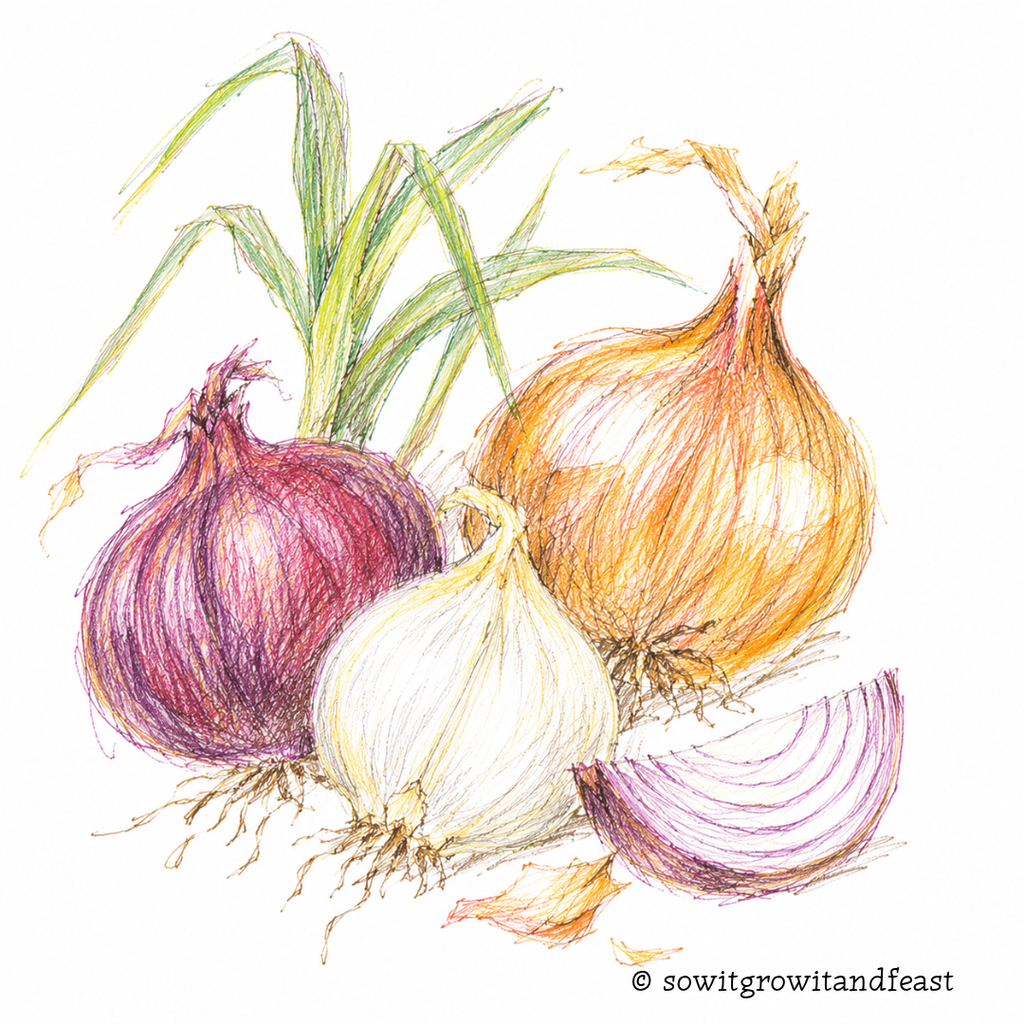
Onion Colourful Sketch

The Remarkable History of the Humble Onion

The common onion, Allium cepa, has been cultivated for thousands of years.

It belongs to the amaryllis family, Amaryllidaceae, alongside garlic, leeks, shallots and chives.

Its exact wild origins remain uncertain, although Central and western Asia are generally considered important regions in its early history.

Unlike some vegetables, whose wild ancestors can still be readily identified, the cultivated onion has a particularly complicated botanical past.

What we do know is that onions were valued by ancient civilisations long before they became familiar inhabitants of British kitchen gardens.

Onions in Ancient Egypt

Onions were cultivated and eaten in ancient Egypt, where they also carried symbolic significance.

Their rounded shape and concentric layers have often been associated with ideas of continuity and eternity.

Onions appear in ancient Egyptian art and archaeological contexts, demonstrating their importance beyond the everyday kitchen.

They were practical crops too.

Onions could be transported, stored and used to flavour otherwise simple meals.

For communities without modern refrigeration, vegetables capable of keeping for extended periods were particularly valuable.

From Ancient Fields to British Kitchen Gardens

Over centuries, onions spread through trade, migration and cultivation.

They became established across Europe and were an important part of medieval cooking.

In Britain, onions were grown in kitchen gardens and agricultural plots, providing flavour and nourishment throughout the year.

Their ability to store made them particularly useful during winter, when fresh vegetables were less readily available.

Today, onions remain one of the most widely used vegetables in British cooking.

From a traditional Sunday roast to a simple cheese and onion sandwich, they have become so familiar that we rarely stop to consider their remarkable history.

Perhaps that is the onion’s greatest achievement.

It has made itself indispensable without ever making much of a fuss.

What Exactly Is an Onion?

The common onion, Allium cepa, is a bulb-forming plant usually grown as an annual crop in the vegetable garden.

Botanically, it is a biennial.

During its first growing season, the plant develops leaves and stores energy in an underground bulb.

If allowed to continue into a second season under suitable conditions, it may produce a flowering stem and seeds.

For eating, we generally harvest onions at the end of their first growing season.

The familiar onion bulb is made up of fleshy, overlapping leaf bases that store water and nutrients.

These layers are enclosed within protective outer skins, which become dry and papery as the bulb matures.

Onions are available in an extraordinary range of colours, sizes and flavours.

Some are sharp and pungent when raw.

Others are mild enough to enjoy in salads.

And almost all develop a wonderful sweetness when cooked slowly.

Choosing the Best Onions to Grow in the UK

One of the pleasures of growing your own onions is discovering the differences between varieties.

Supermarket shelves tend to offer a fairly predictable selection, but seed catalogues reveal a much wider world.

There are golden onions for everyday cooking, richly coloured red varieties, delicate white onions and small pickling onions.

Some are particularly good for storing.

Others are best enjoyed fresh.

Before choosing your varieties, consider how you intend to use the harvest and how much storage space you have available.

Yellow and Brown Onions: The Kitchen All-Rounders

Yellow and brown onions are the familiar workhorses of the British kitchen.

Their flavour can be strong when raw, but cooking transforms their natural sugars into something mellow, rich and wonderfully savoury.

They are ideal for soups, stews, casseroles, roasting and caramelising.

‘Sturon’

A reliable maincrop onion producing rounded bulbs with golden-brown skins.

‘Sturon’ is widely grown in Britain and valued for its good storage potential.

It is an excellent choice for gardeners wanting a dependable crop for everyday cooking.

‘Setton’

A popular variety related to ‘Sturon’, producing firm, rounded bulbs with attractive golden skins.

It is valued for its uniformity, good yields and storage qualities.

It also has useful resistance to bolting under suitable growing conditions.

‘Stuttgarter Riesen’

Often sold as ‘Stuttgart Giant’, this traditional variety produces somewhat flattened, golden-brown bulbs.

It is a well-established choice for home gardeners and has good culinary versatility.

The flavour is suitable for both raw and cooked dishes, depending on maturity and growing conditions.

Red Onions: Colour and Flavour

Red onions are among the most attractive crops in the vegetable garden.

Their skins range from deep burgundy to purple-red, while their flesh often contains beautiful rings of white and crimson.

They are particularly lovely sliced into salads, added to sandwiches or made into pickles.

Although red onions are often described as sweeter than brown varieties, flavour varies considerably between cultivars and growing conditions.

‘Red Baron’

One of the best-known red onions for British gardens.

It produces rounded bulbs with deep red skins and attractively coloured flesh.

‘Red Baron’ is valued for its flavour and relatively good storage potential.

It is a useful choice for both salads and cooking.

‘Electric’

An attractive red onion commonly sold as an autumn-planting variety.

It produces flattened to rounded bulbs with vivid reddish skins.

It is particularly useful for an earlier harvest, although it is generally best used sooner than long-keeping maincrop onions.

White Onions: Delicate Colour, Distinctive Flavour

White onions are less commonly grown in British vegetable gardens, but they are well worth considering.

Their pale skins and white flesh make them particularly attractive.

Flavour varies between varieties, with some pleasantly mild and others noticeably pungent.

They can be used raw, roasted or cooked into sauces and savoury dishes.

‘Snowball’

A white onion producing attractive, pale-skinned bulbs.

It is particularly suitable for fresh use and everyday cooking.

White onions of this type are generally less suited to very long storage than the best brown-skinned maincrop varieties.

Growing Onions from Seeds or Sets

There are two main ways to grow onions in the British vegetable garden.

You can start with seeds or plant small immature bulbs known as onion sets.

Both methods have advantages.

Growing Onions from Sets

Onion sets are small bulbs produced during a previous growing season and prepared for replanting.

They are popular because they are easy to handle and establish quickly.

For beginners, sets are often the simplest approach.

They require less time and attention than raising onions from seed.

However, sets can sometimes be more prone to bolting, particularly if they experience unsuitable temperature conditions.

Choosing heat-treated sets where available can help reduce this risk.

Growing Onions from Seed

Growing from seed offers a wider choice of varieties and can be more economical when producing large quantities.

It also avoids some of the bolting problems associated with sets.

However, onions grown from seed require a longer growing period and more careful management during their early stages.

Many gardeners begin sowing indoors during late winter, then plant out young seedlings in spring.

For a first attempt, onion sets are a perfectly sensible place to begin.

Once you have enjoyed a successful harvest, experimenting with seeds can be an interesting next step.

When to Plant Onions in the UK

The planting season depends on the variety.

Some onions are specifically bred for autumn planting, while others are planted in spring.

It is important to choose the correct type.

Autumn-Planting Onions

Suitable hardy varieties can be planted during September and October, depending on local conditions.

These establish roots before winter and resume growth as temperatures rise.

They are generally harvested earlier than spring-planted maincrop onions, often during late spring or early summer.

Varieties worth considering include ‘Radar’ and ‘Electric’.

Autumn planting can be particularly useful for spreading the harvest across the growing season.

However, autumn-planted onions are not always the best choice for long-term storage.

They can also struggle in persistently waterlogged soil.

Spring-Planting Onions

Most maincrop onion sets are planted during March and April, once the soil is workable.

In colder regions or during particularly wet springs, planting may need to be delayed.

Spring-planted onions generally mature during late summer.

Many suitable maincrop varieties can then be dried and stored for several months.

For gardeners hoping to fill the winter pantry, spring-planted storage onions are especially valuable.

Where to Grow Onions

Onions prefer an open, sunny position.

Choose a growing area that receives plenty of direct sunlight throughout the day.

Good drainage is essential.

Onions dislike sitting in waterlogged soil, particularly during cold weather.

They grow best in fertile, well-structured ground that retains some moisture without becoming saturated.

A soil pH of approximately 6–7 is generally suitable.

Preparing the Soil

Before planting, remove weeds and loosen the soil.

Incorporate well-rotted garden compost where necessary to improve soil structure.

Avoid adding fresh manure immediately before planting.

Onions do not usually require excessively rich soil, and too much nitrogen can encourage soft growth that stores poorly.

If your soil is already reasonably fertile, additional fertiliser may not be necessary.

A soil test can help determine whether particular nutrients are needed.

The aim is steady, healthy growth rather than enormous quantities of foliage.

How to Plant Onion Sets

Planting onion sets is one of the simpler jobs in the vegetable garden.

There is something pleasantly orderly about arranging the little bulbs in neat rows.

At least, until the local blackbirds decide to investigate.

Step 1: Choose Healthy Sets

Select firm, healthy onion sets from a reputable supplier.

Avoid bulbs that are soft, mouldy or badly damaged.

Choose varieties suited to your intended planting season.

Step 2: Prepare the Growing Area

Rake the soil to create a reasonably fine, level surface.

Remove stones and weeds.

If you prefer neat rows, use a garden line to mark your planting positions.

Straight rows are not essential, but they can make weeding considerably easier.

Step 3: Space the Sets

Place onion sets approximately 10–15cm apart.

Allow around 25–30cm between rows.

This provides room for the bulbs to develop.

For smaller onions or pickling varieties, closer spacing may be appropriate.

Step 4: Plant at the Correct Depth

Plant each set with its pointed end facing upwards.

Position it so the tip is just visible at the soil surface or only lightly covered.

Avoid leaving most of the bulb exposed.

In loose soil, sets can be gently pressed into place.

In firmer ground, use a dibber or small trowel to make a planting hole.

Step 5: Protect Newly Planted Sets

Birds sometimes pull newly planted sets from the ground.

They are not necessarily eating them; the small bulbs may simply attract their curiosity.

Temporary horticultural fleece or securely fitted netting can help until the roots establish.

If using netting, ensure it is properly tensioned and checked regularly so wildlife cannot become trapped.

Water after planting if the soil is dry.

Otherwise, natural rainfall may be sufficient.

Growing Onions in Containers

Onions can also be grown successfully in containers.

This makes them useful for smaller gardens, patios and other spaces where a traditional vegetable bed is unavailable.

Choose a container at least 20–25cm deep with adequate drainage holes.

Use a good-quality peat-free growing medium suitable for vegetables.

Plant the sets approximately 10cm apart, allowing enough space for the bulbs to swell.

Position the container somewhere sunny.

Container-grown onions may need more frequent watering than those established in garden soil.

However, avoid allowing the compost to remain waterlogged.

Smaller onion varieties and spring onions are particularly suitable for container growing.

Caring for Onions Through the Growing Season

Once established, onions are relatively undemanding.

Their greatest needs are sunshine, moisture during active growth and freedom from competing weeds.

Watering

Onions require adequate moisture while their leaves are growing and bulbs are developing.

During prolonged dry spells, water thoroughly.

Avoid allowing the soil to become repeatedly saturated.

As the crop approaches maturity and the foliage begins to yellow and fall naturally, reduce watering.

This helps the bulbs complete their development and prepares them for drying.

There is no need to water regularly when rainfall is already providing sufficient moisture.

Weeding

If there is one task that deserves particular attention when growing onions, it is weeding.

Onions have relatively shallow root systems and narrow leaves.

Unlike courgettes or pumpkins, they do not produce broad foliage that shades out competing plants.

Weeds can quickly compete for water, nutrients and light.

Remove them regularly while they are small.

Hoe carefully and shallowly, avoiding damage to the bulbs and roots.

Hand weeding may be preferable close to the plants.

Feeding

Onions benefit from fertile soil, but excessive feeding can cause problems.

If the soil was prepared well before planting, additional fertiliser may not be required.

Where growth is poor and nutrient deficiency is suspected, a suitable balanced fertiliser may be applied during early growth according to the manufacturer’s instructions.

Avoid heavy applications of nitrogen later in the season.

Excessive nitrogen can encourage lush foliage, delay maturity and reduce storage quality.

Why Do Onions Bolt?

Bolting occurs when an onion produces a flowering stem before the bulb has developed as intended.

The stem is usually thicker and firmer than the ordinary leaves.

Bolting can be triggered by temperature fluctuations, particularly when plants experience cold conditions followed by warmer weather.

Onion sets may be particularly susceptible.

Once an onion has bolted, the bulb often develops a firm central stem and is less suitable for long-term storage.

What Should You Do?

If an onion begins to bolt, it is generally best to harvest and use it relatively soon.

Removing the flower stalk will not reverse the changes already taking place within the bulb.

For future crops, choose varieties with good resistance to bolting and consider heat-treated sets where available.

Plant at the recommended time and avoid unnecessary growing stress.

Common Onion Pests and Diseases in Britain

Onions are generally reliable crops, but they can suffer from several pests and diseases.

Recognising problems early can help protect the harvest.

Allium White Rot

White rot is one of the most serious diseases affecting onions, garlic, leeks and other alliums.

It is caused by the soil-borne fungus Stromatinia cepivora.

Affected plants may develop yellowing foliage, poor growth and rotting roots.

White fungal growth and small black resting bodies may appear around the base of infected bulbs.

Unfortunately, there is no reliable cure for white rot in ordinary garden soil.

The fungus can survive for many years, sometimes decades.

Remove infected plants and dispose of them carefully.

Do not place infected material in a typical home compost heap.

Avoid growing susceptible alliums in affected soil, and take care not to transfer contaminated soil elsewhere.

A short crop rotation of several years is not sufficient to eliminate white rot.

Onion Fly

Onion fly larvae feed within the roots and bulbs of onions.

Affected plants may wilt, yellow or rot.

Fine insect-proof mesh can help protect crops if installed before adult flies lay their eggs.

Ensure the mesh is securely fitted and does not allow insects to enter around the edges.

Remove badly affected plants.

Allium Rust

Rust produces orange or brownish pustules on the foliage.

It can affect onions, garlic and leeks, although susceptibility varies.

Severe infections can reduce plant vigour.

Good spacing, air circulation and avoiding unnecessary plant stress can help reduce problems.

Downy Mildew

Onion downy mildew is a fungal-like disease that can develop during cool, humid conditions.

Affected leaves may become pale, distorted or develop greyish-purple growth.

Good air circulation and avoiding overcrowding can help.

Remove infected crop debris and avoid growing onions repeatedly in the same position.

Onion Neck Rot

Neck rot is particularly troublesome during storage.

Affected bulbs may develop soft, decaying tissue around the neck.

Proper maturity at harvest, careful handling and thorough drying can help reduce the risk.

Avoid storing damaged or poorly cured onions.

When Are Onions Ready to Harvest?

Onions have a rather charming way of announcing that their growing season is coming to an end.

Their upright green leaves begin to yellow.

The necks soften.

Then, gradually, the foliage bends over and collapses.

This is usually a sign that the bulbs are approaching maturity.

Spring-planted maincrop onions are often ready during August or September, although timing varies according to variety, planting date and weather.

Autumn-planted onions generally mature earlier.

Should You Bend Onion Leaves Over?

Older gardening advice sometimes recommended bending onion foliage over to encourage ripening.

This is generally unnecessary.

The leaves should be allowed to die back naturally.

Forcing them over can damage the neck and may increase the risk of disease or poor storage.

Patience is usually the better approach.

How to Harvest Onions

Choose a dry day if possible.

Use a garden fork to loosen the soil around the bulbs.

Lift them carefully, avoiding bruising or damage.

Do not pull forcefully on the foliage if the bulbs are firmly rooted.

Gently remove loose soil.

Avoid washing onions intended for long-term storage.

If the weather is dry and settled, freshly lifted onions may be left on the soil surface briefly to begin drying.

However, in Britain’s unpredictable late-summer weather, moving them under cover is often the more reliable option.

How to Dry and Cure Onions

Proper drying is essential if you want to store onions for several months.

Freshly harvested bulbs contain moisture in their outer skins and necks.

Curing allows these tissues to dry, helping protect the bulb during storage.

Choose a Dry, Airy Position

Lay onions in a single layer on mesh racks, trays or another suitable surface.

Choose somewhere dry, sheltered and well ventilated.

An airy shed, covered porch or suitable greenhouse can work well.

Avoid excessive heat, condensation and damp conditions.

Ensure air can circulate freely around the bulbs.

Allow Time to Cure

Drying generally takes approximately two to four weeks, depending on the weather and conditions.

The outer skins should become papery.

The necks should feel dry.

The roots should also become brittle.

Do not rush the process.

Bulbs that have not dried properly are more likely to deteriorate during storage.

Prepare for Storage

Once fully cured, gently remove loose soil.

Trim the dry roots.

The foliage can be cut back, leaving a short neck, or retained for plaiting where suitable.

Avoid removing too many protective outer skins.

These help protect the bulbs.

How to Store Home-Grown Onions

There is something deeply satisfying about storing a harvest for winter.

A string of golden onions hanging in a cool pantry is both practical and rather beautiful.

Properly cured storage onions should be kept somewhere cool, dry, dark and well ventilated.

Mesh bags, open baskets, slatted crates and traditional onion strings are all suitable.

Avoid sealed plastic bags, which can trap moisture.

Inspect the bulbs regularly and remove any showing signs of softening, mould or decay.

How Long Will Onions Keep?

Storage life depends on the variety, maturity and conditions.

Some well-cured maincrop onions can keep for several months, potentially into late winter or spring.

Others, particularly many early and salad varieties, are best used much sooner.

Choose varieties specifically recommended for storage if keeping the harvest is a priority.

Should Onions Be Stored with Potatoes?

It is generally better to store onions and potatoes separately.

Both crops need suitable storage conditions, and moisture released by stored produce can affect neighbouring crops.

Separating them also makes inspection easier and reduces the risk of deterioration spreading between stored vegetables.

Are Onions Good for You?

Onions can make a useful contribution to a varied, balanced diet.

They contain dietary fibre and small amounts of vitamins and minerals, including vitamin C and folate.

They also contain naturally occurring plant compounds, including flavonoids such as quercetin.

These compounds have attracted scientific interest because of their antioxidant properties.

However, claims that onions prevent or treat particular illnesses should be approached cautiously.

Research into individual compounds does not necessarily demonstrate that eating ordinary quantities of onions produces the same effects.

The most dependable benefit of onions is their role in making a wide range of nutritious foods more enjoyable.

They add flavour to vegetables, pulses, soups and other everyday dishes without requiring large quantities of salt or rich ingredients.

And when cooked slowly, their natural sweetness can transform even the simplest meal.

Why Do Onions Make Us Cry?

It is one of the more familiar hazards of preparing supper.

You slice into an onion, and within moments your eyes begin to water.

This happens because cutting damages the onion’s cells, allowing enzymes to react with sulphur-containing compounds.

The reactions produce a volatile substance known as syn-propanethial-S-oxide.

When this reaches the eyes, it causes irritation and stimulates tear production.

Some varieties produce more of this substance than others.

Chilling onions before cutting may help reduce the effect, as can using a sharp knife and working in a well-ventilated kitchen.

Although, as most cooks will agree, there are occasions when a particularly determined onion seems impossible to defeat.

Cooking with Home-Grown Onions

The beauty of onions lies in their versatility.

Raw onions can be crisp, sharp and refreshing.

Gently cooked onions become soft and sweet.

Roasted onions develop a deep, savoury richness.

And slowly caramelised onions can transform an ordinary dish into something quite special.

Here are four lovely ways to enjoy your harvest.

French Onion Soup

A classic dish that allows the onion to take centre stage.

Ingredients

  • 750g brown onions, thinly sliced
  • 40g butter
  • 1 tablespoon olive oil
  • 2 garlic cloves, finely chopped
  • 1 litre good-quality beef or vegetable stock
  • 1 teaspoon fresh thyme leaves
  • 100ml dry white wine, optional
  • Salt and black pepper
  • 4 slices crusty bread
  • 100g grated Gruyère or another suitable hard cheese

Method

Melt the butter with the olive oil in a heavy-based saucepan.

Add the sliced onions and cook gently over a low to medium heat for approximately 35–45 minutes, stirring regularly.

The onions should become deeply golden and sweet without burning.

Add the garlic and thyme, cooking for another minute.

Pour in the wine, if using, and allow it to reduce slightly.

Add the stock and simmer gently for approximately twenty minutes.

Season to taste.

Toast the bread and scatter with grated cheese.

Grill until the cheese is melted and bubbling.

Serve the soup with the cheesy toast on top.

It is a wonderfully comforting meal for a chilly evening.

Caramelised Onion and Goat’s Cheese Tart

A simple tart that makes excellent use of sweet, slowly cooked onions.

Ingredients

  • 1 sheet ready-rolled puff pastry
  • 4 medium onions, thinly sliced
  • 2 tablespoons olive oil
  • 1 teaspoon fresh thyme leaves
  • 100g soft goat’s cheese
  • 1 teaspoon balsamic vinegar
  • Black pepper

Method

Preheat the oven to 200°C, or 180°C fan.

Heat the olive oil in a frying pan.

Add the onions and cook gently for approximately 30–40 minutes until soft and golden.

Stir in the thyme and balsamic vinegar.

Place the pastry on a lined baking tray.

Score a border approximately 2cm from the edge, taking care not to cut all the way through.

Spread the onions within the border.

Crumble over the goat’s cheese.

Season with black pepper.

Bake for approximately 20–25 minutes, until the pastry is puffed and golden.

Serve warm with a green salad.

Homemade Onion Bhajis

Crisp, fragrant onion bhajis are a lovely way to enjoy a generous harvest.

Ingredients

  • 3 medium onions, thinly sliced
  • 120g gram flour
  • 1 teaspoon ground cumin
  • 1 teaspoon ground coriander
  • ½ teaspoon turmeric
  • ½ teaspoon chilli powder, optional
  • 1 tablespoon chopped fresh coriander
  • Approximately 100ml water
  • Salt
  • Vegetable oil for frying

Method

Place the sliced onions in a large bowl.

Add the gram flour, spices, fresh coriander and a little salt.

Gradually add water, mixing until the onions are lightly coated in a thick batter.

Heat vegetable oil in a suitable deep pan to approximately 170–180°C.

Carefully lower small spoonfuls of the mixture into the oil.

Fry in batches until golden, crisp and cooked through.

Drain on kitchen paper.

Serve warm with yoghurt, chutney or a fresh herb dip.

Take care when cooking with hot oil and never leave it unattended.

Roasted Onions with Thyme and Balsamic Vinegar

Sometimes the simplest recipes are the most satisfying.

Ingredients

  • 6 medium onions
  • 2 tablespoons olive oil
  • 1 tablespoon balsamic vinegar
  • 3 sprigs fresh thyme
  • Salt and black pepper

Method

Preheat the oven to 200°C, or 180°C fan.

Peel the onions and cut them into halves or quarters, depending on their size.

Place in a roasting dish.

Drizzle with olive oil and balsamic vinegar.

Add the thyme and season lightly.

Roast for approximately 35–45 minutes, turning occasionally, until tender and caramelised.

Serve alongside roast meats, lentils, potatoes or other seasonal vegetables.

Can You Save Onion Seeds?

Yes, although onions are generally grown from sets or commercially produced seed.

Because onions are biennial, they usually flower during their second growing season.

To save seed, suitable healthy bulbs are retained and replanted, allowing them to produce flowering stems.

Onions are pollinated by insects, and different varieties of Allium cepa can cross with one another.

If you want to maintain a particular variety, isolation or controlled pollination may be necessary.

F1 hybrid varieties will not reliably produce offspring identical to the parent plants.

Seed saving can be an interesting project for experienced gardeners, but purchasing fresh seed or sets is often the simpler approach for a reliable crop.

Ten Jobs for a Successful Onion Harvest

  1. Choose the right varieties. Select onions suited to your garden, planting season and intended use.
  2. Decide between seeds and sets. Sets are often easier for beginners, while seeds offer a wider choice.
  3. Plant at the correct time. Autumn and spring varieties have different requirements.
  4. Prepare well-drained soil. Onions dislike persistently wet ground.
  5. Give plants plenty of sunshine. An open, bright position encourages healthy growth.
  6. Keep weeds under control. Onions compete poorly with vigorous neighbouring plants.
  7. Water during dry weather. Consistent moisture supports healthy bulb development.
  8. Avoid excessive feeding. Too much nitrogen can reduce storage quality.
  9. Harvest when the foliage naturally declines. Do not force the leaves over.
  10. Cure and store carefully. Thorough drying and good ventilation help preserve the harvest.

The Quiet Satisfaction of Growing Onions

By late summer, the onion bed has usually lost much of its springtime neatness.

The once-upright leaves are beginning to bend. Their bright green colour fades to yellow, and the rounded shoulders of the bulbs become visible above the soil.

It is not the most spectacular sight in the vegetable garden.

There are no enormous fruits to admire, no brilliant flowers demanding attention and certainly no reason to invite the neighbours round to witness the harvest.

And yet, lifting onions has a quiet pleasure all its own.

Each bulb is the result of months of growth, from a small set planted in cool spring soil to a firm, beautifully layered vegetable ready for the kitchen.

There is satisfaction in laying the harvest out to dry, watching the skins become papery and eventually gathering the bulbs into baskets or traditional strings.

They will sit patiently through autumn and winter, waiting to become part of everyday meals.

A handful chopped into a casserole. A few slowly cooked for soup. One sliced into a sandwich or roasted alongside Sunday lunch.

Perhaps that is what makes onions such a rewarding crop.

They are not grown for one extraordinary meal or a fleeting moment of celebration.

They become part of the ordinary rhythm of the kitchen, quietly adding flavour to the food we prepare day after day.

And there is something rather lovely about knowing that the onion sizzling in the pan on a cold January evening began life in your own garden many months before.

From a small bulb pressed into spring soil to a harvest that flavours the winter kitchen, growing onions is a reminder that some of the garden’s greatest pleasures are also its simplest.

Further Reading: Why Growing Food Makes You Feel Better, Take the Guesswork Out of Growing Veg, How to Create a Garden That Feeds Your Family, How to Start a Vegetable Garden Now Ready for Spring

Follow us on Instagram, Threads, BlueSky, Twitter, Pinterest & Facebook

Not sure where to start? Take a look at our Grow Your Own Packs with detailed step by step instructions, seeds and 1 years online support.

Growing Your Own Food: A Little Independence, a Lot of Satisfaction

There is something wonderfully reassuring about knowing that a little of what you eat has come from your own garden.

Perhaps it is the handful of parsley gathered for supper, the first ripe strawberry of summer or the satisfaction of lifting potatoes from soil you prepared months earlier. These are small moments, easily overlooked, yet they offer something increasingly valuable in a world where so much of our food arrives ready-picked, packaged and transported from somewhere else.

Growing your own food is hardly a new idea. Generations before us understood the value of a productive garden, not simply as a source of fresh vegetables, but as a way of making household resources stretch a little further.

Today, with food prices placing pressure on family budgets, growing concerns about the environment and a renewed interest in living more sustainably, those old-fashioned skills are finding a new audience.

And the lovely thing is that you don’t need an allotment, a greenhouse or even a particularly large garden to begin.

A sunny balcony, a few containers beside the back door or a modest vegetable bed can all provide the beginnings of something worthwhile.#

Colouring Pencil Sketch of a grow your own harvest,

Knowing Where Your Food Comes From

We have become accustomed to buying food without giving much thought to the journey it has taken.

A bunch of carrots, a punnet of strawberries or a bag of salad leaves appears on the supermarket shelf, beautifully presented and ready to take home.

Yet behind every purchase lies a story of cultivation, harvesting, handling and transportation.

Growing some of our own food allows us to become part of that story.

We know when the seeds were sown, how the plants were cared for and what was used to encourage their growth. We can choose how to manage pests, improve the soil and feed our crops.

It is not that commercially grown food is inherently less safe or less wholesome. British food production operates within established safety standards, and professional growers possess considerable knowledge and expertise.

Rather, growing at home gives us a greater understanding of the work involved in producing food.

A tomato becomes more than something we buy.

It becomes the result of weeks of watering, watching, feeding and waiting for the first fruits to turn red.

And once you have spent an entire summer nurturing a tomato plant, you may find yourself looking at the price of a supermarket tomato rather differently.

Making the Household Budget Go a Little Further

There is no escaping the fact that food has become a significant expense for many households.

From everyday vegetables to fresh herbs and soft fruit, the cost of filling the shopping basket can soon mount up.

Growing your own food offers an opportunity to reduce some of that expenditure, although it pays to be realistic.

A vegetable garden is not entirely free. Seeds, compost, containers, tools and water all have their costs, particularly when establishing a new growing space.

But choose your crops carefully and the rewards can be considerable.

A packet of lettuce seeds can provide repeated harvests throughout the growing season.

Runner beans, once established, can produce generous quantities of pods over several weeks.

A healthy courgette plant can be remarkably productive, sometimes to the point where friends and neighbours begin avoiding eye contact for fear of being offered another one.

Herbs are particularly worthwhile.

Parsley, chives, thyme and rosemary can provide fresh flavour for countless meals, often at a fraction of the cost of repeatedly buying small supermarket packets.

The secret is to grow what you actually enjoy eating.

There is little point dedicating half the garden to beetroot if nobody in the household likes it.

A productive garden should complement the kitchen, not create an entirely new problem of what to do with vegetables nobody wants.

Rediscovering the Taste of Freshly Picked Food

Anyone who has eaten a sun-warmed tomato straight from the plant will understand why gardeners become so enthusiastic about growing their own.

There is something rather special about food harvested at the moment it is ready.

A freshly picked pea has a sweetness that can fade after harvesting.

Strawberries allowed to ripen fully on the plant develop their characteristic fragrance and flavour.

Tender salad leaves, gathered just before lunch, have a freshness that is difficult to improve upon.

Of course, not every homegrown vegetable will taste better than its shop-bought equivalent. Variety, growing conditions, ripeness and storage all influence flavour.

But growing our own gives us the opportunity to choose varieties for taste rather than their ability to withstand transportation or remain attractive on a shelf.

It also encourages us to eat with the seasons.

Instead of expecting everything to be available throughout the year, we begin to anticipate particular harvests.

The first asparagus of spring.

Broad beans and peas in early summer.

Tomatoes and courgettes as the days grow warmer.

Apples, pumpkins and winter squash as autumn approaches.

Each season brings something different to the table.

And perhaps that anticipation is part of what makes homegrown food so enjoyable.

A Garden That Nourishes More Than the Appetite

Gardening has a way of drawing us outdoors, even when we had no particular intention of going there.

A quick visit to check the seedlings becomes half an hour of weeding.

Watering the tomatoes leads to noticing the first flowers on the beans.

And before long, we find ourselves standing in the garden, watching a bumblebee investigate the lavender, having completely forgotten what we originally came outside to do.

There are worse ways to spend an afternoon.

Growing food encourages gentle physical activity through sowing, planting, watering, weeding and harvesting.

These everyday tasks can contribute to maintaining strength, mobility and general fitness.

Time spent gardening may also support mental wellbeing.

Research has associated gardening with improvements in mood, reductions in perceived stress and a greater sense of satisfaction, although experiences and benefits vary between individuals.

Perhaps part of its appeal lies in the simple rhythm of the work.

Plants cannot be hurried into growing.

Seeds germinate when conditions are suitable, flowers appear in their own time and harvests arrive when they are ready.

Gardening asks us to pay attention to the present rather than continually rushing towards the next thing.

There is something quietly restorative about that.

Growing Food with a Lighter Footprint

The environmental benefits of growing food at home are often discussed, and with good reason.

A productive garden can reduce the need for some packaging, provide opportunities to compost organic waste and encourage more seasonal eating.

It can also support wildlife.

Flowering herbs attract bees and other pollinating insects, while healthy soil provides a home for earthworms and countless smaller organisms that help maintain its structure and fertility.

But sustainability is not simply a matter of replacing supermarket vegetables with homegrown ones.

How we garden matters.

A heated greenhouse, excessive watering or repeated purchases of materials may increase the environmental impact of a homegrown crop.

Likewise, food miles alone do not tell the whole story of a product’s carbon footprint. Production methods, heating, refrigeration and transport all contribute.

The most thoughtful approach is to grow with the seasons and make sensible use of available resources.

Collect rainwater where possible.

Make compost from suitable kitchen and garden waste.

Choose peat-free growing media.

Mulch exposed soil to help retain moisture and reduce weed growth.

And grow plants suited to the conditions you can provide.

A sustainable garden need not be elaborate.

Quite often, it is simply one that makes good use of what is already there.

A Little More Independence in an Uncertain World

Recent years have reminded us how closely connected our food supplies are to events taking place far beyond our own communities.

Unpredictable weather, international conflict, rising energy costs and disruptions to trade can all influence food production and prices.

A few vegetable beds will not make a household completely self-sufficient, nor can home gardening replace the work of farmers and the wider food industry.

But growing some of what we eat can provide a modest degree of independence.

It gives us practical skills, a better understanding of food production and the ability to supplement what we buy.

There is reassurance in knowing how to raise plants from seed, improve soil, preserve a harvest or make use of a small growing space.

These are skills that can be shared, developed and passed from one generation to the next.

And they remind us that self-reliance does not necessarily mean doing everything ourselves.

Sometimes it means knowing enough to contribute something useful.

You Don’t Need a Large Garden to Begin

One of the most common misconceptions about growing food is that it requires a substantial amount of space.

In reality, some of the most productive growing areas are surprisingly small.

A sunny windowsill can accommodate pots of herbs.

A balcony may have room for strawberries, salad leaves or compact tomato varieties.

A courtyard can become a productive growing space with carefully chosen containers and climbing supports.

Even a single raised bed can provide a succession of crops throughout the growing season.

The important thing is to choose plants suited to the available light, space and growing conditions.

For beginners, herbs and quick-growing salad crops are often a sensible starting point.

Radishes are relatively straightforward and quick to mature.

Cut-and-come-again lettuce can provide repeated pickings.

Spring onions are useful in the kitchen and take up little room.

Bush tomatoes can thrive in suitable containers, while climbing beans make excellent use of vertical space.

There is no need to grow everything at once.

In fact, starting with just a few crops often makes the experience far more enjoyable.

A small, well-tended growing space is usually more rewarding than an ambitious vegetable patch that becomes overwhelming by midsummer.

Sharing the Harvest and the Knowledge

Growing food has always been a wonderfully sociable activity.

Gardeners are rarely short of advice, particularly when it comes to the best way of growing tomatoes.

Ask three experienced gardeners how they feed their plants and you may receive four different answers.

Yet beneath those differing opinions lies a generous tradition of sharing knowledge.

Seeds are exchanged, spare plants are offered to neighbours and surplus harvests find their way into other people’s kitchens.

Community gardens and allotments provide opportunities to learn from others, particularly for those without suitable growing space at home.

Children, too, can gain enormously from becoming involved.

Watching a seed germinate, caring for a plant and eventually harvesting something edible helps develop an understanding of where food comes from.

It also teaches patience.

A valuable lesson in a world where so much is available at the touch of a button.

And there is something rather lovely about a child proudly presenting a handful of peas they have grown themselves.

Even if most of them never quite make it as far as the kitchen.

Growing Something More Than Food

Perhaps the greatest reward of growing our own food is not the money saved, the vegetables harvested or even the flavour of that first ripe strawberry.

It is the change in perspective.

We begin to notice the weather more carefully.

We understand why a dry spring matters, why healthy soil deserves protecting and why a late frost can be so disappointing.

We become more aware of the work involved in producing the food we eat and perhaps a little less inclined to waste it.

A crooked carrot is no longer something to reject.

It is simply a carrot that has grown around an obstacle, and it will taste perfectly good once washed and prepared.

Growing food reminds us that nature is rarely uniform, that perfection is unnecessary and that abundance often comes in unexpected forms.

There will be failures, of course.

Seeds that refuse to germinate.

Lettuce discovered by slugs before we have the opportunity to enjoy it.

Tomatoes that remain stubbornly green as autumn approaches.

But these disappointments are part of learning to garden.

And every season offers another opportunity to try again.

A Small Beginning, a Lasting Reward

You do not need to become self-sufficient to appreciate the value of growing your own food.

Nor must you transform your garden into a miniature farm.

Sometimes the greatest satisfaction comes from the smallest harvests.

A sprig of rosemary for the Sunday roast.

A handful of strawberries shared on a summer afternoon.

A bowl of freshly picked beans that requires nothing more than a little butter to become something delicious.

These ordinary pleasures have a way of making us feel more connected to the world around us.

They encourage us to live a little more seasonally, waste a little less and appreciate the extraordinary process by which the earth provides our food.

Growing your own is not about turning away from modern life. It is about bringing something valuable back into it.

A little knowledge, a little independence and the pleasure of creating something useful with our own hands.

And it all begins with something wonderfully simple.

A seed, a little soil and the willingness to see what grows.

Further Reading: Why Growing Food Makes You Feel Better, Take the Guesswork Out of Growing Veg, How to Create a Garden That Feeds Your Family, How to Start a Vegetable Garden Now Ready for Spring

Follow us on Instagram, Threads, BlueSky, Twitter, Pinterest & Facebook

Not sure where to start? Take a look at our Grow Your Own Packs with detailed step by step instructions, seeds and 1 years online support.