How to Grow for Flavour: Essential Techniques for Maximum Taste

Growing your own fruits and vegetables offers more than just the satisfaction of self-sufficiency. The ability to harvest crops at peak ripeness, select varieties bred for flavour rather than shelf life, and control growing conditions means homegrown produce can deliver exceptional taste that surpasses shop-bought alternatives. Understanding the science behind flavour development and implementing specific cultivation techniques can transform your garden into a source of intensely flavourful harvests.

The difference between bland and brilliant produce often lies in the details of cultivation. Factors such as variety selection, soil composition, watering practices and harvest timing all play crucial roles in determining the final flavour profile of your crops. Commercial agriculture prioritises uniformity, disease resistance and extended shelf life, frequently at the expense of taste. Home growers, however, can focus exclusively on maximising flavour through targeted growing methods.

This comprehensive guide examines the scientific principles behind flavour development in plants and provides practical techniques to enhance the taste of your homegrown produce. From soil preparation to harvest timing, these evidence-based methods will help you cultivate fruits and vegetables with exceptional flavour intensity.

Understanding Plant Flavour Development

Flavour in plants results from complex chemical compounds that develop throughout the growing process. These compounds include sugars, organic acids, volatile compounds and secondary metabolites that contribute to taste and aroma. Environmental stresses, nutrient availability and growing conditions all influence the concentration and balance of these flavour compounds.

Plants produce flavour compounds for various biological purposes, including attracting pollinators, deterring pests and protecting against environmental stresses. When growing conditions challenge plants appropriately, they often respond by concentrating these compounds, resulting in more intense flavours.

Temperature fluctuations play a significant role in flavour development. Cool nights and warm days encourage plants to produce and retain flavour compounds whilst preventing their breakdown through excessive heat. This temperature differential explains why many crops grown in Mediterranean climates or during specific seasons develop superior flavours.

Variety Selection for Superior Flavour

Choosing the right varieties forms the foundation of flavourful growing. Heritage and heirloom varieties often possess superior flavour profiles compared to modern commercial cultivars. These older varieties were selected for taste rather than commercial considerations such as uniform appearance or extended storage life.

Research specific varieties known for exceptional flavour within each crop type. For tomatoes, varieties such as ‘Brandywine’ and ‘Cherokee Purple’ offer complex, rich flavours that surpass standard commercial types. Among apples, heritage varieties like ‘Egremont Russet’ and ‘Cox’s Orange Pippin’ provide distinctive taste profiles unavailable in supermarket selections.

Consider growing multiple varieties of the same crop to extend harvesting periods and compare flavour characteristics. This approach allows you to identify which varieties perform best in your specific growing conditions whilst providing variety in your harvests.

Small-fruited varieties often concentrate flavours more effectively than their larger counterparts. Cherry tomatoes typically possess more intense flavours than beefsteak varieties, whilst small onions often develop stronger, more complex flavours than large storage onions.

Soil Management for Enhanced Flavour

Soil quality directly impacts flavour development through its influence on nutrient availability and plant health. Well-structured soil with good drainage prevents waterlogging, which can dilute flavours and promote disease. Conversely, soil that retains adequate moisture supports consistent nutrient uptake without causing water stress.

Organic matter content significantly affects flavour development. Compost and well-rotted manure provide slow-release nutrients that support steady plant growth without encouraging excessive vegetative development at the expense of flavour compounds. These organic amendments also improve soil structure and water retention capacity.

Soil pH influences nutrient availability and can directly impact flavour. Most vegetables prefer slightly acidic to neutral conditions (pH 6.0-7.0), though specific crops may have particular requirements. Blueberries require acidic conditions (pH 4.5-5.5) to develop their characteristic tartness, whilst brassicas prefer slightly alkaline conditions for optimal flavour development.

Mineral balance affects flavour intensity. Adequate potassium levels enhance sugar development in fruits, whilst sufficient calcium prevents bitter flavours that can develop when this nutrient is deficient. Regular soil testing ensures optimal mineral balance for flavour development.

Strategic Watering for Concentrated Flavours

Water management represents one of the most critical factors in flavour development. Excessive watering dilutes flavour compounds and encourages soft, bland produce. Conversely, appropriate water stress concentrates these compounds, resulting in more intense flavours.

Deep, infrequent watering encourages strong root development and allows plants to access nutrients more effectively. This watering pattern also prevents the dilution effects of constant moisture availability. Most crops benefit from allowing soil to dry slightly between waterings, encouraging plants to concentrate flavour compounds.

The timing of water restriction can significantly impact flavour development. Reducing watering frequency during the final stages of fruit development concentrates sugars and other flavour compounds. Tomatoes benefit from reduced watering once fruits begin to ripen, whilst root vegetables such as carrots develop sweeter flavours when water is slightly restricted during the final growing period.

Mulching helps maintain consistent soil moisture levels whilst preventing rapid fluctuations that can stress plants unnecessarily. Organic mulches such as straw or compost also contribute nutrients as they decompose, supporting flavour development through improved soil fertility.

Nutrient Management for Optimal Taste

Balanced nutrition supports flavour development without promoting excessive vegetative growth. High nitrogen levels encourage leafy growth at the expense of flavour compound production. Reducing nitrogen availability during flowering and fruiting stages encourages plants to focus energy on developing flavourful produce.

Potassium plays a crucial role in sugar development and flavour enhancement. Adequate potassium levels improve fruit quality and enhance the development of sugars that contribute to sweetness. Wood ash provides a natural source of potassium, though commercial potassium sulphate offers more precise control over application rates.

Phosphorus supports root development and flowering, contributing to overall plant health and flavour development. Bone meal provides a slow-release phosphorus source that supports steady plant development throughout the growing season.

Micronutrients such as boron, magnesium and calcium contribute to specific aspects of flavour development. Boron deficiency can result in bitter flavours in root vegetables, whilst magnesium deficiency affects chlorophyll production and overall plant health. Regular application of seaweed meal or rock dust provides these essential micronutrients in balanced proportions.

Environmental Factors Affecting Flavour

Light intensity and duration influence flavour compound production. Plants grown in full sun typically develop more intense flavours than those grown in partial shade. The increased photosynthetic activity in high-light conditions provides more energy for producing secondary metabolites that contribute to flavour.

Temperature management affects flavour development throughout the growing season. Cool-season crops such as lettuce and spinach develop bitter flavours when exposed to excessive heat, whilst warm-season crops require adequate heat to develop full flavour profiles. Understanding the temperature preferences of specific crops ensures optimal flavour development.

Wind exposure can stress plants beneficially, encouraging the production of protective compounds that enhance flavour. However, excessive wind can damage plants and reduce overall productivity. Strategic placement of crops considers natural wind patterns whilst providing protection from damaging gusts.

Elevation and aspect affect growing conditions through their influence on temperature, light exposure, and air circulation. South-facing slopes receive maximum sunlight exposure, supporting flavour development in sun-loving crops, whilst north-facing locations may suit crops that prefer cooler conditions.

Timing and Harvesting Techniques

Harvest timing significantly impacts flavour quality. Fruits and vegetables harvested at peak ripeness possess maximum flavour intensity, whilst early or late harvesting can result in inferior taste. Understanding the specific indicators of ripeness for each crop ensures harvesting at optimal flavour development.

Morning harvesting often provides superior flavour quality, as plants have had overnight to concentrate sugars and other flavour compounds. Cool morning temperatures also help preserve these compounds and prevent flavour degradation from heat exposure.

Gradual harvesting allows plants to continue developing flavour in remaining fruits whilst ensuring each harvest occurs at peak ripeness. This technique particularly benefits crops such as tomatoes and peppers, where fruits ripen over extended periods.

Post-harvest handling affects flavour retention. Immediate cooling and proper storage prevent flavour degradation and maintain quality. Understanding the specific storage requirements of different crops preserves flavour from harvest to consumption.

Seasonal Considerations for Maximum Flavour

Growing seasons affect flavour development through their influence on temperature patterns, daylight hours, and growing conditions. Cool-season crops often develop superior flavours when grown during their preferred seasons, whilst attempting to grow them during inappropriate periods results in inferior taste.

Succession planting ensures continuous harvests whilst allowing each planting to mature during optimal conditions. This technique prevents the need to harvest crops during suboptimal periods and maintains consistent flavour quality throughout the growing season.

Winter protection techniques such as cold frames and row covers extend growing seasons whilst maintaining flavour quality. These methods allow continued cultivation during periods when outdoor conditions would otherwise prevent growth or reduce flavour development.

Crop rotation supports soil health and prevents the depletion of specific nutrients that affect flavour development. Rotating crop families ensures balanced soil nutrition whilst reducing pest and disease pressures that can impact plant health and flavour quality.

Maximising Your Flavourful Harvest

Developing exceptional flavour in homegrown produce requires understanding the complex interactions between variety selection, growing conditions, and harvesting techniques. The investment in proper soil preparation, strategic water management, and optimal harvesting timing yields remarkable improvements in flavour intensity and quality.

Success in flavour-focused growing comes through careful observation and gradual refinement of techniques. Monitor how different varieties respond to your specific growing conditions and adjust management practices accordingly. Keep detailed records of which combinations of varieties, growing methods, and environmental conditions produce the best flavours.

Begin implementing these techniques gradually, focusing on one or two crops initially before expanding to your entire garden. This approach allows you to master specific methods whilst observing their effects on flavour development. The knowledge gained through focused attention to flavour enhancement will transform your gardening practice and significantly improve the quality of your harvests.

Further Reading: How to Start Your Own Vegetable Patch, How to Plan and Design Your Dream Vegetable Patch, Why Choose Sow It Grow It and Feast for Your Garden?, How to Choose the Perfect Flower Pot for Your Crops, The Principles of Organic Gardening


Why You Should Grow Your Own Food

Food prices are rising at a significant rate, and for many families, in order to make their money stretch, they are having to compromise on the the quality of produce on their shopping list. This situation has led many to question how they can provide healthy, affordable food for their households. One effective solution is to grow your own food. Cultivating a garden, no matter the size, offers a range of benefits that extend beyond the dinner table.

So what are the advantages of growing your own food?

Complete Control Over Your Food’s Journey

When you purchase produce from a supermarket, its journey from farm to shelf is often long and complex. It passes through various stages of harvesting, transport, storage and processing. At each stage, the food can be exposed to chemicals, preservatives and contaminants.

By growing your own fruits and vegetables, you have complete transparency. You know exactly what has gone into nurturing them, from the soil and fertilisers used to the pest control methods applied. This allows you to completely eliminate the use of synthetic pesticides and herbicides, which have been linked to various health concerns. Growing food organically becomes a straightforward choice rather than a costly supermarket option.

Fresher Produce and Superior Taste

The flavour of freshly picked produce is often superior to that of store-bought alternatives. This difference in taste is not just anecdotal; it has a scientific basis. From the moment a fruit or vegetable is harvested, its sugars begin to convert into starches, its moisture content starts to decrease, and its delicate flavour compounds begin to break down.

Supermarket produce may have been harvested days or even weeks before it reaches your kitchen. To withstand the long transit times, many varieties are picked before they are fully ripe and are sometimes artificially ripened using ethylene gas. This process compromises the development of natural sugars and aromatic compounds, resulting in a less flavourful product. When you grow your own food, you can harvest it at its peak of ripeness, ensuring maximum flavour and nutritional value.

Significant Cost Savings

While there is an initial investment required for soil, seeds and tools, growing your own food can lead to substantial long-term savings. The cost of a packet of seeds is minimal compared to the price of purchasing the resulting produce week after week. A single tomato plant, for example, can yield several kilograms of fruit over a season, far exceeding the value of its initial cost.

These savings become particularly noticeable with herbs and salad greens, which are often expensive to buy fresh but are easy and prolific to grow. By cultivating your own produce, you can reduce your grocery bills and allocate those savings to other household needs.

Access to Unique Varieties

Supermarkets typically stock a limited range of fruit and vegetable varieties, selected primarily for their ability to travel well and maintain a long shelf life. This commercial focus means that many flavourful and unique heirloom varieties are not available to the average consumer.

Growing your own food opens up a world of choice. Seed catalogues and local nurseries offer a vast selection of varieties, each with its own distinct taste, colour and texture. This allows you to cultivate produce that is tailored to your culinary preferences and to experience flavours that cannot be found in a typical grocery store.

Reducing Your Carbon Footprint

The modern food supply chain is a significant contributor to greenhouse gas emissions. Produce is often transported thousands of miles by air, sea and road, consuming large amounts of fossil fuels. This journey from farm to consumer is often referred to as “food miles.”

By growing your own food, you eliminate these food miles entirely. Your produce travels only from your garden to your kitchen, drastically reducing the carbon emissions associated with your food consumption. Furthermore, you eliminate the need for single-use plastic packaging, which is a major source of pollution.

Promoting Food Security

Food security refers to having reliable access to a sufficient quantity of affordable, nutritious food. On a household level, a garden can provide a degree of food security, offering a supplementary source of fresh produce that is independent of supply chain disruptions or price fluctuations. While a small garden may not meet all of your nutritional needs, it can provide a valuable buffer and contribute to your family’s resilience.

Stress Reduction and Mental Clarity

Gardening is widely recognised for its therapeutic qualities. Engaging in the physical tasks of planting, watering and weeding can have a meditative effect, helping to lower levels of the stress hormone cortisol. Spending time outdoors, surrounded by greenery, has been shown to improve mood and reduce feelings of anxiety. The sense of purpose and accomplishment that comes from nurturing a plant from seed to harvest can also be a powerful boost to self-esteem.

Physical Activity and Vitamin D

Gardening is a form of gentle, low-impact exercise that involves a variety of movements, such as digging, lifting and stretching. This activity can improve strength, flexibility, and cardiovascular health. Additionally, spending time in the garden exposes you to sunlight, which is essential for the body’s production of Vitamin D. This vitamin plays a crucial role in bone health and immune function.

A Rewarding Family Activity

Gardening can be a wonderful activity for the entire family. It provides an opportunity for children to learn where their food comes from and to develop an appreciation for nature. Involving them in the process of planting and harvesting can encourage them to try new fruits and vegetables, promoting healthier eating habits from a young age.

A Step Towards a Healthier Future

Growing your own food is a practical and rewarding endeavour that offers a multitude of benefits. It provides access to fresher, more nutritious produce, reduces household expenses and lessens your environmental impact. Furthermore, the act of gardening contributes positively to mental and physical wellbeing.

Whether you have a large garden, a small patio or just a sunny windowsill, you can start growing your own food. By taking this small step, you can improve the quality of your diet, gain a greater connection to your food, and contribute to a more sustainable lifestyle for you and your family.

Further Reading: How to Start Your Own Vegetable Patch, How to Plan and Design Your Dream Vegetable Patch, Why Choose Sow It Grow It and Feast for Your Garden?, How to Choose the Perfect Flower Pot for Your Crops, The Principles of Organic Gardening

Guide to Growing Herbs for the Home

Herbs have graced human civilisation for millennia, weaving their aromatic threads through our kitchens, medicine cabinets and cultural traditions. These remarkable plants offer far more than simple seasoning—they represent a living pharmacy and pantry that can transform both your cooking and your family’s wellbeing. From the humble parsley adorning your windowsill to the robust rosemary flourishing in your garden, herbs provide an accessible gateway to self-sufficiency and natural living.

Growing herbs at home connects us to an ancient practice that spans continents and cultures. The Egyptians cultivated herbs along the Nile for mummification and medicine, while medieval monastery gardens preserved knowledge of herbal remedies through the Dark Ages. This rich heritage continues today as modern families rediscover the joy and practicality of maintaining their own herb gardens.

Whether you possess sprawling garden beds or a modest windowsill, herbs adapt remarkably well to various growing conditions. They require minimal space, offer generous harvests, and provide year-round benefits that extend far beyond their culinary applications. The investment in time and resources proves minimal compared to the substantial returns in flavour, fragrance, and natural remedies.

Grow Herbs
Sow It Grow It and Feast.
Launch Offer.  Normally £55 Today £30.
Includes 10 herb plants, guidance booklet and access to our online support portal for one year.

Understanding Herbs: Nature’s Multitasking Marvels

Herbs encompass a diverse group of plants valued primarily for their leaves, though stems, flowers, and seeds often prove equally useful. Unlike vegetables grown for sustenance or flowers cultivated purely for beauty, herbs serve multiple purposes simultaneously. They enhance our meals, support our health, repel unwanted insects and create pleasant aromatherapy experiences throughout our homes.

The distinction between culinary and medicinal herbs often blurs, as many plants serve both purposes effectively. Oregano transforms pizza whilst simultaneously offering antimicrobial properties. Chamomile creates soothing evening teas while its flowers can calm irritated skin. This dual nature makes herbs particularly valuable for families seeking natural alternatives to commercial products.

Most herbs thrive in well-draining soil and appreciate sunny locations, though many tolerate partial shade admirably. Their Mediterranean origins mean many common varieties actually prefer slightly poor soil conditions over rich, heavily fertilised ground. This hardiness makes them ideal choices for beginning gardeners or those with challenging growing conditions.

The Top 10 Essential Herbs for Every Family Garden

1. Basil (Ocimum basilicum)

Sweet basil reigns supreme among summer herbs, with its distinctive aroma instantly evoking thoughts of fresh pesto and Mediterranean cuisine. This tender annual requires warm conditions and protection from cold winds, making it perfect for sunny windowsills or sheltered garden spots.

The bright green, oval leaves possess a complex flavour profile combining sweet, spicy and slightly minty notes. Basil pairs beautifully with tomatoes, mozzarella, and olive oil, creating classic combinations that define Italian cooking. Beyond culinary applications, basil demonstrates natural antibacterial properties and traditionally aids digestion.

Growing tip: Pinch flower buds regularly to encourage leaf production and prevent the plant from becoming bitter.

Recipe idea: Create fresh pesto by blending basil leaves with garlic, pine nuts, Parmesan cheese and olive oil.

Natural remedy: Steep fresh basil leaves in hot water for a digestive tea that can soothe upset stomachs.

2. Rosemary (Rosmarinus officinalis)

This woody perennial herb brings the essence of Mediterranean hillsides to British gardens. Rosemary’s needle-like leaves release an intensely aromatic, pine-like fragrance that persists year-round. The plant develops into an attractive evergreen shrub that can live for decades with proper care.

Rosemary’s robust flavour complements roasted meats, particularly lamb and chicken, whilst its sturdy stems can serve as natural skewers for grilling. The herb contains powerful antioxidants and traditionally supports memory and concentration—hence the phrase “rosemary for remembrance.”

Growing tip: Plant rosemary in well-draining soil and avoid overwatering, as waterlogged roots quickly lead to plant death.

Recipe idea: Thread vegetables onto stripped rosemary stems for aromatic kebabs that infuse food with subtle herbal notes.

Natural remedy: Boil rosemary sprigs in water to create a hair rinse that adds shine and may stimulate circulation.

3. Thyme (Thymus vulgaris)

Common thyme forms low, spreading mats of tiny leaves that pack extraordinary flavour intensity. This hardy perennial tolerates drought conditions admirably and produces delicate flowers that attract beneficial pollinators throughout summer months.

The small leaves offer earthy, slightly minty flavours with subtle floral undertones. Thyme forms the backbone of French cuisine’s bouquet garni and enhances everything from slow-cooked stews to roasted vegetables. Medicinally, thyme contains thymol, a compound with strong antiseptic properties.

Growing tip: Harvest thyme regularly to encourage new growth, cutting stems just above leaf nodes.

Recipe idea: Create herb-crusted chicken by mixing fresh thyme with breadcrumbs, lemon zest and olive oil.

Natural remedy: Gargle cooled thyme tea to soothe sore throats and combat bacterial infections.

4. Sage (Salvia officinalis)

Purple-tinged sage leaves possess a distinctive earthy, slightly bitter flavour that intensifies when cooked. This Mediterranean perennial develops into an attractive shrub with soft, grey-green foliage that provides year-round garden interest.

Sage pairs exceptionally well with pork, turkey, and rich autumn vegetables like squash and pumpkin. The herb’s strong flavour means a little goes a long way in cooking applications. Traditional medicine values sage for its astringent properties and potential cognitive benefits.

Growing tip: Prune sage lightly after flowering to maintain compact growth and prevent woody stems.

Recipe idea: Fry whole sage leaves in butter until crispy for a simple pasta sauce that showcases the herb’s unique flavour.

Natural remedy: Sage tea may help reduce excessive sweating and provide relief during menopause.

5. Oregano (Origanum vulgare)

True oregano delivers the authentic Mediterranean flavours essential to Greek and Italian cuisines. This spreading perennial produces clusters of small white or pink flowers that attract butterflies whilst the leaves maintain their potent flavour even when dried.

Fresh oregano offers bright, pungent notes with hints of lemon and pine. The herb transforms simple tomato sauces, enhances grilled meats, and provides the characteristic flavour in Greek dishes like moussaka and Greek salad. Oregano contains compounds with antimicrobial and antioxidant properties.

Growing tip: Divide oregano clumps every few years to maintain vigorous growth and prevent overcrowding.

Recipe idea: Make Greek-inspired roasted potatoes with olive oil, lemon juice, and fresh oregano.

Natural remedy: Oregano oil, properly diluted, can address fungal infections and respiratory issues.

6. Parsley (Petroselinum crispum)

Both flat-leaf and curly parsley varieties deserve space in family gardens, though flat-leaf types generally offer superior flavour for cooking applications. This biennial herb provides abundant harvests throughout its growing season and tolerates partial shade conditions.

Fresh parsley brightens virtually any savoury dish with its clean, slightly peppery taste. The herb contains exceptional levels of vitamin C, vitamin K and antioxidants. Parsley supports kidney function and traditionally freshens breath after garlic-heavy meals.

Growing tip: Soak parsley seeds in warm water for 24 hours before sowing to improve germination rates.

Recipe idea: Create traditional tabbouleh salad featuring chopped parsley, tomatoes, cucumber, and bulgur wheat.

Natural remedy: Parsley tea may support kidney health and help reduce water retention.

7. Mint (Mentha species)

Various mint species bring cooling properties and distinctive flavours to gardens and kitchens alike. Spearmint offers the classic mint taste, whilst peppermint provides more intense, cooling sensations. These vigorous perennials spread readily and benefit from contained growing conditions.

Fresh mint leaves enhance both sweet and savoury dishes, from lamb accompaniments to refreshing summer beverages. The herb’s cooling properties make it valuable for digestive issues, whilst its antimicrobial compounds support oral health.

Growing tip: Plant mint in containers to prevent aggressive spreading, or install root barriers in garden beds.

Recipe idea: Prepare traditional mint sauce by combining chopped mint with vinegar and sugar for roasted lamb.

Natural remedy: Peppermint tea soothes digestive discomfort and may help relieve headaches.

8. Chives (Allium schoenoprasum)

These slender perennial herbs offer the mildest flavour in the onion family, making them perfect for delicate dishes and garnishing applications. Chives produce attractive purple pompom flowers that are both edible and ornamental.

The hollow, grass-like leaves provide subtle onion flavours that enhance eggs, potatoes, and creamy sauces without overwhelming delicate ingredients. Chives contain beneficial compounds found in other allium vegetables, including immune-supporting properties.

Growing tip: Cut chives like grass, harvesting outer stems first to encourage continuous growth.

Recipe idea: Fold chopped chives into scrambled eggs or sprinkle over baked potatoes with soured cream.

Natural remedy: Chives support cardiovascular health and may help regulate blood pressure naturally.

9. Coriander (Coriandrum sativum)

Both the leaves (cilantro) and seeds of coriander plants offer distinct flavours and culinary applications. This annual herb grows quickly from seed and provides continuous harvests when succession planted every few weeks.

Fresh coriander leaves possess a bright, citrusy flavour that some find polarising due to genetic variations in taste perception. The herb proves essential in Mexican, Indian, and Middle Eastern cuisines. Coriander seeds develop warm, slightly sweet flavours when dried and ground.

Growing tip: Sow coriander seeds directly where they’ll grow, as plants dislike root disturbance.

Recipe idea: Make fresh salsa verde combining coriander, jalapeños, lime juice, and olive oil.

Natural remedy: Coriander seeds steeped in water may aid digestion and help regulate blood sugar levels.

10. Lavender (Lavandula angustifolia)

English lavender brings both culinary possibilities and therapeutic benefits to family gardens. This drought-tolerant perennial produces fragrant purple spikes that dry beautifully for craft projects and aromatherapy applications.

Culinary lavender requires careful application, as its intense floral flavour can easily overwhelm dishes. The herb works wonderfully in baked goods, honey infusions, and herbal teas. Lavender’s calming properties make it valuable for stress reduction and sleep improvement.

Growing tip: Prune lavender after flowering to maintain compact shape and encourage vigorous growth.

Recipe idea: Infuse honey with dried lavender flowers for a fragrant sweetener perfect for tea or desserts.

Natural remedy: Lavender sachets placed under pillows may improve sleep quality and reduce anxiety.

Creating Your Family Herb Sanctuary

Establishing a thriving herb garden requires minimal space and investment whilst providing substantial returns for years to come. These ten essential herbs adapt to various growing conditions and offer countless opportunities for culinary creativity and natural wellness.

Consider beginning with just three or four varieties that match your family’s preferences and growing conditions. Success with initial plantings builds confidence and enthusiasm for expanding your herbal repertoire. Many herbs self-seed readily, ensuring continuous supplies with minimal effort once established.

The practice of growing, harvesting, and using fresh herbs connects families to seasonal rhythms and traditional knowledge. Children learn valuable lessons about plant life cycles, whilst adults rediscover the satisfaction of providing natural ingredients for their households.

Your herb garden represents an investment in both flavour and wellness that will reward your family for years to come. Each harvest brings opportunities to create memorable meals, natural remedies, and aromatic home environments that commercial products simply cannot replicate.

Continue Reading: How to Grow Herbs for Fish Recipes, How to Grow Essential Herbs for Beef Recipe Cooking, Herb Gardening for Chicken Recipes, How to Grow Herbs for Italian Cooking at Home, Grow Herbs for French Cooking at Home

Follow Us on Instagram for Daily Grow Your Own Inspiration 💚

Indoor Edible Garden Guide: Grow Fresh Food at Home

Fresh herbs snipped moments before cooking. Cherry tomatoes plucked directly from the vine. Edible flowers scattered across your salad. These simple pleasures don’t require a sprawling garden or even a balcony—they can flourish right inside your home.

The art of cultivating edible plants indoors has flourished throughout history, from medieval monasteries growing medicinal herbs on windowsills to Victorian households tending kitchen gardens in conservatories. Today’s indoor gardening movement combines this traditional wisdom with modern techniques, bringing fresh, flavourful produce within reach of anyone with a sunny window or a willingness to experiment with grow lights.

Whether you’re living in a compact city flat, a countryside cottage, or anywhere in between, your home holds untapped potential for growing delicious, nutritious food. The key lies in understanding how to harness the light, space, and resources you already have. This comprehensive guide will walk you through everything you need to know about creating a thriving indoor edible garden, from selecting the perfect growing spots to harvesting your first homegrown meal.

Finding the Perfect Growing Spaces in Your Home

Windowsills: Nature’s Growing Shelves

South-facing windowsills receive the most direct sunlight throughout the day, making them prime real estate for sun-loving herbs like rosemary, thyme, and sage. East-facing windows catch gentle morning light, perfect for leafy greens and delicate herbs such as parsley and chives. Even north-facing windows, whilst receiving less direct light, can successfully support shade-tolerant plants like mint and certain varieties of lettuce.

The width of your windowsill determines what you can grow. Narrow ledges accommodate small pots of herbs, whilst deeper sills can house larger containers for cherry tomatoes or cucumber varieties. If your windowsill isn’t wide enough, consider installing a window shelf to extend your growing space.

Bright Rooms and Conservatories

Rooms flooded with natural light offer expanded possibilities for your indoor garden. A bright living room corner can become home to a collection of herb pots arranged on plant stands at varying heights. Conservatories, with their glass walls and ceilings, create an ideal microclimate for heat-loving plants like peppers and aubergines.

Position taller plants like tomato varieties towards the back, with smaller herbs and flowers arranged in front to ensure all plants receive adequate light. This tiered approach maximises both space and light distribution.

Skylights: Overhead Growing Opportunities

Rooms with skylights benefit from consistent overhead lighting that closely mimics natural growing conditions. Hanging baskets suspended from ceiling hooks can transform unused vertical space into productive growing areas. Consider trailing varieties like cherry tomatoes or wild strawberries that will cascade beautifully from elevated positions.

Darker Spaces: Grow Light Solutions

Even the gloomiest corners can burst with edible plants when equipped with proper grow lights. LED grow lights have revolutionised indoor gardening, offering energy-efficient solutions that produce excellent results. Full-spectrum LED panels can support everything from leafy herbs to fruiting plants, whilst simple clip-on grow lights work perfectly for small herb collections.

Position lights 12-18 inches above plants, adjusting the height as plants grow. Most edible plants require 12-16 hours of artificial light daily to thrive indoors.

Choosing the Right Containers

Size Matters: Matching Pots to Plants

The foundation of successful indoor growing lies in selecting appropriate containers. Herbs like basil, parsley, and chives thrive in pots 6-8 inches deep, whilst deeper-rooted plants like rosemary and sage require containers at least 10 inches deep. Fruiting plants such as tomatoes and peppers need substantial root space—containers 12 inches deep and wide provide adequate room for healthy development.

Essential Container Features

Every successful growing container must possess three critical features: adequate size, waterproof construction, and proper drainage. Without drainage holes, even the most careful watering can lead to waterlogged soil and root rot. If you fall in love with a decorative pot lacking drainage, use it as an outer cover for a functional inner pot with holes.

Saucers beneath pots protect surfaces from water damage whilst allowing you to monitor drainage. Choose saucers slightly larger than your pot base to catch overflow effectively.

Material Considerations

Terracotta pots provide excellent breathability but dry out quickly, requiring more frequent watering. Plastic containers retain moisture longer and weigh less—important considerations for hanging arrangements. Ceramic pots offer decorative appeal but can be heavy when filled with soil and water.

For windowsill gardens, lightweight materials prevent stress on window frames. For floor-standing arrangements, heavier materials provide stability for tall plants.

Vertical Growing Solutions

Suspended Shelves: Maximising Space

Wall-mounted shelving systems transform vertical wall space into productive growing areas. Install shelves at varying heights to accommodate plants of different sizes whilst ensuring each level receives adequate light. Adjustable shelving allows you to modify spacing as plants grow.

Consider the weight capacity of your shelves—soil and water add considerable weight to seemingly lightweight plants. Distribute weight evenly and secure shelves firmly to wall studs rather than just plasterboard.

Hanging Baskets: Elevated Growing

Hanging baskets excel for trailing plants like wild strawberries, certain tomato varieties, and cascading herbs. Coconut coir-lined baskets provide excellent drainage whilst maintaining moisture levels. Solid plastic baskets with drip trays work well for areas where water protection is crucial.

Position hanging baskets where they won’t obstruct foot traffic but can easily be reached for harvesting and maintenance. Consider pulley systems for baskets hung at ceiling height, allowing easy raising and lowering for care.

Soil and Growing Medium Selection

The Foundation of Growth

Indoor plants require different growing media than their outdoor counterparts. Garden soil proves too heavy and may harbour pests or diseases unsuitable for indoor environments. Instead, choose high-quality potting compost specifically formulated for container growing.

Multi-purpose compost works well for most herbs and vegetables, providing balanced nutrition and good drainage. For plants requiring excellent drainage, such as rosemary and thyme, blend standard compost with perlite or vermiculite to improve soil structure.

Organic Options

Organic compost varieties support chemical-free growing, particularly important when cultivating edible plants. These composts often contain slow-release organic nutrients that feed plants gradually over time. However, organic options may require supplemental feeding sooner than conventional composts.

Specialised Growing Media

Some plants benefit from tailored growing media. Seed starting compost provides fine texture perfect for germinating small seeds. Ericaceous compost suits acid-loving plants, though most edible varieties prefer neutral to slightly alkaline conditions.

Herb Varieties Perfect for Indoor Growing

Mediterranean Herbs: Sun-Loving Classics

Rosemary stands as the aristocrat of indoor herbs, its needle-like leaves releasing pine-scented oils at the slightest touch. This woody perennial prefers bright light and well-draining soil, rewarding patient growers with years of harvests. Position rosemary plants in your sunniest window and water only when the soil surface feels dry.

Sage produces velvety, grey-green leaves with an earthy, slightly bitter flavour that transforms simple dishes. Like rosemary, sage appreciates bright light and infrequent watering. Pinch flowers as they appear to encourage continued leaf production.

Thyme offers delicate leaves packed with intense flavour. Multiple varieties provide different taste profiles—common thyme for traditional cooking, lemon thyme for citrusy notes, or creeping thyme for groundcover effects. Thyme tolerates some neglect, making it ideal for beginning indoor gardeners.

Tender Annual Herbs

Basil reigns supreme among annual herbs, its bright green leaves essential for countless cuisines. Sweet basil provides classic flavour, whilst purple basil adds visual drama and slightly spicy notes. Basil craves warmth and consistent moisture but abhors cold drafts and overwatering.

Parsley comes in flat-leaf and curly varieties, both excellent for indoor cultivation. Flat-leaf parsley offers more intense flavour, whilst curly parsley provides attractive texture for garnishing. Both types appreciate consistent moisture and bright, indirect light.

Chives produce slender, hollow leaves with mild onion flavour plus attractive purple flowers that are equally edible. This hardy perennial thrives in various light conditions and provides continuous harvests when cut regularly.

Aromatic Specialities

Mint encompasses numerous varieties, each offering distinct flavour profiles from spearmint’s classic taste to chocolate mint’s surprising sweetness. All mints grow vigorously—sometimes too vigorously—making container growing perfect for controlling their spread. Provide consistent moisture and morning sunlight for best results.

Chamomile produces delicate, daisy-like flowers perfect for soothing teas. German chamomile grows as an annual, whilst Roman chamomile forms perennial mats. Both varieties prefer cooler conditions and moderate light levels.

Lemon Verbena offers intensely citrus-scented leaves that make exceptional teas and flavour enhancers. This tender perennial requires warm conditions and bright light but rewards growers with prolific, aromatic harvests.

Feverfew combines medicinal properties with ornamental appeal, producing masses of small white daisy flowers above aromatic foliage. Historically valued for treating headaches, feverfew thrives in containers with good drainage and moderate light.

Edible Flowers: Beauty You Can Eat

Violas and their larger cousins, pansies, produce cheerful flowers in purple, yellow, orange, and white. These cool-weather annuals prefer moderate temperatures and consistent moisture. Their flowers taste mildly sweet with hints of wintergreen, making them perfect for salads and dessert garnishes.

The key to continuous viola production lies in regular harvesting—the more flowers you pick, the more the plants produce. Deadhead spent blooms to encourage ongoing flowering throughout the growing season.

Fruiting Plants for Indoor Gardens

Compact Tomato Varieties

Cherry tomatoes adapt brilliantly to container growing, producing abundant clusters of sweet, bite-sized fruits. Choose determinate varieties that won’t overwhelm your space, or try dwarf varieties specifically bred for container cultivation. Provide sturdy support structures as fruit loads can become surprisingly heavy.

Cherry tomatoes require consistent moisture but excellent drainage. Water deeply when the top inch of soil feels dry, and feed regularly with tomato-specific fertiliser once flowering begins.

Unusual Fruiting Options

Cucamelons produce grape-sized fruits resembling tiny watermelons with cucumber-like flavour and slight citrus tang. These vigorous climbers need strong support but reward growers with unique, Instagram-worthy harvests that delight both children and adults.

Peppers encompass varieties from sweet bell types to fiery chillis, many perfectly suited to container growing. Compact varieties like lunch box peppers or small chilli varieties thrive indoors given adequate warmth and light.

Climbing Varieties

Cucumbers can succeed indoors when given proper support and adequate space. Choose compact or bush varieties rather than full-sized climbing types. Provide consistent moisture and warm conditions for best results.

Ground-Hugging Treasures

Wild strawberries offer tiny but intensely flavoured fruits that far surpass supermarket varieties in taste complexity. These low-growing perennials spread via runners, making them perfect for hanging baskets where trails can cascade attractively.

Unlike commercial strawberries, wild varieties produce fruit throughout the growing season rather than in specific flushes. The small size of individual berries is offset by their incredible flavour concentration and ornamental appeal.

Advantages of Indoor Edible Gardening

Growing edibles indoors provides unprecedented control over growing conditions. You determine watering schedules, nutrient levels, and pest management without weather interference. This controlled environment often results in cleaner, more consistent harvests than outdoor gardens subject to environmental stresses.

Indoor growing extends harvest seasons dramatically. Whilst outdoor herbs may die back in winter, indoor plants continue producing fresh leaves for cooking. Heat-loving plants like basil and peppers can thrive year-round in warm indoor environments.

The convenience factor cannot be overstated. Fresh herbs available steps from your kitchen transform everyday cooking, encouraging more adventurous flavour combinations and healthier eating habits. Children particularly benefit from observing plant growth cycles and tasting homegrown produce.

Indoor gardens provide therapeutic benefits through daily care routines and the satisfaction of nurturing living plants. Many indoor gardeners report stress reduction and improved mental wellbeing from tending their green spaces.

Challenges and Considerations

Indoor growing does present certain limitations. Light levels, even in bright rooms, rarely match outdoor intensity. Supplemental lighting becomes necessary for optimal growth of sun-loving plants, adding to electricity costs and equipment requirements.

Space constraints limit plant size and variety selection. While herbs and small fruiting plants thrive indoors, larger vegetables like corn or full-sized tomatoes prove impractical for most home environments.

Pest management requires vigilance as indoor plants lack natural predator populations that control outdoor garden pests. Aphids, spider mites, and fungus gnats can establish quickly in warm indoor conditions.

Pollination challenges affect fruiting plants, as wind and insect pollinators aren’t available indoors. Hand-pollination becomes necessary for plants like tomatoes and peppers to produce fruit.

Humidity levels in heated homes often fall below ideal ranges for many plants, particularly during winter months. Grouping plants together or using humidity trays helps create beneficial microclimates.

Nurturing Your Indoor Harvest

Creating a thriving indoor edible garden transforms your relationship with food, connecting you to the ancient satisfaction of growing your own sustenance. The herbs you’ve nurtured from seed carry flavours more intense than any shop-bought equivalent, whilst the tomatoes ripened on your windowsill offer sweetness that reminds you why homegrown produce remains unrivalled.

Start small with a few herb pots on your brightest windowsill. Success with parsley and basil builds confidence for expanding into more adventurous territory. Each plant teaches valuable lessons about light requirements, watering needs, and the subtle signs of healthy growth.

Your indoor garden will evolve with your experience and changing seasons. Summer might bring abundant harvests of tomatoes and peppers, whilst winter focuses on hardy herbs and leafy greens. This natural rhythm creates anticipation and appreciation for each plant’s unique contributions.

The investment in containers, compost, and occasional grow lights pays dividends through months of fresh harvests and the immense satisfaction of nurturing life. Your kitchen windowsill becomes a productive landscape, your living room corner a source of fresh ingredients, and your daily routine enriched by the simple act of tending growing things.

Transform your home into a source of fresh, flavourful food—your taste buds, your wallet, and your wellbeing will thank you for the journey.

Further Reading: Microgreens: The Perfect Addition to Your Healthy Salad, The Importance of Growing Your Own Food, The Joy of Brewing Your Own Herbal Teas, How to Get Rid of House Plant Flies, Thriller, Filler and Spiller, How to Choose the Perfect Flower Pot for Your Crops

Eat Yellow: What to Grow, Pick and Eat from the Sunny Side of the Rainbow

There is something inherently cheerful about yellow food.

A bowl of lemons on the kitchen table. Sweetcorn dripping with butter. Golden tomatoes warm from the greenhouse. A perfectly ripe banana. Yellow peppers, squash, courgettes and those little yellow raspberries that look as though someone forgot to colour them in.

Yellow might not get quite as much attention as green when we’re talking about vegetables, but there’s plenty to explore at the sunny end of the fruit and vegetable rainbow.

And quite a lot of it can be grown at home.

Some yellow foods contain plant pigments called carotenoids, although not every yellow fruit or vegetable gets its colour in the same way. They also provide varying amounts of vitamin C, vitamin A precursors, potassium, fibre, folate and other nutrients.

But rather than treating individual foods as remedies for particular health problems, I think there’s a much more enjoyable way to look at them.

Grow a variety. Eat a variety. And enjoy what’s in season.

So, let’s explore some of the yellow foods we can grow, pick and eat — along with a few we might have to leave to growers in rather warmer parts of the world.

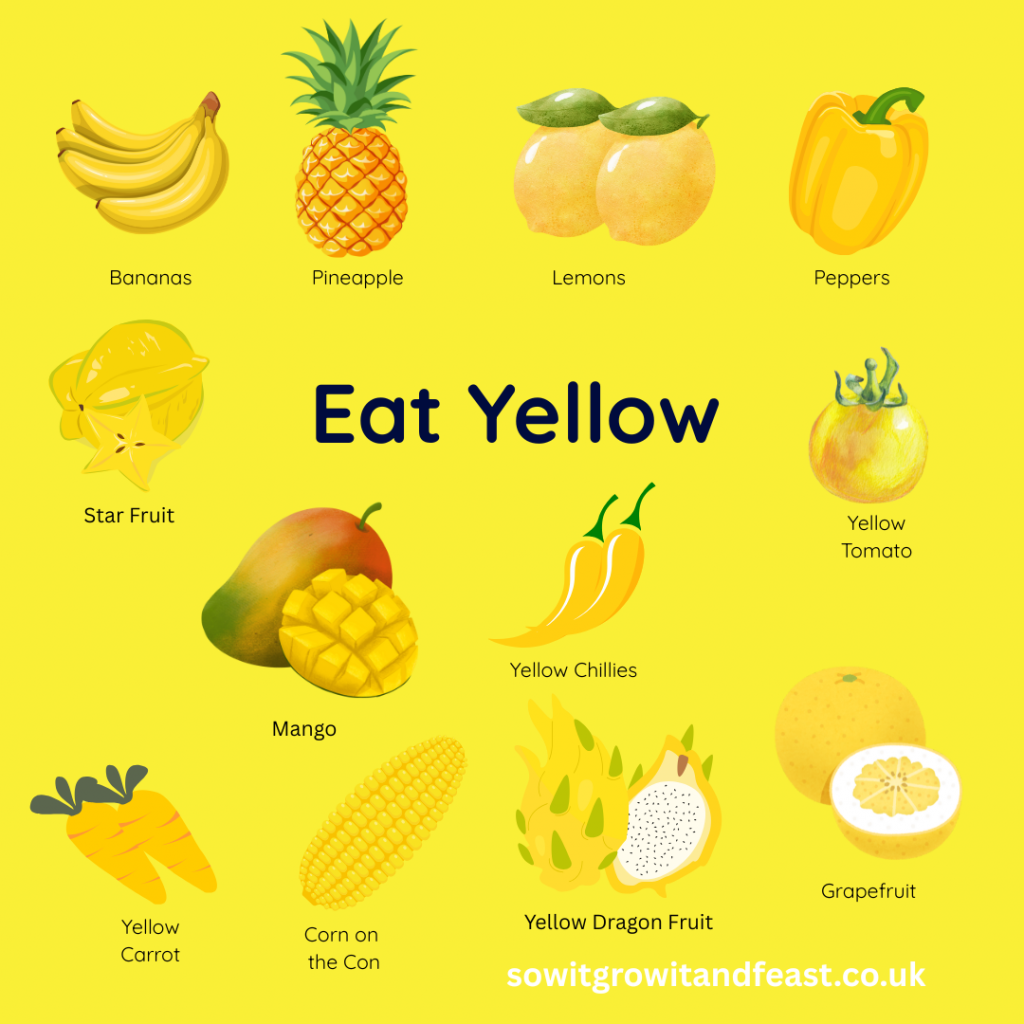
Eat Yellow. Bananas, Pineapple, lemons, Peppers, Star Fruit, Mango, Yellow Carrots, Corn on the Cob, Yellow Dragon Fruit, Yellow Chillies, Yellow Tomato, Grapefruit

Why Are Some Fruits and Vegetables Yellow?

The colour in fruit and vegetables comes from naturally occurring plant pigments.

One group you’ll often encounter in yellow and orange produce is the carotenoids.

These include beta-carotene, lutein and zeaxanthin. Beta-carotene can be converted by the body into vitamin A, while lutein and zeaxanthin are found in high concentrations in parts of the eye.

But colour isn’t a precise guide to what’s inside a particular fruit or vegetable.

A yellow pepper doesn’t contain exactly the same nutrients as a banana simply because they’re the same colour.

That’s really the point of eating the rainbow.

Different fruits and vegetables give us different combinations of fibre, vitamins, minerals and plant compounds.

And they make dinner considerably more interesting.

Yellow Peppers

If you’ve ever left a green pepper on the plant and watched it gradually change colour, you’ll know that peppers don’t necessarily start life yellow, orange or red.

The colour develops as the fruit ripens.

Yellow peppers provide plenty of vitamin C, along with carotenoids and other plant compounds.

They’re also sweet, crunchy and incredibly versatile in the kitchen.

Sow it

Peppers need a long growing season, so sow the seeds indoors early in the year somewhere warm.

They can be a little slow to get going.

Don’t give up on them.

Grow it

Peppers love warmth and sunshine. A greenhouse is ideal, but they can also grow well in pots in a sunny, sheltered position.

Keep them watered and feed regularly once fruits begin forming.

Then comes the difficult part.

Waiting for them to turn yellow.

Feast

Eat them raw in salads, roast them until soft and sweet, add them to pasta sauces or stuff them and bake them.

If you’ve grown several plants and they all decide to ripen simultaneously, roasted peppers can also be frozen for later.

Yellow Tomatoes

Red tomatoes may be the familiar choice, but tomatoes come in a glorious range of colours.

Yellow varieties can be particularly beautiful.

You can grow tiny golden cherry tomatoes, plum varieties and enormous beefsteak tomatoes in shades ranging from pale lemon to deep gold.

Their nutritional profile varies by variety, but tomatoes generally provide vitamin C, potassium, folate and a range of carotenoids.

For me, though, the main reason to grow yellow tomatoes is flavour.

Sow it

Sow tomatoes indoors in late winter or early spring.

Grow it

Give them plenty of light and warmth, then gradually acclimatise plants to outdoor conditions before putting them outside once the danger of frost has passed.

Depending on the variety, they’ll grow happily in greenhouse borders, growbags, pots and sunny outdoor beds.

Feast

Mix yellow tomatoes with red ones for one of the easiest beautiful summer salads imaginable.

Add olive oil, basil, a little salt and perhaps some mozzarella.

When you’ve grown something that tastes that good, there’s really no need to interfere with it very much.

Yellow Courgettes

I have a particular fondness for yellow courgettes.

They’re grown in much the same way as green ones, but their bright colour makes them wonderfully easy to spot beneath the leaves.

Anyone who has discovered a green courgette approximately the size of a marrow hiding under a plant will appreciate this advantage.

Courgettes provide fibre, vitamin C and potassium, among other nutrients.

Sow it

Sow courgettes indoors in spring or directly outside once conditions are warm enough.

One or two healthy plants can produce an impressive amount of food.

Possibly too impressive by August.

Grow it

Give courgettes rich soil, plenty of water and enough room to spread.

Pick them regularly while they’re relatively small and the plant should continue producing.

Feast

Slice them into pasta, grill them, roast them, grate them into fritters or turn them into courgette cake.

And when everyone in the household says, “Not courgettes again”, start making chutney.

It’s practically a gardening tradition.

Sweetcorn

There are few things more satisfying than growing your own sweetcorn.

Partly because the plants become so magnificently tall, and partly because freshly picked sweetcorn can be extraordinarily sweet.

Sweetcorn provides carbohydrate and fibre as well as folate and some B vitamins. Yellow varieties also contain carotenoids including lutein and zeaxanthin.

Sow it

Sweetcorn likes warmth, so sow indoors in spring or directly outside once the soil has warmed.

Grow it

Plant sweetcorn in a block rather than a long single row.

It’s wind-pollinated, so growing plants together improves the chances of the pollen reaching neighbouring plants and producing well-filled cobs.

Feast

The sooner you eat sweetcorn after picking, the better.

Boil or grill the cobs and add butter.

That’s it.

Sometimes the feast part really doesn’t need to be complicated.

Yellow Carrots

Carrots weren’t always orange.

They come in purple, white, red and yellow varieties too, and growing a mixture is an easy way to make an ordinary crop more interesting.

Yellow carrots provide fibre and contain carotenoids, although the amounts and types vary between different varieties.

Sow it

Carrots are best sown directly where they’re going to grow because they dislike root disturbance.

Sow thinly into fine soil and keep the area watered while the seeds germinate.

Grow it

Carrot root fly can be troublesome, so avoid crushing the foliage unnecessarily when thinning and consider growing resistant varieties or using a physical barrier.

Carrots also grow surprisingly well in deep containers.

Feast

Roast them, grate them into salads, add them to soups and stews or simply steam them and add butter.

Home-grown carrots also have the advantage of coming in shapes never encountered in a supermarket.

Some require a little imagination.

Butternut Squash

Technically a fruit, although firmly treated as a vegetable in the kitchen, butternut squash is one of autumn’s great comfort foods.

Its golden flesh contains beta-carotene, which the body can convert into vitamin A, along with fibre, potassium and vitamin C.

Sow it

Start squash seeds somewhere warm in spring.

Grow it

Give the plants space.

Then give them a little more space.

Squashes have an impressive ability to head off across the vegetable garden in whatever direction you least expected.

They like fertile soil, sunshine and regular watering.

Allow the fruits to ripen fully and cure them properly after harvesting and many squash varieties will store for months.

Feast

Roast butternut squash with herbs, make soup, stir it into risotto or add it to curries.

Growing food that stores well is particularly satisfying because you’re still eating from the garden long after the growing season has slowed down.

Golden Raspberries

Yes, raspberries come in yellow.

Golden raspberries are varieties of raspberry that produce pale yellow or golden fruit rather than the familiar red.

They’re beautiful, delicious and just unusual enough to make people ask what on earth you’re growing.

Like red raspberries, they provide fibre, vitamin C and a range of plant compounds.

Grow it

Autumn-fruiting golden raspberries can be particularly straightforward to manage.

Give them sunshine, decent soil and support where necessary.

Once established, raspberry plants can produce fruit for years.

Feast

Eat them straight from the cane.

If sufficient quantities actually reach the kitchen, they’re lovely with yoghurt, porridge or puddings and can be frozen for later.

That’s quite a big “if”.

Lemons

Now we reach something a little more ambitious for the British gardener.

Lemons are rich in vitamin C and contain several plant compounds, including flavonoids.

They’re useful in almost everything from salad dressings and marinades to cakes, puddings and drinks.

But despite what you may have read online, you don’t need lemon water to “detox” your body.

That’s a job your liver and kidneys are already rather good at.

What lemons are very good at is making food taste wonderful.

Grow it

Lemon trees can be grown in Britain, but they need protection.

A pot is usually the most practical option because the plant can spend warmer months outside and be moved somewhere bright and frost-free during winter.

Growing your own lemon isn’t necessarily the easiest route to self-sufficiency.

But picking a lemon from your own tree in Britain feels disproportionately exciting.

Feast

Squeeze them over salads and vegetables, use the zest in baking, make lemon curd or add them to marinades.

And if life gives you lemons…

Well, you know the rest.

Bananas

You can grow a banana plant in Britain.

Producing a useful crop of edible bananas is another matter entirely.

Bananas provide carbohydrate, fibre, potassium and vitamin B6, among other nutrients.

They’re convenient, inexpensive and easy to eat, which is probably reason enough for their enduring popularity.

For most of us, however, bananas belong firmly in the feast rather than grow category.

Slice them over porridge, freeze ripe bananas for smoothies or use those alarmingly brown ones in banana bread.

A brown banana is not necessarily a failed banana.

Sometimes it’s simply cake waiting to happen.

Pineapple

Pineapple provides vitamin C and manganese and contains an enzyme mixture called bromelain.

You’ll sometimes see sweeping claims made about bromelain and digestion or inflammation. It’s more sensible to regard pineapple as what it is: a nutritious fruit that can form part of a varied diet, rather than a treatment for anything.

You can actually grow a pineapple plant from the leafy crown of a shop-bought fruit.

Whether you’ll eventually harvest a pineapple from it in Britain is considerably less certain.

But gardening would be rather dull if we only grew things guaranteed to succeed.

Grapefruit

Grapefruit provides vitamin C, fibre and several plant compounds.

It has also acquired a long-standing reputation as a “weight-loss food”, but no individual fruit has magical fat-burning properties.

There’s another important reason grapefruit deserves a little caution.

Grapefruit can interact with some medicines, changing the amount of medication that enters the bloodstream. Anyone taking medication that’s affected by grapefruit should follow the advice provided with it or speak to a pharmacist or healthcare professional.

For the rest of us, it’s simply a beautifully sharp citrus fruit.

Sometimes breakfast is enough of a job for a grapefruit.

Star Fruit

Star fruit — or carambola — is a tropical fruit that looks particularly impressive when sliced crossways into little stars.

It provides vitamin C, fibre and various plant compounds.

It’s unlikely to become a productive garden crop in Britain, but it’s an interesting addition to the yellow rainbow when you come across it.

There is, however, an important caveat: people with kidney disease may be advised to avoid star fruit because it contains substances their kidneys may not clear effectively.

This is a good reminder that “natural” doesn’t automatically mean suitable for everyone.

Grow a Little Patch of Sunshine

If you’d like to grow some yellow food yourself, don’t try to grow everything.

Start with what suits your space.

For a small garden or patio, try:

Yellow tomatoes + yellow courgettes + yellow peppers.

Have a little more room?

Add sweetcorn and a squash.

Fancy something permanent?

Plant a golden raspberry.

Suddenly you’ve got an edible patch producing yellow food from summer well into autumn.

And that’s where eating seasonally becomes much more interesting.

You aren’t choosing yellow tomatoes because somebody told you they’re a “superfood”.

You’re eating them because there are twenty-seven ripe ones in the greenhouse.

What to Do With a Yellow Harvest

Growing food has a habit of producing either absolutely nothing or far more than any reasonable household could possibly eat.

Rarely does the vegetable garden provide exactly three courgettes at convenient weekly intervals.

So when the yellow harvest arrives, make the most of it.

Roast peppers and freeze them.

Turn courgettes into fritters, pasta sauces and chutney.

Freeze tomatoes whole for cooking later.

Cure and store squash.

Freeze raspberries.

Enjoy sweetcorn as soon as you pick it.

And give some away.

One of the loveliest things about growing food is being able to knock on someone’s door and say:

“Would you like some of these?”

Eat the Rainbow — But Grow It Too

Eating a varied selection of fruit and vegetables gives us a broad mixture of fibre, vitamins, minerals and naturally occurring plant compounds.

Yellow foods are simply one part of that bigger picture.

You don’t need lemon water to detox your liver.

You don’t need grapefruit to boost your metabolism.

And no single pepper, pineapple or banana is going to transform your health.

Food doesn’t need those sorts of promises to be worthwhile.

Grow what you can.

Buy what you can’t.

Eat plenty of different plants.

And when you pick a yellow tomato you’ve grown from a seed, slice it open while it’s still warm from the sun and eat it standing in the garden.

You’ll understand exactly why I think we should eat more yellow.

Not because it’s miraculous.

Because it’s delicious.

Further reading: Why You Should Eat More Purple, Why Eating Green Is Good For You, Eat the Rainbow: The Power of Red, Why Orange Foods Deserve a Place on Your Plate, The Incredible Benefits of Growing Your Own Food

Follow us on Instagram, Threads, BlueSky, Twitter, Pinterest & Facebook

Not sure where to start? Take a look at our Grow Your Own Packs with detailed step by step instructions, seeds and 1 years online support.

Eat Purple: What to Grow, Pick and Eat from the Purple End of the Rainbow

Purple carrots pulled from the soil. Shiny aubergines hanging from the plant. Blackberries staining your fingers. Great ruffled red cabbages, purple sprouting broccoli and bowls of dark, sweet plums.

Purple fruit and vegetables are certainly good at getting noticed.

And they aren’t purple simply for our benefit.

Many get their extraordinary colour from naturally occurring plant pigments called anthocyanins. These belong to a larger family of plant compounds called flavonoids and can produce colours ranging from red and purple through to deep blue.

Purple foods also provide different combinations of fibre, vitamins, minerals and other plant compounds.

But there’s no need to turn them into miracle foods.

Rather than eating blueberries because they’re going to “boost your brain” or beetroot because it’s going to “detox your liver”, there’s a much simpler reason to put more colour on our plates.

Different plants give us different nutrients. Variety is a good thing.

And from a gardener’s point of view, purple crops are enormous fun to grow.

So let’s look at what we can sow, what we can grow and — the important bit — what we can feast on afterwards.

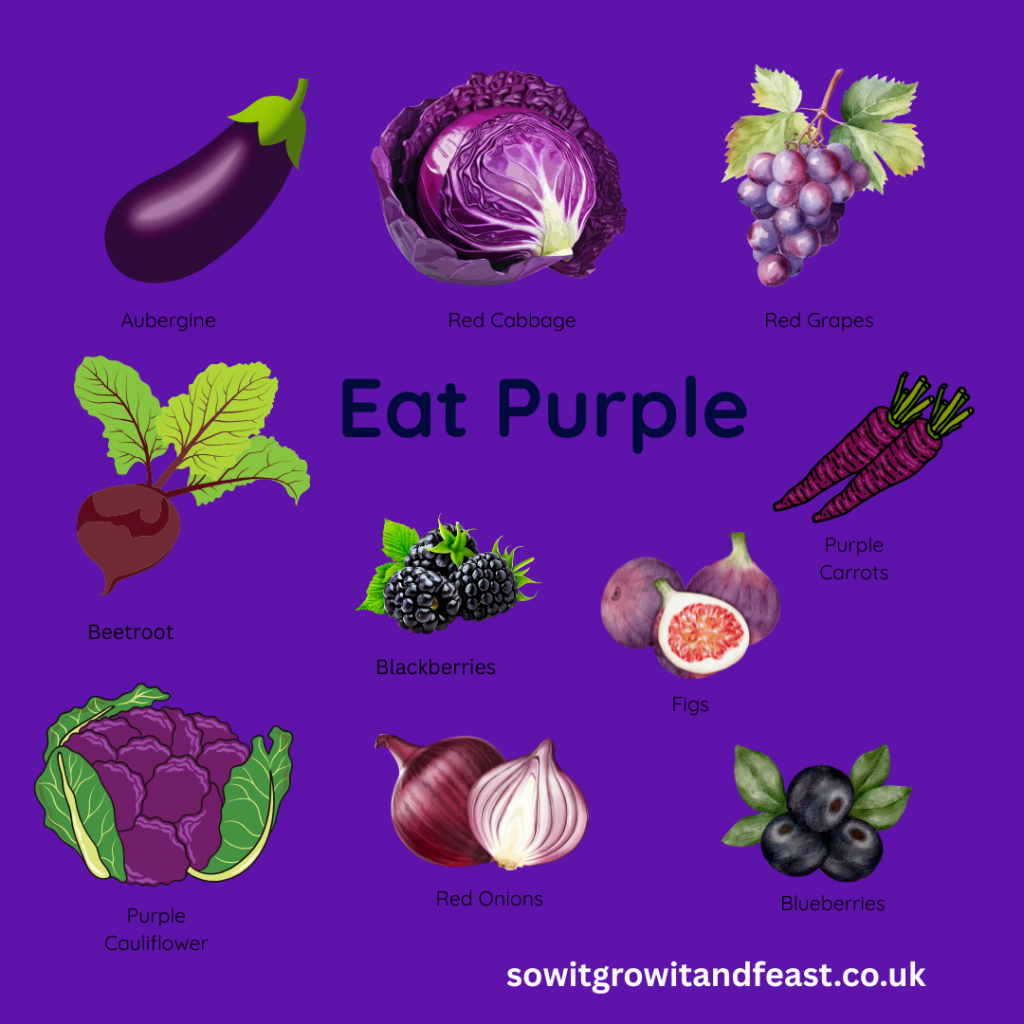
Eat Purple. Aubergine, red cabbage, red grapes, beetroot, purple cauliflower, red onions, figs, purple carrots, blackberries, blueberries

Why Are Some Fruits and Vegetables Purple?

That deep purple, blue or almost black colour often comes from anthocyanins.

Anthocyanins are naturally occurring pigments found in plants. They’re responsible for the colour of foods including blackberries, blueberries, blackcurrants, red cabbage and many purple varieties of vegetables.

They’re also antioxidants, which means they can interact with processes involving oxidation in the body.

There’s a growing body of research looking at anthocyanins and other plant compounds, but that doesn’t mean we need to assign every purple vegetable a particular illness to prevent or health problem to solve.

Food is much more complicated than that.

And so are we.

The useful message is wonderfully simple:

Eat lots of different plants.

If some of them happen to be purple, all the better.

Aubergines

Few vegetables look quite as glamorous in the garden as an aubergine.

Those glossy purple fruits hanging beneath large leaves look almost too perfect to be real.

Almost.

Aubergines provide fibre and small amounts of various vitamins and minerals. Their purple skin contains anthocyanins, including a pigment called nasunin.

But the main reason to grow aubergines is culinary.

A freshly picked aubergine can become an extraordinary number of good things.

Sow it

Aubergines need a long growing season, so sow them early indoors somewhere warm.

They’re not a crop to rush.

Grow it

A greenhouse or polytunnel gives you the best chance of a good harvest in much of Britain, although they can also grow outside in particularly warm, sunny and sheltered positions.

They’re also very happy in large pots.

Give them warmth, sunshine, regular watering and feeding once the fruits begin developing.

Feast

Roast them, grill them, add them to curries or make ratatouille, parmigiana or baba ganoush.

Aubergines absorb flavours beautifully, particularly olive oil, garlic, tomatoes, herbs and spices.

Suddenly growing three plants doesn’t seem excessive at all.

Purple Carrots

Carrots haven’t always been orange.

Purple carrots have a very long history, and growing them is an easy way to make an everyday vegetable feel rather more exciting.

Depending on the variety, they may be purple all the way through or have a purple exterior surrounding an orange, yellow or white centre.

Purple carrots provide fibre and various carotenoids, while purple varieties can also contain anthocyanins.

Sow it

Sow carrots directly where they’re going to grow.

They dislike having their roots disturbed, so transplanting isn’t generally worth the trouble.

If you have heavy or stony soil, try growing them in a deep container instead.

Grow it

Keep the soil moist while the seeds germinate.

Carrot root fly can be troublesome, so consider resistant varieties, fine mesh or other physical barriers if it’s a problem where you garden.

Then comes the good bit.

Pull one up.

You never quite know what shape is going to emerge.

Feast

Roast purple carrots, grate them into salads, add them to soups or simply steam them.

One warning: some purple varieties are enthusiastic about sharing their colour with everything else in the pan.

Consider yourself warned.

Beetroot

Is beetroot red?

Is it purple?

Burgundy?

I’m not sure it matters.

It certainly belongs at this end of the rainbow.

Beetroot provides folate, manganese and potassium and naturally contains dietary nitrates. Its intense colour comes from pigments called betalains, rather than anthocyanins.

That’s a useful reminder that foods of similar colours aren’t necessarily nutritionally identical.

Sow it

Beetroot is wonderfully straightforward to grow from seed.

Sow directly outside from spring onwards and make smaller sowings every few weeks if you’d like a succession of roots rather than thirty-seven beetroot becoming ready simultaneously.

Grow it

Keep plants watered during dry spells and harvest some while the roots are still young and tender.

Don’t forget the leaves.

Young beetroot leaves are edible and can be used in salads or cooked similarly to chard.

Feast

Roast beetroot, pickle it, grate young roots into salads or pair it with feta, goat’s cheese, walnuts or horseradish.

Just don’t prepare it immediately before going somewhere important wearing white.

Red Cabbage

It is called red cabbage.

It is quite clearly purple.

Gardening is full of these little mysteries.

Red cabbage contains fibre, vitamin C and vitamin K, among other nutrients, and its colour comes from anthocyanins.

It’s also an excellent vegetable for the cooler months.

Sow it

Depending on the variety, cabbage can be sown at different points during the year.

Choose a variety suited to when you want to harvest it rather than assuming all cabbages behave in the same way.

Grow it

Cabbages like fertile, firm soil.

Protect young plants from pigeons and keep an eye out for cabbage white butterflies, whose caterpillars can turn a beautiful cabbage into lace with remarkable efficiency.

Feast

Shred red cabbage into winter salads and slaws or cook it slowly with apple and spices.

Pickling is another excellent option if you’ve got more than you can use immediately.

A jar of jewel-coloured pickled cabbage is a rather good thing to have waiting in the fridge.

Purple Sprouting Broccoli

Purple sprouting broccoli is one of my favourite crops because it arrives when the vegetable garden can otherwise feel rather quiet.

After months of waiting, those purple shoots begin appearing in late winter and spring.

Suddenly the garden is feeding you again.

It provides fibre, vitamin C, vitamin K and folate, along with a variety of naturally occurring plant compounds.

Sow it

Purple sprouting broccoli requires patience.

It’s usually sown months before you expect to harvest it, which means you’re giving valuable vegetable-garden space to something that appears to be doing very little for quite a long time.

Trust the process.

Grow it

Give plants fertile soil and enough room to develop.

Protect them from pigeons and caterpillars where necessary and support tall plants in exposed gardens.

Feast

Pick the shoots regularly and more should follow.

Steam them, roast them or sauté briefly with garlic and olive oil.

Don’t overcomplicate it.

One of the great pleasures of seasonal growing is waiting months for something and then eating it as simply as possible.

Blackberries

Blackberries are the fruit that prove you don’t always have to sow something to enjoy a harvest.

Come late summer, Britain’s hedgerows can be full of them.

Their dark colour comes from anthocyanins, and blackberries provide fibre, vitamin C and vitamin K among other nutrients.

You can also grow cultivated varieties at home, including thornless types that are considerably kinder to your arms.

Grow it

Blackberries and hybrid berries generally appreciate sunshine and some support.

Cultivated varieties can produce larger fruits than their wild relatives and can be trained neatly against wires or fences.

If you’re picking wild blackberries, make sure you’re somewhere you’re permitted to forage and that you can confidently identify what you’re collecting.

Feast

Eat them with yoghurt, make crumble, turn them into jam or freeze them.

To freeze berries individually, spread them on a tray first and transfer them to a container once frozen.

This prevents the entire harvest becoming one enormous blackberry iceberg.

Blackcurrants

Blackcurrants have one of those flavours that instantly tastes of summer.

They’re particularly rich in vitamin C and contain fibre and anthocyanins.

They’re also a very useful fruit to grow because an established bush can provide crops for years.

Grow it

Blackcurrants prefer reasonably fertile, moisture-retentive soil and will crop best with a decent amount of sun.

Once established, pruning out some of the older wood encourages fresh productive growth.

Feast

Fresh blackcurrants can be quite sharp, which is exactly what makes them so good for cooking.

Turn them into compote, jam, cordial, puddings or sauces.

They also freeze beautifully.

Blueberries

Despite having blue in the name, I’m claiming blueberries for the purple end of our edible rainbow.

Their blue-purple colour comes largely from anthocyanins.

Blueberries also provide fibre, vitamin C, vitamin K and manganese.

The important thing to know if you want to grow them is that blueberries are acid-loving plants.

Grow it

If your garden soil isn’t acidic, don’t try to persuade it otherwise.

Grow blueberries in containers filled with an ericaceous growing medium.

Rainwater is preferable for watering where possible, particularly in hard-water areas.

Growing more than one compatible variety can also improve pollination and extend the harvest.

Feast

Eat blueberries straight from the bush, scatter them over breakfast, bake them into muffins or freeze them.

Like strawberries, they have a mysterious habit of disappearing between garden and kitchen.

Purple Potatoes

Cutting open a purple potato for the first time is quite a surprise.

Some varieties have coloured skins but ordinary pale flesh. Others are spectacularly purple all the way through.

Purple-fleshed potatoes contain anthocyanins alongside the carbohydrate, fibre, potassium and vitamin C associated with potatoes more generally.

Grow it

Purple potatoes are grown in much the same way as other potatoes.

Plant seed potatoes in the ground, large containers or potato bags and earth up the plants as they grow.

Choose varieties according to whether you want first earlies, second earlies or maincrop potatoes.

Feast

Roast them, boil them or turn them into mash.

Some retain their colour better than others during cooking.

Purple mashed potato may take the family by surprise.

I consider that an advantage.

Purple Cauliflower

If you think cauliflower is boring, grow a purple one.

Purple cauliflower gets its colour from anthocyanins and provides fibre, vitamin C, folate and other nutrients.

It’s grown in much the same way as more familiar white varieties.

Grow it

Cauliflowers appreciate fertile soil and consistent growing conditions.

They can be slightly demanding, particularly if growth is interrupted by drought or other stresses.

But producing a perfect purple cauliflower from your own garden is enormously satisfying.

Feast

Roast it.

Cauliflower transformed by a hot oven, olive oil and seasoning is a completely different proposition from the over-boiled cauliflower some of us remember from childhood.

It also works beautifully in curries, salads and vegetable bakes.

Purple Asparagus

Purple asparagus is one for the patient gardener.

Like green asparagus, it is a perennial crop. Establish a bed successfully and it can produce spears for many years.

The purple colouring comes from anthocyanins, and the spears provide fibre, folate and other vitamins and minerals.

Grow it

Asparagus wants a permanent home in well-drained soil.

Prepare the ground carefully because this isn’t a crop you’ll want to move next year.

And don’t expect an immediate feast.

Young asparagus beds need time to establish before being harvested heavily.

Feast

When those first proper harvests finally arrive, keep things simple.

Steam, roast or griddle the spears and add butter, olive oil or a squeeze of lemon.

You’ve waited years for them.

They deserve centre stage.

Plums

A plum tree can be one of the great pleasures of a productive garden.

Depending on the variety, the fruit might be red, yellow, green or deep purple.

Purple-skinned plums provide fibre and contain a range of plant compounds, including anthocyanins in the coloured skin.

Grow it

Choose the variety and rootstock according to the space you have available.

Some plums are self-fertile, while others crop better with a suitable pollination partner nearby, so check before buying.

Then hope the tree doesn’t decide to produce its entire annual crop during the one week you’ve gone on holiday.

Feast

Eat ripe plums straight from the tree, bake them, poach them or turn them into jam and chutney.

A plum crumble is also an excellent answer to most autumn questions.

Figs

Figs aren’t always obviously purple, but many familiar varieties ripen to beautiful shades of deep purple or burgundy.

They provide fibre, potassium and other nutrients.

They’re also a fascinating fruit to grow in Britain.

Grow it

Figs often crop particularly well when their roots are restricted.

That’s why you’ll frequently see them grown against sunny walls with their roots contained or planted in large pots.

Give them the warmest, sunniest position you can.

Feast

A perfectly ripe fig needs very little interference.

Eat it fresh, add it to salads or serve with yoghurt or cheese.

If you’re lucky enough to have too many, make jam or chutney.

Red Onions

Yes, another supposedly red vegetable that’s actually purple.

Red onions contain various sulphur compounds and flavonoids, including the flavonoid quercetin, and provide some fibre and vitamin C.

More importantly for the kitchen, they’re wonderfully versatile.

Sow it

You can grow onions from seed or sets.

Sets are particularly straightforward if you’re new to growing onions.

Grow it

Give them a sunny position and reasonably well-drained soil.

Once the foliage begins to die back and the bulbs are mature, harvest and dry them properly if you want to store them.

Feast

Slice them raw into salads, roast them, pickle them or slowly cook them until soft and sweet.

Quick-pickled red onions are one of those ridiculously simple things that make almost everything else on the plate look more impressive.

Grow a Purple Patch

One of the pleasures of growing your own food is discovering that vegetables don’t have to look like the versions we’re accustomed to seeing in supermarkets.

Carrots can be purple.

Cauliflowers can be purple.

Potatoes can be purple.

Asparagus can be purple.

Even Brussels sprouts can be purple.

If you’re new to growing food, though, don’t attempt everything at once.

Try:

Purple carrots + beetroot + blackberries.

Have a little more room?

Add:

Red cabbage + purple potatoes + blackcurrants.

And if you’re prepared to play the long game:

Plant some purple asparagus.

That’s a wonderfully colourful little edible garden.

What to Do With a Purple Harvest

Eventually, every productive gardener encounters the same problem.

You wanted home-grown food.

You now have rather a lot of home-grown food.

This is when the feast part of Sow It Grow It and Feast earns its keep.

Freeze blackberries, blueberries and blackcurrants.

Pickle red onions and cabbage.

Turn plums into jam or chutney.

Roast beetroot.

Store suitable potatoes.

Make blackberry crumble.

And give some away.

A bag of home-grown produce handed over the garden fence is one of life’s small pleasures.

Eat the Rainbow — But Grow It Too

There’s good sense behind the familiar advice to eat a wide variety of fruit and vegetables.

Different plants give us different combinations of fibre, vitamins, minerals and naturally occurring plant compounds.

Purple foods are one interesting part of that bigger picture.

They don’t need to detox our liver.

They don’t need to give us younger-looking skin.

And we don’t need to eat a handful of berries expecting them to transform our memory, blood sugar or energy levels.

Food doesn’t have to behave like medicine to be worth growing and eating.

So plant the purple carrot.

Grow the blackberry.

Wait patiently for the plum tree.

And when something is finally ready, pick it and take it into the kitchen.

Because the really lovely thing about eating the rainbow is discovering that you can grow quite a lot of it yourself.

Sow it. Grow it. And then feast.

Keeping your blood sugar levels stable is vital for your overall health. The fibre and compounds in purple foods can help.

Further Reading: Why You Should Eat More Purple, Why Eating Green Is Good For You, Eat the Rainbow: The Power of Red, Why Orange Foods Deserve a Place on Your Plate, The Incredible Benefits of Growing Your Own Food

Follow us on Instagram, Threads, BlueSky, Twitter, Pinterest & Facebook

Not sure where to start? Take a look at our Grow Your Own Packs with detailed step by step instructions, seeds and 1 years online support.

Eat Green: What to Grow, Pick and Eat from the Green End of the Rainbow

“Eat your greens.”

It’s probably one of the first pieces of nutritional advice most of us heard.

Usually while staring suspiciously at a pile of cabbage.

But our parents and grandparents did have a point.

Spinach, peas, broccoli, beans, courgettes, kale, cabbage, lettuce, apples, herbs and all the other foods at the green end of the rainbow provide us with different combinations of fibre, vitamins, minerals and naturally occurring plant compounds.

And from a gardener’s point of view, there’s something else rather wonderful about green food.

An awful lot of it is very easy to grow.

You can grow salad leaves on a windowsill, herbs by the back door, peas in a pot and courgettes on a patio. Give over a little more space and you could be picking beans, broccoli, cabbages and apples too.

So rather than looking at individual green foods as remedies for tiredness, inflammation, bloating or anything else, let’s look at them for what they are.

Good food.

Food we can sow, grow, pick and turn into something delicious.

Eat Green. Celery, Courgette, Cucumber, Spinach, Cabbage, Broccoli, Apple, Grapes, beans, Pear, Rocket, Peas

Why Are Fruits and Vegetables Green?

Plants owe much of their green colour to chlorophyll.

Chlorophyll plays an essential role in photosynthesis — the process plants use to capture energy from light.

But green fruits and vegetables contain far more than chlorophyll.

Depending on what you’re eating, they can provide fibre, folate, vitamin C, vitamin K, potassium, calcium, iron and a wide range of naturally occurring plant compounds.

Leafy vegetables can also contain carotenoids such as lutein and beta-carotene. We tend to associate carotenoids with yellow and orange foods, but in green leaves their colour is masked by all that chlorophyll.

The nutritional make-up of a cucumber is very different from that of broccoli or spinach, which is why the important word is variety.

Eat different plants.

And if you can, grow a few of them too.

Spinach

Spinach has acquired a rather heroic reputation over the years.

Popeye probably has something to answer for.

It does contain iron, although plant-based iron isn’t absorbed by the body as readily as iron from some animal sources. Spinach also provides folate, vitamin K and carotenoids, among other nutrients.

But forget bulging cartoon muscles.

Spinach is worth growing simply because it’s quick, useful and tastes particularly good when picked young.

Sow it

Spinach can be sown directly outside and is particularly happy in the cooler parts of the growing season.

Sow small amounts regularly rather than the entire packet at once.

That way you’re more likely to have a steady supply of tender leaves rather than enough spinach to feed the entire street for three days.

Grow it

Keep plants watered because hot, dry conditions can encourage spinach to bolt — producing flowers rather than continuing to make lots of lovely leaves.

Young leaves can be harvested for salads, while larger ones are excellent for cooking.

Feast

Wilt spinach into pasta, curries and soups, add young leaves to salads or simply cook it briefly with a little butter.

An enormous pan of spinach will collapse into approximately three forkfuls.

This is completely normal.

Peas

Fresh peas eaten straight from the pod are one of the great arguments for growing your own food.

They barely need to make it as far as the kitchen.

Peas provide fibre, protein, vitamin C, folate and other vitamins and minerals.

But their real selling point is flavour.

A freshly picked pea is sweet, crisp and completely different from one that’s been sitting around for days.

Sow it

Peas can be sown from spring, with exact timing depending on the variety and conditions.

You can also grow pea shoots indoors or outside if you want something particularly quick to harvest.

Grow it

Most peas appreciate something to climb.

Twiggy sticks, netting or supports all work well.

Keep them watered once flowering and pod production begin, particularly during dry spells.

Feast

Eat young peas raw, cook them briefly, stir them through risotto or pasta, or make pea and mint soup.

And don’t forget pea shoots and tendrils.

They’re delicious too.

Courgettes

Courgettes are a wonderful crop.

Right up until the point when you’ve eaten courgettes for breakfast, lunch and dinner and somebody cheerfully informs you there are another six ready to pick.

One or two healthy plants can be astonishingly productive.

Courgettes provide fibre, potassium and vitamin C, and their high water content makes them a useful and versatile summer vegetable.

Sow it

Sow courgettes indoors in spring or directly outside once conditions are sufficiently warm.

Grow it

Give them fertile soil, sunshine, regular watering and plenty of room.

Pick the fruits while they’re relatively small.

Leave one unnoticed beneath a leaf for several days and it may turn into something resembling a small submarine.

Feast

Grill them, roast them, grate them into fritters, spiralise them, add them to pasta or bake them into cakes.

When the inevitable glut arrives, make chutney.

Every courgette grower eventually reaches the chutney stage.

Green Beans

There is something enormously satisfying about walking outside and picking tonight’s dinner.

Green beans — whether climbing French beans, dwarf beans or runner beans picked young — are one of those crops that can give you harvest after harvest.

They provide fibre, folate and vitamin C, among other nutrients.

Sow it

Beans like warmth, so sowing generally begins in spring once conditions are suitable.

They can be started under cover for planting out later.

Grow it

Climbing beans need sturdy support.

And I do mean sturdy.

A mature row of beans covered in leaves and pods can become surprisingly heavy.

Keep picking regularly and the plants should continue producing.

Feast

Cook beans until tender and serve simply with butter, toss them through salads or add them to pasta dishes.

If you’ve got a glut, blanching and freezing them is one of the easiest ways to save some for later.

Broccoli

Broccoli is one of those vegetables that’s worth understanding because there isn’t just one kind.

There’s calabrese, which gives us the familiar large green heads, and sprouting broccoli, which produces smaller shoots over a longer period.

Broccoli provides fibre, vitamin C, folate and vitamin K, as well as naturally occurring compounds called glucosinolates.

Sow it

Sowing times vary considerably according to the type and variety, so check the seed packet.

Some broccoli is harvested within the same growing season. Other types require considerably more patience.

Grow it

Brassicas generally appreciate fertile, firm soil.

Unfortunately, we’re not the only creatures who like eating them.

Cabbage white caterpillars and pigeons can make short work of unprotected plants, so netting can be invaluable.

Feast

Steam it, roast it, stir-fry it or add it to pasta.

And eat the stalk.

Peel away any tough outer layer and you’ll find the centre is perfectly edible.

Throwing it away is wasting one of the best bits.

Kale

Kale has gone from humble winter vegetable to fashionable ingredient and back again.

Through all of this, it has remained what it always was: a very useful garden crop.

Kale provides fibre, vitamin C, vitamin K and carotenoids, along with other nutrients.

It’s also wonderfully hardy.

Sow it

Kale is generally sown in spring or early summer for harvesting later in the year, although timings vary by variety.

Grow it

Give plants good soil and protect them from the usual brassica-loving wildlife.

One of kale’s great advantages is that it can stand outside through cold weather, providing fresh leaves when much of the vegetable garden has gone quiet.

Feast

Strip away tough stalks and steam, sauté or roast the leaves.

Kale also works beautifully in soups, pasta and dishes with beans.

And yes, you can make kale crisps.

No, you don’t have to pretend they’re exactly the same as crisps.

Cabbage

Cabbage doesn’t always get the appreciation it deserves.

Perhaps school dinners have a lot to answer for.

But a cabbage grown well and cooked properly is an entirely different thing from something boiled into submission.

Green cabbage provides fibre, vitamin C, folate and vitamin K.

And by choosing varieties carefully, it’s possible to harvest cabbage at different times of year.

Sow it

There are spring, summer, autumn and winter cabbages, so check the variety before sowing.

Grow it

Cabbages appreciate fertile, firm soil and consistent growing conditions.

Protect them from caterpillars and pigeons.

Slugs may also express an interest.

Gardening is essentially the process of growing food while negotiating with everything else that would also like to eat it.

Feast

Shred cabbage into slaws, stir-fry it, steam it briefly or add it to soups.

Just don’t boil it until the entire house smells of cabbage.

We’ve moved on.

Brussels Sprouts

Brussels sprouts may be one of Britain’s most divisive vegetables.

I’m firmly in favour — provided they’re treated properly.

They’re members of the brassica family and provide fibre, vitamin C, folate and vitamin K, along with various plant compounds.

Sow it

Brussels sprouts require a fairly long growing season, so they’re generally sown in spring for harvesting later in the year.

Grow it

Give them firm, fertile soil and enough room.

Tall plants may need staking in exposed positions.

As with other brassicas, protect them from pigeons and caterpillars where necessary.

Feast

Steam them briefly, roast them until the edges caramelise or shred and stir-fry them.

If your only experience of Brussels sprouts is a grey-green vegetable boiled for half an hour on Christmas morning, I’d argue you haven’t really met a Brussels sprout yet.

Lettuce and Salad Leaves

If you’re completely new to growing food, start here.

You don’t need a vegetable garden.

You don’t even need a garden.

Many salad leaves can be grown in pots, troughs and window boxes, and some are ready to harvest remarkably quickly.

Leafy salads provide varying amounts of folate, vitamin K and other nutrients depending on the varieties you’re growing.

Sow it

Sow small amounts every few weeks for a succession of leaves.

Cut-and-come-again mixtures are particularly useful because you can harvest young leaves and allow the plants to regrow.

Grow it

Keep plants watered and watch for slugs and snails.

During very hot weather, a little shade can help prevent some varieties from bolting.

Feast

Pick what you need immediately before eating.

That’s one of the simplest luxuries a garden can provide.

Rocket

Rocket is almost ridiculously easy to grow.

It germinates quickly, doesn’t need much room and gives salads that wonderful peppery bite.

Like other members of the brassica family, rocket contains glucosinolates and provides nutrients including vitamin K and folate.

Sow it

Sow directly outside or in containers from spring onwards.

Make small repeat sowings to keep fresh leaves coming.

Grow it

Keep rocket watered.

Hot, dry weather encourages plants to bolt and can make the leaves much stronger in flavour.

Feast

Add it to salads, scatter it over pizza after cooking or stir it through pasta.

Homemade rocket pesto is also an excellent answer to an unexpectedly enthusiastic crop.

Cucumbers

There is something immensely satisfying about finding a cucumber hiding beneath a mass of leaves.

Particularly because it can apparently go from tiny to enormous overnight.

Cucumbers have a very high water content and provide small amounts of several vitamins and minerals.

Sow it

Start cucumbers in warmth during spring.

Choose varieties according to whether you plan to grow them in a greenhouse or outdoors.

Grow it

They like warmth, regular watering and feeding once they’re producing fruit.

Avoid letting plants repeatedly dry out.

Feast

Eat them fresh, add them to salads, make tzatziki or pickle smaller cucumbers.

If you’ve never eaten a cucumber minutes after picking it, try it.

The flavour may surprise you.

Celery

Celery has a reputation for being slightly demanding to grow.

The reputation isn’t entirely undeserved.

But home-grown celery can be crisp, aromatic and very satisfying.

Celery provides fibre, potassium and folate, among other nutrients, and has a very high water content.

Sow it

Celery needs a long growing season and is usually started under cover.

The tiny seeds need patience.

Grow it

Modern self-blanching varieties make life considerably easier than traditional trench celery.

The clue to good celery is water.

Don’t let plants struggle in dry soil if you want tender stems.

Feast

Eat celery raw, add it to soups and stews or use it as part of the classic base of onion, carrot and celery for sauces and slow-cooked dishes.

The leaves are useful too.

Asparagus

Asparagus is a crop for gardeners prepared to wait.

Plant an asparagus bed and you’re making an investment in future dinners.

Once established, though, a good bed can continue producing for many years.

Asparagus provides fibre, folate and several vitamins and minerals.

Grow it

Choose a permanent sunny position with well-drained soil.

Prepare it properly before planting because asparagus doesn’t appreciate being moved around.

New beds need time to establish before you begin harvesting heavily.

Patience really is part of the recipe.

Feast

Fresh asparagus needs very little.

Steam it, roast it or griddle it.

Add butter or olive oil and perhaps a squeeze of lemon.

When you’ve waited years for something to grow, covering it in an elaborate sauce seems almost rude.

Green Apples and Pears

Not everything green comes from the vegetable patch.

Apple and pear trees can turn even a relatively small garden into a productive one.

Both fruits provide fibre and vitamin C, along with various naturally occurring plant compounds.

Grow it

The important thing when choosing a fruit tree isn’t just the variety.

It’s the rootstock.

Rootstock influences how large the mature tree will become, so choose one appropriate for the space you have.

Also check pollination requirements. Some varieties are self-fertile, while others benefit from a compatible tree flowering nearby.

Feast

Eat them straight from the tree, bake them, poach pears, make apple sauce or turn a glut into chutney, crumble or preserves.

An apple picked from your own tree and eaten in the garden takes some beating.

Herbs

Parsley, basil, mint, chives, coriander, dill and countless other herbs deserve a place in the green garden too.

Nutritionally, herbs contain various vitamins and plant compounds, but their greatest contribution to dinner is flavour.

And they’re among the easiest edible plants to squeeze into small spaces.

Grow it

A few pots near the kitchen door can transform the way you cook.

Just be careful with mint.

Plant it in the ground and it may decide that what you actually wanted was a mint garden.

Keeping it contained in a pot saves future negotiations.

Feast

Use herbs generously.

Make pesto.

Chop parsley over vegetables.

Add mint to peas.

Put basil with tomatoes.

Sometimes the difference between something tasting worthy and something tasting wonderful is simply a handful of fresh herbs.

What About Avocado and Kiwi?

Not every green food needs to come from your garden.

Avocados provide mostly unsaturated fats, along with fibre, folate and potassium.

Kiwi fruit provides vitamin C and fibre among other nutrients.

Kiwi vines can actually be grown in Britain in suitable conditions, although they need space, support and some thought about pollination depending on the variety.

Avocados are a rather less realistic prospect if your ambition is a reliable British harvest.

And that’s fine.

Growing your own food doesn’t have to mean trying to become completely self-sufficient.

Grow what suits your garden. Buy what doesn’t.

Grow a Green Garden

If you’ve never grown food before, green is perhaps the easiest place to begin.

You could start with just:

Salad leaves + peas + courgettes.

All three are relatively straightforward and can be grown without an enormous vegetable garden.

Have more room?

Add:

Beans + broccoli + kale.

And if you’re planning for the future:

Plant an apple tree or an asparagus bed.

Before long, you’ll have green food appearing through much of the year.

And you’ll start experiencing one of the nicest things about growing your own.

Dinner sometimes begins with walking outside to see what’s ready.

What to Do With a Green Harvest

There comes a moment every summer when the garden changes from:

“Is anything ever going to grow?”

to:

“What on earth are we going to do with all this?”

This is when the feast part becomes particularly useful.

Freeze beans and peas.

Turn rocket and herbs into pesto.

Make courgette chutney.

Use cucumbers for pickles.

Freeze spinach for cooking.

Turn apples into sauce or crumble.

And give some away.

Nobody who grows courgettes should be afraid of appearing at a neighbour’s door carrying vegetables.

They’ll understand eventually.

Eat the Rainbow — But Grow It Too

Eating plenty of different fruits and vegetables gives us a varied mixture of fibre, vitamins, minerals and naturally occurring plant compounds.

Green foods are a wonderfully diverse part of that picture.

But spinach doesn’t need to promise us boundless energy.

Celery doesn’t need to “detox” us.

Cucumber doesn’t have to give us younger-looking skin.

And broccoli doesn’t need to solve a particular health problem before it earns a place on the plate.

Food doesn’t need miraculous claims to be good for us.

Grow some peas because peas eaten straight from the pod are delicious.

Grow salad because you can pick it five minutes before dinner.

Grow a courgette because watching something that started as one small seed produce an absurd quantity of food is still a little bit magical.

Sow it. Grow it. Pick it. Feast on it.

That’s more than enough reason to eat your greens.

Further reading: Why You Should Eat More Purple, Why Eating Green Is Good For You, Eat the Rainbow: The Power of Red, Why Orange Foods Deserve a Place on Your Plate, The Incredible Benefits of Growing Your Own Food

Follow us on Instagram, Threads, BlueSky, Twitter, Pinterest & Facebook

Not sure where to start? Take a look at our Grow Your Own Packs with detailed step by step instructions, seeds and 1 years online support.

Eat Red: What to Grow, Pick and Eat from the Red End of the Rainbow

Strawberries warm from the sun. A bowl of raspberries that somehow never quite makes it back to the kitchen. Shiny red peppers, handfuls of cherries, rosy apples and tomatoes in every imaginable shade of scarlet.

And then there’s beetroot.

Anyone who has ever prepared beetroot while wearing a white top will already know that red fruit and vegetables aren’t shy about announcing themselves.

But those wonderful colours aren’t there simply to make our dinner look pretty.

The reds, pinks and deep purples we see in fruit and vegetables come from naturally occurring plant pigments and compounds, including lycopene and anthocyanins. Different red foods also provide varying amounts of fibre, vitamin C, folate, potassium and other nutrients.

That’s one reason we’re encouraged to eat a varied diet containing plenty of fruit and vegetables.

But there’s another reason I particularly like red foods.

Many of them are remarkably easy to grow.

From a pot of strawberries by the back door to radishes squeezed into a spare patch of soil, raspberries along a fence or tomatoes ripening in the greenhouse, you don’t need an enormous vegetable garden to put something home-grown and red on your plate.

So rather than thinking of red foods as something we should eat, let’s look at what makes them interesting, what we can grow ourselves and — most importantly — what we can do with them when they’re ready to pick.

Eat Red. Strawberries, toomatoes, radish, raspberries, rhubarb, apples, cherries, red potato, red grapes, red chillies, cranberries, red pepper

Why Are Red Fruits and Vegetables Red?

The colour of fruit and vegetables comes from naturally occurring plant pigments.

Two you’ll often hear mentioned in connection with red produce are lycopene and anthocyanins.

Lycopene is a carotenoid responsible for the red and pink colour of foods such as tomatoes and watermelon.

Anthocyanins are another group of plant pigments. Depending on the food and its chemistry, they can produce shades ranging from red and pink through to purple and blue. You’ll find them in foods including berries, cherries and some varieties of apple.

These compounds are often described as antioxidants because of the way they interact with oxidation in the body.

But there’s no need to turn every tomato into a medicine.

Fruit and vegetables contain complicated mixtures of nutrients and plant compounds, and eating a wide variety of them is much more useful than pinning miraculous properties on one particular ingredient.

And frankly, there are plenty of good reasons to eat a ripe home-grown strawberry without asking it to improve anything at all.

Tomatoes

If I could persuade someone to grow just one edible plant, tomatoes would be high on the list.

A tomato picked warm from the plant tastes completely different from one that’s travelled halfway across Europe in a refrigerated lorry.

Tomatoes contain lycopene, the pigment responsible for much of their red colour, as well as vitamin C, potassium and folate.

Interestingly, processing and cooking tomatoes can make lycopene easier for our bodies to absorb, so fresh tomatoes aren’t the only ones worth eating. Tomato sauces, soups and roasted tomatoes all have a place at the table.

Sow it

Tomatoes are usually sown indoors in late winter or early spring in Britain because they need a long growing season.

Grow it

Give them warmth, plenty of light, regular watering and feeding once the fruits begin to develop.

You don’t need a greenhouse. Many varieties grow happily in a sunny sheltered spot outside, and compact varieties can be grown in pots.

Feast

When they’re coming faster than you can eat them, roast a tray with garlic and herbs, make tomato sauce for the freezer or turn them into soup.

And the very best ones?

Eat them immediately.

Strawberries

There are few gardening pleasures quite like spotting the first properly red strawberry of summer.

Strawberries provide vitamin C, fibre and folate and contain anthocyanins and other naturally occurring plant compounds.

They’re also one of the easiest fruits to grow when space is limited.

Grow it

Strawberries will grow in the ground, pots, containers and hanging baskets, making them ideal for smaller gardens and patios.

Keep an eye on them as the fruit ripens because birds and slugs are remarkably good at identifying the perfect strawberry approximately five minutes before you do.

Feast

Eat them straight from the plant, add them to breakfast, make strawberry compote or freeze extras for smoothies and puddings later in the year.

Although I have yet to experience the mythical phenomenon known as “too many strawberries”.

Raspberries

Raspberries are another excellent fruit to grow at home because they’re expensive to buy and spectacular when freshly picked.

They’re naturally high in fibre and provide vitamin C and manganese, as well as anthocyanins and other polyphenols.

Summer-fruiting and autumn-fruiting varieties mean it’s possible to enjoy home-grown raspberries over a surprisingly long season.

Grow it

Give raspberries a sunny position and reasonably fertile soil. Most varieties will need some support, although once established they can reward you with fruit for years.

Feast

Eat them fresh, scatter them over porridge or yoghurt, make jam or freeze them individually on a tray before transferring them to a bag.

They’re excellent straight from the freezer too.

Not that I would know anything about standing in front of an open freezer eating frozen raspberries.

Beetroot

Beetroot deserves far more attention in the vegetable garden.

It’s easy to grow, doesn’t require enormous amounts of space and gives you two things to eat: the roots and the young leaves.

Beetroot provides folate, manganese and potassium and is naturally rich in compounds called dietary nitrates.

And then, of course, there’s that extraordinary colour.

Sow it

Beetroot can be sown directly outside from spring onwards. Sow small amounts every few weeks rather than the entire packet at once and you’ll have a steadier supply.

Grow it

Thin seedlings if necessary and keep them watered during dry weather. Don’t wait for every root to become enormous — smaller beetroot can be beautifully tender.

Feast

Roast it, pickle it, grate young beetroot raw into salads or combine roasted beetroot with feta, walnuts and leaves.

And remember that the young leaves are edible too.

Red Peppers and Chillies

A green pepper and a red pepper can actually be the same fruit at different stages of ripeness.

As many peppers mature, their colour changes and their flavour becomes sweeter.

Red peppers are particularly rich in vitamin C and also contain carotenoids. Chillies contain capsaicin, the compound responsible for their heat.

Sow it

Peppers and chillies need a long growing season, so start them indoors early in the year.

Grow it

They like warmth and sunshine and grow very well in pots, greenhouses and sunny sheltered positions.

Feast

Roast red peppers until sweet and soft, add them to salads, soups and pasta sauces or preserve a glut.

Chillies can be used fresh, dried or frozen — which is useful because one enthusiastic chilli plant can produce a rather alarming amount of fruit.

Radishes

If patience isn’t your greatest gardening virtue, grow radishes.

Some varieties can be ready to harvest only a few weeks after sowing, making them particularly satisfying for new gardeners and children.

Radishes provide vitamin C and fibre, along with a range of naturally occurring plant compounds.

Sow it

Sow little and often from spring onwards.

Grow it

Keep them watered. Dry conditions can make the roots woody or excessively peppery.

Because they’re quick-growing and don’t need much room, they’re brilliant for filling little gaps between slower-growing vegetables.

Feast

Slice them into salads, add them to sandwiches or try roasting them.

And don’t automatically throw away the leaves. Young radish leaves can be eaten too.

Cherries

Unlike radishes, cherries require rather more patience.

But a cherry tree in blossom is beautiful before it has produced a single fruit.

Cherries contain fibre, vitamin C and potassium, as well as anthocyanins and other plant compounds.

If space is limited, look for trees grown on dwarfing rootstocks, which can make growing fruit trees in smaller gardens much more practical.

Just remember that birds adore cherries every bit as much as we do.

Possibly more.

Red Apples

Not every apple is red, of course, but rosy-skinned varieties certainly earn their place here.

Apples provide fibre and vitamin C, and much of their fibre and many of their plant compounds are found in or close to the skin.

They’re also one of the great seasonal pleasures of the British garden.

An apple eaten straight from the tree on an autumn afternoon is a completely different experience from one that’s spent months in storage.

If you have room for a tree, choose carefully. The right rootstock can make the difference between a manageable garden tree and something requiring an orchard.

And if you end up with more apples than you can possibly eat, there are worse problems to have.

Apple crumble springs immediately to mind.

Rhubarb

Botanically, rhubarb is a vegetable, although we generally treat it as a fruit in the kitchen.

It provides fibre, potassium and vitamin K, but I mainly grow it because there are few things more cheering than seeing those first pink stalks pushing their way out of the soil.

Rhubarb is perennial, so once established it can return year after year.

And an important note: eat the stalks, not the leaves. Rhubarb leaves should not be eaten.

Feast

Rhubarb crumble is the obvious answer, but try roasting it too. It’s delicious with yoghurt, porridge or granola.

You can also turn a good harvest into compote, jam or chutney.

Watermelon

Watermelon isn’t the easiest thing to grow outdoors in the British climate, but adventurous gardeners with a greenhouse or very warm sheltered position may enjoy trying.

Its pink-red flesh gets its colour partly from lycopene, and — unsurprisingly given its name — watermelon has a very high water content.

Sometimes growing something slightly ridiculous simply to see whether you can is part of the fun of gardening.

Cranberries and Pomegranates

Not everything on the red plate needs to come from your garden.

Cranberries and pomegranates contain a variety of polyphenols and other plant compounds and can bring sharpness, sweetness and colour to winter food.

Fresh cranberries are particularly useful for sauces and baking, while pomegranate seeds are wonderful scattered over salads, roasted vegetables and grain dishes.

Growing your own should never become a competition to achieve total self-sufficiency.

Grow what works for you.

Buy the rest.

Grow a Red Garden

If you’re new to growing food, you don’t need to attempt everything on this list.

Start with three.

For example:

Strawberries + tomatoes + radishes.

All three can be grown in containers, which means you could create a tiny edible red garden on a patio, balcony or sunny doorstep.

If you have more room, add raspberries, beetroot and a redcurrant bush.

Before long you’ll start noticing how the seasons move through your red harvest.

Radishes appear quickly in spring.

Strawberries arrive with early summer.

Tomatoes and raspberries take us through the warmer months.

Then apples and beetroot carry us towards autumn.

That’s one of the pleasures of growing food: you don’t simply eat with the seasons.

You watch them happen.

What to Do With a Red Harvest

There is a particular point in the growing year when pride in your productive vegetable garden can turn into mild panic.

You’ve grown it.

It’s ready.

And now there’s rather a lot of it.

This is where the feast part matters.

Freeze raspberries and strawberries.

Turn tomatoes into sauce.

Roast and pickle beetroot.

Dry or freeze chillies.

Make apple sauce, chutney or crumble.

Preserve what you can’t eat now and share some with friends, neighbours and family.

Growing food isn’t just about producing vegetables.

It’s about enjoying them.

Eat the Rainbow — But Grow It Too

There’s good sense behind the familiar advice to eat plenty of different fruits and vegetables.

Different plants provide different combinations of fibre, vitamins, minerals and naturally occurring plant compounds, which is why variety matters more than concentrating on one supposedly “super” food.

But I’d add something else.

Try growing some of that rainbow yourself.

Sow a row of radishes.

Plant a strawberry in a pot.

Grow a tomato by the back door.

Put a raspberry cane against the fence.

Then wait.

Because however nutritious something may be, there’s another benefit to growing food that’s rather harder to measure.

The pleasure of walking outside, spotting something ripe and thinking:

I grew that.

And then eating it.

That’s the good bit.

Further Reading: Why Orange Foods Deserve a Place on Your Plate, Why Eating Green Is Good For You, Why You Should Eat More Purple, Grow Your Own: Best Fruits for Your Garden, The Importance of Growing Your Own Food

Follow us on Instagram, Threads, BlueSky, Twitter, Pinterest & Facebook

Not sure where to start? Take a look at our Grow Your Own Packs with detailed step by step instructions, seeds and 1 years online support.

Eat Orange: What to Grow, Pick and Eat from the Orange End of the Rainbow

Carrots pulled from the soil. Pumpkins glowing in an autumn garden. Apricots, peaches, sweet potatoes and great wedges of butternut squash roasting in the oven.

Orange food is rather difficult to ignore.

And that’s a good thing.

Many orange fruits and vegetables get their colour from naturally occurring plant pigments called carotenoids. These include beta-carotene, which our bodies can convert into vitamin A.

But orange fruits and vegetables aren’t all nutritionally identical simply because they happen to share a colour. Between them they provide different combinations of fibre, vitamin C, potassium, folate and other vitamins, minerals and plant compounds.

That’s why I prefer to think about variety rather than miracle foods.

And, of course, quite a few of these orange foods are things we can grow ourselves.

So let’s leave the promises of detoxes, glowing skin and miraculous health transformations to one side and do something rather more interesting.

Let’s sow them, grow them and eat them.

Eat Orange. Pumpkin, cantaloupe melon, butternut squash, tomatoes, sweet potato, apricots, carrots, peppers and chillies, peaches.

Why Are Some Fruits and Vegetables Orange?

That wonderful orange colour often comes from a family of plant pigments called carotenoids.

One of the best known is beta-carotene, found in foods including carrots, sweet potatoes, pumpkins and some squashes.

The body can convert beta-carotene into vitamin A, which has a number of normal functions in the body, including contributing to normal vision and immune function.

Other carotenoids include alpha-carotene, lutein and zeaxanthin.

But there’s no need to remember all their names before you’re allowed to eat a carrot.

The important thing is that different plants contain different mixtures of nutrients and plant compounds, which is one of the reasons eating plenty of different fruits and vegetables makes sense.

And growing different ones makes the vegetable garden considerably more interesting too.

Carrots

Let’s start with the obvious one.

Carrots are so closely associated with the colour orange that it’s easy to forget they also come in purple, yellow, red and white.

Orange carrots are particularly associated with beta-carotene. They also provide fibre and potassium, among other nutrients.

They’re also satisfying to grow.

Admittedly, pulling up a carrot can occasionally reveal something resembling a pair of trousers rather than a supermarket specimen.

But that’s part of the fun.

Sow it

Carrots are best sown directly into the soil because they don’t particularly enjoy being transplanted.

Sow little and often from spring onwards for a succession of roots rather than an enormous crop arriving all at once.

If your soil is heavy or stony, try growing carrots in containers filled with a finer growing medium.

Grow it

Keep the soil moist while seeds are germinating and avoid disturbing the foliage unnecessarily, as the scent can attract carrot root fly.

There are also resistant varieties and physical barriers available if carrot fly is a problem in your garden.

Feast

Eat young carrots raw, roast them, grate them into salads or add them to soups and stews.

Carrot tops can be used too, although their flavour is quite strong. Try a small amount chopped into a herby pesto rather than automatically putting all the foliage on the compost heap.

Pumpkins

Few vegetables announce the arrival of autumn quite like a pumpkin.

Technically a fruit, pumpkins are members of the squash family and range from enormous orange Halloween specimens to smaller varieties grown primarily for eating.

Their orange flesh contains carotenoids, including beta-carotene, as well as fibre and various vitamins and minerals.

But the best reason to grow an eating pumpkin is what happens when you bring it into the kitchen.

Sow it

Pumpkins need warmth, so sow seeds under cover in spring before planting outside after the risk of frost has passed.

Grow it

Give them fertile soil, plenty of water and room.

Lots of room.

A pumpkin plant can set off across a vegetable patch with the determination of someone who’s just remembered they’re late for a train.

Let the fruits mature fully on the plant and harvest them before the first serious frosts.

If properly cured, many varieties will store for months.

Feast

Roast pumpkin with herbs and garlic, make soup, add it to curries and risottos or turn it into purée.

Don’t automatically throw away the seeds either. Clean and roast them for a crunchy snack or topping.

One plant; plenty to eat.

Butternut Squash

Butternut squash has become such a familiar supermarket vegetable that it’s easy to forget you can grow it yourself.

Its deep golden-orange flesh contains beta-carotene as well as fibre, potassium and vitamin C.

It’s also an excellent crop for extending the home-grown season because properly ripened squash can be stored after harvesting.

Sow it

Start seeds somewhere warm in spring.

Grow it

Like pumpkins, butternut squash appreciate rich soil, warmth and plenty of water.

They also like to roam.

If space is limited, you can experiment with training some squash plants vertically over sturdy supports, although the developing fruits may need supporting.

Feast

Roast it, make soup, stir it through pasta or risotto, add it to curry or mash it with butter and black pepper.

A tray of roasted squash is also one of those useful things that can become several different meals over the following few days.

Orange Tomatoes

Tomatoes aren’t just red.

There are yellow, green, purple, almost black and beautifully orange varieties too.

Different tomato varieties contain different proportions of carotenoids and other plant compounds, alongside nutrients including vitamin C, potassium and folate.

But I grow unusual tomatoes primarily for something much simpler.

They taste good and look glorious together on a plate.

Sow it

Sow tomatoes indoors in late winter or early spring.

Grow it

Give them warmth, light, regular watering and feeding once the fruits begin developing.

Choose your variety according to where you’re going to grow it. Some tomatoes are happier in greenhouses while others perform well outdoors in a sunny, sheltered position.

Feast

Combine orange tomatoes with red and yellow varieties, tear over some basil and add olive oil.

That’s summer lunch sorted.

If you have a glut, roast them or turn them into sauce for the freezer.

Orange Peppers

Peppers begin green and many change colour as they ripen, depending on the variety.

Orange peppers are sweet, crisp and particularly useful in the kitchen. They’re a source of vitamin C and contain various carotenoids.

They’re also a lovely crop to grow if you have somewhere warm.

Sow it

Start peppers early indoors because they need a long growing season.

Germination is much better with warmth.

Grow it

A greenhouse is ideal, but peppers can also do well in pots in a sunny, sheltered spot.

Water consistently and feed plants once they’re fruiting.

Then be patient.

Watching a green pepper gradually turn orange is surprisingly satisfying.

Feast

Eat them raw, roast them, stuff them, add them to pasta sauces or chop them into salads.

Roasted peppers can also be frozen, which is handy when several decide to ripen at once.

Orange Chillies

Chillies are closely related to sweet peppers and come in an extraordinary range of shapes, colours and levels of heat.

Their heat comes from capsaicin, while orange varieties may also contain carotenoids responsible for their colour.

Sow it

Sow chillies early and give them warmth.

Some varieties can be slow to germinate, so don’t assume nothing is happening after a few days.

Grow it

Chillies grow beautifully in pots and can be surprisingly ornamental plants.

Give them sunshine and warmth and they’ll often keep producing well into autumn.

Feast

Use them fresh in curries, stir-fries and sauces.

If your plants produce more chillies than you know what to do with, freeze them whole or dry suitable varieties.

One productive chilli plant can supply a household for a surprisingly long time.

Especially if you accidentally chose a very hot one.

Sweet Potatoes

Sweet potatoes aren’t closely related to ordinary potatoes despite the name.

They’re a warm-climate crop and the orange-fleshed varieties are rich in beta-carotene. They also provide fibre, potassium and vitamin C.

Growing them in Britain is possible, although they need a long, warm growing season.

Grow it

Sweet potatoes are generally grown from young shoots called slips rather than from seed.

Give them your warmest, sunniest position. A greenhouse, polytunnel or large container in a sheltered spot can improve your chances.

Feast

Bake them, roast them, turn them into wedges, mash them or add them to soups and curries.

They’re naturally sweet, which also makes them surprisingly versatile.

Apricots

Apricots are one of those fruits that remind you just how much difference ripeness makes.

A ripe apricot picked from a tree is soft, fragrant and quite unlike many of the firm fruits we encounter in supermarkets.

Apricots contain carotenoids as well as fibre, potassium and vitamins including vitamin C.

Grow it

Growing apricots in Britain takes a little thought.

They flower early, which makes blossom vulnerable to frost, and they appreciate warmth and shelter.

A sunny south-facing wall can provide the sort of microclimate they enjoy.

If you’re gardening in a colder or exposed spot, they may be more of a challenge.

Feast

Eat perfectly ripe apricots fresh.

If you’re lucky enough to have a generous crop, they can also be poached, baked, turned into compote or made into jam.

Peaches

Peaches are another fruit that can be grown successfully in Britain if you give them the right conditions.

They contain fibre, vitamin C, potassium and various carotenoids and other plant compounds.

But again, flavour is the reason I’d make room for one.

Grow it

Peaches appreciate warmth and shelter, and training a tree against a sunny wall can work beautifully.

They flower early, so blossom may need protection from frost.

Growing under cover can also help with peach leaf curl, a common fungal problem.

Feast

A properly ripe peach needs very little assistance.

Eat it over the sink.

You’ll understand why.

If you’ve got more, grill them, poach them or add sliced peaches to salads and puddings.

Oranges and Mandarins

Oranges may be the most obvious orange food of all.

They provide vitamin C, folate, fibre and various plant compounds.

They’re not an obvious outdoor crop for most British gardens, but citrus trees can be grown in containers if they’re protected appropriately during colder weather.

Grow it

Citrus trees like plenty of light and will generally need winter protection in Britain.

Growing them in pots allows you to move plants between a sheltered outdoor summer position and suitable winter accommodation.

Don’t expect your home-grown oranges to replace supermarket bags any time soon.

That’s not really the point.

The first fruit you pick from your own citrus tree will feel ridiculously exciting anyway.

Feast

Eat oranges and mandarins as they are, add segments to salads or use the zest and juice in cooking and baking.

And use the zest before throwing away the peel.

There’s an extraordinary amount of flavour in it.

Melons

Orange-fleshed melons such as cantaloupe contain plenty of water as well as nutrients including vitamin C, potassium and carotenoids.

They like considerably more warmth than the average British summer reliably provides, but they’re certainly worth trying if you have a greenhouse or polytunnel.

Grow it

Start seeds in warmth and give plants the sunniest conditions you can.

Melons need consistent watering while growing, although conditions should not remain permanently soggy.

Feast

Chill them and eat them simply.

A ripe melon doesn’t require a recipe.

Turmeric and Ginger

These aren’t orange fruits or vegetables in quite the same sense as carrots and pumpkins, but they often find their way onto orange-food lists.

Turmeric contains the yellow-orange pigment curcumin, while ginger contains a range of aromatic compounds responsible for its characteristic flavour.

Both are used extensively in cooking.

They’ve also attracted enormous numbers of health claims online.

There’s interesting scientific research into compounds found in both plants, but that doesn’t mean adding a spoonful of turmeric to a smoothie will “detox” your liver or cure inflammation.

I prefer them for the reason cooks have valued them for centuries.

They taste good.

Both can also be fascinating plants to try growing somewhere warm, even if producing substantial rhizomes in the British climate can be challenging.

Grow an Orange Garden

If you’d like to grow some of the orange rainbow yourself, keep it simple.

You don’t need an allotment full of exotic crops.

Try:

Carrots + orange tomatoes + an orange pepper.

If you’ve got more room, add:

Pumpkin or butternut squash.

And if you have a greenhouse or particularly sheltered garden, perhaps experiment with:

Sweet potatoes, melons or even a citrus tree in a pot.

That’s the lovely thing about growing food.

There’s always something else to try.

Some things will thrive.

Some will sulk.

And occasionally something you’re absolutely convinced won’t work will surprise you.

What to Do With an Orange Harvest

Late summer and autumn can produce an impressive amount of orange food.

So think beyond tonight’s dinner.

Roast and freeze peppers.

Cure pumpkins and squash for winter storage.

Turn tomatoes into sauce.

Freeze chillies.

Make apricot or peach preserves.

Store suitable carrots.

And eat plenty while it’s fresh.

Preserving a harvest is satisfying, but don’t become so determined to save everything for later that you forget to enjoy it now.

Eat the Rainbow — But Grow It Too

There is good reason to eat a wide variety of fruit and vegetables.

Different plants provide different combinations of fibre, vitamins, minerals and naturally occurring plant compounds.

Orange fruits and vegetables are one colourful part of that bigger picture.

They don’t need to “detox” us.

They don’t need to transform our skin.

And we don’t need to assign each vegetable a particular health problem to solve.

A carrot can just be a carrot.

Preferably one you’ve pulled from the ground yourself, brushed off, taken into the kitchen and turned into something delicious.

Because that’s what Sow It Grow It and Feast is really about.

Grow good food. Enjoy growing it. And then feast on what you’ve grown.

Further Reading: Why You Should Eat More Purple, Why Eating Green Is Good For You, Eat the Rainbow: The Power of Red, Grow Your Own: Best Fruits for Your Garden, The Importance of Growing Your Own Food

Follow us on Instagram, Threads, BlueSky, Twitter, Pinterest & Facebook

Not sure where to start? Take a look at our Grow Your Own Packs with detailed step by step instructions, seeds and 1 years online support.

All About Onions

Onions are a true kitchen staple, adding a foundational flavour to countless dishes around the world. But have you ever experienced the crisp, pungent taste of one pulled straight from your own garden? Growing your own onions is a deeply rewarding process, and with a little guidance, it’s something any gardener can achieve.

A Brief History of the Humble Onion

The onion, known botanically as Allium cepa, is one of the oldest cultivated vegetables in the world. It belongs to the same plant family as garlic, leeks, chives and shallots. While its exact wild origins are uncertain, botanists believe it likely originated in Central Asia. Archaeological and written records suggest that onions were being cultivated in ancient Egypt as far back as 3500 BC. They were not just food; they were worshipped for their spherical shape and concentric rings, which were thought to symbolise eternal life.

From ancient civilisations to medieval kitchens and modern-day allotments, the onion has remained a constant. Its ability to be stored for long periods made it an essential crop, providing vital nutrition and flavour when other fresh produce was scarce. Today, it’s hard to imagine a cuisine that doesn’t rely on the onion’s unique ability to build a rich and savoury base.

Onion Varieties for Your Garden

When you decide to grow onions, you’ll find there are many varieties to choose from. They are typically categorised by colour—red, white and yellow (or brown)—and can be grown either from seeds or from “sets,” which are small, immature bulbs. For beginner gardeners, starting with sets is often the easiest and most reliable method.

Here are some excellent varieties that perform well in the UK climate:

Yellow/Brown Onions

These are the classic all-rounders, perfect for cooking. They have a strong flavour that mellows beautifully when sautéed, roasted, or caramelised.

  • ‘Sturon’: A very popular and reliable variety. It produces firm, globe-shaped bulbs with golden-brown skin and stores exceptionally well. It’s a great choice for a main crop.
  • ‘Setton’: An improved version of ‘Sturon’, offering even better yields and excellent storage potential. It has good resistance to bolting (flowering prematurely).
  • ‘Stuttgart Giant’: A traditional favourite that produces large, slightly flattened bulbs. It’s known for its mild flavour and is good for both cooking and slicing raw into salads.

Red Onions

Known for their vibrant colour and milder, sweeter taste, red onions are wonderful in salads, salsas, and sandwiches. They also add a lovely colour to cooked dishes.

  • ‘Red Baron’: This is one of the most reliable red onion varieties for the UK. It produces deep red, globe-shaped bulbs with a crisp texture and good flavour. It also stores well for a red onion.
  • ‘Electric’: A fast-maturing variety that produces flat-topped, vivid red bulbs. It’s best used relatively quickly after harvesting as it doesn’t store as long as other types.

White Onions

White onions have a sharper, more pungent flavour when raw but become sweet when cooked. They are a staple in many Mexican dishes.

  • ‘Snowball’: A classic white onion that produces round, pure-white bulbs. It has a mild flavour and is best used fresh from the garden, as it has a shorter storage life.

How to Grow Onions

Growing onions is a straightforward process. You can start them from seed for a cheaper but more labour-intensive option, or from sets for an easier, quicker crop. We’ll focus on growing from sets, as it’s the most common method in the UK.

When and Where to Plant

  • Autumn Planting: Some hardy varieties, like ‘Radar’ and ‘Electric’, can be planted in September or October. This gives them a head start, resulting in an earlier harvest the following summer.
  • Spring Planting: The main planting season for onion sets is from March to April, once the soil has warmed up and is workable.

Onions need a sunny, open spot with well-drained soil. They do not thrive in heavy, waterlogged clay. Before planting, prepare the bed by removing any weeds and stones. Dig in some well-rotted organic matter, like compost, to improve soil structure and fertility. A week or two before planting, rake in a general-purpose fertiliser. Onions prefer a soil pH between 6.0 and 7.0.

How to Plant Onion Sets

Planting your sets is simple. Follow these steps for success:

  1. Prepare the Sets: Gently separate the small bulbs.
  2. Mark Your Rows: Use a string line to create straight rows. This makes weeding much easier later on. Space your rows about 25-30cm (10-12 inches) apart.
  3. Plant the Bulbs: Push each set into the soil so that just the very tip is showing above the surface. If your soil is firm, you may need to use a trowel to make a small hole for each one.
  4. Spacing: Space the sets about 10-15cm (4-6 inches) apart within the row. This gives them enough room to swell into full-sized bulbs.

Birds can sometimes be a problem, as they may pull the newly planted sets out of the ground. Covering the bed with horticultural fleece or netting for a few weeks until the roots are established can prevent this.

Caring for Your Onion Crop

Once planted, onions are relatively low-maintenance, but a little care will ensure a healthy, heavy crop.

Watering

Water your onions regularly, especially during dry spells. The soil should be kept consistently moist but not waterlogged. When the bulbs start to swell, consistent watering is crucial. Stop watering completely once the onions are fully grown and the foliage starts to turn yellow and fall over, as this helps them to mature and prepare for storage.

Weeding

It is very important to keep your onion patch weed-free. Onions have shallow roots and do not compete well with weeds for water and nutrients. Weed carefully by hand or with a hoe, taking care not to damage the delicate onion bulbs just below the surface.

Feeding

If you prepared the soil well before planting, your onions may not need additional feeding. However, if growth seems slow, you can give them a boost in early summer with a high-nitrogen liquid feed, like a sulphate of ammonia fertiliser. Avoid feeding them after mid-summer, as this can encourage soft growth that won’t store well.

Pests and Diseases

Onions are generally robust, but there are a few issues to watch out for:

  • Onion White Rot: This is a serious fungal disease that causes the leaves to turn yellow and wilt, and a white, fluffy mould appears on the base of the bulb. There is no chemical cure, and the fungus can remain in the soil for many years. If you find it, you must remove and destroy affected plants and avoid growing onions, leeks, or garlic in that spot for at least eight years.
  • Leek Rust: This appears as bright orange pustules on the leaves. It’s more common in wet weather. While it looks alarming, it rarely affects the bulb’s development. Ensure good air circulation and avoid overcrowding to reduce the risk.
  • Onion Fly: The larvae of this fly burrow into the bulbs, causing them to rot. You can protect your crop by covering it with insect-proof mesh from May onwards.

Harvesting and Storing Your Onions

Your onions will tell you when they are ready for harvesting. The leafy tops will start to turn yellow and flop over. This usually happens in late summer, from August to September.

How to Harvest

On a dry day, gently lift the bulbs from the soil using a garden fork. Be careful not to spear them! You can leave them on the surface of the soil for a day or two to dry in the sun, but bring them under cover if rain is forecast.

How to Dry and Cure Onions

Properly drying, or “curing,” your onions is the secret to making them last for months.

  1. Find a Dry Space: Lay the onions out in a single layer on racks or trays. An airy greenhouse, a sunny conservatory, or a well-ventilated shed is ideal. Make sure they are not touching, as this allows air to circulate freely.
  2. Let Them Cure: Leave them to dry for two to three weeks, or until the foliage is dry and papery and the outer skins are crisp.
  3. Prepare for Storage: Once cured, you can trim the roots off the bottom of the bulb and shorten the dried tops. You can either cut the tops down to about 2.5cm (1 inch) or leave them long if you plan to create a traditional onion plait.

How to Store Onions

Store your cured onions in a cool, dry, and dark place. Net bags, old tights, or plaited strings hung from the ceiling are perfect as they allow for good air circulation. Avoid storing them in plastic bags, as this will cause them to rot. Do not store them with potatoes, as onions release ethylene gas which can cause potatoes to sprout prematurely.

Properly stored, maincrop varieties like ‘Sturon’ and ‘Red Baron’ can last well into the following spring.

Using Your Home-Grown Onions

There is nothing more satisfying than cooking with produce you have grown yourself. The flavour of a freshly harvested onion is often more intense and vibrant than anything you can buy. Here are a few simple recipe ideas to make the most of your crop:

  • Classic French Onion Soup: The ultimate celebration of the onion. Slowly caramelise thinly sliced onions for at least 40 minutes until they are deeply brown and sweet, then simmer in a rich beef broth. Top with a crusty slice of bread and melted Gruyère cheese.
  • Caramelised Onion Tart: A simple yet elegant dish. Spread deeply caramelised onions over a sheet of puff pastry, crumble over some goat’s cheese or feta, and bake until golden.
  • Simple Onion Bhajis: Mix thinly sliced onions with a spiced gram flour batter and fry in small spoonfuls until crisp and golden brown. A perfect snack or starter.
  • Roasted Onions: Peel and halve your onions, toss them with olive oil, salt, and a sprig of thyme, and roast them in a hot oven until tender and sweet.

Your Garden, Your Kitchen

Growing onions is a journey that connects you to the food you eat. From the simple act of pushing a small set into the soil to the satisfaction of plaiting your cured crop for winter storage, it’s a process that is both grounding and fulfilling. You can bring a fundamental ingredient from your garden straight to your plate, adding flavour and nourishment to your meals. We hope this guide has encouraged you to give it a try.

Further Reading: Your Complete Guide to Growing Garlic, All About Pumpkins, What to Do in Your Vegetable Garden in September